
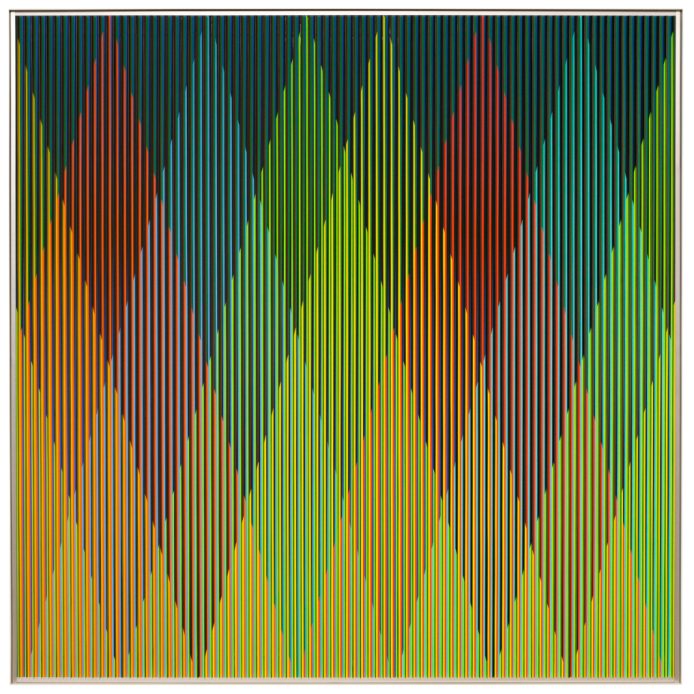

Adriana Cruz Delgado is flanked by gallerists Adolfo Cayon and Jaime Ponce de Leon.
A proponent of the Kinetic Art movement and one of Latin America’s most important artists, Carlos Cruz-Diez, is being commemorated on his centenary year through exhibits in several countries, including the Philippines. Though he passed away in 2019 at the age of 95, the Venezuelan painter lives on through his mesmerizing large-scale public installations and experiential paintings.
Cruz-Diez’s artworks dare viewers to perceive color elements that appear to have a life of their own. He wanted people to interact with colors and appreciate their variants just by the viewer’s change of angle. His relief paintings of varicolored strips seem to oscillate as one passes them. He called this effect “physiochromie.”
One of his famous onsite projects is in his homeland, the Simon Bolivar International Airport, the gateway to Venezuela. The transit zone becomes a sensorial experience for travelers as they walk past walls and floors covered with bands of primary colors that create an optical illusion of depth and movement.
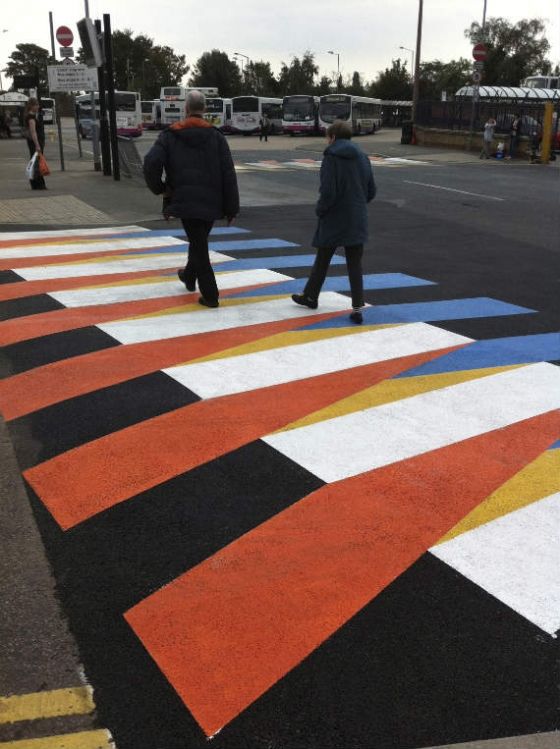
Art on the crosswalk in Los Angeles
Designer Miuccia Prada paid homage to Cruz-Diez by having the Prada store’s façades in London and Asian cities done with reliefs of repetitive blades of color and metal that shift in hues according to the intensity of the light and the movement of the viewers.
The artist’s daughter, Adriana Cruz, came to the Philippines for the opening of her late father’s exhibit at Leon Gallery International. The average price of the artwork is 300,000 euros (Php18,142,743). The exhibit is a collaboration with Spanish gallerist Adolfo Cayon.
Cruz-Diez was born in the Venezuelan capital of Caracas on Aug. 17, 1923. After studying at the School of Plastic Arts, he worked as an art director for the local branch of a multinational advertising firm. He painted figurative and social realist subjects such as shanties in his spare time. Weary of poverty porn subjects and accepting that an artist can’t solve all social problems, he was drawn to abstraction.
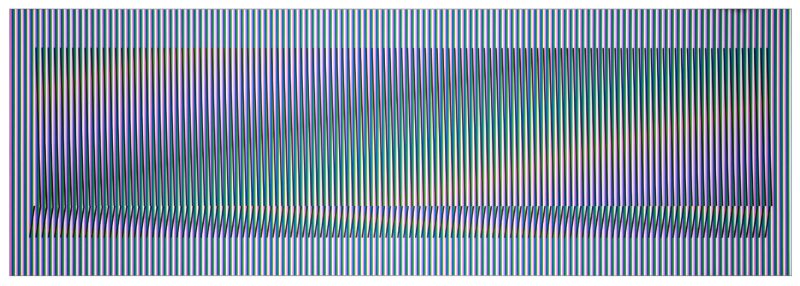
“Induction Chromatique à Double Fréquence,” Tinaco

“Induction Chromatique à Double Fréquence,” Tinaco
Yet, Cruz said, her father was discontent because he wasn’t making any innovations. Among the elements of art, he appreciated color the most and studied how the eye perceived them. Cruz-Diez was inspired by how Impressionists such as Georges Seurat’s used pure colors instead of mixing them, and by the color theories of Josef Albers to produces his bright linework and gridded compositions that seem to vibrate.
Likewise, after being exposed to Kinetic Art at the “Le Mouvement” exhibition in Paris, he ventured into abstraction. The artist established Estudio de Artes Visuales, a school for graphic and industrial design in Venezuela and started his research on colors and human perception.
Cruz-Diez’s vertical bands of color with subtle spaces in between became his signature. “When you see his work, you have to walk in front of it and move around to see what’s happening. Not all the colors that you perceive are from the paints,” said Cruz.
However, the Venezuelan art world was still stuck on figurative and realistic art. Cruz-Diez migrated to Paris in 1960 where he was elated by the progressive art movements in Op Art and Kinetic Art. “He met artists who had the will to change painting. They believed that the viewer could participate through immersion. You must experience the work and how colors reveal themselves through your own observation,” said Cruz.
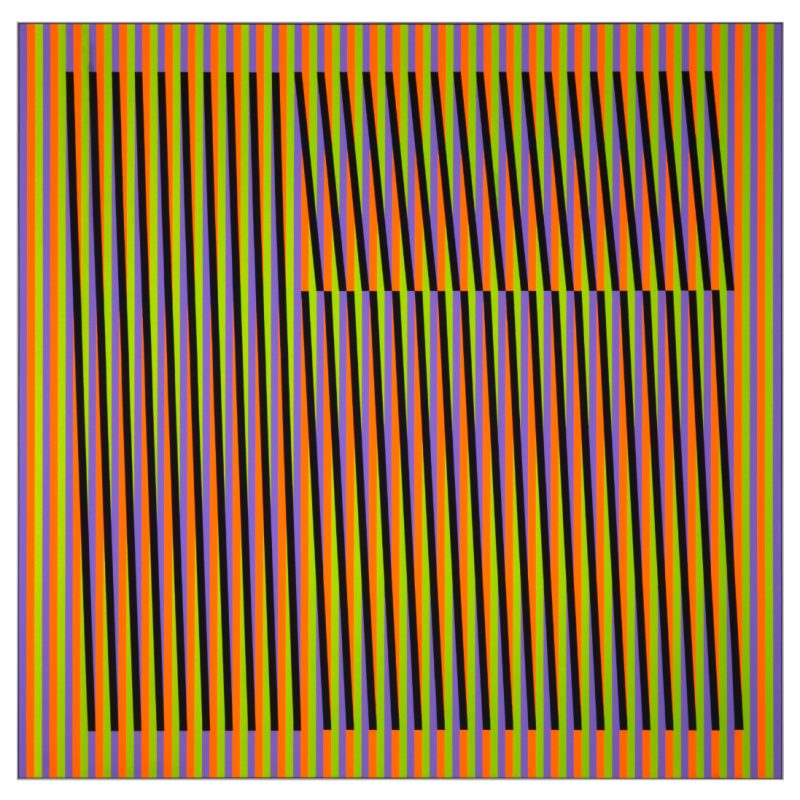
“Induction Chromatique N°214”
To create his series of vertical bands, Carlos-Deiz invented a machine that produced uniform straight lines. “His craft was slow and meticulous. He made plans like an architect and worked with assistants. Even the grandchildren helped him to revise,” said Cruz.
Cruz-Diez’s other signature, chromasaturation, is an immersive experience, which involves the viewer being occupied in an entire space or a labyrinth of saturated colors, produced by lights. The heat emitted from the lights can be so intense.
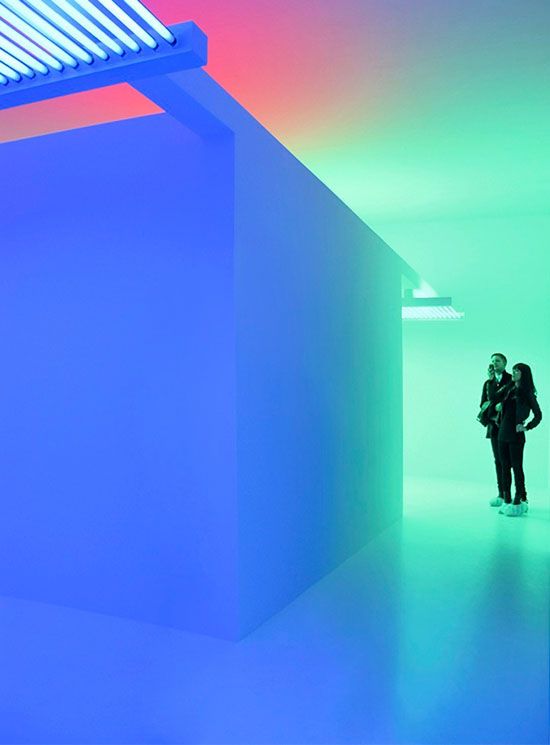
Chromosaturation by Carlos Cruz-Diez at a New York gallery
Asked what her father’s contribution to art was, she replied that Carlos-Diez expanded the appreciation of color and its independent behavior. “He made color more important than form.”
“Carlos Cruz-Diez: The Color Itself” runs through Oct 7 at Leon International, Corinthian Plaza, 121 Paseo de Roxas, Makati City.


