
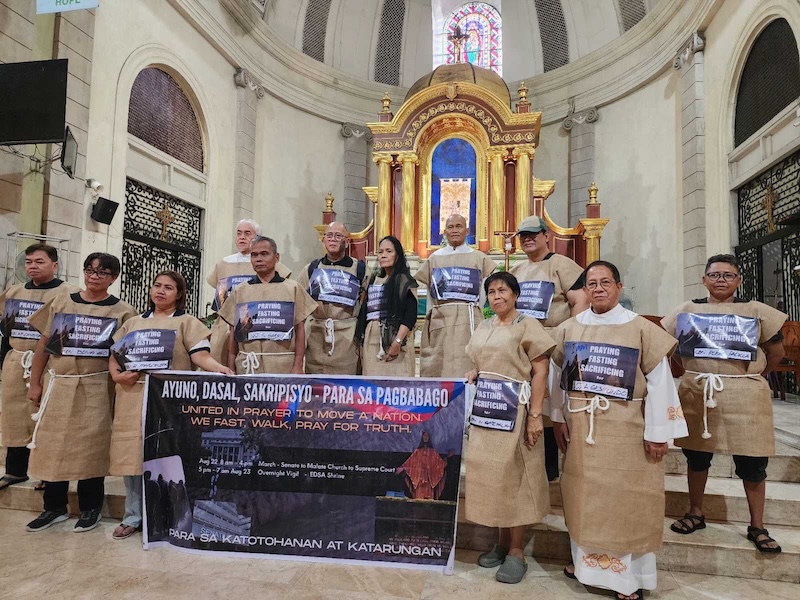
I woke up on the 22nd of August to incessant rains and news of flooding in some areas in Manila. We planned on starting our Day of Prayer, Fasting and Sacrifice at the Senate grounds, where the trial to impeach Vice President Sara Duterte was supposed to proceed after the measure was approved by the House of Representatives on February 5 this year. However, the Senate president Chiz Escudero hemmed and hawed in taking action, as he said, “to allow the Senate to tackle priority legislative measures before the 19th Congress adjourned.”
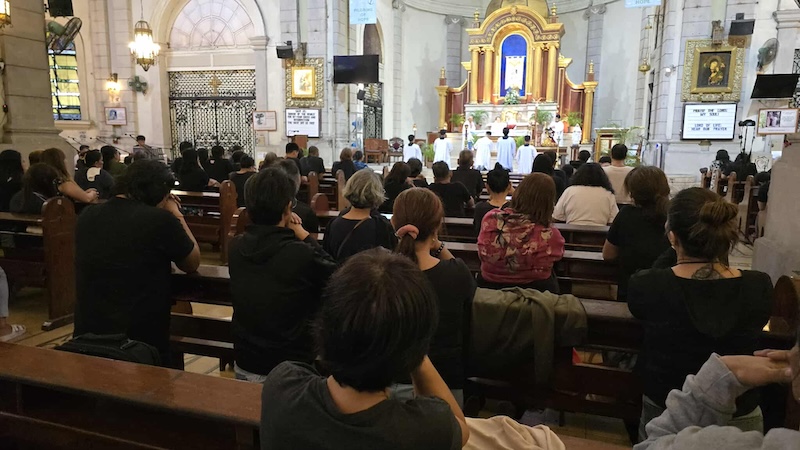
The Mass and ecumenical service at Malate Church
It took four long months before the Senate tackled the impeachment case, only to have the articles of impeachment remanded to the House of Representatives on June 10, despite the call of the case’s proponents for the trial to begin forthwith. Eventually, the impeachment case was archived by the Senate, which voted 19-4 in favor of a motion to adhere to the Supreme Court ruling that declared the impeachment articles unconstitutional.
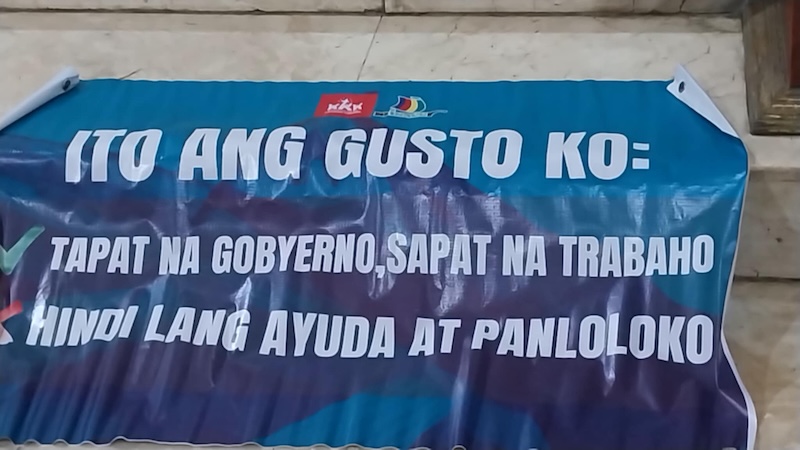
A sign says it all
The Senate, therefore, became the first target of the 24-hour Ayuno, Dasal at Sakripisyo rally and vigil organized by the Clergy for Good Governance (CGG). CGG was founded by the men of cloth with the belief that God has called them “to be stewards, prophets, and pastors of the Church to stand for what is right, for what is true, and for what promotes the common good.”
In the fight against endemic corruption and political dynasties, and in this particular instance, for the impeachment of Sara Duterte, the CGG, with the Catholic laity, called on other faith-based groups to join. The latter includes my own Bible study group, Church Café.
Our group is composed of artists, writers, journalists, and a historian, from different religious affiliations. For over 20 years now, we have been meeting once a week to study the Scriptures, discuss the events happening in our country, and to simply get together for birthdays and other celebrations, and to have coffee together, thus the name Church Café.
With the Institute for Studies in Asian Church and Culture (ISACC), which recently celebrated its 47th anniversary, we have noted and heeded the call of CGG to protest the impunity and outright disregard for the impeachment trial as a critical mechanism for accountability in governance, and to come together in prayer, fasting, and sacrifice for real change and against corruption and dynasties in our wretched country. ISACC is led by its president and founder, social scientist Dr. Melba Padilla Maggay.
That the impeachment case was preemptively dismissed, deprived all of us the opportunity to see the evidence of the alleged corruption of the Vice President, decried as brazen and unimaginable, to hear her defense, and judge for ourselves her fitness to continue in public service.
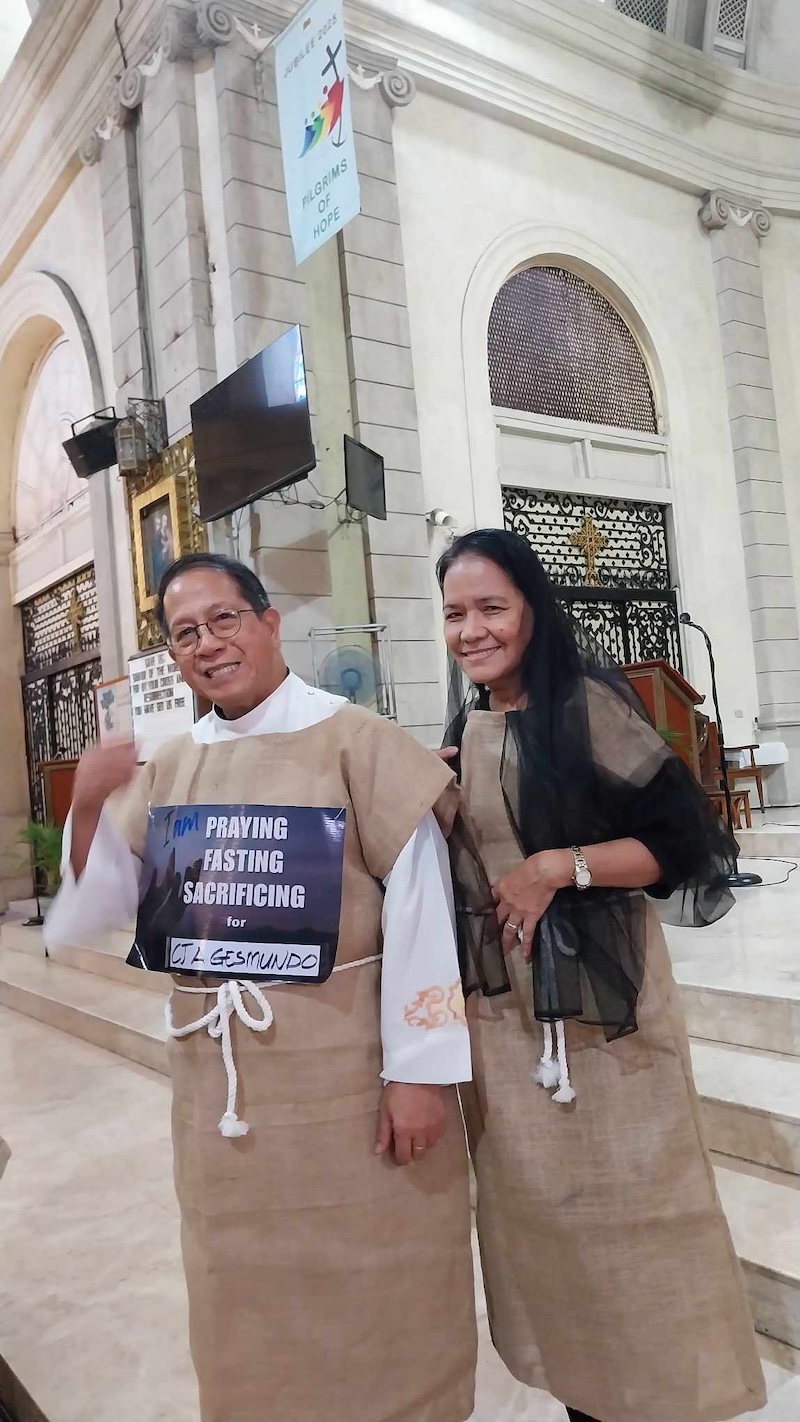
The author with Msgr. Jerry Bitoon of the Diocese of San Pablo
From the flooded Senate grounds that fateful day of August, the rallyists who braved the harsh weather joined those who had already proceeded to the Nuestra Señora del Remedios (NSDR) Church in Malate. The Mass was officiated by CGG’s Msgr. Jerry Bitoon of the diocese of San Pablo and Fr. Raul “Puti” Enriquez. It was followed by an ecumenical service by ISACC and Church Café, a meaningful getting together of the Catholic faithful and the evangelicals.
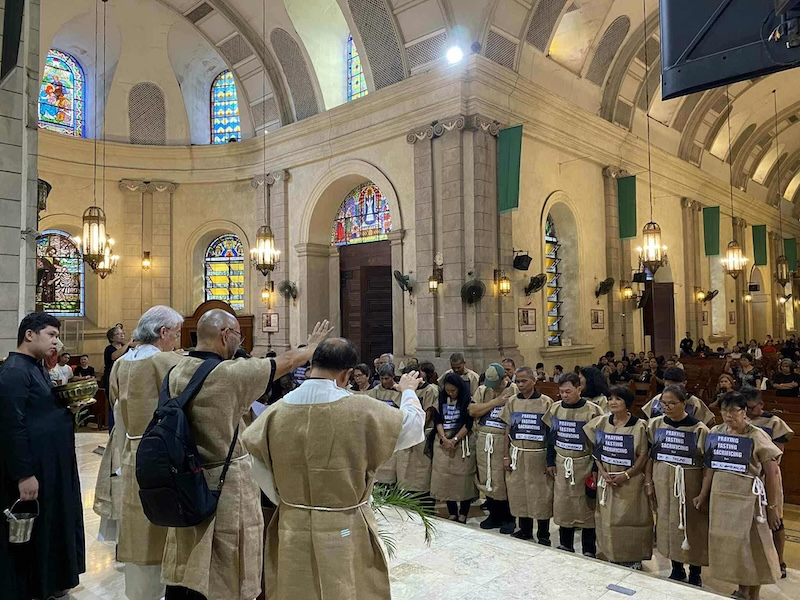
Fr. Puti Enriquez, Fr. Robert Reyes, and Msgr. Jerry Bitoon blessing the people in sackcloth
The Bible wrote about the prophet Jonah, who warned the king of the city of Nineveh that “40 more days and Nineveh will be overthrown” due to its extreme wickedness and unrepentant sin. The king asked the Ninevites to fast “and all of them, from the greatest to the least, put on sackcloth.”
The Bible said, “When God saw what they did and how they turned from their evil ways, he relented and did not bring on them the destruction he had threatened.”
Inspired by the conversion of Nineveh, Fr. Robert Reyes, also known as the Running Priest, and a convenor of the CGG, rallied the faithful to wear sackcloth and “sprinkle ashes on ourselves as we pray and fast against the evil roaming and reigning in our institutions like the Senate and the Supreme Court.” The aim is for the conversion of the individual and deliverance of our country, which he calls the new Nineveh.
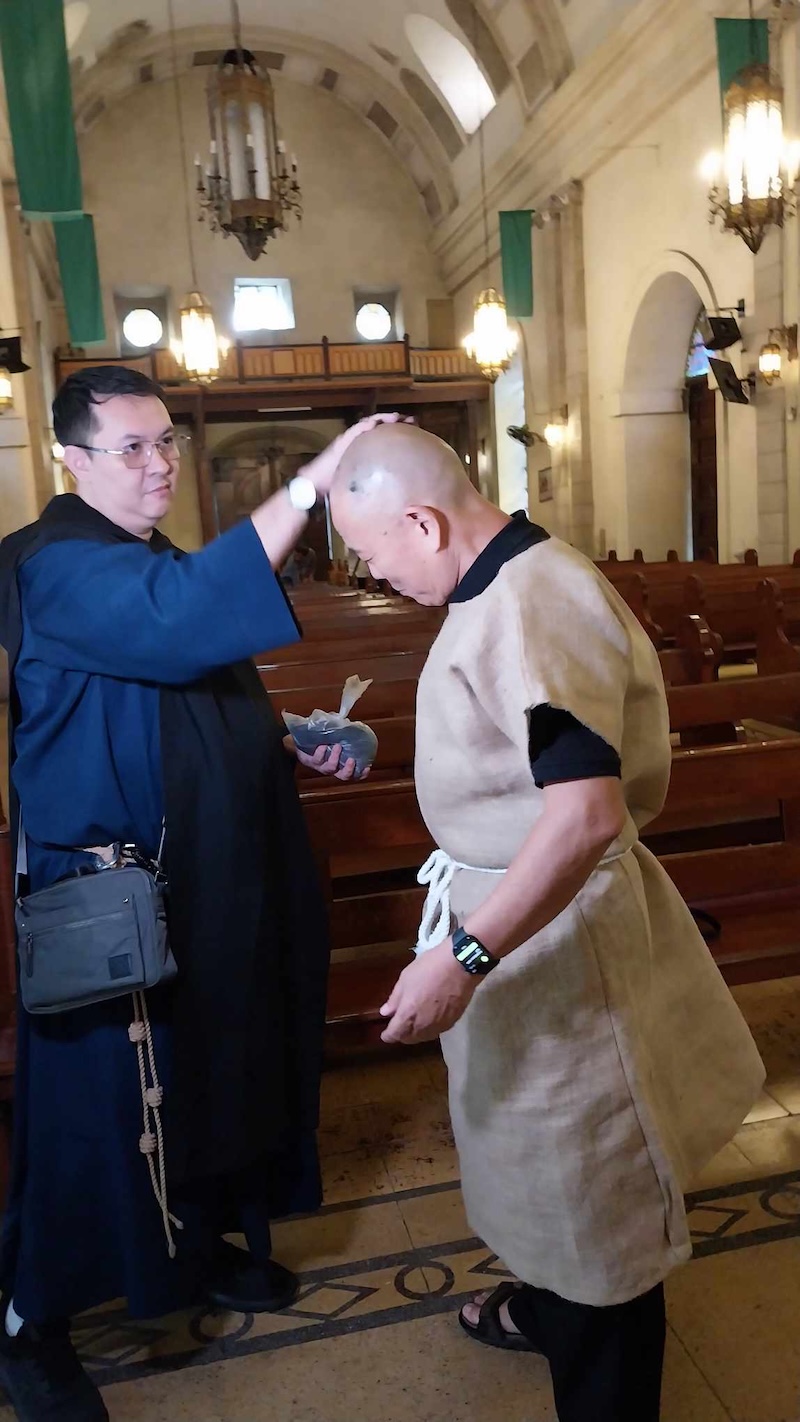
The rite of ashes
Father Robert prayed that the campaign of sackcloth and ashes bring about change, purification, and opening of the mind, heart and spirit, will, and soul of each one. He also sought the Lord’s help for Filipinos to “once again understand what it means to be dust, to be ordinary and small, so that they may worship the God of eternal glory.” The rite of the ashes was then performed on the rallyists who chose to wear sackcloth. I was one of them.
Why did a septuagenarian like me, an activist during the so-called First Quarter Storm in the ’70s who became an exile in China and came back to the country after the People Power Revolution, choose to wear sackcloth and cover herself in ashes? And now, in the autumn of her life?
Growing up in a family devoted to the teachings of the United Methodist Church, I later would believe in Karl Marx’s dictum that religion is the opium of the people. My activism took me to China when I joined my firebrand of a husband. This move would seal the absence of Christ, or the absence of Christianity in my life for 15 years.
But I guess I never did lose God during all those years in a Communist country, because I would seek Him at times, during moments of utter desperation when life seemed to be taking a turn for the worse, and when going back to my native land seemed to be an elusive dream.
I never did lose God during all those years in a Communist country, because I would seek Him at times, during moments of utter desperation
The euphoric liberation of the country from the Marcos military rule and President Cory Aquino’s taking the helm brought us home and back to our religion. Church Café would figure in my husband’s and my life when Maningning passed away in 2000. Thanks to the Mangahas couple, the poet Roger and historian Fe, Church Cafe gave us an anchor when we got lost in the sea of intense grief and sadness.
The call of the CGG, which started with an online gathering for prayer, reflection, scripture reading, and hymns aiming to link homes, communities, and hearts across the Philippines and other countries for seven days, which started on Aug 15 and culminated on Aug. 22, was a call not just to the Catholic faithful but also to the evangelicals, even Moslems, and other religions. It was a call to everybody to come together in prayer to sacrifice for the greater good, since it could be our last resort when everything else is failing.
Wearing sackcloth and ashes on the skin expresses my profound grief and mourning for the state of our nation, and deep repentance and prayer for conversion of those who have been betraying our people, both in the Senate and Congress, and in the Supreme Court.
Just think, when Sara Duterte’s impeachment case was put on hold after the Senate archived the articles of impeachment, the case was removed from the Senate’s active docket, with no trial unless a motion to revive it is approved.
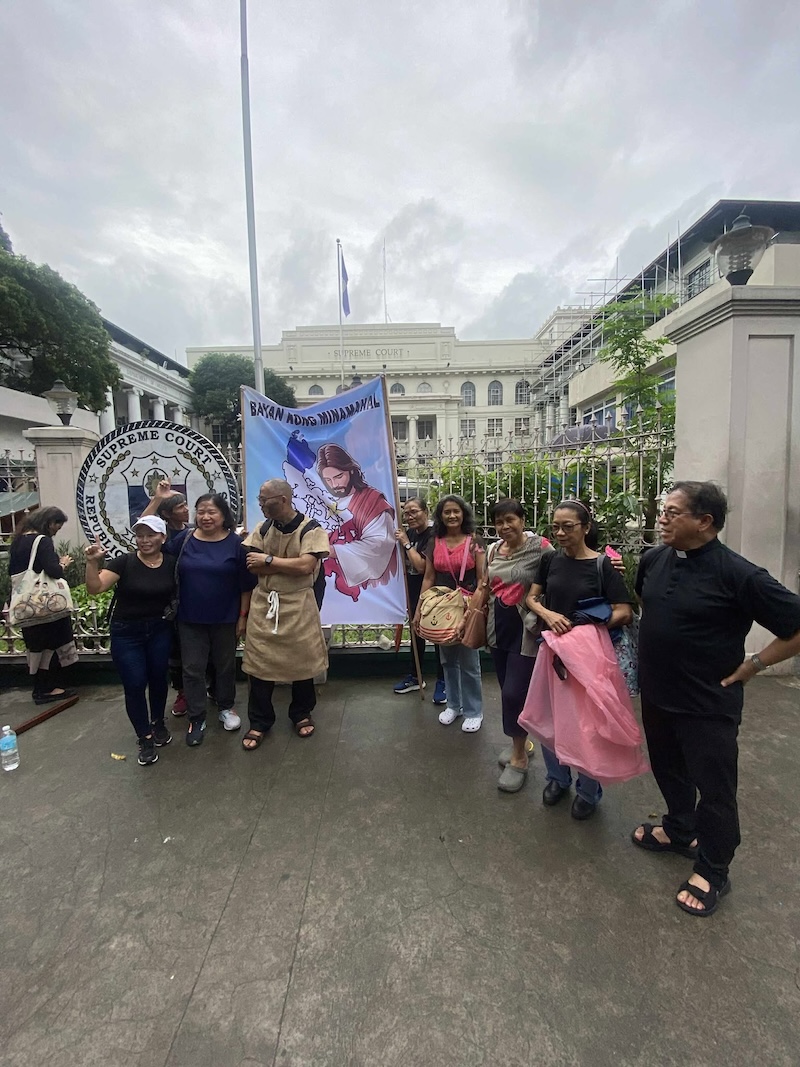
At the Supreme Court
As politicians and legal analysts pored over the ruling, three former Supreme Court justices—Adolf Azcuna, Artemio Panganiban, and Antonio Carpio—offered their own deep dives into the implications, fairness, and timing of the decision.
Azcuna said that the Court did not give the House a fair chance to be heard on the issues, as it did not first require it to file an Answer or even a Comment to the Petitions at bar. He said that many respected legal observers, including former Chief Justice Artemio Panganiban, marked that these are necessary due process steps heretofore invariably followed.
Panganiban argued that the Court could have opted for a “Status Quo Ante” order—freezing the process while giving both the justices and the public a fuller picture of the issues at stake, as this case “has transcendental importance to the nation and to our people.”
Retired Senior Associate Justice Antonio Carpio called the Supreme Court’s timing “unusual,” highlighting fresh legal hurdles for impeachment. He added, “It’s obvious that they wanted to come out with a decision before the impeachment trial could start because their decision is to declare the articles of impeachment unconstitutional.”
The legalities in the issue confounded the simple folk even when the corruption issue against the Vice President is reportedly crystal clear: at least ₱612.5 million of confidential funds were allegedly squandered on questionable accounts. As Secretary of the Department of Education (DepEd) for two years, she requested ₱150 million in confidential funds, which were reportedly not used for direct services nor to address the sector’s pressing needs.
Do you want to recall a real anti-corruption purge? Yes, we actually had a real anti-corruption purge played out in our neck of the woods. Back in 2014, the Office of the Ombudsman under the incorruptible and fearless Justice Conchita Carpio Morales, with the backing of equally incorruptible and courageous President Benigno Aquino, Jr., achieved a landmark year by filing an unprecedented number of plunder and graft charges, including those against three sitting Senators implicated with the businesswoman Janet Napoles in the misuse of Priority Development Assistance Fund (PDAF).
The three senators were Juan Ponce Enrile, former defense minister, accused of getting ₱172.8 million in kickbacks, charged with 15 counts of graft; Jinggoy Estrada, on accusations that he took kickbacks worth ₱183.793 million, charged with 11 counts of graft; and Bong Revilla, accused of getting kickbacks worth ₱224.5 million, charged with 16 counts of graft. All three senators were jailed at Camp Crame in 2014; then Enrile, because of his age and his health, was detained in a hospital instead.
In 2014, the Office of the Ombudsman under Justice Conchita Carpio Morales, with the backing of President Benigno Aquino, Jr., achieved a landmark year by filing an unprecedented number of plunder and graft charges
A total of ₱2.5 billion in behest agricultural loans to friends and associates of former President Gloria Macapagal-Arroyo and her husband Mike was exposed. Sen. Frank Drilon, who made the exposé, said it was impossible to recover the loans, since most of the borrowers were not identified, did not want to pay, or had been reported as dead.
The former president, who spent five years in hospital detention for plunder charges, was acquitted in 2016. She had a political comeback as representative of the 2nd district of Pampanga. The senators were acquitted by President Duterte and got elected again.
Alas, we are now back to square one. Add to this the big can of worms from the Department of Public Works and Highways. Even the media is not actually immaculately clean. Corruption everywhere is endemic. To many, the Supreme Court, supposedly the highest court in the land and the court of last resort, had been a big disappointment in the impeachment case. It was the reason CGG decided to march from the Malate Church to Supreme Court to do a Jericho Walk, a Biblical allusion which is a symbolic act of faith to bring down “walls of injustice, addiction, or spiritual strongholds” in the hope of bringing victory or divine intervention.
The Edsa Shrine, which has been a symbol of protest since the iconic People Power Revolution in 1986, was the last stop in the August 22 prayer-fasting- and sacrifice gathering. In the prayer vigil held till 7 am the following day, Father Puti declared that only “‘God power’—beyond People Power as Filipinos know it—can help solve the nation’s problems.”
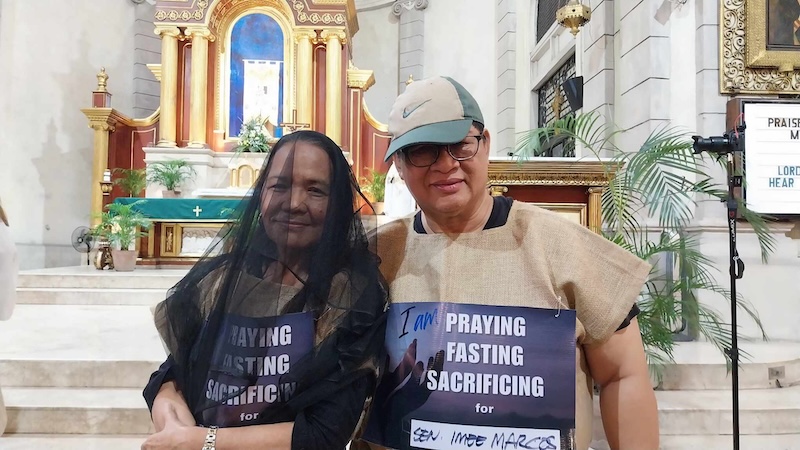
The author with Ostrich egg sculptor Danny Rayos del Sol
The CGG is continuing its Faithline: The Online Prayer Gathering for the Nation. What started as an online seven-day prayer gathering, which culminated in the August 22 event, came back every Friday at 9 pm starting August 29. It hopes that it will catch fire nationwide, or even in countries where there are pockets of Filipinos.
ISACC hopes to educate communities and create a critical mass of voters for the 2028 elections.
Meanwhile, I guess I have to continue wearing sackcloth and ashes on my skin whenever there’s a call for it—for my grandson and his generation, with hopes and prayers that they may yet see a better future devoid of corruption and dynasties, where people will live in peace and harmony and prosperity.


