
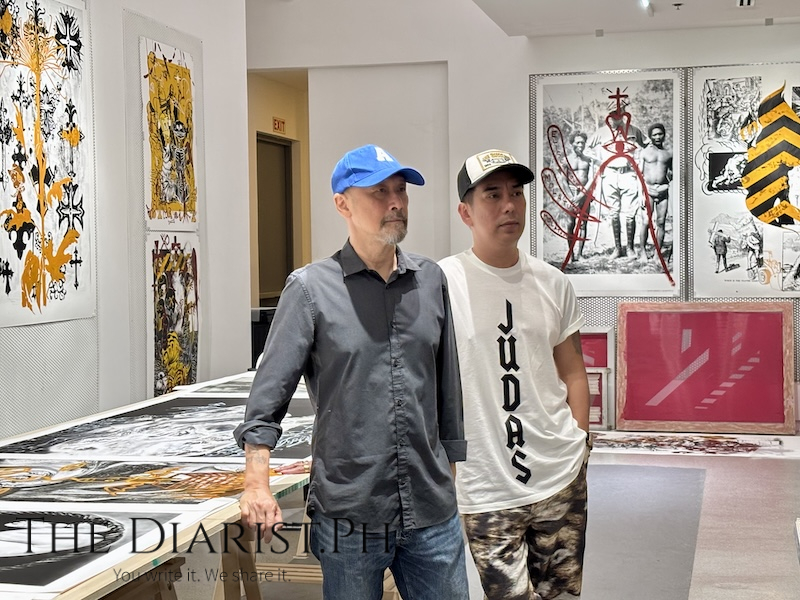
“Dialogo,” curated by Ruel Caasi, is on view starting Dec. 9, 2025 at Cloudgrey Gallery, 2nd floor, Grand Hyatt Manila Residences, 8th Avenue corner 36th St., BGC, Taguig.
How does Ronald Ventura remain hungry? Why?
We inevitably ask ourselves that each time we see Ventura (not often, really)—how does an artist, whose work is arguably one of the most in demand in Southeast Asia and beyond, stay hungry, never feeling satiated despite fame and wealth? We see him this afternoon at Cloudgrey Gallery, hunched over the long table, poring over the unfinished works he has just shown the media—fully engrossed, undistracted by the presence of media.
It is this hunger that has always struck us about Ventura, his hunger for learning and doing, his audacity to push his art and passion beyond the here and now. “May talino, may angas pa,” we always said of his work that gives us the viewer such informed discomfort. Sharing our roots in Malabon, we admire his enduring memory of place and how he’s mined it for his art.
“Thank you—not to have food on the table, you know?” he replies when we ask why he stays hungry even now that he’s at the pinnacle of his career, his works drawing world acclaim and among the highest rates; he is a universe removed from the world of the starving artist. “We don’t go hungry, yet we hunger, we try to survive by painting. Spiritually.”
After all these years, Ventura still sees art as the root of his survival, the threshold to a greater learning, creation, and even the tumult that comes with it. This month at Cloudgrey Gallery, he links up with another rule-breaker, Manuel Ocampo, in Dialogo. Curated by Ruel Caasi, it’s actually an interesting departure from the exhibit norm, in that these two important names in Philippine contemporary art will work on each surface, not as partners or collaborators, but as independent forces or creators bound by neither medium nor images, thoughts nor moods. The creation process at the Cloudgrey studio is done throughout the exhibit run, so that neither of the two can predict what the finished work will be, and at exactly what point. In short, it takes interaction or collaboration to a higher level; it is not done in a single session.
“Ocampo and Ventura are two of the most important artists working on the international stage. Their partnership shows what happens when strong artistic identities risk entering each other’s orbit. A third entity takes shape, one that speaks with greater force because it carries the strengths, tensions, and contradictions of two powerful visions,” concluded Cloudgrey in a statement given media.
Ventura, whose work found an enviable niche in Southeast Asia, the US, and Europe, achieved resonance with collectors and the art world in general for the intricate yet highly pronounced and precise layering of images, media, and perspectives, much of the latter forceful and even stubborn, borne of a life beset with earlier challenges. Art could hardly encapsulate that mind, not its hyperrealist images or graffiti.
Ocampo’s iconoclasm, whether in religion, history, or socio-politics, has gained a world audience for contemporary Philippine art. “Chaos”—that’s the word he gave TheDiarist.ph to describe his approach to art—a contrast to Ventura’s method. Yet in their interview below with TheDiarist.ph, Ventura admitted it was this untrammeled iconography that drew him to Ocampo.
“Ocampo approaches imagery like a saboteur. His work arrives raw, full of political triggers, Catholic signposts, colonial ghosts, and symbols imported out of their original contexts…much is in flux… Ocampo’s practice turns painting into a battlefield where icons are annihilated,” Cloudgrey describes the artist, whose works are found in leading museums abroad.
Harmony is not the point. Instead, they build an unstable zone where their aesthetics collide
The rest of the Cloudgrey statement:
“Ventura moves differently. His surfaces are precise, almost seductive in their detail. He balances realism with fever dreams. A boy appears inside a haze of smoke while Richie Rich floats above him, dripping bling. Bodies slide between flesh and anime, classical form and muted invention, Renaissance and anime. He draws the viewer in with beauty, then shows the cracks and the disconnect beneath it.
“Imagine if you will the Dead Kennedys jamming with Dream Theater. Ocampo’s punk rock marks crash into Ventura’s virtuosic polish, Ventura’s clarity throws Ocampo’s chaos into sharp relief. Instead of diluting each other, they amplify each other’s extremes. The edges blur…and what makes this partnership significant is that Ocampo and Ventura do not merge into each one another. Harmony is not the point. Instead they build an unstable zone where their aesthetics collide. That instability becomes the driving force. It shapes a visual language that neither artist would reach alone.
“Ventura explains the process: ‘Ano ba talaga and lalabas bilang obra? A visual dialogue? Maybe. Pero pag masyadong malalim, baka malunod sa research. Minsan sa art ang kailangan ay memory, reaction, impact. ‘Yung ‘third vision’ na pinagsamang world view naming dalawa. Doon lumalabas yung dialogue.”
‘Nung tiningnan ko yung existing pieces namin, the collaboration works…. Parang tuyo sa champorado….’
“Ocampo agrees: “Curious din ako, kasi iba approach niya, iba approach ko. Yung akin raw, yung kanya refined. Kahit sketchbook niya, parang Renaissance master. Nung tiningnan ko yung existing pieces namin, the collaboration works…. Parang tuyo sa champorado….”
“Champorado” and more. Their dialogue yields a confluence and clash of techniques and media: silkscreen, digital print, paint—medium responding to another medium.
In this exclusive, candid interview with TheDiarist.ph, Ventura and Ocampo describe how they gravitated towards each other to create this “dialogue,” two artists with contrasting personas and approaches to art, who can’t be any more different from each other. Ventura’s method vis-a-vis Ocampo’s chaos. Ocampo calls Ventura a Renaissance man in his well-rounded acuity and precision: “He deals with the different subjects, different mediums. Like he makes sculptures, makes big paintings, makes prints, multimedia. Artworks, so… He paints on cars, he paints on canvas… Walang limit. He tries to put his creative hand on a lot of things.”
Ventura describes the visceral Ocampo as a cave man—no rules, unconquered.
Interestingly, this interview explains how they serve as “trigger” to each other.
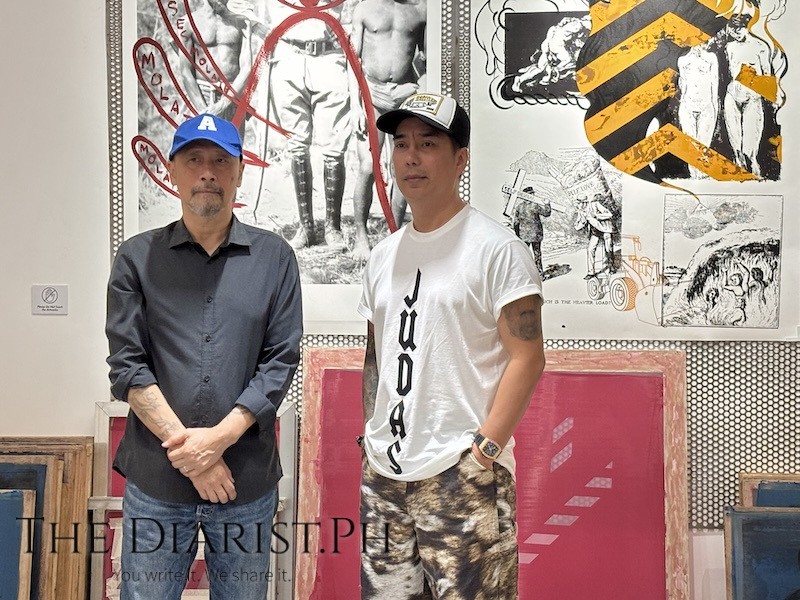
Ocampo and Ventura in ‘Dialogo’ (Photo by Thelma San Juan)
How will the art world, the art market, receive Dialogo? Ocampo has a good insight: “It actually subverts the logic of the market…Because the authorship is divided. Whereas in the art market, they want only one, one personality, one signature style…” Not only could it provoke, it could also polarize, he says.
The market? Ventura replies, “Let the gallery handle that.” He explains that “the moment of two artists is more interesting than the material value of the work.” Apparently, Ventura’s commercial success hasn’t polluted his art; money hasn’t shielded him from the continuous struggle that is art.
It is notable how living in this age of social media, the two artists have not been distracted by the noise and clutter—not distracted from the history of their art. On their travels and stints abroad, the masters, Ocampo notes, continue “to talk” to them beyond the boundaries of the museums—in fact, beyond the boundaries of time. Whenever he roams museums abroad, Ventura remains mesmerized by the Renaissance artists, by the old masters, and can’t get enough of them. He says he remains “haunted by the masters.”
Most important, this interview affirms what the two major artists of Philippine contemporary art share: hunger. Beyond the physical.
Ventura tells TheDiarist.ph: “I’m a glutton. Parang when I see art history, when I see the history of painting, parang I’m nasa buffet, ‘no? You want to try many things. You want to eat everything….Walang kabusugan. But sometimes you vomit things out. Maybe my work is what I vomit out.”


