
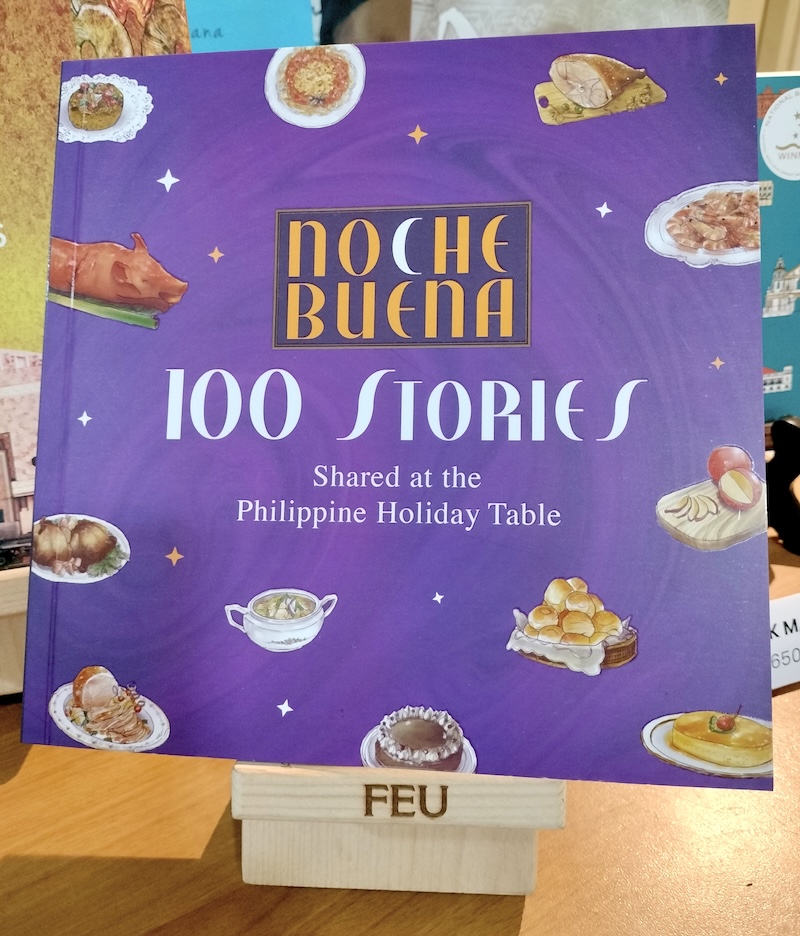
‘Noche Buena: 100 Stories’ is the first book in FEU’s Centennial Publishing Series.
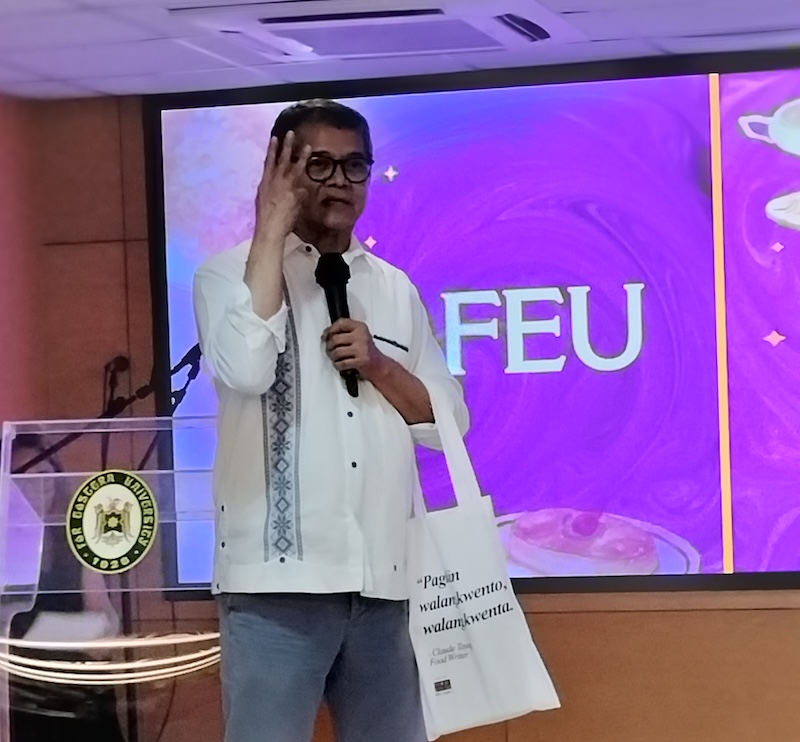
Claude Tayag talking about good food and good stories.
Photos and videos by Liana Garcellano
Restaurateur and food writer Claude Tayag broke the ice in the conference center of Far Eastern University (FEU) Manila on the afternoon of November 28 at the launch of Noche Buena: 100 Stories Shared at the Philippine Holiday Table. The first question he was asked was how the best or worst noche buena shaped him.
“Noche buena is family. My worst Christmas was when I was crying because I was alone in Spain. It was in 1979 and I was trying to call home, but I couldn’t get through,” Tayag said.
Guillermo “Ige” Ramos, food writer and managing director of Ugnayan Center for Filipino Gastronomy (UCFG), answered the second question: How has the noche buena tradition changed through the years?
Ramos founded UCFG, a research, education, and culinary hub where the exploration, preservation, and innovation of Filipino cuisine are anchored on Philippine history and identity.
He lamented how the rice cakes associated with Simbang Gabi (the dawn Masses leading to Christmas Eve) aren’t Filipino anymore, with the substitution of ingredients: “We eat bibingka after Simbang Gabi. But the sellers in the churches in Manila and Cavite now don’t use galapong (ground glutinous rice). They use rice flour imported from Thailand—a cheaper alternative—because few Filipino farmers plant malagkit (glutinous rice) now.”
The same goes for puto bumbong. According to Ramos, the traditional purple rice has been replaced with the commonplace rice flour dyed with McCormick purple food coloring, and grated cheese has taken the place of grated coconut because the cheese doesn’t spoil as easily as coconut.
But Ramos’ plaint is dovetailed with a Christmas wish—an exhortation, if you will: “Let’s support our farmers to get back our tradition. Why celebrate Filipino food when ingredients aren’t local?”
Paralleling the ethos, FEU trustee Gianna Montinola said Noche Buena: 100 Stories is “a celebration of the heart of the Filipino Christmas through stories…transforming noche buena into more than a memory.”
“Every recipe carries a family’s signature dish, and the food cooked is an invitation to gather and eat. May we keep the noche buena tradition alive,” she said.
Noche Buena: 100 Stories is the first in FEU’s 100-title series intended to commemorate its centennial anniversary in 2028. The mini coffeetable book features the personal stories of 100 chefs, restaurant owners, bakers, etc. in the Philippines, 24 recipes, and original illustrations by Isaiah Israel D. Susi, dean of the FEU Institute of Architecture and Fine Arts.
Maria Teresa Trinidad Tinio, FEU’s senior vice president for academic affairs, said she and the FEU Culture Collective—the university’s writers, researchers, and artists—threw themselves headlong into the book project with joy and laughter despite lacking culinary knowledge.
“We did the book because of the really wonderful and moving stories of the contributors: stories of family closeness and generations of traditions, of the love of a mother or grandmother or other family members expressed through food, stories of struggle, hard work and commitment and eventual success found through a dedication to authenticity in food,” she said.
In line with the book’s festive tone, the program included song performances by the FEU Chorale, story-reading, a cooking demonstration, and a presentation to the contributors of their copy of Noche Buena.
The FEU Chorale sang Ryan Cayabyab’s Kumukutitap, describing the festive twinkling lights animating the Christmas season in the Philippines, and the near-operatic Lechon Maynila, a song about La Loma’s famous roasted pigs. The song was composed by FEU alumnus Ramon “Monchie” Ferreros, owner of Monchie’s Lechon and contributor to the book.
Ferreros said, in a brief chat with TheDiarist.ph, that he composed the song for a choir in the 1980s, and used to sing the solo part in his younger days. The title was a toss-up between Lechon La Loma and Lechon Maynila.
In the story reading, Neliza de Lara read the stories of Rowena Yebra of Bong and Wen’s Eatery (Taal, Batangas), and of Kristin Treñas of Panaderia de Molo (Iloilo City). Austere Rex Gamao read the stories of Sandy Daza of Casa Daza (Quezon City) and Raymund Acuna of Davao Cake Counter (Poblacion, Davao City).
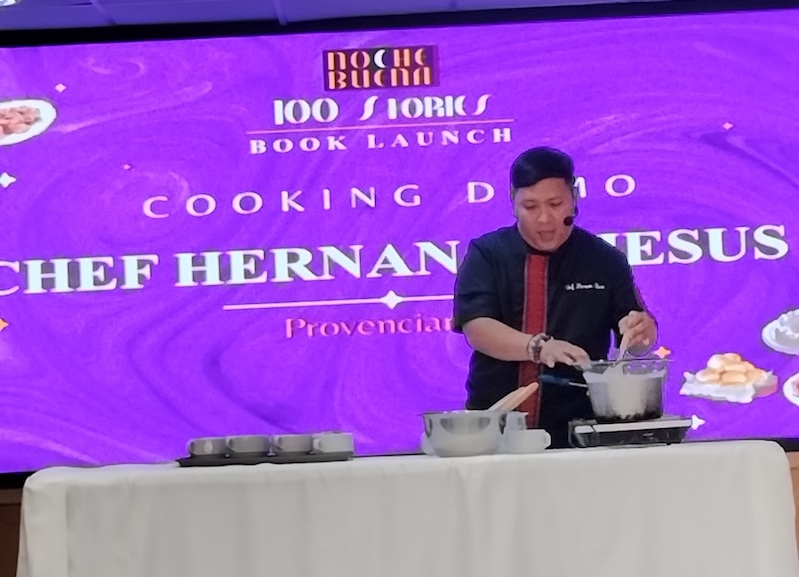
The program ended on a sweet note with Chef Hernan Christian De Jesus of Provenciano (Maginhawa Street, Quezon City) demonstrating how to make custard fruit salad. (The salad was part of the refreshments after the launch.)
To start, De Jesus said, “Mix the condensed milk and Nestlé cream over the stove and temper it with beaten 12 egg yolks for 30-40 minutes, or until the texture thickens into a custard.” (According to Google, tempering is a cooking technique that involves whisking small amounts of the hot liquid into the beaten eggs by slowly combining the egg mixture with the hot liquid, and constantly whisking to prevent clumps.)
To flavor the egg mixture, De Jesus suggested sprinkling cinnamon, nutmeg, or vanilla into it 15 minutes into the tempering process. And while the egg mixture tempered, he advised preparing the drained canned fruit cocktail by adding apple slices for a crunchy texture. He also recommended topping the fruit salad with grated cheese, cubed queso de bola, walnuts, or almonds.
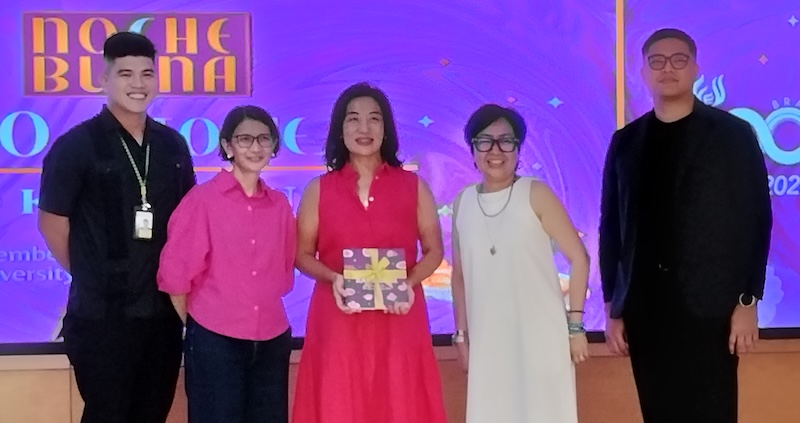
Milky Way’s Malu Gamboa-Lindo (center) with her copy of ‘Noche Buena’ with FEU Institute of Tourism and Hotel Management dean Harold Bueno, FEU publications manager Lance Caperal, FEU vice president for corporate affairs Rowena Capulong Reyes, and FEU Institute of Architecture and Fine Arts dean Isaiah Israel Susi
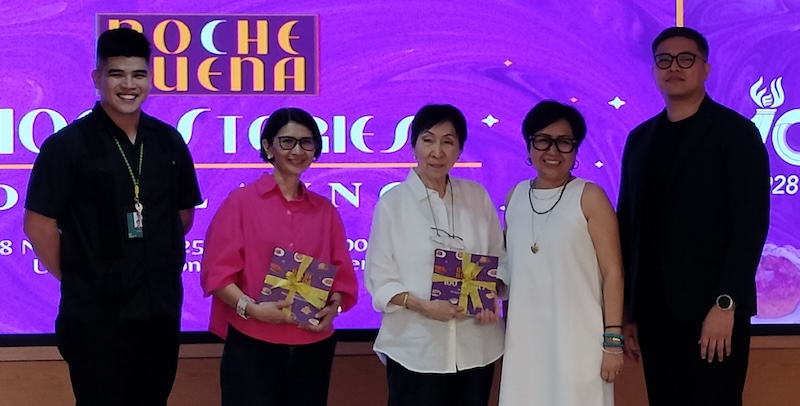
FEU executives with Emelita Galang (center) of Emelita W. Galang Culinary Arts Studio
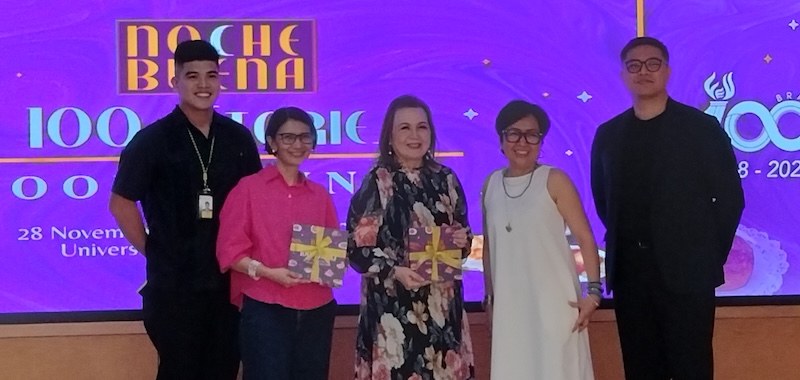
FEU executives with Aristocrat’s Cookie Reyes (center)
So what’s for noche buena? The Christmas lunch menu of the Tayag family always has lechon, ligang pasku, and buko sherbet, Tayag said. In his piece in the book, he wrote: “Liga is Kapampangan for nilaga (boiled), so nilagang pasku isn’t the usual nilagang manok (boiled chicken), but an elaborate one closer to the Spanish cocido, which has beef, pork, chicken, ham bones for flavoring, and an assortment of vegetables.”
Tayag said his paternal grandfather, Dr. José Tayag, started the Christmas lunch tradition while “raising 16 children.” His own “Tatang” continued the tradition, “often inviting some of his siblings plus us children,” he said. “We would be a party of about 100.” His Lolo José’s speciality condiment of fish sauce, kalamansi, and mashed chicken liver with siling labuyo (wild chili) on the side was always part of the menu.
Ferreros wrote that he and his family have noche buena with their employees: “We have pancit palabok or Canton, fried chicken, and lots of fruits. But no lechon. We are surrounded by lechon 365 days a year so for noche buena, we want to have something else.”
JT Manukan Grille owner Joel Torre (yes, the actor) wrote that his Christmases were full of food. After attending the Mass on Dec. 24, they’d come home to a feast prepared by his mother Luz —“My mother was a terrific cook,” he said. On their noche buena table would be lechon, Chinese ham, turkey, queso de bola, fruit salad, spaghetti, and roast pork.
Torre said that among the dishes, the roast pork was his favorite, which none of his siblings had been able to replicate. “My mom had a magic touch; her food was extra special,” he recalled.
Jackie Ang Po of Fleur de Lys wrote that her noche buena was a feast of spaghetti, embutido, kare-kare, lutong toyo, and leche flan prepared by her husband Mitch’s grandmother, Flordeliza.
Po trained with culinary expert Sylvia Reynoso and at the California Culinary Academy but, she said, “we never would supplement Lola’s spread with anything like lechon… The star of the celebration had to be the cooking of Lola. No one was allowed to outshine Lola.”
Sisters Gina, Joy, and Mia Ylagan Navarro of Estrel’s wrote that they’ve continued the traditional Christmas celebration formerly led by their aunt Estrella and mother Alice, with Gina as the de facto organizer. (Estrel’s is popular for the mouthwatering caramel cake decorated with butter roses in pastel colors.)
For their Christmas menu, the Navarros’ appetizers include an assortment of cheese, pâté, mini deep-fried lumpia ubod (their mother’s recipe), and Spanish chorizo and jamon. Soup is chowder, pumpkin, fresh mushroom, binakol, or Cajun. Main course is a cornucopia of roast beef and lechon from Elar’s, chicken pastel or Alexandra, lasagna (using homemade pasta), baked salmon with lemon and dill, and pan-fried prawns with butter and herbs. Desserts are sans rival, baked ube yema (Estrel’s recipe), chocolates, and fresh fruits.
Gallery by Chele owner Jose Luis “Chele” Gonzalez isn’t Filipino, yet his experience is now very Filipino. Gonzalez wrote that although Christmas is different in the Philippines, he loves the spirit of the season and the warmth of the people.
Gonzalez, a native of Torrelavega in Cantabria in Northern Spain, said his Christmases were all about his mother’s lechazo (roasted baby lamb) and its rich aroma filling the house. Their noche buena began around 10 or 11 pm and was followed by gift giving at midnight. Now, he celebrates Christmas in the Philippines with his Filipino wife and her family.
“Our celebration is simple; sometimes I cook steak or gambas al ajillo. Christmas is…gathering with the people I love, with good food at the center of it all,” said Gonzalez.
“Noche Buena: 100 Stories Shared at the Philippine Holiday Table” is regularly priced at ₱880. A pre-selling price of ₱790 is available until Dec. 19. Order from TAMS Bookstore at tamsbookstore@feu.edu.ph.


