
This year marks the centennial birth anniversaries of Queen Elizabeth II, Marilyn Monroe, Jerry Lewis, and Mel Brooks. The latter is still with us, and we hope to see him blow 100 candles on his birthday in June.
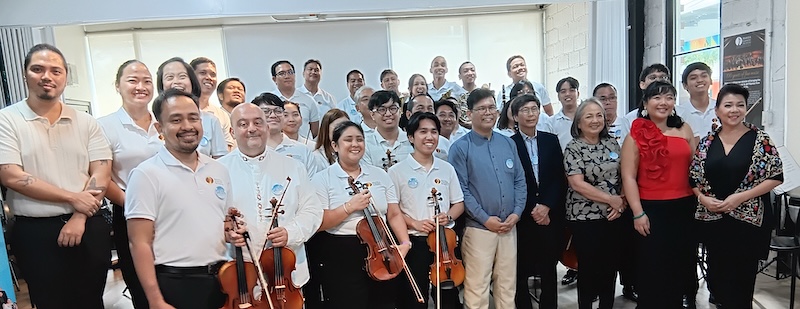
Also going strong is the Manila Symphony Orchestra (MSO) which is marking its centennial anniversary with a special concert on Jan. 22, 2026 at the Samsung Performing Arts Center, Circuit Makati.
Founded by Austrian conductor Alexander Lippay under the patronage of Asociacion Musica de Filipinas, the orchestra was composed of musicians from the University of the Philippines (today’s UP College of Music) and the Philippine Constabulary Band.
The MSO has been based in various theaters, from its first home at Manila Grand Opera House to the Manila Metropolitan Theater, and its current base at Circuit Makati. It has survived every crisis imaginable—natural calamities, World War II, and recently, the pandemic.
At a recent press preview of the MSO centennial concert, MSO president Maan Hontiveros explained how she became connected with the orchestra. She had taken a five-year sabbatical to recover from an illness. During this time she enrolled at St. Scholastica’s College, in Bachelor of Arts in Music major in guitar. The campus was then the MSO’s base.
Upon joining MSO, she sought to have the orchestra’s board of directors revamped. “We needed a board to help us professionalize the orchestra. The artists had to be paid for the performances,” she explained. The musicians, she added, had to be assured they could earn a decent livelihood from their craft and not just consider the MSO concerts as free gigs.
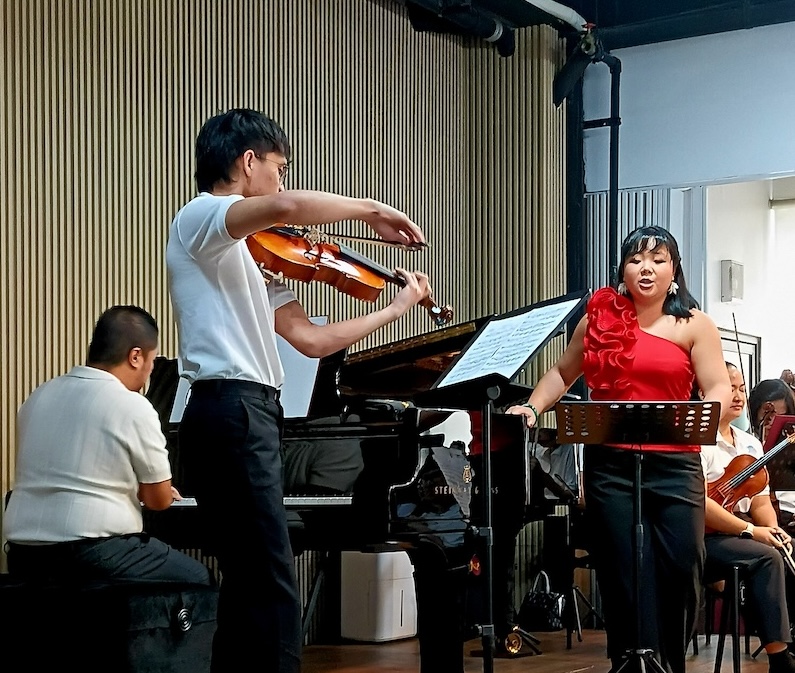
Michelle Mariposa at the press preview
In the press preview, the orchestra gave the media a foretaste of this year’s repertoire. With music professor and MSO associate conductor Jeffrey Solare at the baton, the orchestra spectacularly performed the Overture from Mozart’s Marriage of Figaro, followed by soprano Michelle Mariposa’s rousing Habanera from Bizet’s Carmen in Tagalog. This version was first performed by the MSO in the 1950s.
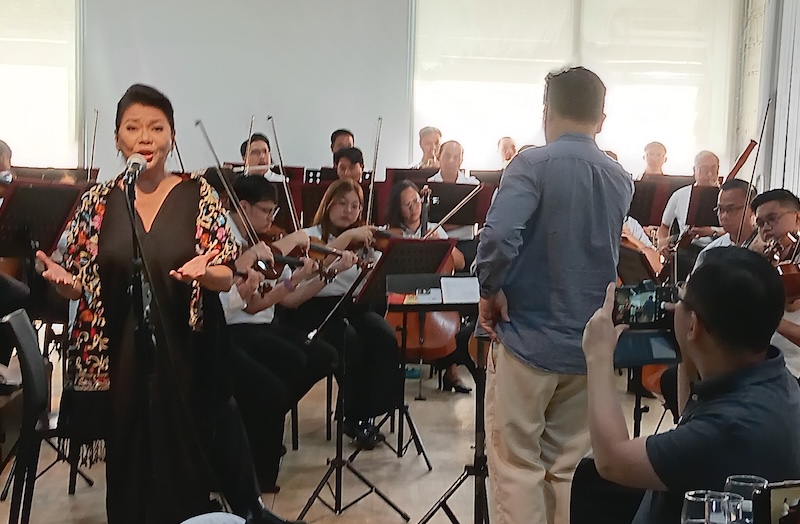
The country’s leading soprano Rachelle Gerodias-Park sings ‘Mutya ng Pasig,’ with MSO associate conductor Prof. Jeffrey Solare conducting.
Up next was premiere soprano Rachelle Gerodias-Park who brought the house down with an exquisite rendition of Mutya ng Pasig. Rachelle and Michelle will be guest artists in the upcoming MSO concerts this season.
After the press conference, Ms. Rachelle chatted with a few members of the press. She talked about her firstborn, whom she had at age 43. She said her Korean husband, the baritone Byeong In Park, wanted to name their first son after our national hero. She vetoed the idea. She said, “There’s no way our son is going to be named Jose Rizal Park.”
It was a light-hearted moment between the star and us media who almost overstayed our welcome, lingering in the rehearsal hall and finishing what was left of the buffet. These were the same people I’d bump into in every press conference and concert of the MSO and the Philippine Philharmonic Orchestra (PPO).
But there was a good reason we stayed longer—arts and culture journalist Dexter Matilla wanted to try out the MSO’s beautiful Steinway baby grand. The rest of us gathered around the piano, not to admire Dexter’s prowess, but to eject him from the bench for our turn to show off too. Amadis Guerrero played what he described as an American folk song whose title he couldn’t recall, yet he easily remembered the notes. I had my turn and did a jazzy version of Tomorrow from Annie and almost started a sing-along. But we were all upstaged by Adrian Lontoc, the walking encyclopedia of classical music, who did Beethoven’s Third Movement of Midnight Sonata. He couldn’t finish it because Dexter insisted on playing something more current.
So now I realize the reason we’re in almost every event that involves classical music. We’re all musicians at heart.
I still recall the first time I covered this “beat” more than 20 years ago. Michel Legrand held a concert with the now defunct San Miguel Philharmonic Orchestra at PICC. Listening to them perform the poignant music he wrote for the film Brian’s Song was a transcendental experience.
Shortly after, the Cultural Center of the Philippines (CCP) hosted a mini press conference to promote an upcoming concert of the PPO. It was a dream assignment because the guest artist would be David Benoit. I would meet my idol, whose albums I played at home and while driving. CCP’s PR director Irene Rada explained the concert was a fundraiser. The orchestra needed to acquire musical instruments.
So there we were at CCP in a small conference room with Benoit seated at the head of the table. I and my colleagues, all of us fans who begged our editors for this assignment, were star-struck. We just stared at him for what seemed like an eternity because it felt surreal. Count on Irene Rada to single me out to ask the first question. I stammered and thankfully, I got to ask about the music he wrote in tribute to the late senator Benigno Aquino (Hymn for Aquino). Benoit was in the country when Aquino was assassinated, and he was profoundly touched by the outpouring of grief that followed. That got the press conference rolling.
This was less a media conference and more of a meet-and-greet. After the interviews, we lined up for his autograph (mobile phones with cameras were still rare then). I proudly presented my David Benoit piano book for him to sign. The book had cost me an arm and a leg. But he was even more surprised with what artist/writer Igan D’Bayan showed him: an original LP of Benoit’s first album. The concert, which Benoit described as jamming with the PPO, would be a success.
I also couldn’t forget the time the PPO held an outreach concert in a coastal town in Antique. The program included a majestic performance of Leroy Anderson’s Serenata which evokes old time glamour and images of soaring Art Deco skyscrapers. Or when the MSO played Lalo Schifrin’s iconic theme from Mission: Impossible, which gave me the kind of thrill that no shot of rum could match.
In between concerts, we’d trudge to the food court of Landmark at TriNoma where a high school band played every weekend. Classical music would not be in the repertoire, but instead they offered the most enjoyable and affordable form of Sunday afternoon entertainment. Just buy a sandwich and savor the music, and watch a couple suddenly get up from their table to boogie to the band’s exciting rendition of the Pointer Sisters’ I’m So Excited. It would be enough to make me cancel my plan to see a movie.
Sights and sounds such as these should lead to a great release of endorphins. As Maan Hontiveros recalled, the music and the music played by the MSO did much to help her recover from her health crisis.


