
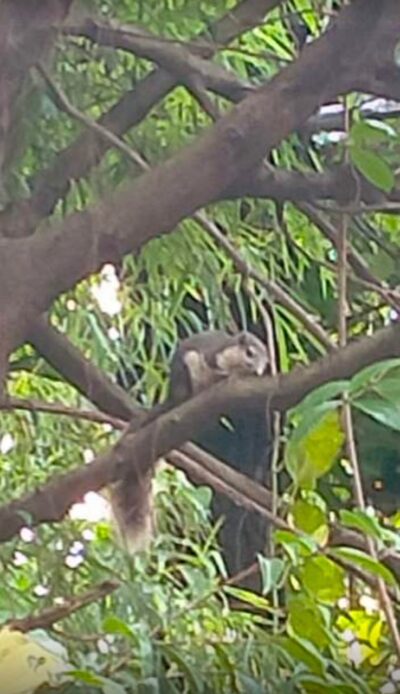
Every morning in our subdivision begins with birdsong, filtered sunlight, and—if you look closely enough—squirrels. Quite a number of them.
Thanks to the abundance of mature trees in our front and backyard, our home has apparently been designated as unofficial squirrel lounge, playground, dining area, and aerial training academy.
They arrive early, before most humans are fully awake, scampering across branches with the confidence of creatures who know they own the place.
Watching them has become a quiet ritual. Coffee in hand, binoculars ready, one can observe a level of energy that puts most of us to shame. While humans stretch, yawn, and negotiate with alarm clocks, the squirrels are already mid-parkour, bouncing from mango tree to star apple tree like tiny, furry Spider-Men.
Squirrels are not casual climbers; they are elite athletes. Their movements look playful, almost careless, but are in fact highly refined.
Each leap is calculated. Each landing is precise. They run upside down along branches, cling vertically to tree trunks, and execute mid-air course corrections that would make Olympic gymnasts quietly reconsider their career choices.
At first glance, they appear to be ordinary squirrels. But when you watch closely—especially through binoculars—you begin to notice something extraordinary. Some of them appear to fly. Not exactly fly, of course, but glide.
When they leap from higher branches, their limbs stretch outward, revealing what looks suspiciously like webbing between their legs. These skin membranes act like tiny parachutes, allowing them to glide gracefully from tree to tree—nature’s version of a wingsuit.
This explains how they cross seemingly impossible gaps without falling, pausing briefly mid-air like they’ve momentarily forgotten gravity applies to them.
Unfortunately, all this charm comes with consequences—particularly for our fruit trees.
The squirrels adore our mango and star apple trees. Unfortunately, they do not believe in finishing what they start. They nibble. They taste. They abandon.
Perfectly good mangoes end up discarded, half-chewed, left dangling, or dropped to the ground like rejected appetizers. Star apples suffer the same fate—sampled, judged, and then ignored.
This is not hunger. This is culinary curiosity.
It is hard not to feel mildly offended when you find a fruit ruined after just one experimental bite, as if the squirrel was thinking, “Hmm. Not ripe enough. Next.”
The result is heartbreaking waste, especially for anyone who has waited patiently for mango season. One begins to understand why farmers across the world have complicated relationships with squirrels.
Our cat, Putim, once took it upon herself to address the squirrel situation. Cats, after all, believe they are apex predators, even when the evidence is mixed.
For weeks, Putim chased squirrels with great enthusiasm and very little success. The squirrels, unimpressed, treated her like background entertainment, leaping just out of reach and pausing occasionally to look back—as if checking whether she was still trying.
Then one day, Putim returned home triumphant. In her mouth was a squirrel’s tail. Just the tail.
She deposited it proudly on the floor, eyes shining, body language clearly saying, “You’re welcome.”
The squirrel, presumably, survived—slightly shorter, perhaps emotionally shaken, but alive. Putim never managed a full capture again. The squirrels, on the other hand, seemed to move with even greater agility afterward, possibly having updated their internal threat assessment and reaction.
As delightful as they are to watch, the squirrels have begun to worry the subdivision administrators. Beyond fruit theft, they have developed another problematic habit: gnawing.
Squirrels’ teeth never stop growing, which means they must constantly chew to keep them manageable. Unfortunately, they are not particularly picky about what they chew. Tree bark. Wooden structures. Electrical lines. Cable wires.
Unfortunately, they are not particularly picky about what they chew. Tree bark. Wooden structures. Electrical lines. Cable wires
This is where charm starts giving way to hazard.
Chewed cables can cause power interruptions, internet outages, and in worst cases, fire risks. Suddenly, the playful squirrel becomes a potential infrastructure problem. Notices are posted. Residents are encouraged to catch them and turn them over to authorities.
This is the moment when a community must decide: Are these creatures a blessing or a nuisance?
Before we condemn them entirely, it’s worth remembering that squirrels play real ecological roles.
They are seed dispersers. In their habit of burying nuts and forgetting where they put them, squirrels inadvertently help trees grow. Many forests owe part of their regeneration to absent-minded squirrels.
They are also indicators of a healthy environment. Their presence suggests abundant trees, sufficient food, and relatively clean surroundings. In many ways, they are living proof that our subdivision still has space for wildlife.
And then there is the mental health benefit. Watching squirrels scamper about in the early morning is undeniably calming. Their joy is infectious. Their energy lightens the mood. For a few moments, emails, deadlines, and news cycles fade into the background.
They remind us that life can be playful.
So…boon or bane? The honest answer, of course, is: both.
The squirrels are pests when they waste fruit and damage property. They are delights when they leap, glide, and play among the trees.
They are a problem when unmanaged. They are a privilege when appreciated responsibly.
Perhaps the real issue is not the squirrels, but how we coexist with them. Responsible fruit protection, proper cable insulation, and humane wildlife management can reduce damage without turning the subdivision into a battleground between humans and rodents.
After all, we planted the trees. We created the habitat. The squirrels merely accepted the invitation.
As the sun rises and the squirrels begin their daily acrobatics, it is hard to be angry for long.
They leap. They chase each other. They pause, tails flicking, alert and alive.
In a world increasingly paved, wired, and enclosed, these moments of untamed life feel precious—even when they eat our mangoes.
Perhaps the squirrels are neither boon nor bane. Perhaps they are simply neighbors—noisy, mischievous, occasionally destructive neighbors—who remind us that nature does not exist only in forests and documentaries.
Sometimes, it lives right outside our window, nibbling fruit, chewing cables, and flying—just a little—between trees.
And maybe that’s a small price to pay for a front-row seat to nature’s morning show.


