
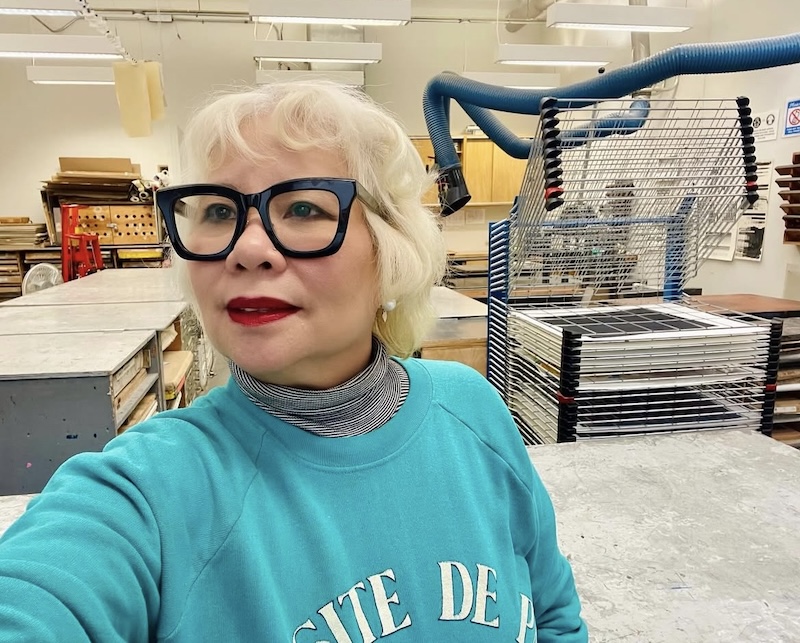
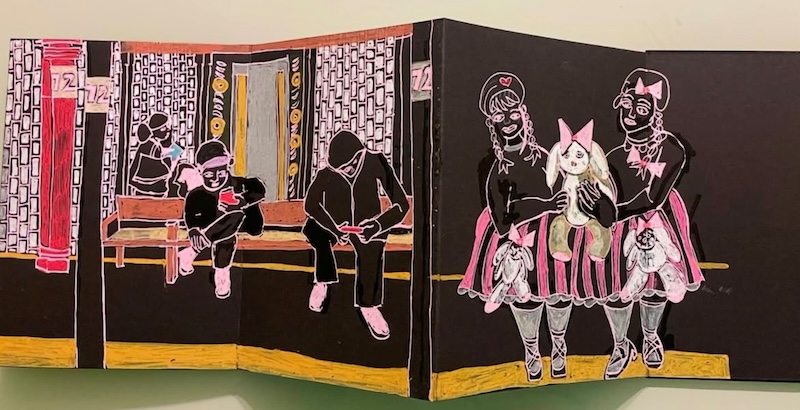
Impressions from the subway–boys looking at their phones and the two girls in sleeveless dresses with stuffed toys
(Plet Bolipata exhibit runs March 14 to 31, 2026 at Vetted 126, Mile Long Arcade, Amorsolo Street, Legaspi Village, Makati)
For nearly three decades, Plet Bolipata has built a career alongside her husband, Elmer Borlongan. She often felt she stood in his shadow.
Plet works in saturated color. Her figures are unruly and fable-like, drawn from memory and instinct. Elmer paints lean, elongated bodies, and is known for social realism. His city scenes are spare and unsentimental.
When she doubted her worth, he did not. He urged her to keep working, keep showing. Now she presents a new exhibition at Vetted 126 built on lithography and Posca acrylic markers. It signals a fresh chapter and a firmer claim to her place.
“The time has come to talk of many things,” says Plet on her show titled Of Posca Paints, Lithographies and Dreams Beyond the Sea.
The third of six children, Plet or Maria Rosario Preciosa is the only visual artist in the family. The brothers were nurtured as musicians and became leading ones—pianist Jaime Edgardo (Jed), cellist Ramon Lorenzo (Chino), and violinist Alphonso (Coke). Their father wanted the girls to be professionals. Maria Socorro Johanna (Non) Bolipata Lerer is a lawyer, and Rica Bolipata-Santos is director of the Ateneo Press. Plet is a B.S. Computer Information Systems graduate (1984) of St. Joseph’s University in Philadelphia.
She showed little interest in art as a child. That changed when she visited the studio of her uncle, Federico Alcuaz, the National Artist for Visual Arts. She remembers the sharp bite of turpentine, the metallic tang of oil paint, the dampness of rags steeped in linseed oil. The air felt thick and alive, and she felt, finally, the pull of something she could call her own.
Since the late 1980s, Plet has worked across media: oil, watercolor, collage, assemblage, and filmmaking. She has mounted installations, designed sets, and experimented with drawing and mixed media. Her practice has always been fluid, moving with intuition rather than strict genre.
Her turn to printmaking began during the pandemic. Lockdowns made art supplies scarce, so Elmer, who had studied printmaking under abstractionist Raul Isidro, offered his equipment at home. Plet learned the process to stay occupied, but she was less concerned with printing editions than with making images on the plate itself.
Printmaking begins with a plate, the surface that holds the image. The artist draws or carves, inks it, then runs it through a press to transfer the image to paper. Plet experimented with recycled materials, carving directly into the aluminum lining of used Tetra Paks. The grooves hold ink as soft, slightly uneven lines with a rough texture, giving each print a raw, handmade quality. She and Elmer later set up a printing press in Zambales that other artists could use.

Plet Bolipata waits for the bus to school in aphoto taken by her husband, Elmer Borlongan.
In January 2025, Plet went to New York for personal reasons. At her husband’s urging, she enrolled in lithography at the Art Students League, founded in 1875 and renowned for training generations of American and international artists. Lithography is a printmaking method in which the artist draws on a flat limestone or metal surface, which then transfers the image to paper, preserving subtle gesture, shading, and texture. It captures the artist’s hand directly, making prints feel intimate and alive.
Having Caroline Ongpin, a respected Filipino artist and master printer, as her teacher was good foundation. With that support, Plet shaped a body of lithographs that reaffirmed her voice.
In her upcoming exhibit, she returns to a recurring subject: nude women, exploring their lives and idiosyncrasies. One early piece shows a stark figure in the foreground making a hand gesture, a tree rising behind her. Lines are direct, precise, yet spare.

Lithograph of sleep
In another black-and-white work, sleep becomes the subject. A figure curls on a pillow, dense marks pressing around her. The artist builds black tones through repeated rubbing and pressure, producing grainy shading instead of smooth gradients. The face and hands are left mostly bare, giving the figure a sense of stillness amid the waves around it. The body is shaped by weight and shadow rather than anatomical detail, while the visible lines record the hand of the artist. Sleep feels fragile, contained amid the marks pressing in.
“Lithography demands precision,” Plet says. “It challenges the brain. Even sharpening the pencil constantly is part of the discipline.”
Other pieces draw on New York. At Metro Diner, two topless women, attended by servers, stand in for Plet and her sister Non. “You are most vulnerable when you are naked,” she says. Two girls emerging from a subway station, dressed in stuffed toy-adorned sleeveless outfits in the middle of a harsh winter, became a subject for another drawing. Plet asked them to hold a toy for her artwork, capturing both resilience and whimsy.
At Metro Diner, two topless women, attended by servers, stand in for Plet and her sister Non. ‘You are most vulnerable when you are naked,’ she says
Her lithograph of The Ansonia apartment building tilts upward from a low vantage, showing curved balconies, mansard roofs, and rows of repeating windows. The Beaux-Arts architecture is drawn with firm, disciplined lines. Overhanging branches in the foreground are worked through rubbing and layered marks. The tones are uneven, textures granular, lines slightly wobbly, giving the building depth and an impression shaped by lived perspective rather than measured geometry.
At 74th Street Café, two customers chat amid packed tables. Plet defines the figures, floor, and walls with clear lines, then adds soft shading that opens up the room. Even the human figures carry undershading, which grounds them and pushes them forward in space.
Alongside her black-and-white prints, Plet works with Posca acrylic markers. These paint pens lay down bright, opaque color that sits on the surface rather than sinking into it. She was initially insecure with the medium, but Elmer encouraged daily practice. She now uses the full spectrum to fill figures and scenes with bold planes of color that have become her signature.
Her childhood-inspired series, Salut D’Amour, reflects horror vacui, a Filipino aesthetic characterized by filling every inch of space. Electric greens and tropical pinks define the family garden, while Dalmatians create rhythmic patterns, with young Plet and Non in Miriam (Maryknoll) grade school uniforms, sliding with their mother at the end. Another part of the frame shows Coke practising on the violin under their mother’s strict eye. “She absorbed everything the teacher said. My brothers excelled because she was there,” says Plet.
Since Zambales is mango country, one piece shows little Non and Plet in uniform surrounded by baskets of native mangoes, while Coke enjoys a fruit. “I lived in a mango orchard. My grandfather planted 600 mango trees, though 300 were expropriated by the Americans,” she recalls. Another piece shows one sister giving a Dalmatian a manicure while the other fluffs its fur; Coke lies nearby with a sword. The dog was a gift from comedian Dolphy. Coke recurs in her work because he was always close to his sisters.

Art Brides –Frida and I
One of her Frida Kahlo-inspired series shows two women holding roosters—one representing Frida, the other Plet. “I felt an affinity with Frida,” Plet says. “We both had fertility issues and struggled to step out of our husbands’ shadows.” Frida’s husband, Diego Rivera, shaped her public recognition while overshadowing her early career with his murals of Mexican history and politics Likewise, Elmer has been a constant source of support and artistic context despite his popularity in social realism. In the background, the husbands shake hands as comrades.

Bolipata’s signature theme of naked women under the sun
Another Frida-themed work shows Plet and Frida with easels on a boat named Zambaleno, framed by the West Philippine Sea and a mountain range. Plet also returns to her signature theme of naked women, basking under the sun.
Her New York series captures both the vibrancy and cold of the city. In a bistro, two men animatedly chat; Plet exaggerated their gestures. A painting of the girls on the subway dressed in stuffed toy-adorned dresses pops with color. In Flurries, No Worries, she maps winter using horror vacui, stacking a café table against dark buildings to create a flat, crowded perspective. Neon yellows and teals contrast with deep blues and burgundies, turning cold bricks into a saturated urban landscape. Small white strokes suggest drifting snow, while a burger and coffee anchor the scene, a private pause in a hectic city.

Self-portrait of Bolipata with her art materials at the hotel room
Her self-portrait in primary colors is vivid and graphic. Dressed in a red-and-black striped sweater and crimson cap, she sits against a black cityscape marked with white architectural lines. The circular geometry of the tan table and the roundness of the markers echo the polka-dotted playfulness of her socks, linking the foreground to the figure and giving the scene visual cohesion. Thick outlines and a blue floor push her forward from the window. The bright colors and bold shapes draw attention to her figure in the scene.

Elmer Borlongan waiting for Plet in a cafe in NY
Plet paints Elmer in bold blues, yellows, greens, and magentas, using color contrast to suggest form instead of shading. The face anchors the work in ochre, pink, acid yellow, and pale lavender, prioritizing mood over natural skin tone. His tilted head and folded hands suggest pause, but the palette avoids sentimentality.
Posca allows little correction, so contours wobble, thicken, and repeat. The artist layers strokes and leaves under-marks, giving the portrait the energy of an engraving. Repeated passes of blue on her husband’s jacket create rhythm and movement, even in flat color. Everyday object such as a cup, papers, and a pen ground the scene. The portrait feels alive, made through careful, real-time observation and drawing.
Before meeting Elmer, Plet had embraced single blessedness while living in New York. She studied at the Art Students League and mounted exhibitions in the Philippines and abroad, but often felt unseen. “When I met Emong,” she says, using his nickname, “he saw my work, believed in it, and brought it to Boston Gallery.” Art patron Joven Cuanang immediately offered her a show.
‘When I met Emong,’ she says, using her husband’s nickname, ‘he saw my work, believed in it, and brought it to Boston Gallery’
“In hindsight, your only enemy is yourself,” she says of her self-doubt. For years, she sought mediums that would not invite comparison. “In the end, I’m still a painter. Now that we’re older, all that insecurity, all those questions we raised in our youth, don’t mean a thing. You just do what you want to do.”
Where does she find validation? “From Emong. He tells me, ‘You’re doing great. Stop thinking that way.’” The art world may seem male-dominated, she says, but at this stage, that logic no longer applies.
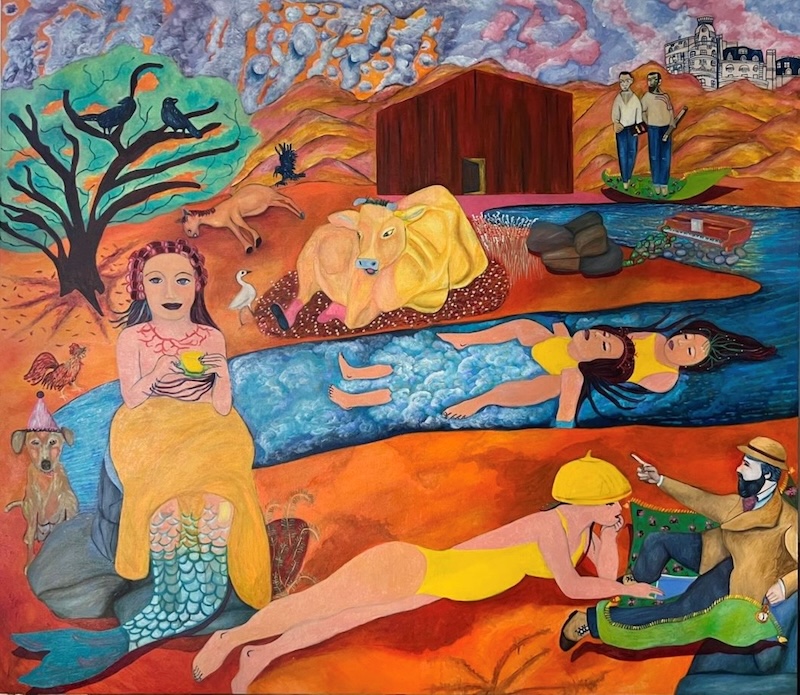
‘She Walks Amongst Us’
After lithographs and Posca studies, Bolipata returns to scale with a seven-by-eight-foot oil painting, She Walks Amongst Us. originally for Art Basel Hong Kong from March 26 to 29. It will be shown at Vetted 126 on March 14.
Across tiered hills, Plet builds interlocking stories. Ochre and burnt orange blaze against a winding electric-blue stream. Lemon-clad swimmers and a mermaid in yellow hold the foreground. A golden cow, a crow, a rooster, and a deep red barn define the middle ground. Lavender haze and pink clouds frame a distant white manor. At the lower edge of the canvas appears the image of the French painter Edouard Manet, arriving on a flying carpet.
“I believe in storytelling, with the canvas as my medium. There is a solid plot to begin with, but it has many twists and turns as the process evolves,” she says. “My canvas is alive with the sound of the cow’s moo, the rooster’s cock-a-doodle-doo, the crow’s caw, the wind’s sigh, and the river’s flow.”
Layered in brights and earth tones, the painting becomes a crowded, rhythmic world, thick with movement and noise. The mermaid’s tale led Plet back to oils, rekindling an old love and pushing her to paint with renewed conviction.
The exhibit will run from March 14 to 31. Vetted 126 is located at Mile Long Arcade, Amorsolo Street, Legaspi Village, Makati.


