
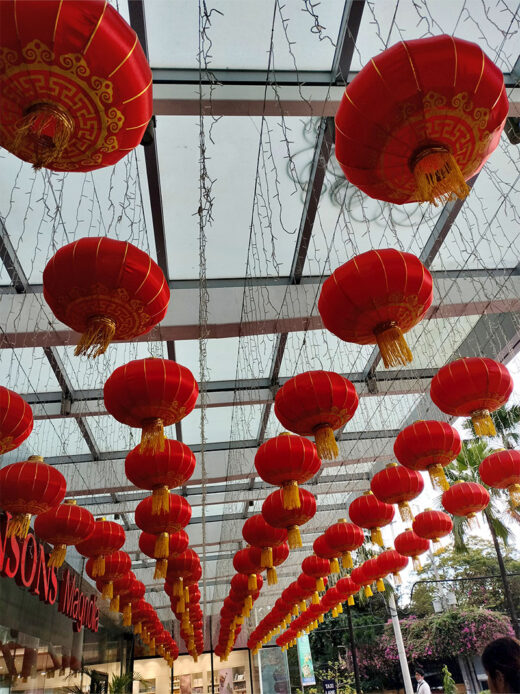
From the mall’s top floor came the distinctive sounds of the gong, cymbals and drums one afternoon. A lion dance was in progress, banishing evil spirits and ushering in prosperity for a shop. The mall was festooned with bright red lanterns, and a giant replica of a Chinese zodiac animal sat at the main entrance lobby. A serpentine dragon was on display two years ago, followed by a snake. This year’s fiery horse is less conspicuous, installed in a roofless gazebo encircled by huge dreamy pink flowers.
I was finishing my Moroccan mint tea when memories of Chinese New Year (CNY) celebrations spent overseas came rushing in like waves to the shore. CNY was relatable for its comparative propinquity to Filipino culture, but it also indicated my outsider status.
Singapore had spellbinding lion dances. Once, I had a front-row seat to a lion dance from a café on the ground floor of Orchard Central. The colorful lion—powered by two lithe, powerful dancers—leaped onto the high poles, its head shaking, eyelids fluttering, and ears flicking. The viewers gasped collectively as it jumped with adroit ease the high poles that were at a distance from each other. They laughed when the lions—now in pairs and on terra firma—panther-crawled and cat-walked before leaping to “eat” the hóngbāo (Mandarin for ed packet with money) and lettuce leaves hanging overheard.
Years later, Global Prestasi School in Bekasi, Indonesia, where I taught English literature, always had a barongsai (lion dance) and liong (dragon dance) to celebrate Imlek, the local term for CNY. The teachers, staff, and students, dressed in red, always assembled at the main building’s entrance to watch the dances, which heightened the festive atmosphere and doubled the school’s good fortune.
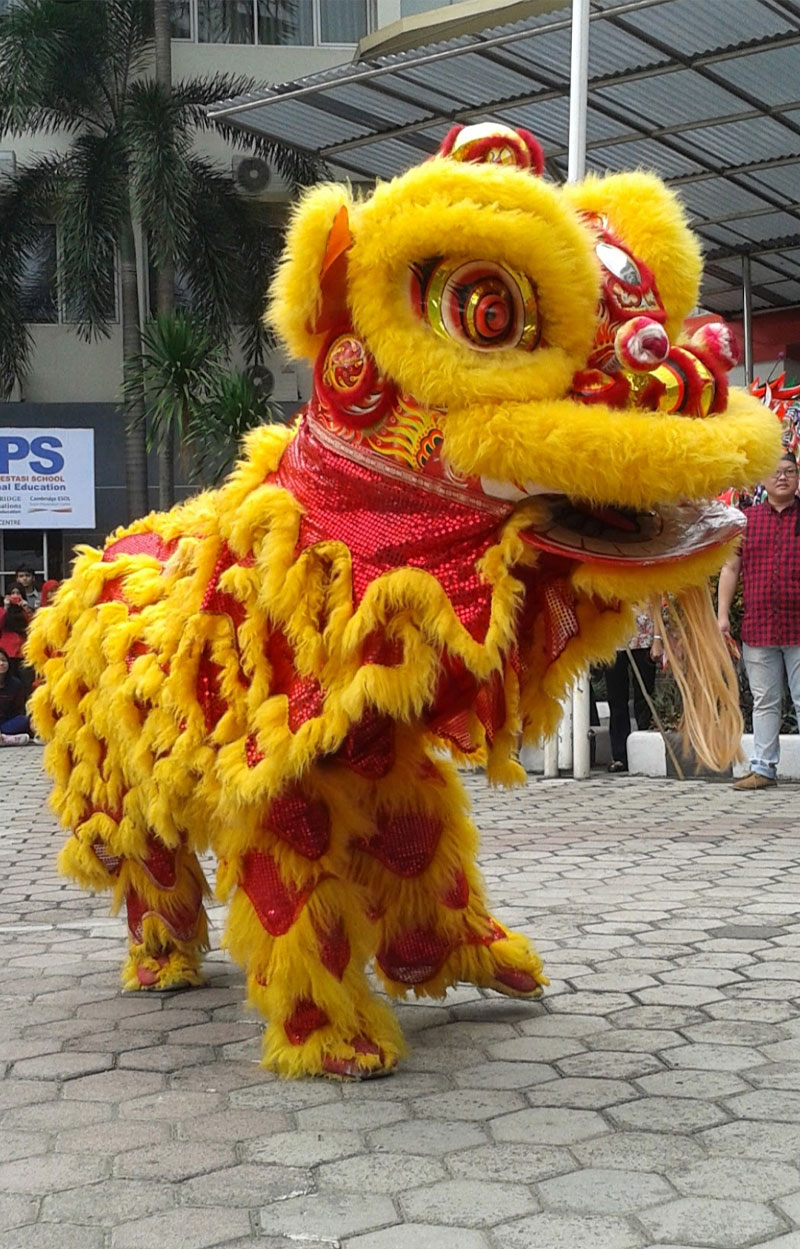
The lion is ready to ward off evil spirits.
I marveled at the liong dance, with the bright-color serpentine dragon flying above us. The performers moved the poles in near-synchronicity, making the dragon glide, dip, and soar gracefully through the clear blue sky.
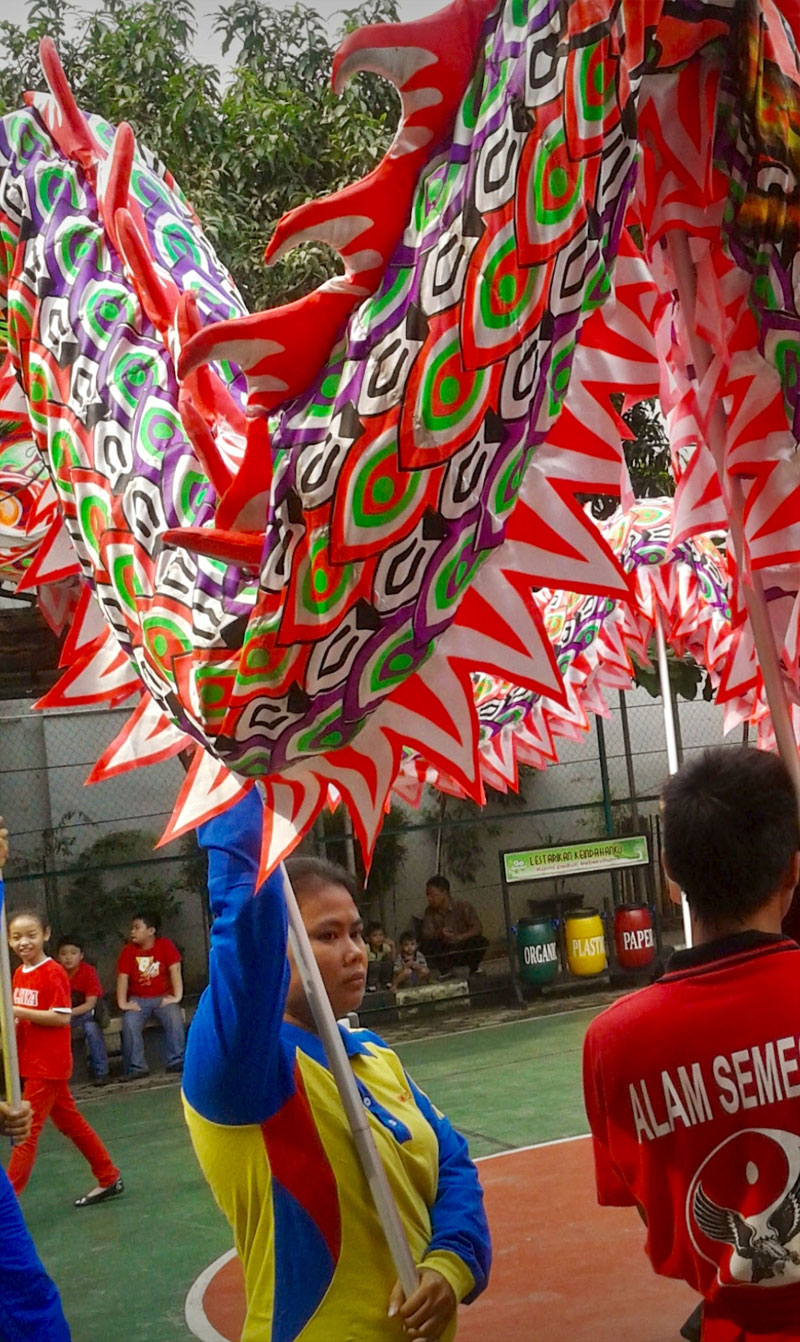
A serpent dragon ushers in prosperity during Imlek.
The first hóngbāo I received was from one of the bosses of a Singapore publishing company I worked for. K wished everyone a blessed CNY while distributing the hóngbāo. We could have seen eye to eye if I had fawned on him, as the art director advised me to, except that I wouldn’t. K loved pontificating about how we should be like Haw from his favorite book, Who moved my Cheese? It was his way of exhorting us editors to embrace the “changes,” his euphemism for the cost-cutting measures the company implemented. Arguing would have prolonged the agony of hearing the cheese story again, so we didn’t.
The red packet contained S$2. A pittance, as indicated by the silence and smirks considering K’s new 7-series BMW parked at the office entrance. Nonetheless, I thanked him because looking the gift horse in the mouth would’ve been impolite. Actually, I was thinking of buying chee kueh—soft water cake topped with preserved radish—with it from the hawker center.
A friend, C, always looked forward to getting his hóngbāo from relatives. It made up for their snide remarks about him being mixed-race: Chindian, half-Chinese from his mother’s side and half-Indian from his father’s side. C let the taunts slide, but he wasn’t going to break bread with them. It was always amusing when people trash-talked him to his face, thinking he didn’t understand Chinese. His clapback in fluent Mandarin was as iconic as those revenge scenes in Korean drama. The heckler was blown to smithereens.
But C’s fat hóngbāo quickly shrank when he did his post-CNY shopping. In one such occasion he blew all his hóngbāo money on a pair of Levi’s he’d always wanted.
The giving of hóngbāo, which I discovered was also de rigueur in weddings, follows an unbreakable rule. For both occasions, the gifted amount shouldn’t contain the number 4 because the pronunciation of the figure is identical to the Chinese word for death.
K also gave out two mandarin oranges to herald balance and unity. Eager to practice my Chinese, I chirped Kung Hei Fat Choi to the one distributing the oranges. She wasn’t pleased at hearing it and lectured me on the “correct” greeting.
“It should be the Mandarin greeting Gong Xi Fa Cai,” she pointed out. “Kung Hei Fat Choi isn’t Mandarin.”
I retorted: “That’s how the Chinese communities greet in the Philippines.” Mentally, I was greeting her again but this time in Hokkien — Kiong hee huat tsai, the way people in Binondo, Manila, wished everyone prosperity.
Undoubtedly, the purist would raise a stink if she learned that in Indonesia, nian gao is kue keranjang; CNY is Imlek, which is derived from the Hokkien im-lek meaning lunar calendar; and barongsai is a portmanteau of barong (Javanese for lion) and sai (Hokkien for lion).
But she was strangely nonchalant in uttering ang pao instead of hóngbāo, considering that ang pao is Cantonese. She also didn’t get riled when she heard me say nian gao — a sticky sweet/savory rice cake known as tikoy in the Philippines.
She turned and went about putting oranges on other desks. My cheery mood dissipated, burst by her elevation of a culture and language, and denigration of another in the name of “correctness.” What happened to unity and harmony?
The Singaporean CNY tradition of lo-hei was the closest I got to experiencing a reunion dinner. The invitations came from hotels’ PR teams. The Cantonese phrase means “tossing high”; the higher the toss, the greater fortune and prosperity for everyone. Picture a platter of pieces of raw salmon, shredded vegetables, deep-fried crackers, and condiments on the table surrounded by diners with chopsticks. They mix the salad by tossing the ingredients high into the air while shouting “Lo-hei!” The salad is later portioned out and served to the diners.
At my first lo-hei I tossed the salad gingerly, careful not to break the cardinal Filipino rule of never playing with food. But after several lo-hei invitations I was vying for the highest toss.
Part of the CNY feast is the dish called poon choi, with its layered abalone, roast meats, seafood, sea cucumber, etc. stewed in an enormous ceramic bowl. The delight was audible when it was brought to our table, the rich smell stirring our appetite. The top layers of tofu, seafood, and vegetables quickly disappeared, but it was a leisurely pace eating the abalone, chicken, and duck at the bottom. The CNY lunch stretched on like an Italian lunch, ending with a matchbox serving of nian gao to refresh the palate after the heavy meal.
Conversely, my celebration in Indonesia was subdued following the Imlek dances. I ate the special box lunch of nasi kuning (yellow rice), deep-fried duck quarter, and perkedel jagung (corn fritter) alone in my office.
The solitariness wasn’t for the lack of trying to connect. Work shackled me to my office. Conversation with others was nonexistent or stilted because my Indonesian was at tourist level (my Chinese proficiency was limited to profanities), and learning Indonesian wasn’t encouraged. Foreign English teachers were prohibited from conversing with others in Indonesian.
Sipping my second cup of tea, I finally conceded that I was an outsider. Belonging, I recalled, wasn’t about finding a common ground but for me to be more accommodating, which I was. However, realizing there was no reciprocity and getting tired of feeling like an interloper, I became reclusive, connecting socially only occasionally.
Living abroad was a long lesson in navigating the social landscape of circumspection and perfunctoriness. In the end, I became proficient in the art of guardedness, but now and then I let my hair down for a lo-hei.


