

For the longest time, the image of a cockfighter, a half-consumed cigarette in his mouth while he petted his rooster, stayed with me like a childhood memory. It’s from a painting by National Artist for Visual Arts Fernando Amorsolo, titled Sabungero. For some strange reason, since the pandemic years, it’s been appearing in my news feeds.
Amorsolo’s subject, like any of his romanticized figures, is a well-groomed middle-aged barrio man, in white camisa de chino, squatting, a head scarf tied in reverse—thin, brown-skinned but not that old, his hair still black. His is a generic face in remote barrios—the sun-soaked farmer with a bolo tied to the belt.
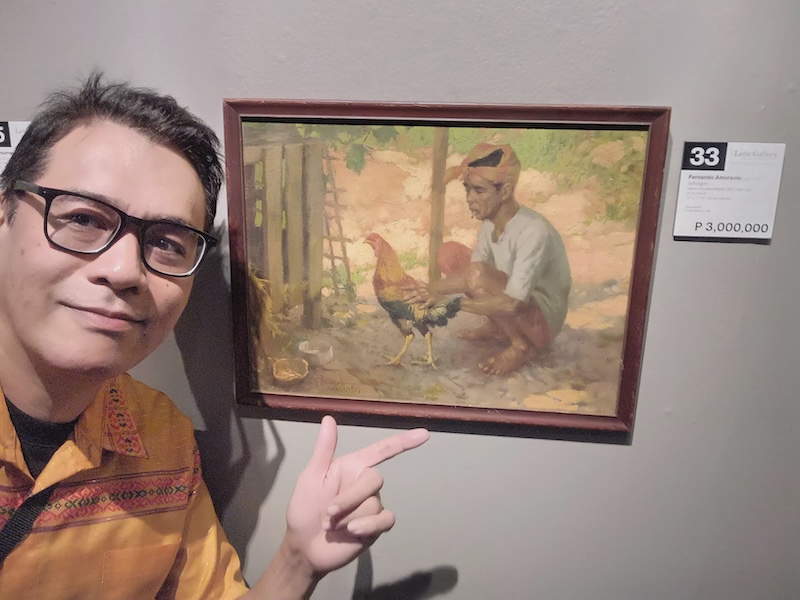
The author taking a selfie with Fernando Amorsolo’s ‘Sabungero’ (Photo by Totel V. de Jesus)
I’ve learned over the years that Amorsolo did more paintings of cockfighters, or beautiful ladies in baro’t saya in idyllic setting. Sabungero must be the only one that focuses on one cockfighter, capturing the devotion and mood of a romanticized gambler.
I can only speak of cockfighting in the 1980s. In a little seaside town of Unisan in Quezon province where I grew up, cockfighting was a favorite Sunday past time for boys and men who could afford to bet thousands of pesos’ worth of a regular rank-and-file employee’s monthly salary.
It was only in my teen years that I was allowed into a cockpit arena. A high-school classmate, whose father and uncles were cock breeders and gamers, invited me. For some time, sabong and tupada (pocket, small-scale cockfights) were banned because the sabungeros become addicted to the game. As National Artist for Literature Alejandro Roces once said of this national malady that has been romanticized as part of Philippine culture in his short stories, “A typical sabungero is often so obsessed with his cocks and cockfighting that he tends to neglect his wife.”
RELATED STORY: Why I can’t forget Anding Roces—the humor, the wisdom, the writing—and the six-pack abs
Things have changed nowadays because derbies, not only in Unisan, but in other towns, are also held on weekdays. Even in Manila, national derbies are held in airconditioned coliseums.
On a few visits to museums and art gallery auctions in the past couple of years, I kept hoping to see Amorsolo’s Sabungero, despite the knowledge that it could be owned by a private collector.
So, it was a “lo-and-behold” moment when, during the preview cocktails on Feb. 11, 2026 for the recent fundraising auction of Leon Gallery for the Asian Cultural Council Philippines Fellowship Program, I saw Sabungero.
It was a ‘lo-and-behold’ moment when, during the preview cocktails for the recent fundraising auction of Leon Gallery for the Asian Cultural Council Philippines Fellowship Program, I saw ‘Sabungero’
Goosebumps. I had had a few glasses of wine and I had to pinch myself to check if I was seeing the real thing. It’s as if everything around me—the voices of art connoisseurs and patrons, some of my fellow social-climbing media colleagues, the clinking of wine glasses—vanished.
I gave in to the urge to touch the painting, right on the rooster’s beak, which seemed to be telling me, “Come and get me, bring me home!” Then back to reality—the opening bid was P3,000,000.
In the catalogue, Hannah Valiente wrote that Sabungero (signed and dated in Manila in 1937) was created during what art historians consider Amorsolo’s “Golden Period.” It covers his works from the 1920s to the early 1940s. “The works created during this era are among those from Amorsolo’s creative peak, seeing him at his best and brightest. He was flexing his creative dexterity, laying down the foundation for the creative giant Amorsolo that he would become in the coming years.”
On the Feb. 14, 2026 auction, from the opening bid of P3,000,000, Sabungero sold for P5,287,040.

Leon Gallery’s Jaime Ponce de Leon, Mark Wilson, and the author (Photo by Totel V. de Jesus)
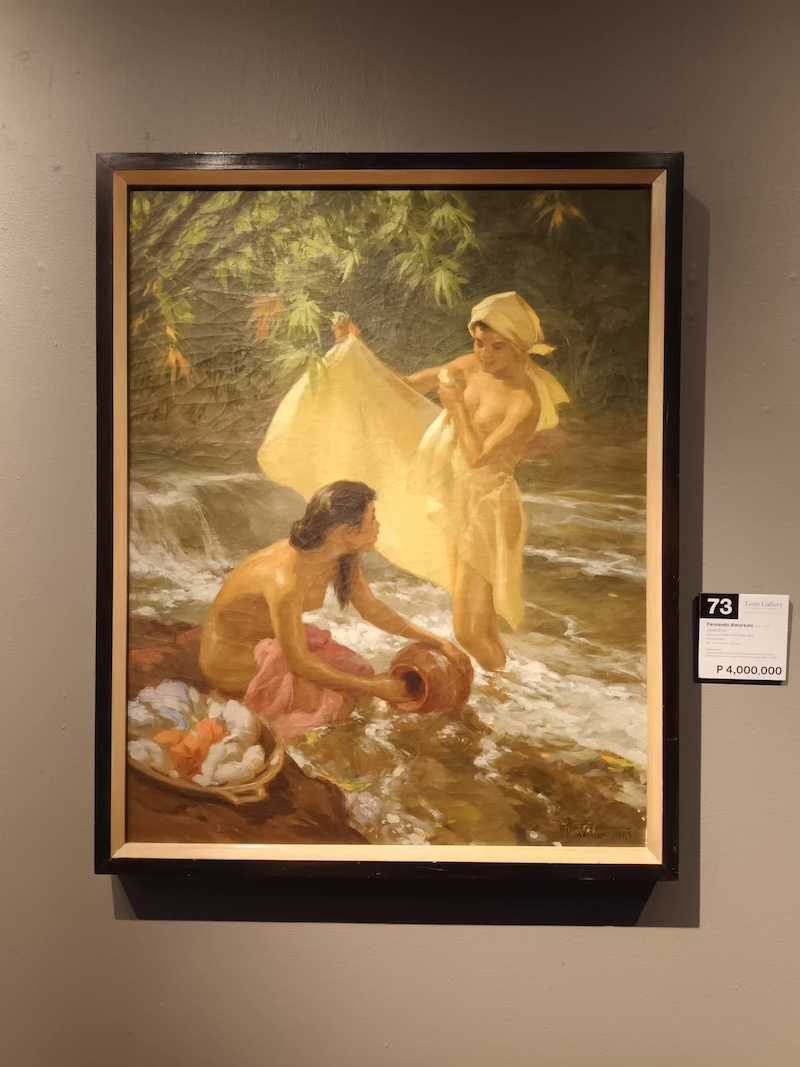
Fernando Amorsolo’ ‘Lavanderas.’ Could Virginia Santos be one of the ‘lavanderas’ here? (Photo by Totel V. de Jesus)
The biggest painting in the section was Lavanderas (1949)—two near-naked maidens in the stream, one holding a clay water jug, the other standing before her, both covered only with tapis. The bamboo trees on the left lead the viewer’s eyes down the rushing river and on to the two subjects.
One of the main reasons I am fixated with Sabungero and other Amorsolo paintings is, even as a child, I was familiar with the name Amorsolo, long before I learned how great and influential the man was, from our arts and history classes and field trips to museums in Manila.
There was a descendant of Amorsolo in our town named Xavier Maxino Amorsolo. He was the son of engineer Jorge Santos Amorsolo, one of the children of Fernando Amorsolo and his common-law wife, Virginia Guevarra Santos.

Fernando Amorsolo with a portrait of his first wife, Salud (Screenshot from Ambeth Ocampo Facebook page)
According to published articles on Fernando Amorsolo, he sired more than a dozen children from three women. Some say 14, other write-ups claimed 20. His first wife was Salud Tolentino Jorge from Cabanatuan City, Nueva Ecija, whom he married in 1916. They had six children.
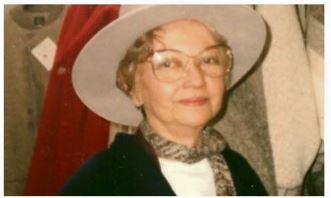
Gracia Amorsolo-Valdes (Screenshot from Julia Valdes FB page)
Acclaimed multi-platform actress Eula Valdes, via Facebook messenger, confirmed to TheDiarist.ph that Salud Jorge was her grandmother. Her mother, Gracia Jorge Amorsolo, married Estanislao Valdes, also from Nueva Ecija.
Salud passed away in 1931. The widowed Amorsolo then fell in love and lived with Virginia, one of the models of his paintings. Some write-ups never mentioned her, however.
Interestingly, Salud and Amorsolo’s firstborn daughter was named Virginia. She married a fellow Novo Ecijano named Dr. Eli Ballesteros.—the grandparents of TV host, comedian, and actor Paolo Ballesteros.
One case study uploaded on Scribd.com says Virgina Santos and Amorsolo initially had three children: Manuel, who also became a painter, Jorge, and Norma. But the artist, it is said, was also in love with another woman, Maria del Carmen Zaragosa, a Bulakenya. The tale went that Virgina discovered an engagement ring for Maria del Carmen, so she left Fernando with their three children.
Amorsolo and Maria del Carmen got married in 1935, and they had eight children. He remained married to Maria del Carmen until he died in 1972 at age 79.

Jorge Santos Amorsolo and Evelyn Maxino-Amorsolo (Photo from Xavier Amorsolo’s still existing Facebook account)
Jorge Santos Amorsolo was married to Evelyn Maxino, a resident of the seaside town of Unisan in Quezon province. She belonged to a prominent clan of landowners and public servants. Her grandfather, Don Antonino Maximo Sr. (not Antonio, as earlier articles mistakenly said), was a Spanish military officer who later served as judge.

Xavier Maxino Amorsolo and wife Luchie Garcia-Amorsolo (Photo courtesy of Xavier Amorsolo family)
Evelyn’s father, Gerardo, was once mayor of the town during the Japanese Occupation (1941 to 1944). Gerardo was married to Rosita, who also took care of Xavier from the time he was a baby until his teenage years.
I remember that big, old Spanish mansion owned by Xavier’s ancestors, occupying a whole block in the población, constructed just a few meters away from Kalilayan River. In my teen years, it was in this expansive garden that some of the tupadas were held. Xavier and his cousins were accommodating enough to friends and neighbors who were into cockfighting.
I was already working in Manila when I learned that what was left of the dilapidated Maxino ancestral house was bought by real estate tycoon and antique house collector Jose Acuzar in 2007. It was reconstructed in Las Casas Filipinas De Acuzar in Bagac, Bataan. It’s called Casa Unisan and now houses the Filipino restaurant named Cusina Ni Nanay Maria.

Casa Unisan in Las Casas Filipinas de Acuzar in Bagac, Bataan (Screenshot from Memories of Old Manila)
There are more interesting stories behind it. We quote a news story from GMA News Online:
“Casa Unisan, constructed in 1839, was the first stone house to be built in Unisan, Quezon…It was owned by Don Antonino Maxino Sr., whose entire family was murdered by a gang of thieves. Only the youngest daughter Carmen survived after being hidden by a helper in a storage bin—a bayong—for dirty laundry.” Don Antonino survived.
Francisco de Jesus Jr., a family friend of the Maxinos, told The Diarist.ph that Don Antonino survived the massacre because he wasn’t in the house when the bandits (“tulisan”) came. Don Antonino remarried, this time Concha, an immigrant from Valencia, Spain.
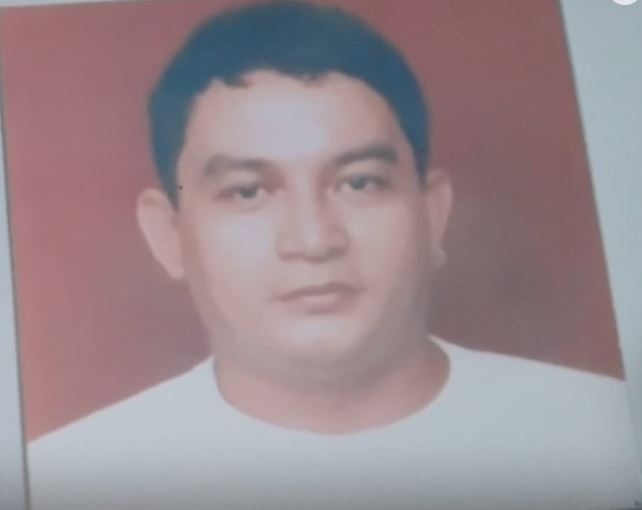
The young Xavier Maxino Amorsolo (Photo from the family)
Xavier Maxino Amorsolo was mestizo, with movie-actor looks. I learned later from Luchie that Xavier must have gotten the features from his great grandmother Concha, a pure Spaniard.
Xavier had two brothers. The eldest, Robert, died at an early age, and the middle child, Juan Enrico or Eric, has a family of his own in Las Piñas. Among the three, it was Xavier who grew up in Unisan.
Xavier studied in Unisan until high school. After college in Manila, Xavier went back to Unisan, started several businesses, and married Luchie, his high school sweetheart. They have five children, three girls and two boys, all adults now.
I remember, in my high school years, Xavier was tending his sari-sari store beside the Maxino mansion. There was a painting of a family—mother, father, kids—hanging in the store, but I can’t recall if it was done by his grandfather. A store helper told me it was an Amorsolo painting. Then again, I can’t be sure.
Behind the store, Xavier constructed a small makeshift wooden movie house using a Betamax player with a wide TV screen. It was a simple open-air mini movie theater. It was our version of Cinema Paradiso, nipa hut-style. So, those in my generation in our town, when asked where they first saw this and that movie from the 1980s, would say, “Doon kina Amorsolo.”
When his sari-sari store business flourished into a grocery, he moved to a bigger location. There were only a few groceries in the población, so people would say, “Doon ka mamili kay Amorsolo, mas mura (We buy from Amorsolo, cheaper).”
And that was how we Unisan folk became familiar with the name Amorsolo—a kind-hearted grocer, a humble townmate who gave us the opportunity to experience the wonders of cinema.
I learned more about Fernando Amorsolo in Humanities in college, but it never occurred to me that Xavier was related to him.
My last communication with Xavier was in December 2022, in an event at the renovated Metropolitan Theater in Manila. The second floor lobby displayed the famous Amorsolo mural. I took some selfies and posted them on my Facebook. Xavier, a Facebook friend, when I told him they were done by his grandfather, wrote a simple response: “Thank you, sana makapunta ako at makita ng personal.”
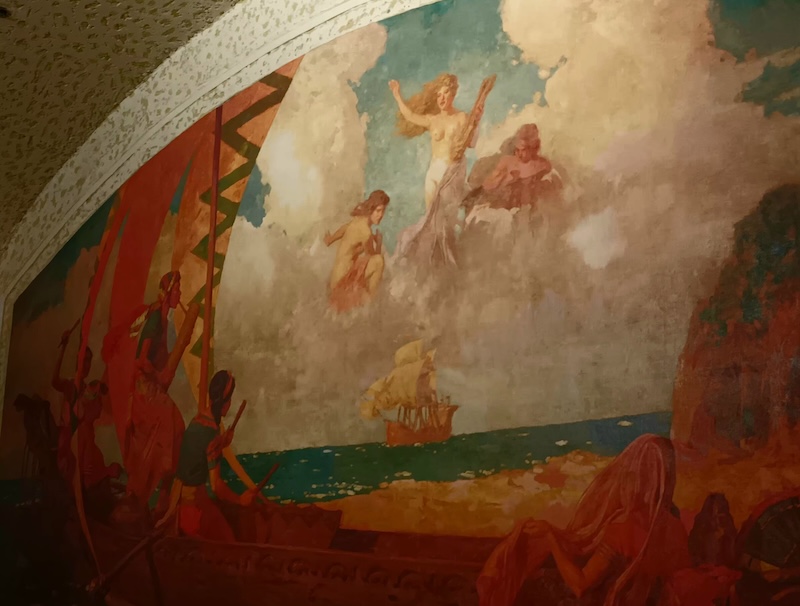
Detail of Amorsolo’s ‘History of Music’ at Metropolitan Theater (Photo by Totel V. de Jesus)
Kristine, the eldest of Xavier and Luchie, told TheDiarist.ph that she and her siblings grew up being associated with the name Amorsolo and his fame, much like heirs of famous people do. In school, they were often asked if they could also paint or draw—like their great grandfather. “We just told them we had no talent in painting, or we simply answered, it’s not our thing,” she said.
Luchie told TheDiarist.ph how people would ask them if they had inherited an Amorsolo painting. “May nag-o-offer na kung meron kami, kahit sketch lang, bibilhin daw ng P2 million (They would offer P2 million even for a sketch), but we had none,” she said.
She added it was the heirs of Maria del Carmen, the second wife of Amorsolo, who inherited the bulk of his paintings and materials. According to news articles, she donated Fernando’s studio furniture, memorabilia, and more than 100 studies to the National Museum.
Xavier, born on Dec. 3, 1966, was only six years old when Amorsolo died of heart attack on April 24, 1972. He became the first National Artist, awarded posthumously a few days after his death. Whenever I bought some stuff in the Amorsolo grocery store, it didn’t cross my mind to ask Xavier if he remembered seeing his lolo, or if he remembered attending his funeral.
Luchie remembered Xavier telling her there were instances when Jorge brought the young Xavier and his brothers to meet Amorsolo during family gatherings. Since Xavier’s older brothers were based in Manila, they were the ones who met Amorsolo on several occasions.
“As told to Xavier by his father, when they were young and they would ask for extra allowance, they needed to work for it. Jorge and his siblings would be asked to sweep the floor in their father’s house, or clean his studio, some household chores. You have to earn your keep. And that’s good because they learned the value of hard work. That money doesn’t fall from trees,” Luchie said.
Kristine, who took over running the grocery store with Luchie, remembered how, during summer vacations in high school, she and her siblings would stay in their lolo Jorge’s house in Las Piñas.
A few days ago, in the Amorsolo store, I bought a bottle of Ginebra San Miguel, or what we often call “gin bulag” because if you drink beyond your limit, you go blind. Again, I failed to ask Kristine if she proudly tells people that the iconic Marca Demonio gin label, the one with the image of St. Michael the Archangel defeating Lucifer, was originally designed by her great grandfather. Then again, I realized she wouldn’t do that, having inherited her father’s humility.
When Jorge died, Luchie said she, Xavier, and their children met the other Amorsolos at the wake. “But we were never close to them. Xavier, like the quiet man that he was, simply wanted a low-profile life here in Unisan. He was close only to his brothers.”
Xavier died of heart attack on Oct. 27, 2024, at 57. Luchie said if there’s one thing she’s most proud of, it was that Xavier was a supportive, loving husband and father to their children. She still misses him: “We’ve always been together, all our lives.”
“He did his best for our family. He was a man of few words, quiet, but he was good in business. He left us so early and we were not ready. That’s why it’s very painful for us, but that’s the reality of life…We’re thankful to him because we know he suffered a lot for us to survive all the challenges and hardships that beset our family. That’s what we’re doing now, my children and I, to survive and live without him,” she added.
She has begun to enjoy traveling with her daughters, something she and Xavier kept on postponing. She can only look back on the good memories he left behind.
The Filipino people will always remember the enduring legacy of Fernando Amorsolo. In Unisan, there’s the memory of Xavier, the Amorsolo who made good as a simple, hard-working, supportive, loving family man. That is a masterpiece in itself.
RELATED STORIES
Leon auctions off copy of Rizal’s signed ‘Fili’ for over P25 million
Leon Gallery at 15: A defining presence in PH art and culture


