
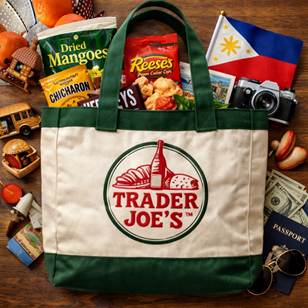
There are luxury handbags that cost more than a small car. There are designer totes of Italian leather, with French stitching and price tags that require emotional preparation to buy. Then there is the humble canvas bag from Trader Joe’s in the US.
Made of cotton. Usually off-white. With simple red logo. Priced somewhere between “milk tea” and “banana split.” And yet—mysteriously, irrationally, irresistibly—this bag has become one of the most requested pasalubong items for Filipinos and perhaps half of Asia.
Not chocolates. Not gadgets. Not vitamins.
A grocery bag.
Humanity is fascinating.
It felt like being asked to bring home the paper napkin instead of the steak
The first time a clinic staff asked me, “Doc, pwedeng pasalubong Trader Joe’s tote?” I thought she was joking.
“A bag?” I asked.
“Yes, the bag.”
Not the cookies inside. Not the nuts. Not the dark chocolate almonds that can destroy all dieting intentions.
The bag!
It felt like being asked to bring home the paper napkin instead of the steak.
It begins innocently. One relative visits the US, brings home a Trader Joe’s tote. Uses it in the palengke or grocery. Suddenly, neighbors notice.
“Uy, galing abroad?”
“Ang cute ng bag!”
“San mo nabili ‘yan?”
Within days, the tote has more social exposure than its owner. It becomes a status symbol.
Not loud. Not flashy. But quietly cosmopolitan.
It whispers: I have relatives overseas.
This is what makes the tote magical. It is cheap in America. But priceless in Manila.
In the US, it costs a few dollars.
In the Philippines, it costs:
– One plane ticket
– 16 hours of flying
– Two balikbayan boxes
– And a willing relative to bring it.
Which automatically upgrades it from “reusable grocery bag” to “imported lifestyle accessory.”
Supply and demand, Harvard-level economics.
Let’s be honest. The bag is not even fancy. It looks like something a school project would produce.
Plain. Sturdy. Slightly crunchy. But that’s the charm.
It says, “I am practical.”
It says, “I care about the environment.”
It says, “I shop mindfully.”
Even if the bag is carrying chicharon and three packs of instant noodles.
Filipinos have a soft spot for objects that work hard.
We admire things that:
– last long
– survive washing
– carry everything
– and refuse to die.
The Trader Joe’s tote is indestructible. You can put rice, canned goods, and your emotional baggage inside—it will not complain.
It survives jeepneys, tricycles, rain, and being folded into impossible shapes.
It is basically the tsinelas of bags. Reliable. Loyal. Slightly heroic.
I have personally seen:
– Someone carefully hand-carrying an empty Trader Joe’s tote like it was a fragile artifact
– A relative asking for “two medium, one small, at saka yung Christmas design” like ordering siopao
– A friend refusing to let it touch the floor because “imported ‘yan!”
My favorite was a cousin used hers exclusively for church. Not groceries. Not errands. Church.
Apparently, holiness increases with American cotton.
Why does this happen? Because pasalubong is never about the object.
It’s about connection. When someone brings you a Trader Joe’s bag, they’re really saying:
“I thought of you.”
“I carried this across oceans.”
“I saved space in my luggage for you.”
It’s love disguised as canvas.
The funny part? Americans probably don’t think twice about the bag. It’s free advertising. A grocery extra. Something you forget in the trunk.
Meanwhile, in the Philippines, it has reached near-collectible status. Some people even say:
“May bago ka bang design diyan?”
Design.
For a grocery bag.
This is how legends begin.
I used to laugh at the tote craze. Then one day, I brought a few home “just in case.” Within 24 hours, they were all gone. Claimed. Reserved. Pre-ordered.
I had relatives messaging: “May extra ka pa? Pahingi pang isa.”
I suddenly understood. The tote was no longer just a bag. It was besought.
In a world of expensive brands and unnecessary upgrades, there is something beautifully honest about loving a simple, useful thing. No pretensions. No hype. Just a bag that carries stuff well. Maybe that’s very Filipino, too.
We appreciate what’s practical. We reuse. We recycle. We make things last.
The tote fits our values perfectly—even if we pretend it’s imported glamor.
So yes, the ordinary Trader Joe’s canvas bag has become one of the most powerful pasalubong items in Asia. Not because it’s luxurious. But because it’s familiar, useful, and carried home with affection.
It may not sparkle. It may not impress customs officers.
But somewhere in Manila, a tita is proudly using it at the market, smiling quietly, thinking: Galing ‘to abroad.
And somehow, that’s enough. Because sometimes, the best souvenirs aren’t the expensive ones.
They’re the simple things that say: “I went far…and I brought something back for you.”
Even if that something is just a grocery bag. And honestly, that might be the most Filipino thing of all.


