
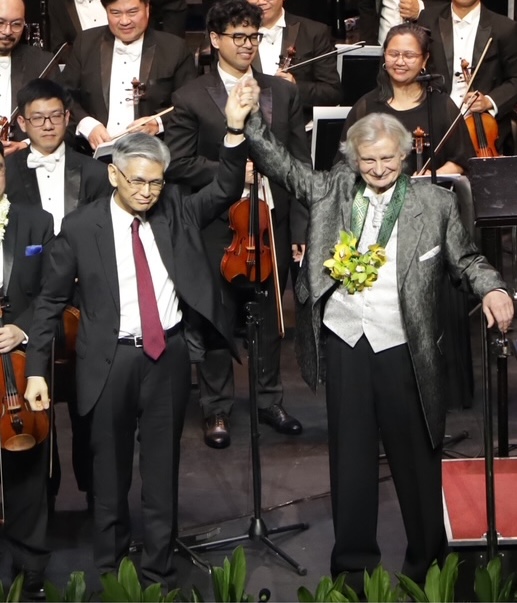
Jeffrey Ching’s new symphonic work, Ring Symphony, after Richard Wagner’s The Ring of the Nibelung, took center stage at Philippine Philharmonic Orchestra’s (PPO) seventh concert, titled Opera, held March 13, 2026 at Metropolitan Theater.
The concert was instructive, providing holistic understanding of the opera through the arias, plus an overture penned by Italian composers on one hand, and Richard Wagner on the other.
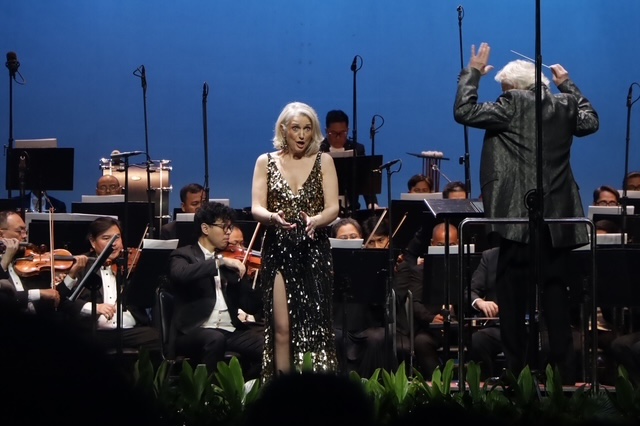
British soprano Katerina Mina (Photo by Orly Daquipil)
The first part featured British dramatic soprano Katerina Mina. She sang three Italian operatic arias, namely Pace, pace mio Dio from Giuseppe Verdi’s La forza del destino; La mamma morta from Umberto Giordano’s Andrea Chenier; Vissi d’arte from Giacomo Puccini’s Tosca; and a lyrical piece, Angel of Fire, by the Swiss composer Stephan Hodel.
The soprano was warmly received by the audience. She sang the three Italian arias securely tacked in the bel canto tradition. Phrasing was convincing, and her voice was amply projected. She essayed brilliant vocal lines in the lower and middle ranges. The top notes were secured, but wanted more in brilliant radiance to give that ringing sound. She was much at home in her singing of the last song, that was indeed cut for her voice.
The overture from Verdi’s La forza del destino showcased the symphonic might of the PPO. Its playing was an effective breaker for the soprano, who sang the first two arias in succession.
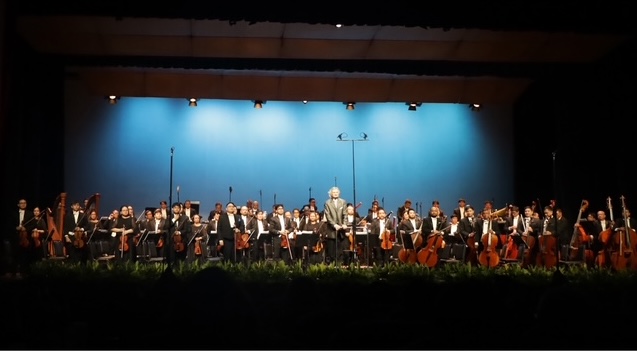
The PPO with conductor Nowak acknowledges applause. (Photo by Orly Daquipil)
The second half featured the new work of the Filipino prolific composer, Jeffrey Ching. Ching is the PPO’s current composer in residence, upon the invitation of Maestro Grzegorz Nowak himself last 2024-2025 concert season. He started working on the Ring Symphony on November 13 last year, and finished it last January 3.
Ching’s new work was commissioned by Achim Freyer, a German stage director, designer, and painter for his film music project, Wagner X Fryer, to be shown at the Great Hall of the Festpielhaus Hellerau in Dresden, Germany, next month, April 17. The PPO, under its principal conductor, Maestro Grzegorz Nowak will provide the music through a multi-channel recording.
Ching’s work was an abridged version of Wagner’s The Ring of the Nibelung that consists of four operas, namely Das Rheingold (The Rhine Gold), Die Walkurie (The Valkyrie), Siegried, and Gotterdammerung (Twilight of the Gods).
In writing the work, composer Ching, as he explained in the program notes he himself wrote, did not follow the sequence in which the four operas were originally arranged. Instead, he organized his work following an “autonomous symphonic logic,” as distinguished from purely “symphonic extractions” that some of his predecessors had done. In short, rather than mechanical extractions, Ching had arranged his work according to the best of his thinking, the music being its primary consideration rather than the sequential unfolding of the story, that still kept the Wagner mold, so to speak.
Meticulously, Ching had to plow through some 2,372 bars of the original work to dispense with the specified instruments not found outside Europe, including Manila.
Ching had to plow through some 2,372 bars of the original work to dispense with the specified instruments not found outside Europe
The audience, who stayed through the 82-minute performance without intermission, was mesmerized. The usual time spent for the second part of the PPO’s concert is only half of the entire duration of Ching’s opus.
It was quite a feat for the audience to listen through the entire music, played by some 80 musicians of the PPO, with the venerable Maestro Nowak authoritatively wielding his baton. (Watching him at rehearsal a day before the concert, we saw how he meticulously repeated passage after passage until the desired effect was achieved. This was done in the presence of the composer, who gave his corrections and approval.)
At once, the audience was struck by the magnificent sounding of the brasses, that called to mind the Prelude of the first opera, Das Rheingold, blended so skillfully to create a thick dramatic texture. Here, the popular notion of the brasses as “oom pah pah” instruments was at once dismissed, as these instruments had been given the task of weaving harmonized, moving melodic lines. This was made even more arresting when the woodwinds, and eventually the strings joined the brasses to create a rich, dramatic texture, all expressed in the composers’ layering of melodic lines that interacted at the same time.
This hovered for some time until a new material the composer lifted from Siegfried was layered to create a complex, continuous soundscape that defined the piece’s configuration.
Conductor Nowak stood firmly on the podium, wielding his baton. The musicians played with gusto, forging intimate rapport among themselves.
Later, one was struck by the familiar strains of Die Walkurie, and more from Gottadamerung, leading to a dramatic climax expressed magnificently in full by the entire orchestra that truly left the audience in awe. Then came the denouement expressed by a shortened quote from the Prelude of Das Rhinegold that was heard at the start.
As the last note faded, the audience burst into thunderous applause, with vigorous shouts of “bravo”! In the lobby, the piece became the topic of conversation as some listeners were simply in awe of its grandeur, both in form and substance.
It is this continuous, uninterrupted flow of music that differentiates a Wagnerian opera from an Italian opera. In the latter, the music is interrupted upon the singing of an aria, for instance, where the audience always waits for the full sounding of the high note usually placed at the end.
The program’s first part that featured some operatic arias appropriately affirmed this. In Ching’s work, one’s full attention was engaged to the end. A symphonic version of the Ring, this novel Ching opus provided a stark contrast to the music heard in the program’s first part. Ching’s work made Wagner’s operatic music seem alive and kicking in a pure symphonic manner—a continuous flow of music in varying tonal colors, away from separations noted typically in Italian opera. Listening became a marvelous experience, as one’s mind actively followed that continuous flow of music that seemed like an unending melody.
In the Wagnerian tradition, the mere size and instrumentation of the orchestra, such as the sounding of the brasses, are enough to drown the singers who are not equipped with that so-called robust Wagnerian timber. We recall what the late violinist-conductor Oscar Yatco told us many years ago. He was chosen by Wagner’s grandson to be the concert master of the Bayreuth Festival Orchestra (1974-1979) for the prestigious Wagner Festival held in the famous Bayreuth Festspielhaus. He told me that the orchestra pit was sunken, totally hidden from view, for the music to blend with the singers, not overpower them!
Ching’s new composition affords Manila music lovers the chance to hear it first, ahead of the world. His work is a veritable addition, a humble Filipino contribution, to the list of notable persons, such as Otto Kemperer, Lorin Maazel, and Henk de Vlieger, who made recordings of symphonic arrangements extracted from Wagner’s gigantic opera, The Ring of Nibelung.
As the Cultural Center of the Philippines’ composer-in-residence, Jeffrey Ching is for keeps!
Mabuhay, and congratulations!


