
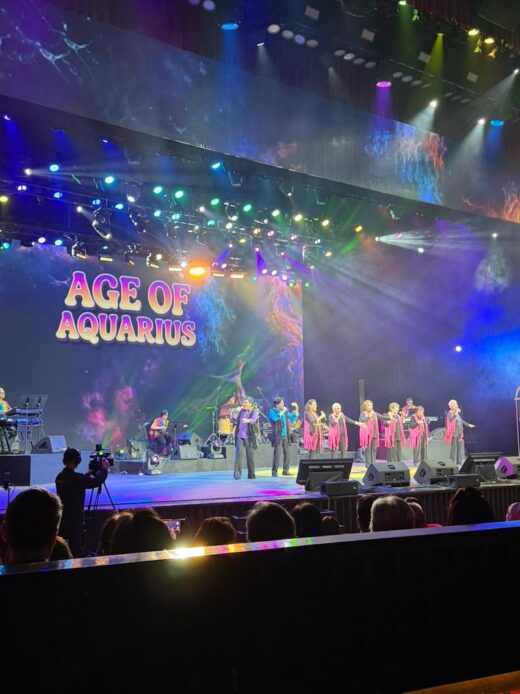
What happens when nine original members of the Organisasyong Pilipinong Mangaawit (OPM), who can still grandly flex their vocal cords, decide to band together to raise funds and help fellow singers in need? Having known personally these regrouped singers, now collectively known as OPM Friends, who in their heyday were solo artists, I wasn’t surprised that the onstage camaraderie and ease of performance were second nature.
Celeste Legaspi, Mitch Valdes, Leah Navarro, Pat Castillo, Pinky Marquez, Nanette Inventor, Ding Mercado, and Bo Cerrudo, at some point or another in their solo careers, performed with one another. Each one had a distinct singing style and was noted for solo hits. All together now, the show’s repertoire still showcased their individual styles and vocal ranges as they performed at Groovin’ the Greatest Hits last March 27, 2026, 8 pm, at the Newport Performing Arts Theater in Newport World Resorts.
In the tradition of pop concerts, the show opened with an ensemble number. All six females wore black tops and pants, contrasted with fuchsia fringed vests, in keeping with the hippie-inspired fashion of the era. Similarly, the two male singers wore black vests and pants with purple long-sleeved shirts. The opening song, Age of Aquarius, was made popular in the late ’60s by the group The Fifth Dimension. Aquarius was the zodiac sign that symbolized peace, harmony, and community involvement. This song was combined with yet another song of the era, Let the Sunshine In, from the first hippie musical, Hair. The two songs together were then recognized as one, making it a hit that won for The Fifth Dimension a Grammy Award.
Following this was Love the One You’re With, extending the thought of the opener and setting the musical mood for the evening, which would be one of musical nostalgia.
These were many opening songs to kick off the era when all eight singers dominated the Philippine music genre that was known as OPM (Original Pilipino Music). The acronym was made up by the late Danny Javier, a member of the Apo Hiking Society, an equally popular singing trio. OPM the organization was formed a few years later. Its purpose was to support the artists who popularized and promoted original Pilipino music—two wittily created, identical acronyms for two organizations in support of each other.
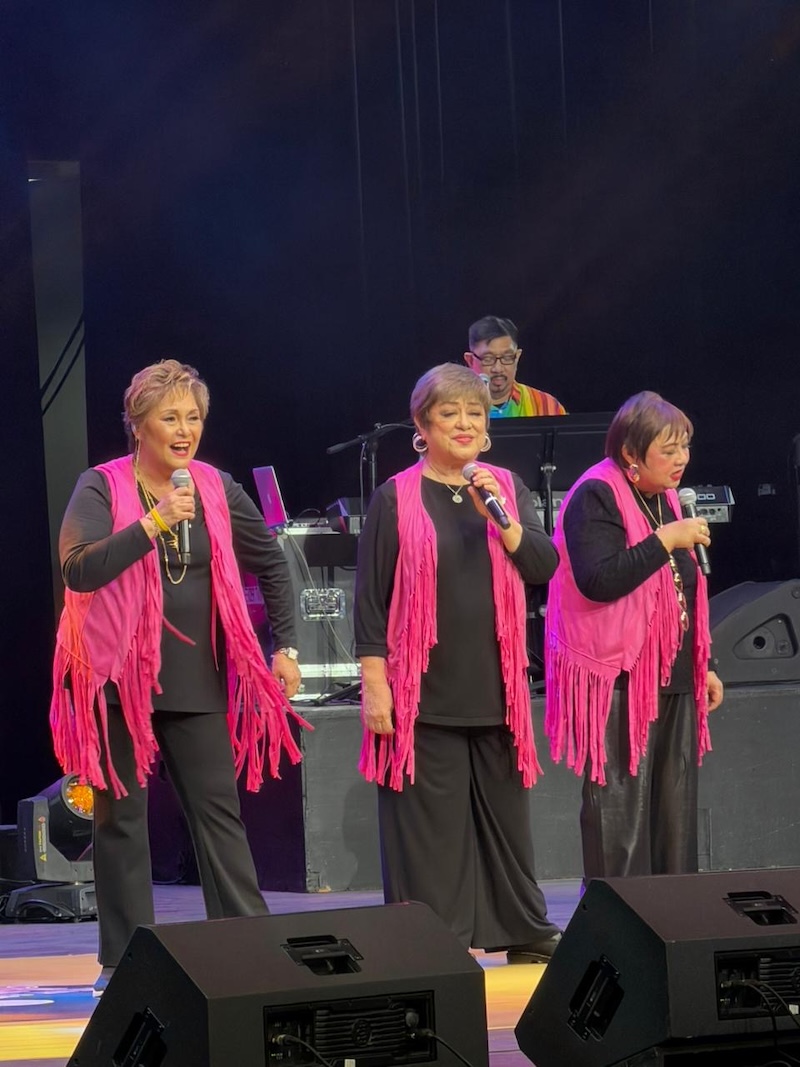
Leah, Mitch, Nanette sing ‘Lady Marmalade.’
Pinky Marquez, known for her musical theater performances, mostly with Repertory Philippines, was then and clearly still is a strong presence on stage with her power-packed multi-range vocals. Opting to sing Aretha Franklin’s hit A Natural Woman, Pinky did not fail to hit the high notes with soul integrity. Joining her after her breathless climax, Pat, Mitch, and Nanette came on stage for yet another disco hit of the ’70s, Lady Marmalade, popularized by LaBelle, which included Patti LaBelle, another disco hitmaker.
The high notes cooled down with Pat taking centerstage with her warm alto, befitting a hit of the late ’60’s, Our Day Will Come, a song with a bossa nova beat. She was followed by Leah, perhaps the youngest of the female singers, who made her singing debut in 1977 in the role of the First Woman alternating with Celeste Legaspi in Alice Reyes’ Tales of the Manuvu, the first rock ethnic dance opera in the Philippines, whose music was composed by popular songwriter Nonong Pedero, also Leah’s early manager. For her spot number, she chose one of her early hits, Ang Pag-Ibig Kong Ito, a song associated with the specific music genre known as the Manila Sound.
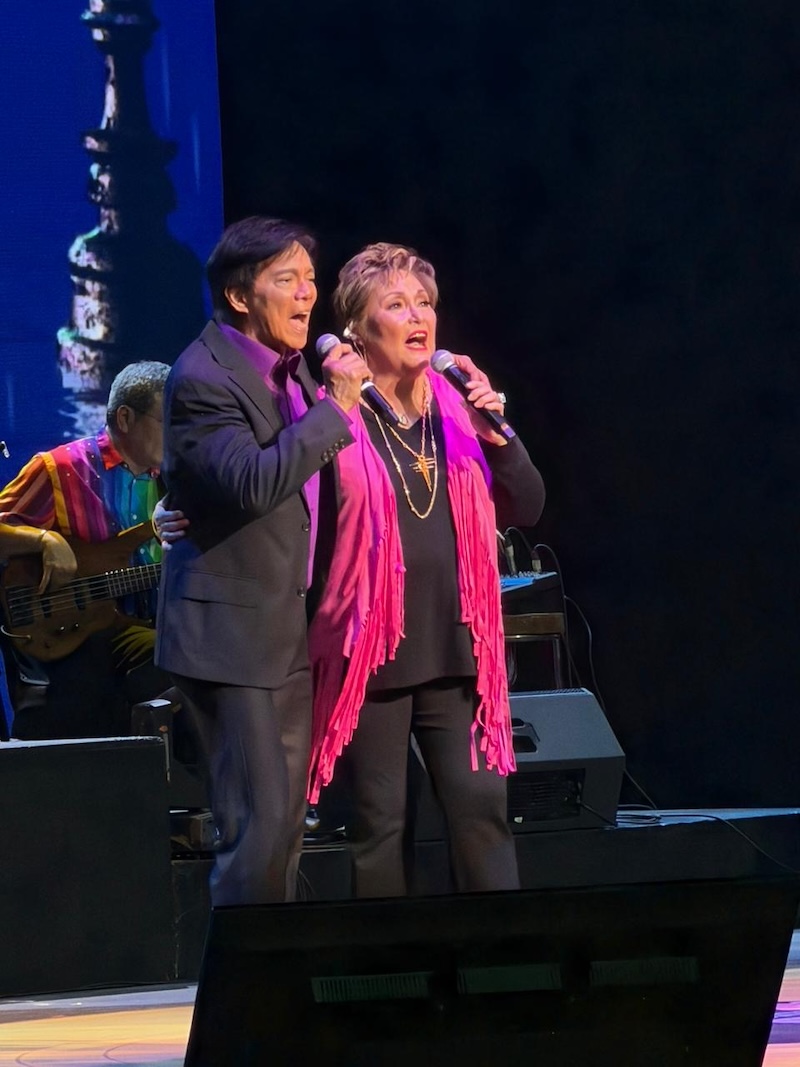
Leah and Bo ‘Lagi na Lang.’
A few years after her singing debut, Leah was often paired with Basil Valdez, one of the country’s biggest hit makers. (The pair, in fact had a weekly musical show entitled Basil at Leah.) The song, Lagi Na Lang, was one duet they sang together for a 1980 album of Leah entitled Leah at Paag-Ibig, making it a well-known OPM classic. For this performance, she was joined by Bo Cerrudo, whose distinct trained tenor range has a sentimental romantic quality that can deliver a song’s soul, whether romantic ballad or dancing tune. Following the duet was Bo’s Pag Tumatagal Lalong Tumitibay, roundly backed up by Pinky and Nanette.
The repartée among the group, if scripted, did not show any signs of memorized spiels, but rather, an easy, conversational tone among friends who happen to be familiar with their craft and each other. Mitch and Nanette, who often did shows together, took over the stage, starting off with a rollicking exchange. “Ang kakantahin natin mga hits….ano tayo? Yung jukebox?” quipped Nanette, before diving into the medley of songs by Imelda Papin, Eva Eugenio, Didith Reyes, and Claire de la Fuente, known as the jukebox queens of Pinoy music.
These “queens” were known to perform their hits with a heart-wrenching delivery and dramatic movements. Apart from hitting the demanding vocal range, both Mitch and Nanette accompanied these with the appropriate movements copying the original queens, which made for an amusing performance.
Ding Mercado followed with The Harder I Try, appropriate for his rich baritone. Once an original member of The New Minstrels, an early popular group, he later became a contract artist and television host for 15 years at HKTVB in Hong Kong, after winning the Grand Prize in the Asian Singing Contest in that same city. It was here that he achieved superstar status, so much so that, when passing the immigration counter in Hong Kong with a Philippine passport, it was not unusual for me to be asked if I knew “Deeng Mah-kah-to.” Ding’s baritone to this day is clear and powerful, as in his days of greatest popularity.
To stretch his performance even more, Celeste joined him for what I consider the most dramatic interpretation of the song I Don’t Love You Anymore, written by Butch Monserrat and first recorded by Ding’s younger brother, Ernie, with his then fiancée, Louanne Cuenco, both members of the second-generation New Minstrels. Between Celeste’s and Ding’s theatrical prowess, the song took on the quality of a musical theater performance, depicting a painful break-up coldly initiated by the female, contrasting with the heartbreaking pleas of the male for them to work it out.
The song reached its denouement of non-reconciliation, and was met by thunderous applause from the attentive audience, who seemed to be on the edge of their seats as the tension of the song heightened, driven by both singers’ convincing facial expressions and melodramatic interpretation.
A sigh of relief was tangible when Celeste shifted mood, breaking into her light-hearted songs written for her by her husband, Nonoy Gallardo, who was in the audience: Mamang Sorbetero and Saranggola ni Pepe, whose lyrics actually have deeper meaning than what is heard. While Sorbetero is a witty description of an ice cream man and the excitement children feel when hearing his bell announcing his presence, Saranggola ni Pepe was written at a time when the country was under martial law. The saranggola refers to hope and soaring dreams, freedom from oppression, just as “Pepe” refers to our national hero, Jose Rizal. Despite the metaphors of restriction, the song nonetheless ends with encouragement to keep hope alive as one follows one’s own heart.
A tribute medley to some OPM singers who started out as fellow band members of the OPM Friends but have sadly gone ahead was made up of songs associated with these singers.
There was Nakapagtataka for Hajji Alejandro, who was with Pat in the Circus Band; Bridges for Jacqui Magno, who also was with the Circus Band; Nothing I Want More for Eugene Villaluz; and Mr. Melody for Louie Reyes. Both Eugene and Louie were, together with Ding, original members of the New Minstrels. It was a touching memory for both the performers and the audience members who had known the singers.
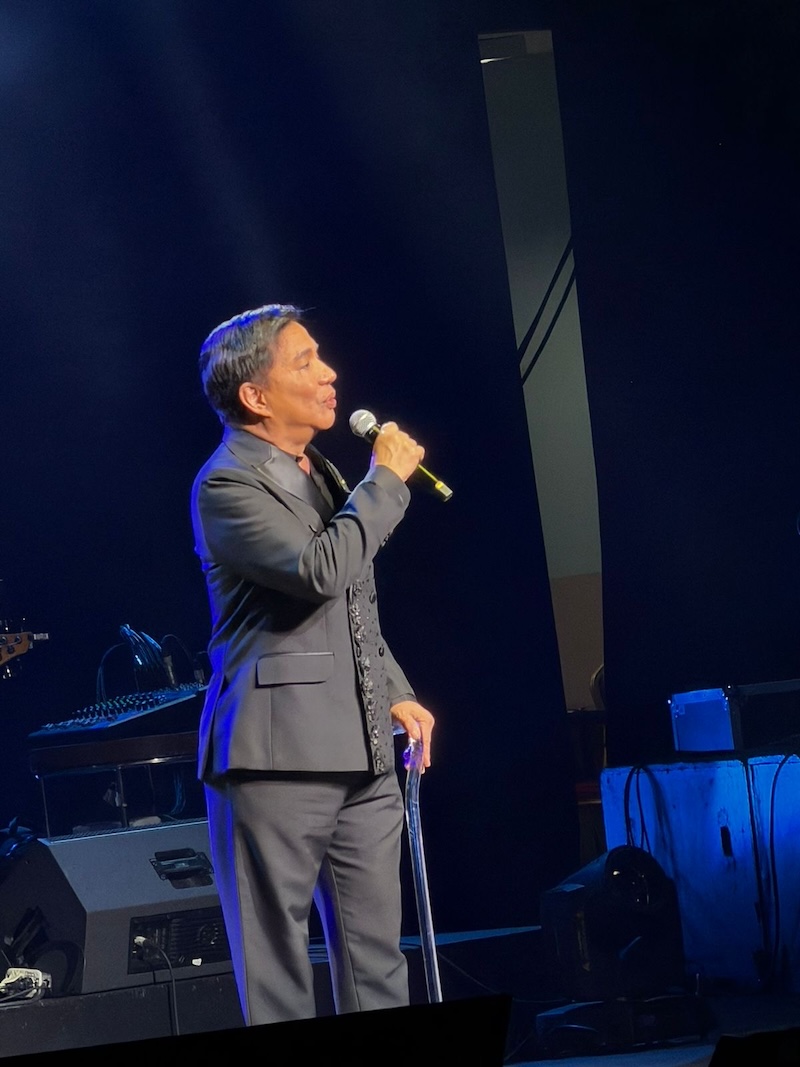
Nonoy Zuñiga
The tribute continued as special guest Nonoy Zuñiga was introduced. Most of Nonoy’s songs were composed and written for him by prolific composer and musician Willy Cruz, whose untimely passing in 2017 was a great loss felt by the OPM community. Willy’s albums of OPM music were many, known for their highly emotional notes with poetic lyrics, in both English and Tagalog. That evening, the trio of Nonoy, Celeste, and Leah sang Mahawi Man Ang Ulap, Init sa Magdamag, and Love Without Time. For his solo numbers, Nonoy went down memory lane with Araw Gabi and the award-winning hit Never Say Goodbye. If there was a tearjerking moment, these two tributes were it.
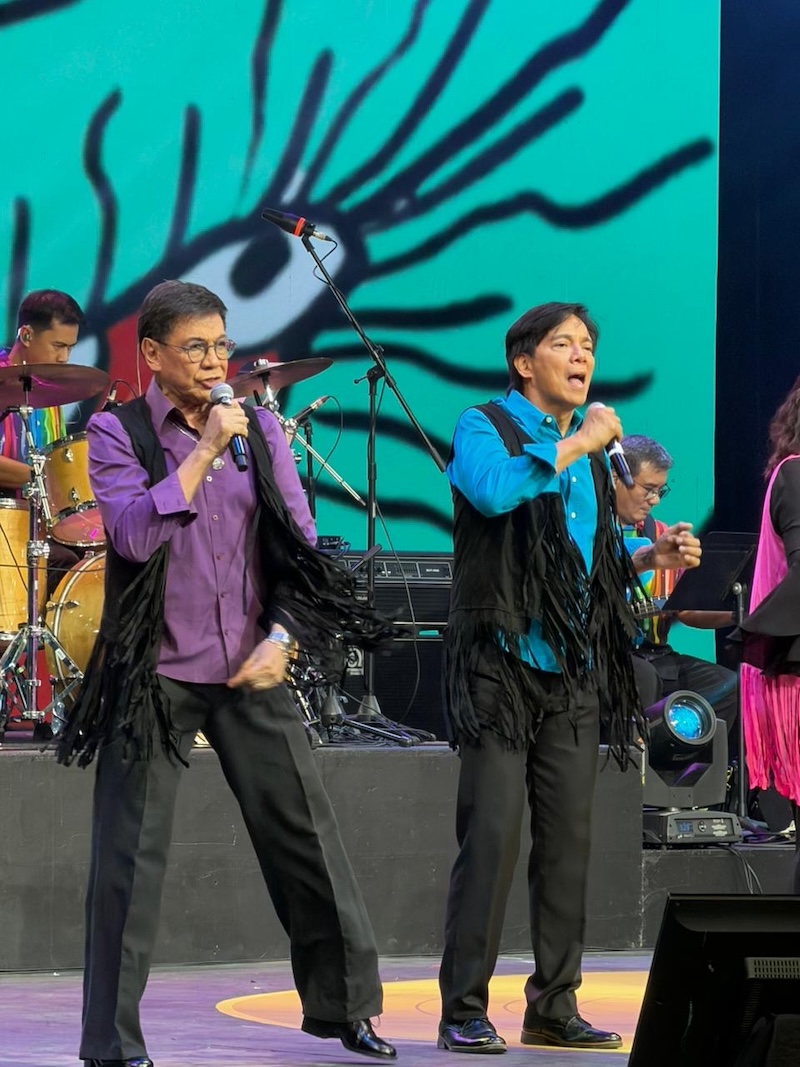
Ding and Bo sing ‘Doon Lang’ and ‘Kumusta Ka’ medley
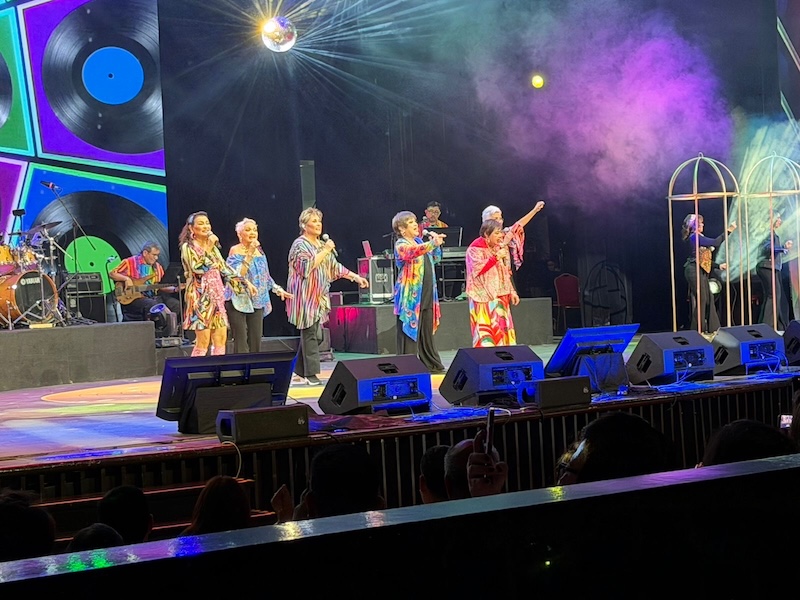
Female singers with ‘Disco Queens Medley’
The all-male medley of Doon Lang and Kumusta Ka, followed by the all-female “Disco Queens Medley,” saw the cast change costume from hippie mode to psychedelic colors with everyone, including the band, dressed in those hallucinatory colors and prints of the period. It wound up with everyone singing the Babes ’70s Medley, a collection of choice ’70s hits arranged by musical director Babes Conde.
For an ending on a grand scale, the show’s finale was a medley of award-winning Metropop songs, clearly defining the abundance of Filipino music talent and musical genres creatively used and introduced. The show was truly a tribute to the art form, introduced by various artists responsible for encouraging and preserving the national treasure that is music.
As the audience demanded an encore, the group burst into a mix of songs by one of the most popular foreign groups of the ’70s and ’80s, Earth, Wind and Fire. The contagious dance beat of the songs that the group made popular literally awakened the audience’s muscle memory, getting them on their dancing feet and doing dance moves of the era.
Not satisfied with that encore, the Friends segued to a medley of danceable OPM hits by the popular group, VST. That medley did not end the show that had by this time run overtime. It did not at all bother the enthused audience, whose hair strands distinctly showcased 50 shades of gray, as they continued groovin’ the night away, even if it was way past their bedtime.


