
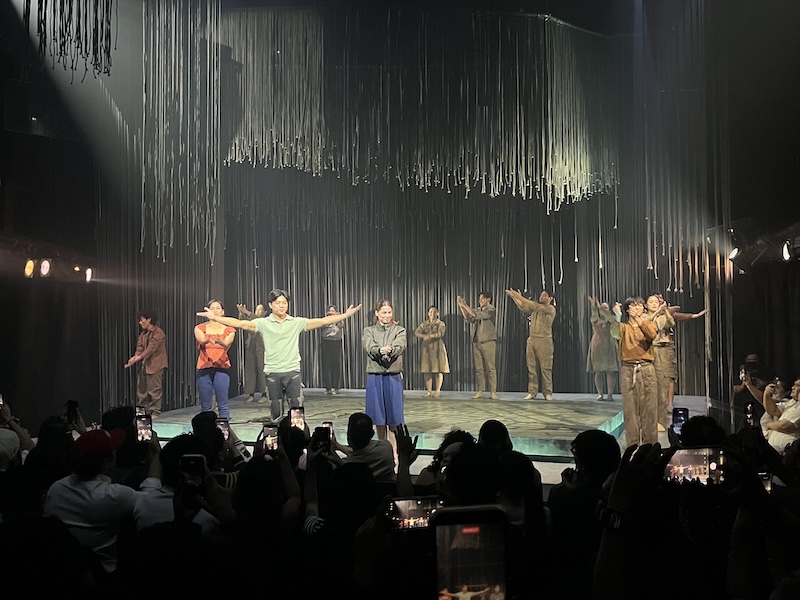
Endo. runs until May 10 at the PETA Theater Center, Quezon City. Tickets are available at https://www.ticket2me.net/event/22737.
What is Endo. without, well, endo?
That appears to be the self-imposed challenge behind Endo., the new stage adaptation of the 2007 Cinemalaya film now running at the Philippine Educational Theater Association (PETA) Theater Center. Note the period in the play’s title: a brash stylistic choice most likely intended to set the offspring apart from its progenitor. And, boy, is there a world of difference between the two.
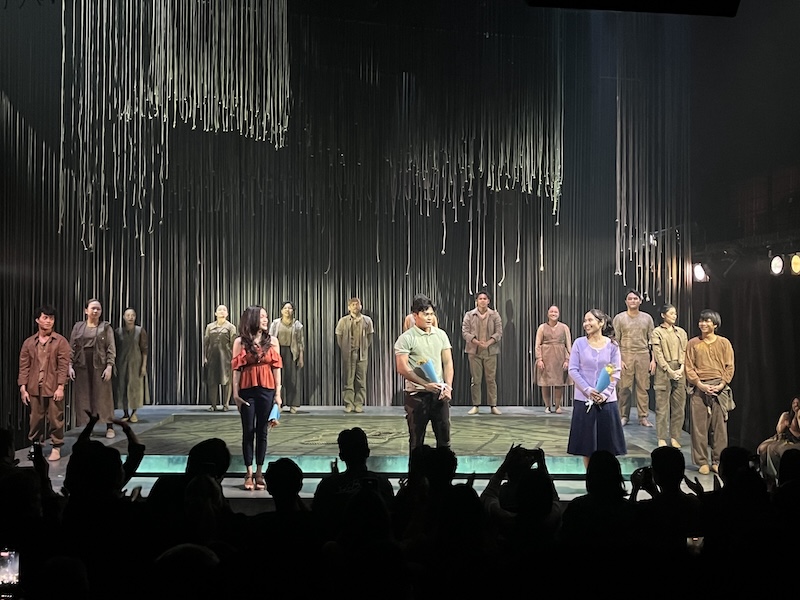
Kate Alejandrino-Juan, Esteban Mara, and Rissey Reyes-Robinson during the curtain call of ‘Endo’ (Photo by Vincen Gregory Yu)
Directed by Jade Castro, who also wrote the screenplay with Michiko Yamamoto and Moira Lang, Endo (the film—no period) is a marvel of economy, deceptively simple in its use of a love story to critique the Philippine labor regime. It’s about two young lovers, Leo and Tanya, who drift from one contractual job to another—all while trying to make their relationship work—their inability to secure permanent, decent-paying employment being as much a consequence of their lack of privilege as it is a product of a system long gamed by big corporations.
In a survey by the website Pinoy Rebyu—now associated with the Society of Filipino Film Reviewers—Endo was ranked the 14th best Filipino film of the 21st century. (The survey was published in 2017 and involved 33 critics, reviewers, academics, and archivists.) The citation by Philbert Dy, former resident reviewer of ClickTheCity, lauded the film’s honesty (“you feel like everything’s coming from a genuine place”) and naturalistic aesthetic that mixes the political with the romantic (“Endo isn’t a very big movie, but it’s got a very big heart”).
Talking to Rappler about cinema as a gateway to understanding the state of Philippine democracy, Richard Bolisay provided a more incisive—and expansive—take on the film, highlighting what he believed to be a frequently overlooked aspect of it: It’s “the story of the working class; of those who are left out because of the limits of their material reality.”
Bolisay accurately identified how Leo’s life is in “a perpetual chokehold under capitalism,” his every human interaction—with Tanya, with past flings, with co-workers, with family—seemingly “transactional” in nature. In portraying how “love and romance serve as an escape” for these characters—not bourgeois indulgences, but a reprieve—the film becomes “a form of quiet yet powerful activism,” insisting on the constant need to extend “empathy and care for its characters” and the people they represent.
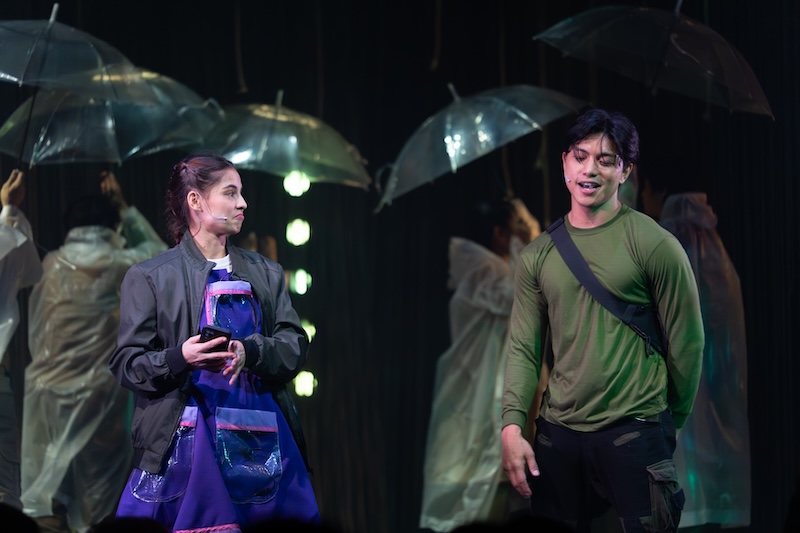
Jasmine Curtis-Smith and Royce Cabrera in ‘Endo’ (Photo by Shella Toledo)
The good news is: The stage adaptation written by Liza Magtoto has, in some way, sharpened the film’s message. Endo. the play is definitely in touch with the plight of Filipino workers, fully cognizant of the longstanding ills preventing them from ascending the social ladder. (The possibility alone of the play fumbling this particular dimension is tantamount to heresy, when one considers the fact that the PETA Theater Center—this theatrical heartland of progressivism in Metro Manila—is its chosen birthplace.)
The not-so-good news: The major conceptual update used by the play somehow dims the fundamental power of the narrative from the start.
Endo is shorthand for “end of contract,” referring to the widespread illegal practice of terminating employees right before they hit the six-month mark—when they would have to be regularized by their employers under Philippine law and bestowed the mandatory benefits that come with that change of status. It’s one of the defining symbols of socioeconomic precarity in the neocapitalist country: low-income workers, imaginably minimum-wage earners, slogging it out at one menial job, with no certainty of a future in the workplace, and always haunted by the prospect of having to find another job before the year is even over.
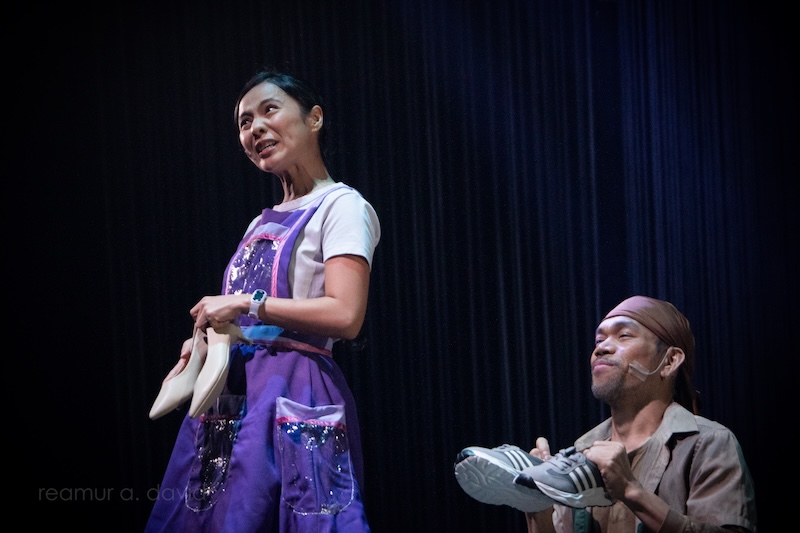
Rissey Reyes-Robinson in ‘Endo.’ (Photo by Reamur A. David)
That’s the grave reality lived by Leo and Tanya in the film’s early 2000s milieu: one unstable job after another, without which they would be deprived of their source of income and absolutely unable to survive the urban madness of the National Capital Region. There’s not even time for a lucrative side hustle simply because that one job already consumes so much of their lives.
Magtoto has made a consequential edit to the play: Endo. is now clearly set in the present. And it’s no longer exactly about endo, but about the gig economy. Leo and Tanya now juggle multiple jobs: the former, a luggage salesman, a ride-hailing app driver and courier, a traffic aide, a masseur; the latter, an online live seller, an English-language teacher to Korean nationals, a call center agent.
While the film establishes contractual work as a singular lifeline for the characters, the play subjects Leo and Tanya to the plight of working several jobs just to make a decent living. Needless to say, both are untenable predicaments.
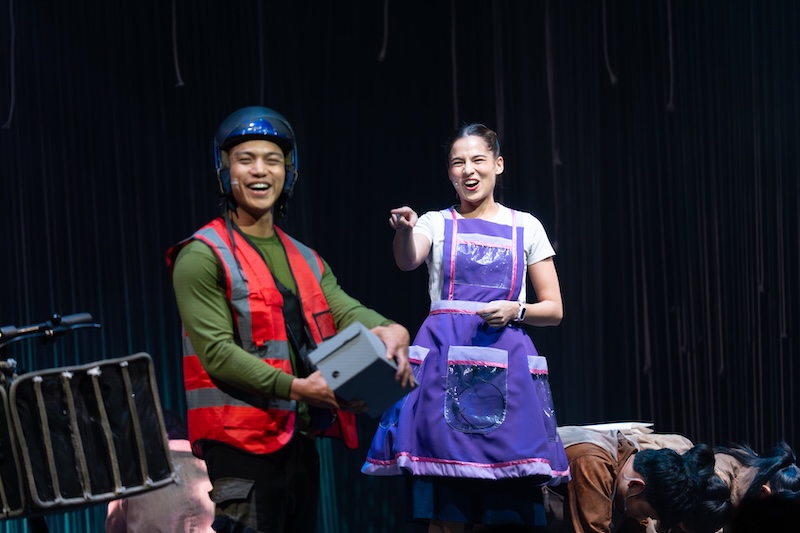
Royce Cabrera and Jasmine Curtis-Smith in ‘Endo.’ (Photo by Shella Toledo)
Yet, one is not exactly like the other: The film will leave its characters penniless without that one endo job; the play grants them the latitude of looking for another source of income even while already holding two. By this play’s logic, no one here is at risk of becoming jobless—because its protagonists are apparently expert hustlers.
Gone is that legitimate, visceral fear that the next peso might not come at all—and with it, the very specific anxiety that elevates the film to dramatic heights. Even though these characters’ lives remain full of hardship, the stakes have been somewhat lowered onstage.
Magtoto’s update also renders the third character of Candy—Leo’s ex—largely irrelevant. The film makes Candy something of a poignant bookend: It begins with the bittersweet, flickering end of her relationship with Leo, then hurtles toward the credits with a sticky rebound situation. Candy in the film epitomizes the romantic reality made possible by the cruel constraints of endo: the shredding of relationships by the end of contracts and the need for lovers to move on to different, time-consuming jobs in different poles of the Metro—but also, the potential of rekindling that relationship through the possibility of working again under new contracts in the same workplace, or within the same area, even if only for five measly months.
Once again, there are stakes there—which are now absent in the play, in which Candy is much closer to an afterthought.
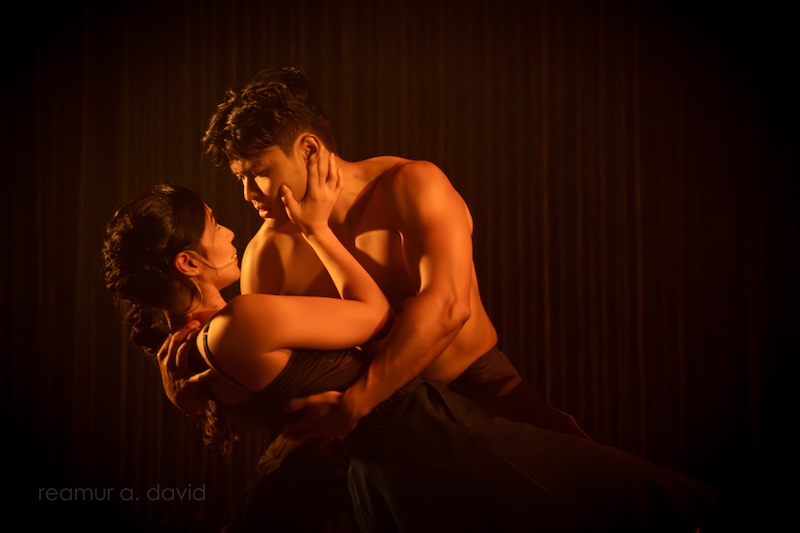
Esteban Mara and Rissey Reyes-Robinson in ‘Endo.’ (Photo by Reamur A. David)
Certain lines and plot points further threaten to upend the weightiness—and more important, the dramatic plausibility—of the play. In one scene, for example, Tanya remarks that she thought endo is no longer being practiced widely (“Akala ko hindi na úso ang endo”)—has she been living under a rock all this time?
There is also the matter of her future abroad: In a critical juncture in the film, she gets hired to work on a cruise ship. In the play, she’s now a non-practicing nurse who miraculously lands a position in Switzerland. As a health worker watching this, I had to suspend my disbelief to the utmost: Good for Tanya that she’s somehow able to edge out the über-qualified nurses from Philippine General Hospital, St. Luke’s Medical Center, and other leading institutions in the country for that prestigious spot in Europe, despite her credentials. (I suppose it’s a huge plus over there if you can multitask.)
But if Magtoto’s script is already a considerable departure from the play’s, the production directed by Melvin Lee deviates even further from the film’s sensibilities. Of course, adaptations are never expected to replicate their sources. In fact, deviations can make screen-to-stage transfers more interesting and worth checking out.
Where the film is restrained, minimalist, and unmistakably brimming with a rich interior life, the current play is noisy, maximalist—to a fault—and teeming with all sorts of big, surface gestures.
The noise and reliance on physical gestures are justifiable: Lee’s production is a movement piece, choreographed by Christine Crame. The gig economy is rendered in a whirlwind of action, the characters sliding in from one job to the next in near-robotic fashion. It’s basically Karl Marx saying that under capitalism, people become alienated from their inherent humanity, no longer fully alive but merely existing to survive. These characters are always on the move, pun intended. And the cyclone of huffing and puffing they find themselves in makes you understand why Magtoto might have chosen to update the story: They might as well saw parts of their bodies off just to accommodate the many jobs they are compelled to undertake to make a livable wage (that’s lagáre culture for you). The film threatens Leo and Tanya with poverty; the play offers them the alternative of amputation.
Onstage, the proceedings end up feeling exactly like that: rushed, breathless. I don’t mean this to be a good thing. Because it’s so intent on replicating the gasping rhythm of the gig economy, the production inadvertently makes it difficult for the viewer to anchor themselves emotionally on Leo and Tanya’s story. You see them hustling nonstop, squeezing themselves into a succession of roles—sometimes with precise, period-specific humor—but you can’t really enter their psychological worlds, so to speak. The whole thing is theatrical not because it draws you in, but because it almost jumps at you with verbiage and movement.
The set itself (by D Cortezano) is a curiosity: a platform that resembles a gigantic balance board, wobbling and tipping toward a particular side with every heavy motion, as if the actors were in the gym instead of the theater. Watching the cast maneuver that stage, you quickly understand the metaphor of precarity. But it also becomes tiresome, even an optical challenge for the vertigo-prone: a literal, physical distraction. There are ropes hanging from the ceiling that look stunning, especially under David Esguerra’s lighting, but how they are used in this production is the very definition of on-the-nose. And the props for the sex scenes—otherwise beautiful, balletic sequences to behold—border on the ridiculous (a billowing sheet as stand-in for a condom, really?).
All could be stars of Philippine Fashion Week, or sensations on the BENCH runway
The main cast for this production is also a peculiar assemblage: Royce Cabrera and Esteban Mara as Leo; Jasmine Curtis-Smith and Rissey Reyes-Robinson as Tanya; Iana Bernardez and Kate Alejandrino-Juan as Candy. All look like they could be models! In the era of the gig economy, it’s not hard to imagine they could make it as influencers in no time, contributing to the mindless content on Facebook, Instagram, and TikTok, while padding their pockets. All could be stars of Philippine Fashion Week, or sensations on the Bench runway, or even pageant picks. Rikki Lopez, the genius behind The Knee-Jerk Critic, might have been joking when he wrote in his review that the hunky Cabrera and Mara could have simply turned to OnlyFans—and raked in millions—but that’s actually a fair point. There’s something to be said here about believability and casting.
Among the six main players, Reyes-Robinson comes closest to succeeding in the age-old actorly challenge of looking ugly, and attaining a palpable sense of truthfulness and defiance in her portrayal of Tanya, in spite of everything. Mara also reaches for something closer to vulnerability—a sad, pitiful interior masked by a shell of muscle. Cabrera, on the other hand, is all brawn and audacity, and I never for a second believed he’d ever find himself stuck in the pits; he might stumble, but he’d definitely find a way out and be just fine, as far as fine goes for people like him.
Both times I saw this production, I was awash with the same mix of feelings by curtain call: gratitude, first of all, for the creators’ initiative to spotlight the insidious harms inflicted by the gig economy upon a generation for whom owning a house, having a fat enough bank account, or living free from the fear of going into debt is sadly beyond the majority’s grasp. Then, exhaustion (see the many preceding paragraphs above). Finally, wistfulness and longing for a more delicate work of art.
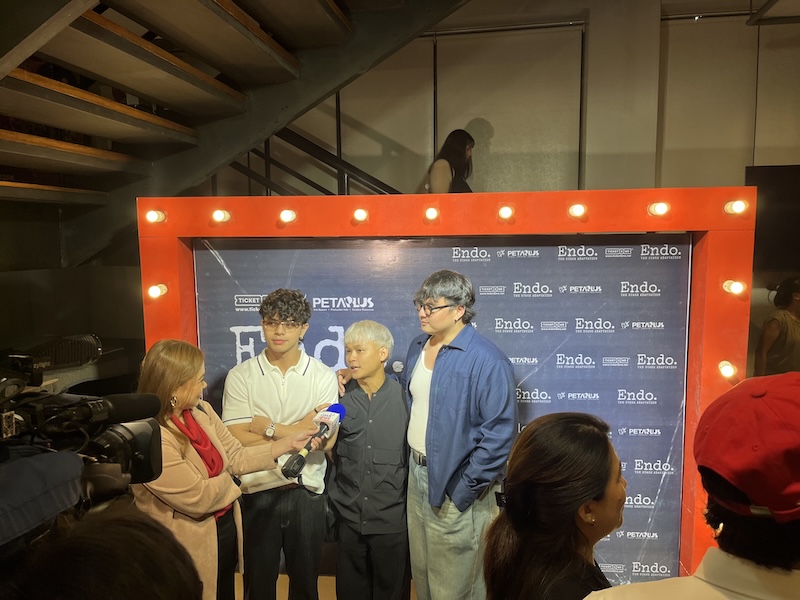
Actor Kokoy de Santos and other guests being interviewed during preview night of ‘Endo.’ (Photo by Vincen Gregory Yu)


