
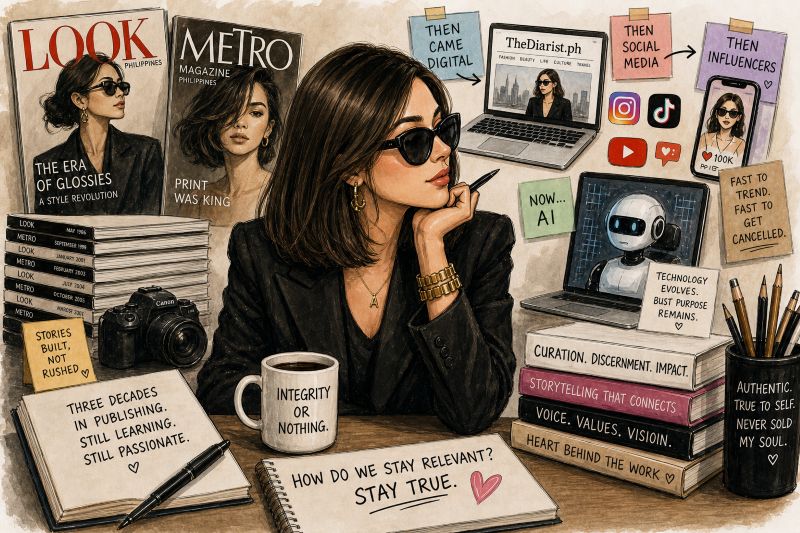
(The author was brand manager of the defunct ABS-CBN Publishing, which published such titles as MeTro magazine, then brand manager of Inquirer for its glossies LOOK, COCOON. After a digital publishing course at NYU, she helped found TheDiarist.ph.)
This is not a review of The Devil Wears Prada 2. It’s a reflection on where publishing has gone the last three decades—and what it really takes to still matter in an industry that keeps reinventing itself.
Change has always been the only constant, but nowhere does that feel more real than in publishing. I stepped into this industry as a fresh graduate nearly three decades ago, wide-eyed, eager, and convinced that I had found my place. Looking back now, I realize that while I’ve spent most of my professional life in publishing, the industry I entered no longer exists in the form I once knew. And yet, somehow, I’m still here.
I’ve seen it all—or at least it feels that way. I remember the era of the glossies, when print was king and the tactile experience of flipping through a magazine was unmatched. Print was everything. Covers, paper quality, and the smell of fresh ink mattered. Editorial calendars were mapped months in advance. Stories were built, not rushed. There was a rhythm to the way content was created and consumed.
Then came the digital wave. At first, it felt like an extension—websites complementing print, not replacing it. But soon enough, the balance shifted. Deadlines grew tighter. Content became faster, sharper, more disposable. What used to take months to curate now needed to be produced in days, sometimes hours. The audience changed, too. Attention spans shortened and readership loyalty became fleeting. The way people consumed content changed. And we had to keep up, whether we were ready or not.
And then social media arrived—not as a tool, but as a force. Suddenly, everyone had a platform. Everyone had a voice. Publishing was no longer just about institutions; it became about individuals. Influencers emerged, redefining authority and credibility. Somehow, authority became less about experience and more about visibility. Everyone had something to say. A teenager with a smartphone could command more attention than a legacy publication with decades of history. Some of it was exciting. A lot of it was chaotic.
Metrics started to matter more than instinct. Engagement became the goal
With that came a new kind of pressure. The need to always be “on.” To be relevant, to be timely, to be first. Metrics started to matter more than instinct. Engagement became the goal. And with speed came risk—because the faster you move, the easier it is to stumble. Cancel culture added another layer of volatility. One misstep, one poorly worded sentence, and everything you’ve built could unravel in an instant.
And now, we stand at the edge of yet another transformation: artificial intelligence. Content can be generated in seconds. Articles, captions, even entire campaigns can be produced without human touch. It’s efficient and impressive. But it also raises a question that feels both urgent and uncomfortable—where does that leave us? Are we still needed? Are we becoming obsolete? Or are we being challenged to redefine our value?
For me, the answer has never been purely about adapting to technology. Tools will always evolve. Platforms will rise and fall. What remains constant—and what I believe truly sustains relevance—is something far less tangible: the heart I bring to the work.
Publishing, at its core, has never just been about content. It’s about perspective. It’s about understanding not just what people want to read, but what they need to feel, to question, to remember. That kind of depth cannot be automated. We know what to write, and whom we write it for.
Publishing has never just been about content…It’s about understanding not just what people want to read, but what they need to feel, to question, to remember
I’ve always approached this career with everything I had. Not perfectly, not without mistakes, but with commitment. There’s a certain intensity required in this field—a willingness to push, to demand excellence, to care deeply about the final product. In that sense, I relate to the archetype of the exacting editor (you know who you are, *wink*.) The one who refuses to settle. Because standards matter. They always have.
But beyond that drive, what has grounded me is authenticity. In an industry that constantly reinvents itself, it’s easy to lose your sense of self. To chase trends and to mimic what works for others. To prioritize visibility over substance. I’ve seen it happen, again and again.
I made a different choice. I stayed true to my voice, my values, and my boundaries. I never believed in selling my soul for relevance. If anything, I’ve come to understand that integrity is the only thing that endures when everything else changes. Trends fade, platforms disappear. But the way you show up—consistently, honestly—that’s what people remember.
Relevance today isn’t about being everywhere or doing everything. It’s about knowing what you stand for and letting that guide how you evolve. It’s about discernment—choosing when to adapt and when to hold your ground. It’s about recognizing that while the medium may change, the message still matters.
Publishing may look very different now, but the core of it—the reason it exists—hasn’t changed. It’s still about telling stories that matter. It’s still about creating something that connects. And that kind of work doesn’t become obsolete just because technology evolves. As long as that purpose exists, there will always be a place for those who are willing to approach it with intention and heart.
So no, this isn’t a review of a film sequel. It’s a reflection on survival and transformation, and on staying relevant without losing myself in the process. Because in the end, the real challenge isn’t keeping up with change—it’s knowing who I am while everything around me changes.
Because in an industry that constantly asks you to adapt, the real challenge isn’t just keeping up. It’s knowing when not to.


