
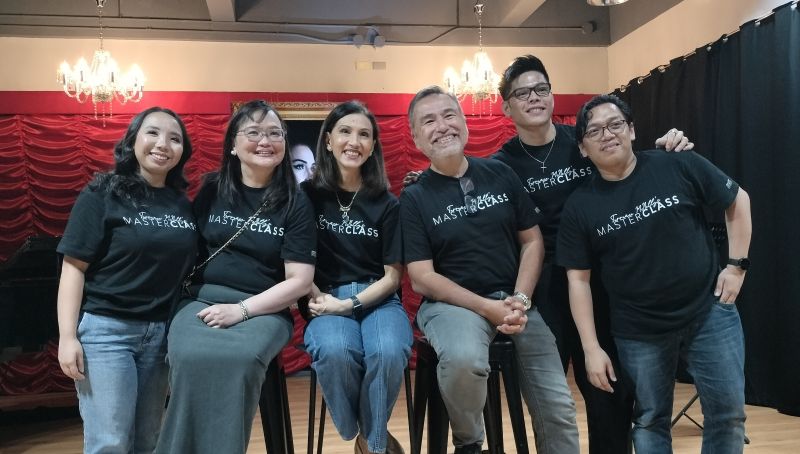
Alexandra Bernas, Philippine Opera Company founder Karla Patricia Gutierrez, Menchu Lauchengco-Yulo, Jaime del Mundo, Arman Ferrer, and Louie Angelo Oca
All videos and photos by Liana Garcellano
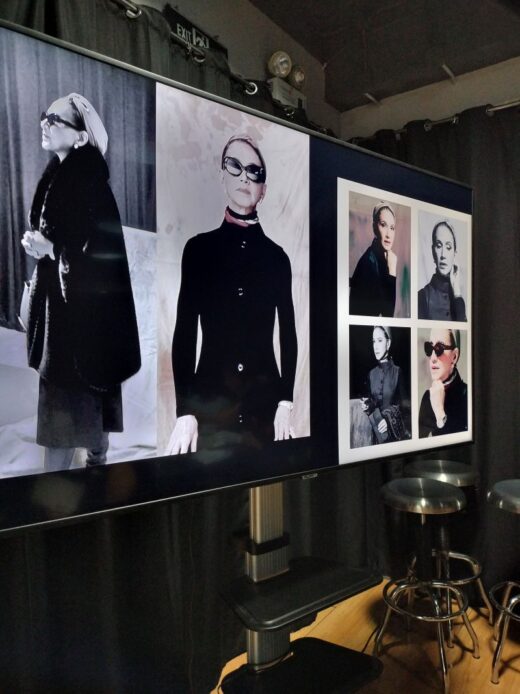
Maria Callas’ reputation as a singular soprano with a dramatic flair is somewhat eclipsed by her tumultuous romance with shipping tycoon Aristotle Onassis. People know her as Onassis’ jilted lover, the one he left for Jacqueline Kennedy, a former first lady of America. But there’s much more to Callas, and that she had a life after Onassis is what Filipino artists Menchu Lauchengco-Yulo, Louie Angelo Oca, and Alexandra Bernas gave credence to at the media launch of Master Class last April 21.
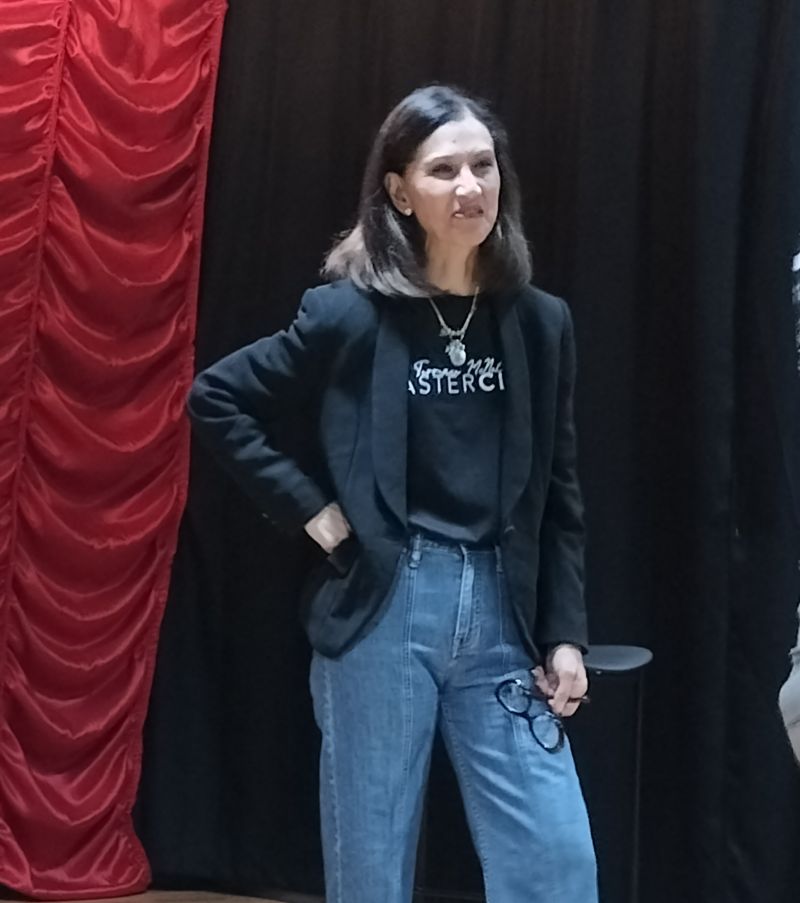
Menchu Lauchengco-Yulo steps into the shoes of Maria Callas.
At the launch, stage actress Lauchengco-Yulo leads the trio in presenting the other side of Callas, who conducted public masterclasses at Juilliard School in New York. They take their positions “on stage” at the Philippine Opera Company (POC) in Makati for their scene from Master Class, a play by Terrence McNally: They’re in a music room in Juilliard, and the year is 1971. Lauchengco-Yulo portrays the legendary Callas, Oca is the accompanist Manny Weinstock, and Alexandra Bernas is the soprano Sophie de Palma, one of Callas’ three pupils.
Master Class won the Tony Award for Best Play and the Drama Desk Award for Outstanding New Play in 1996. It tells about what happens in Callas’ masterclasses while detailing her personality (she was passionate, straightforward, and had exacting standards), triumphs and sacrifices along with her unrelenting pursuit of artistic truth.
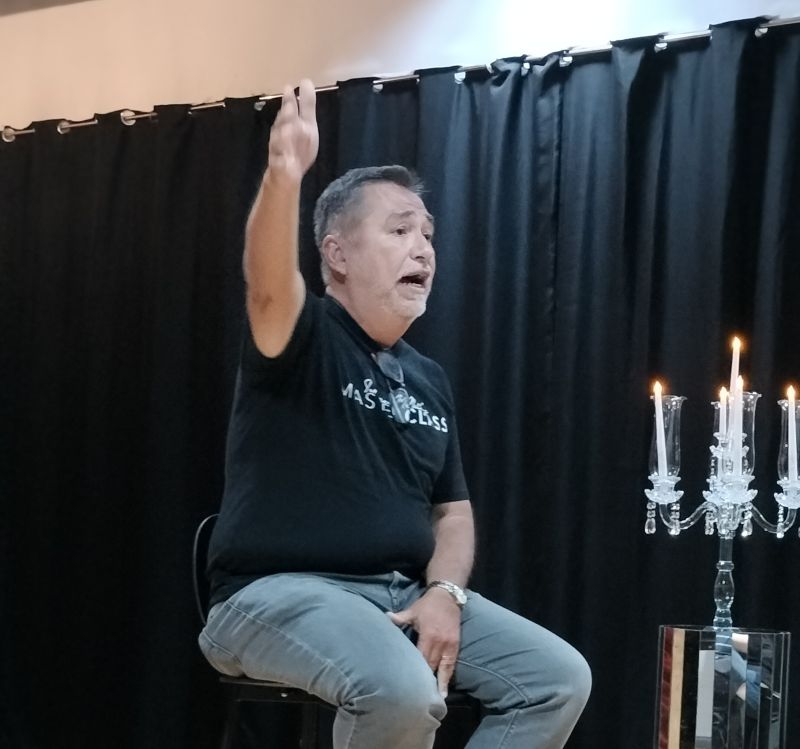
Jaime del Mundo, director of ‘Master Class’
But director Jaime del Mundo cautioned against thinking that the play is a documentary on Callas. He said it’s a theater piece by McNally who admired what Callas stood for.
“It’s about love, passion, and the desire to communicate to the younger generation, from the experiences of an old-generation singer, and what makes art,” said Del Mundo, who was a resident actor of Repertory Philippines until 1989, and who has appeared in more than 50 productions.
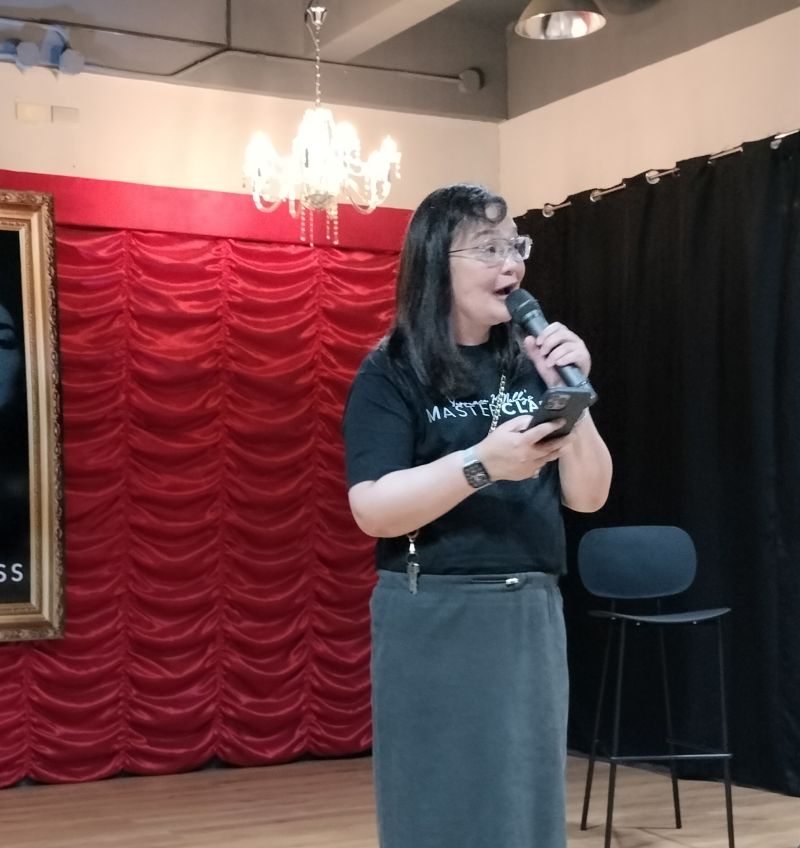
Philippine Opera Company founder Karla Patricia Gutierrez delivers the opening remarks.
Master Class is POC’s special production for its 25th anniversary season. It last staged the play 16 years ago, and the revival symbolizes the company’s commitment to honoring the legends who shaped the operatic world. Per POC founder Karla Patricia Gutierrez, this highlights the company’s dedication to bringing opera closer to Filipinos and fostering an understanding of classical music.
Gutierrez is herself a soprano who trained under the coloratura soprano Fides Cuyugan-Asensio at the University of the Philippines Diliman and Doris Andrews at the Accademia Internazionale delle Arti in Italy.
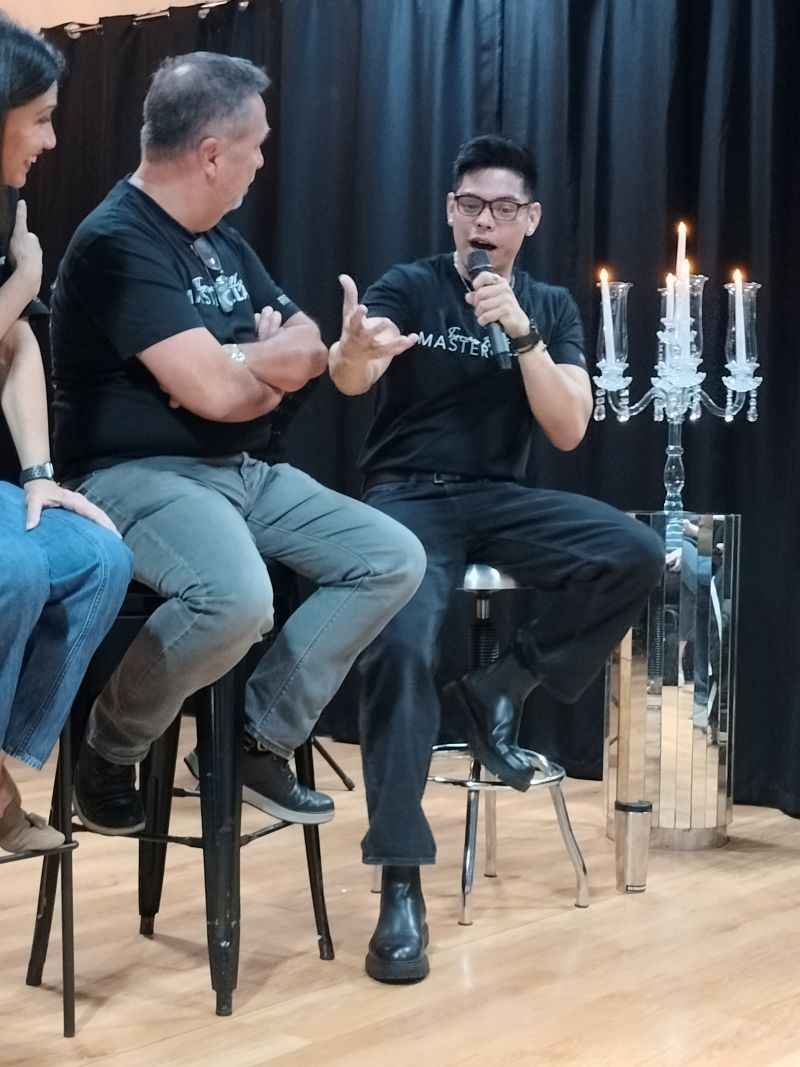
Arman Ferrer answering a question from the floor
Lauchengco-Yulo’s Callas brims with wit and imperiousness, synching with the soprano’s supposed perfectionist personality—one who doesn’t sugarcoat words or mollycoddle students like De Palma (who looks terrified of the teacher). Callas is further portrayed as unwavering in her passion for her art and her deep commitment to bringing out the best in De Palma and Anthony Candolino (played by classical singer Arman Ferrer), molding them into greatness with her musical insight.
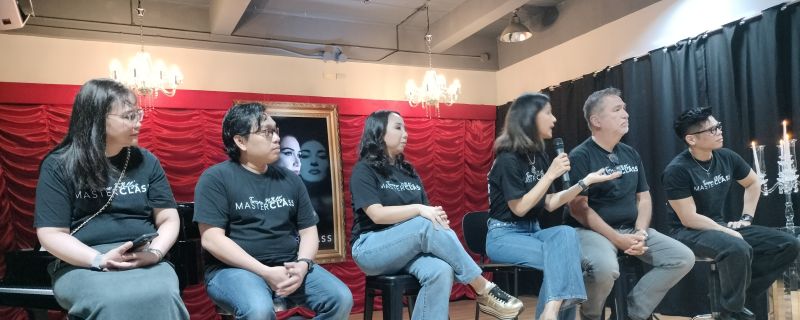
Philippine Opera Company founder Karla Patricia Gutierrez, Louie Angelo Oca, Alexandra Bernas, Menchu Lauchengco-Yulo, Jaime del Mundo, and Arman Ferrer at the Q&A
Being new to the biography of Callas, one can’t help but wonder if the diva was truly intimidating. At the Q&A, Lauchengco-Yulo said Callas was misunderstood because she was hard on her students, to the point of browbeating them. But Callas’ behavior was nothing out of the ordinary because it was all about the craft, the actress said. In the same breath, she marveled at the subject’s greatness: Callas tutored her students despite being unable to sing anymore—she whose vocal talent was unmatched during her prime. Callas sang La Traviata one day and Tosca the next, which nobody else could do then, and it sadly led to Callas losing her voice entirely, Lauchengco-Yulo said.
Hailed as the “first lady of Philippine musical theater,” Lauchengco-Yulo said she didn’t want to mimic Callas in her portrayal. “What I show is her essence—i.e., discipline and uncompromising artistry—but the passion that goes into the character is me. I don’t think I can be Maria Callas, who brought drama or acting to opera,” she said.
She recognized a likeness in terms of their losing their singing voice: “My voice isn’t what it used to be because of age,” she said. “I have accepted that I can’t sing certain songs anymore, but I’m not like Callas in that I lost everything.” She said she identifies with Callas’ work ethic, dedicating herself to the role and in making students see that “it’s more than the voice,” that it’s what a singer is “talking” about.
While Lauchengo-Yulo doesn’t have to sing like an opera singer in the play, it is a prerequisite for those playing the three students. Bearing this point in mind, Del Mundo added soprano Angeli Benipayo to play Sharon Graham, to complete the trio of students, along with Bernas and Ferrer.
Lauchengco-Yulo had the attention of the media audience from start to finish of the preview. It wasn’t difficult to see her virtuosity and grasp of her craft—the obvious ease with which she moved around the stage, her convincing acting, her mastery of her monologues (she didn’t fumble with her lines).
She had everyone laughing when she addressed the audience like they were her students. With a cocky smile and amusing hauteur, she harangued them on the importance of having “a signature look, so people would remember you.”
“You think you’re all special, you’re a dime a dozen,” she said. (Only one in the audience passed her standard.)
Callas’ arrogance was further revealed when the new student, De Palma, arrived for her lesson and caught her teacher’s ire with her mousy comportment. Callas wanted De Palma to prove her mettle and commanded her to sing. De Palma, overcoming her trepidation, sang Vincenzo Bellini’s aria La Sonnambula (The Sleepwalker), while Callas listened intently at stage left.
The diva’s high-handedness didn’t go unmentioned by some in the young audience. In the era of safe space, will today’s students bend a knee before Callas—and her ilk—or cancel her? Also, will they cancel Del Mundo for directing a play with an overbearing, almost-abusive character?
Pondering on how Master Class would sit with a younger crowd, Del Mundo candidly said that the theater isn’t a safe place to begin with, and that, like the stage legends Sir Ian McKellan and Dame Judy Dench, he’s an old guard of the theater. He admitted he has yet to wrap his head around the idea that Callas may be deemed abusive, and wished he could be more understanding of the reality of safe space these days.
“Theater is a place where the director et al tell the audience to trust us as we take them on a journey,” Del Mundo said. “If it’s child’s play, there won’t be decapitation. If it’s for adults, it should be for adults. Art should be triggering. It should make one think.”
Lauchengco-Yulo interjected that their team creates a safe space in theater and that she, for one, isn’t abusive during rehearsals. She said the whole troupe stays true to the texts: If an actor is unable to do what the role requires, “then don’t do it.
“I hate it when the production is compromised,” she asserted. “Callas said to never compromise. It’s 100 percent about details, total concentration, and giving the audience what they deserve.”
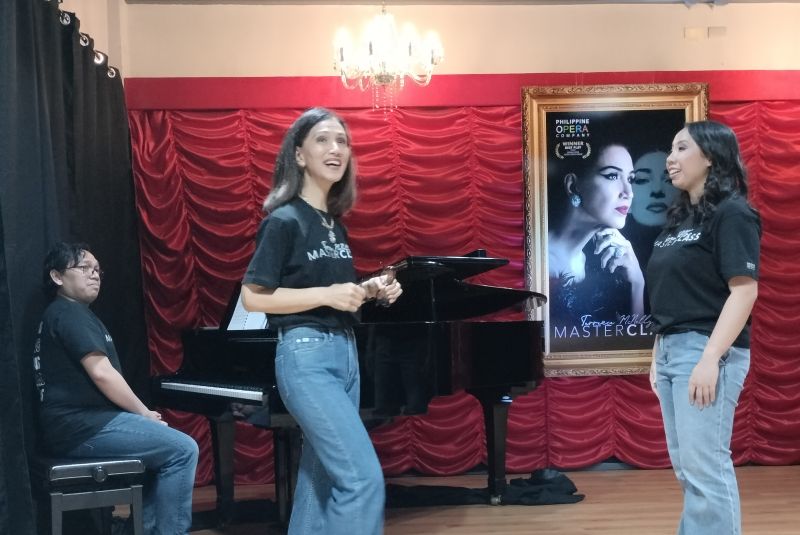
Louie Angelo Oca, Menchu Lauchengco-Yulo, and Alexandra Bernas in a scene from ‘Master Class’
The topic at the Q&A shifted to what people aren’t privy to when the curtains remain undrawn for Master Class and other productions. According to Lauchengco-Yulo, people don’t see the crying, frustrations, and processes that go into musical theater, which make social media posts on opera brutal. Oca agreed with her, saying that the posts are superficial because the techniques, hours of learning the arias, and the artists’ self-care aren’t ever shown.
Undoubtedly, theater actors struggle to put a production together, and the struggle remains hidden from the audience. Lauchengco-Yulo said she grappled with a turf war between the creatives and producers: “We wanted to give the audience something but it couldn’t happen, so we had to compromise. We also had to be understanding.”
Del Mundo’s challenge constituted artists who couldn’t deliver. He explained: “I talk to artists because I want to create with artists. You choose people who you want to work with… gauge what has to happen, and because you know they can give you what you want. But sometimes there’s someone who doesn’t give you what you want.”
Oca’s struggle was with poverty, he said. He doesn’t own a keyboard, making getting a constant piano workout difficult. “In theater, your safe space is yourself,” he said. “Poor people don’t know about mental health; it’s a privilege.” However, on the same note, he said he felt joy in playing the piano and acting in Master Class.
After becoming a cast member of Master Class, classical singer Ferrer said he showed up to rehearsals with an open mind, remembering his motto of learning and trusting the people in the production. “If I insisted on what I knew, there wouldn’t be growth. What’s important to me is to grow as an artist,” he said.
Despite the problems confronting the Philippines, Del Munro is optimistic of the play’s resonance with the audience, especially the younger crowd, when it premieres on May 15 at the Carlos P. Romulo Auditorium, RCBC Plaza in Makati. Actually, one doesn’t have to be a fan of Callas because, as Del Mundo explained, Master Class can be the story of any artist’s passion and obsession, their art and growth, and how they stand on the shoulders of their mentors. He said he hopes the young audience will get to understand the value of Master Class, and theater in general, once they see the amount of work and sacrifice that goes into a production.
“It’s literally blood and guts. It’s what Callas once said: ‘I gave everything to you,’” he said.
Paralleling Del Mundo’s thoughts, POC founder Gutierrez circled back to the place of art in people’s lives: “History reminds us that through the darkest times theater finds a way to speak. Thus, Master Class is relevant. It’s about vulnerability and discipline. It affirms our belief that the arts must continue not only in times of peace, but more so in times of war.”
Master Class runs on May 15–30, with Friday and Saturday performances at 8 pm and weekend matinees at 3 p.m. For tickets, call Philippine Opera Company at tel. no. (0917) 645-2946 or visit https://ticket2me.net/MASTERCLASS.


