
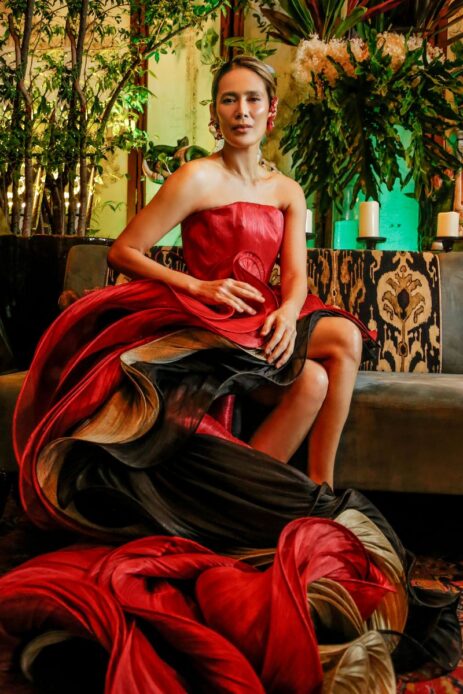
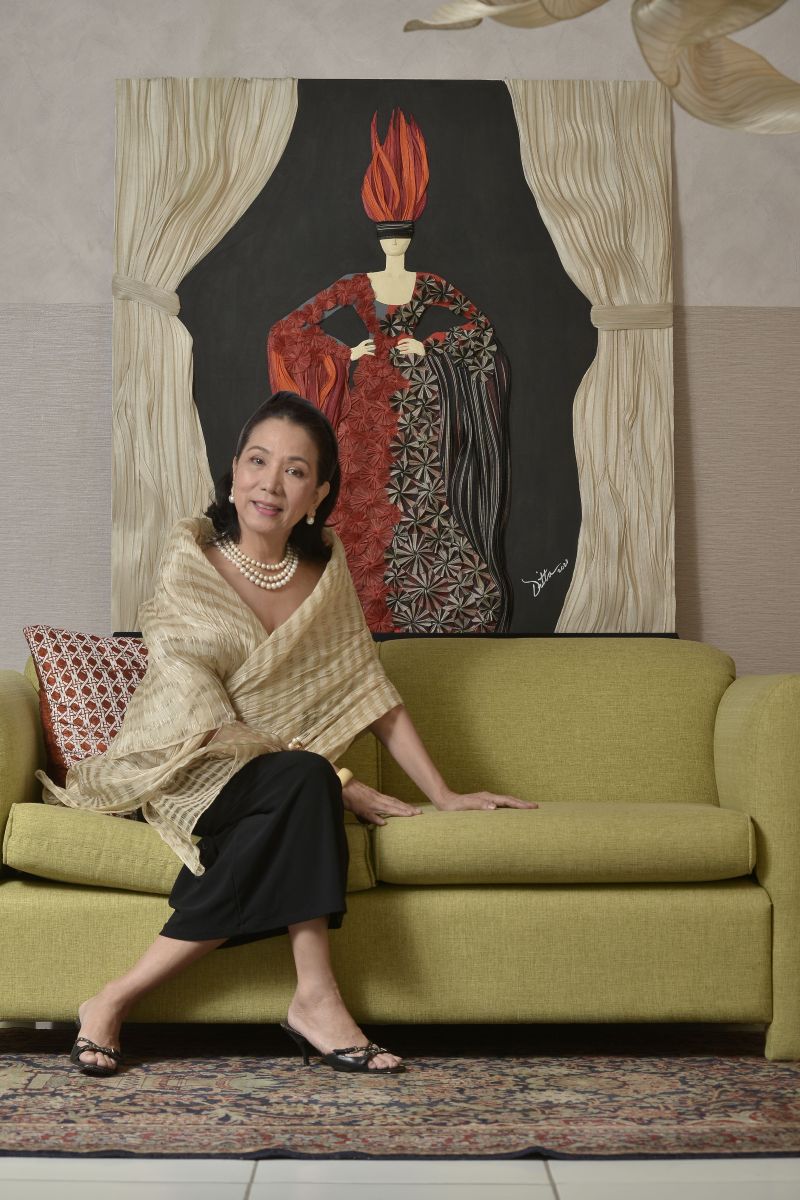
Ditta Sandico creates artworks on canvas using discarded fabrics such as ‘Mayari,’ inspired by the goddess of beauty.
The designer, who turned abaca into a fashionable wrap, now wraps up the story itself.
In her book, It’s a Wrap: Unraveling the Future of Fashion, Ditta Sandico charts four decades of work with weaving communities. The project was proposed by Martin Lopez, executive director of the President’s Committee on Culture at Far Eastern University, to FEU Publications. The story is by Francine Medina Marquez, with photographs by Ukrainian visual artist and former model Arthur Tselishchev.
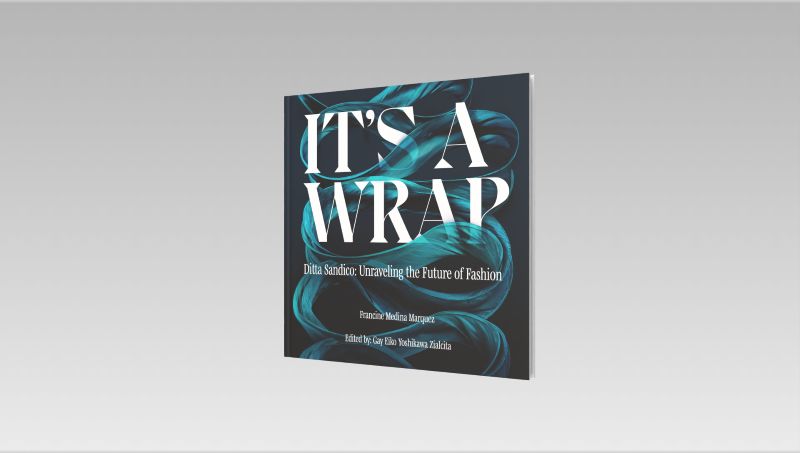
‘It’s a Wrap: Unraveling the Future of Fashion,’ published by FEU Publications
The book traces how her earliest spark came in Mindoro, her father’s home province. Ditta spent the summers of childhood on his cattle ranch, and joined him on mountain trips. On one trip, she watched a farmer pick cotton, clean the seeds, spin thread, weave cloth, and dye it on site. “It felt like magic seeing cotton turning into fabric before my eyes,” she recalls. The encounter launched a vision: Use local fibers, and employ the hands that make them.
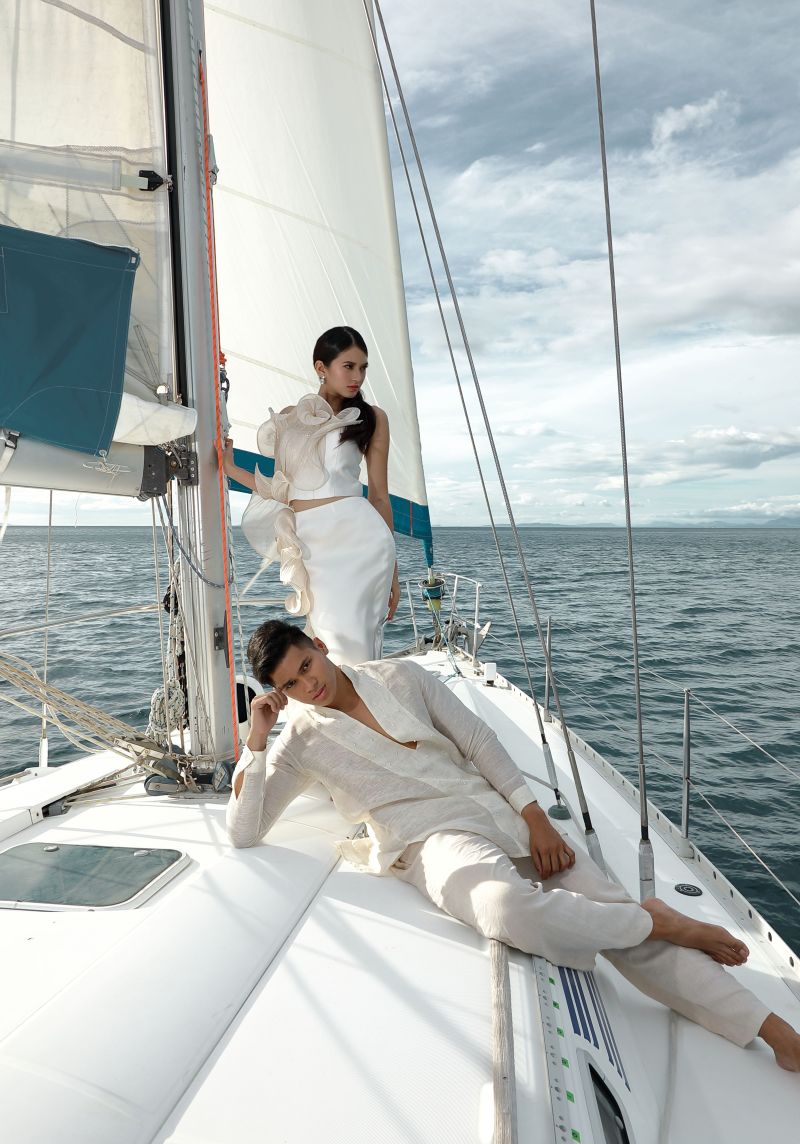
DITTA signature bridal gown and men’s ‘barong’ sculpted in silk gazar and accentuated with banaca
Decades later, that instinct drew her closer to the Mangyan through Anya Postma, whose father, the Dutch anthropologist Antoon Postma, lived among the Hanunuo. A subtribe, the Hanunuo Mangyan are known for handwoven cotton and needlework of fine, geometric motifs such as zigzags, chevrons, and diamonds, stitched in bright threads onto narrow cotton strips called ramit. Ditta also taught them how to recycle abaca offcuts into rolled beads, and later worked with embroiderers to refine their motifs. In turn, their patterns adorned her terno sleeves. During the Paris Paralympic Games 2024, one of the uniforms of Team Philippines was the tracksuit with embroidered habol fabric made by the tribe in Panaytayan, Mindoro.
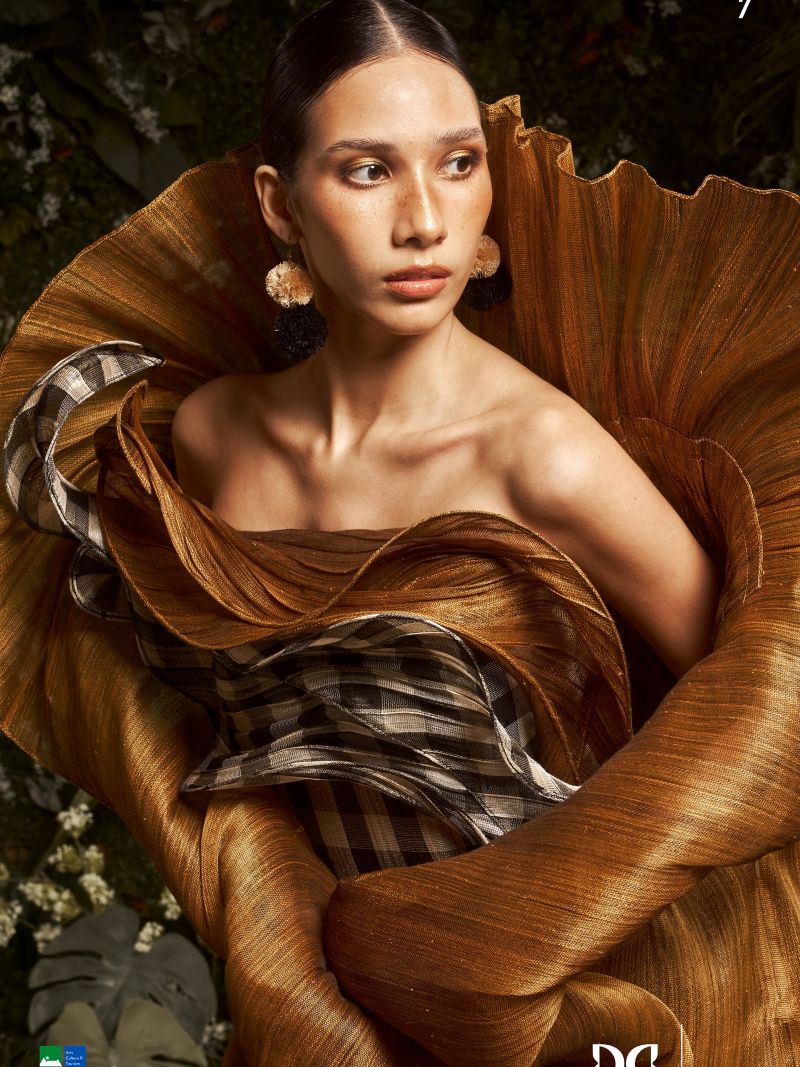
Gold unfurls against black in checkered folds, framed by the Capa La Reyna.
Ditta, a fashion merchandising graduate of Tobe-Coburn School in New York, began her retail career in the family-owned department store, COD. By mid-1980s, she turned to the North for design inspiration. In Vigan, Ilocos Sur, her mother’s hometown, she recast inabel blankets into crisp separates. Today she collaborates with Corazon Agosto of Santiago, Ilocos Sur, where cottage weavers run pedal looms in backyard sheds and supply Vigan’s stalls. The community keeps abel Iloko alive with classic weaves such as binakol and pinilian, patterns passed down at home and traded across the province.
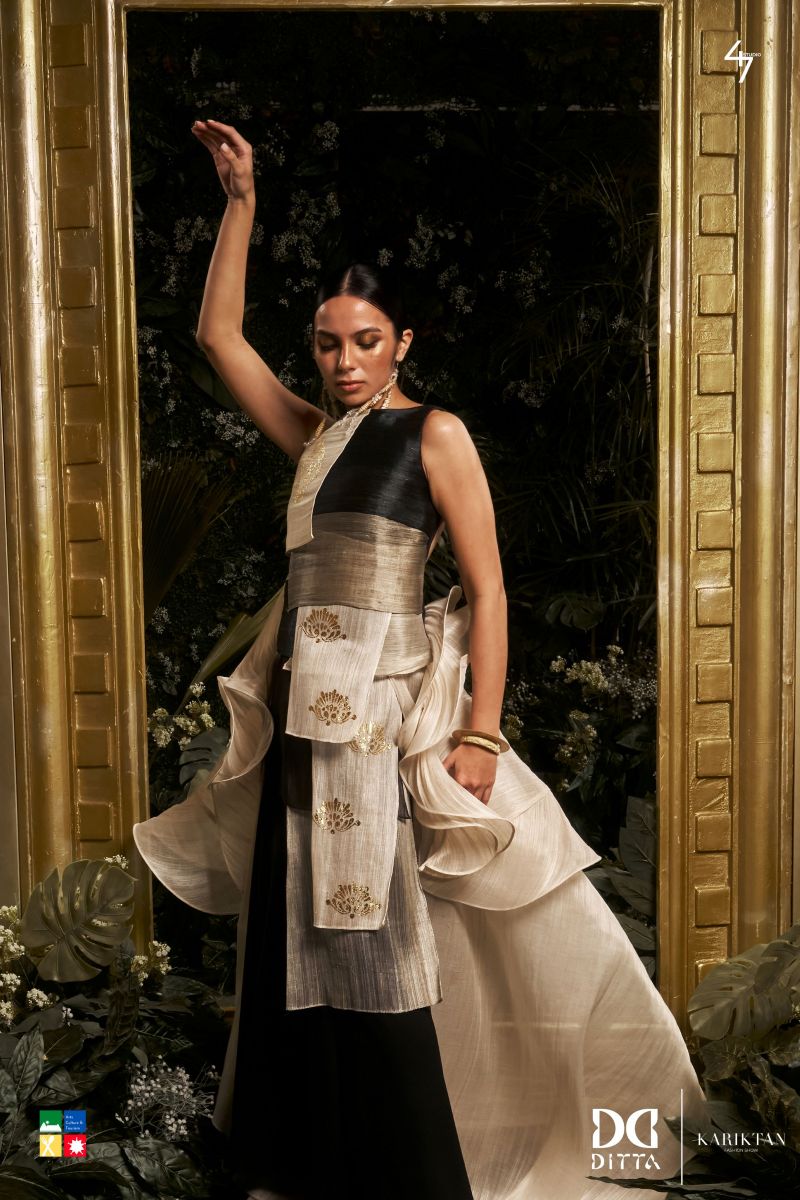
Handwoven banaca elevated with San Nicolas gold leaf
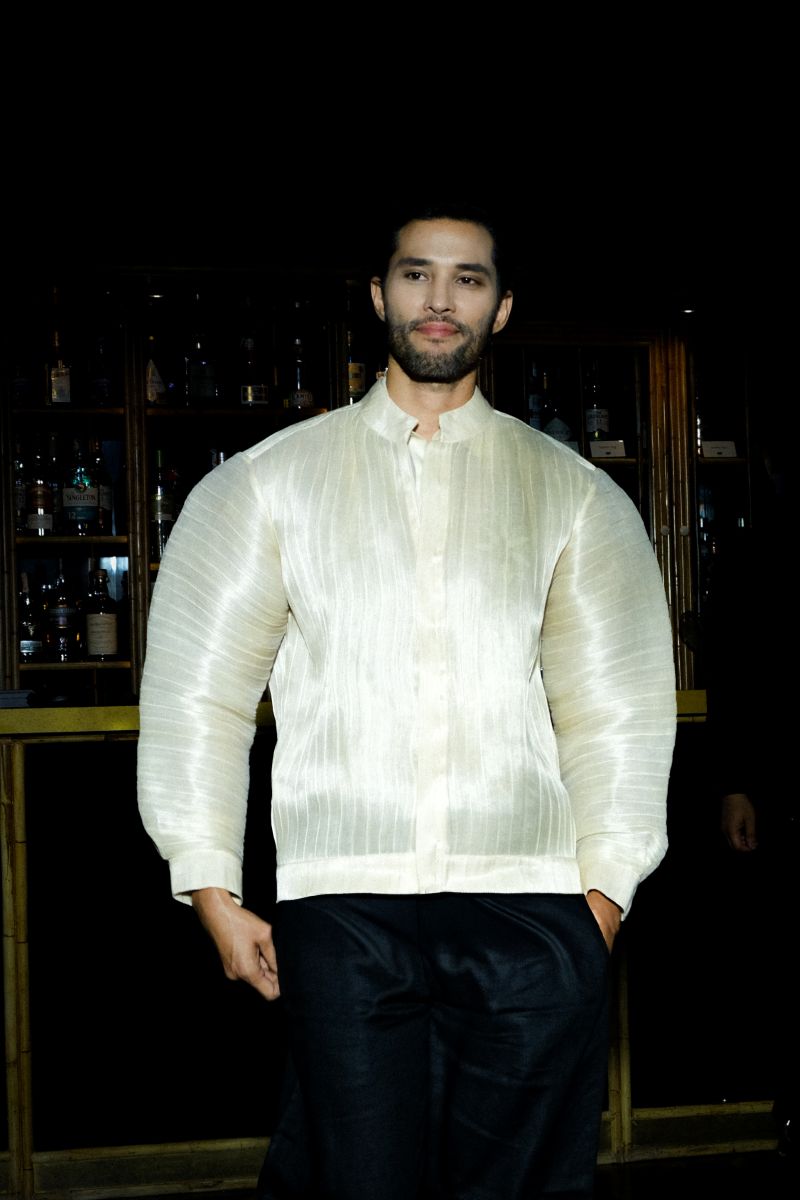
Pleated banaca ‘barong’ Tagalog
By the early ’90s, she was working on piñalino—piña blended with linen—with the weavers of Elisa Reyes. Based in Bulacan, the atelier is known for fine piña and piñalino, consistent yarns, and crisp finishing.
Two years later came a turning point. In 1995, Virgilio Apanti of Baras, Catanduanes, arrived with rough, undyed abaca swatches. Seeing the province’s rich stands of abaca, Sandico partnered with local weavers to develop natural dyes, improve fiber processing, and tighten the weave for strength. She coined “banaca,” a portmanteau of banana and abaca. The Baras community has grown since; Apanti’s daughter, Rejoice, now runs the weaving center.
Banaca has moved beyond her signature wraps into full-length gowns, evening pants, and fluid skirts. Evening pieces come in bright, metallic tones, often layered over silk or crepe chemises. The silhouettes are more sculptural—twirls, swirls, and waves of banaca that build volume and motion.
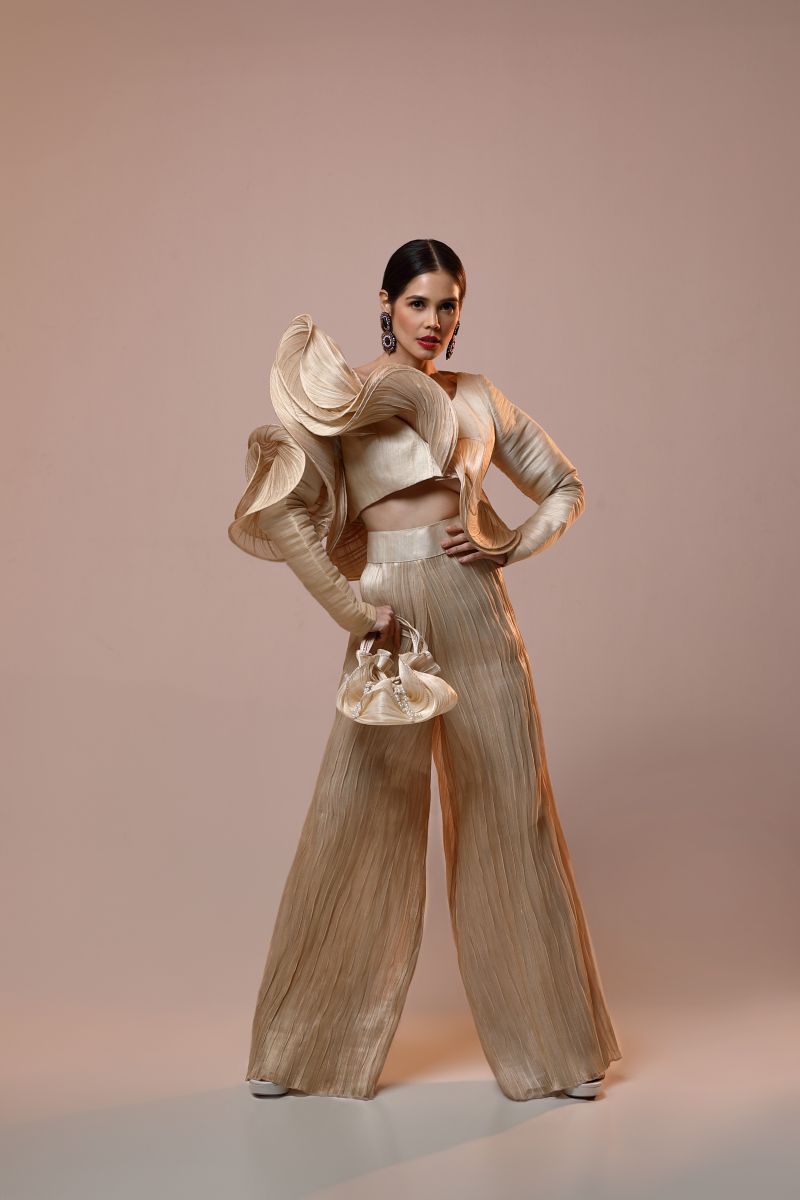
Sculptural banaca and pants
Sandico describes It’s a Wrap as both record and resource. “It’s meant as an academic book for a younger generation so they can learn from my stories and what I went through, including travels, a few awards over 40 years, and the experiences of the weavers and some of the models.”
There were hard lessons. “I saw the challenges and how I managed most of them,” she says. In Catanduanes, calamities repeatedly hit. The weaving center flooded, equipment was washed away, and the team had to start again.
There were losses brought about by copyright infringement, as well. Export buyers visited her atelier and later sold lookalikes. “I couldn’t pursue my rights in Japan, so I let it go.”
Her sister once found bags and visors in a department store that looked exactly like her label. Cebu has since become a hub for banaca, producing sculptural wraps similar to her namesake brand.
Then the pandemic arrived. “I had a whole inventory from Rustan’s, and I couldn’t let it sit,” she says. She then established her showroom in her Quezon City home, moved sales online, and saw clients once restrictions eased. During lockdown she began to paint, cutting and collaging cotton and banaca. An at-home exhibit featured Philippine goddesses as figures of women’s empowerment. Several of those works now appear in the book.
Four decades on, she talks about easing off, then returns to the work. The hard part takes time, from testing fibers for daily wear to building weaving centers that last. “Continuous improvement is key,” she says. Banaca now includes bridal. “That’s the bread and butter for most designers. That’s how they survive,” she says. “We still have our own look and our own styling. We have loyal clients, and there is room to grow.”
‘It’s A Wrap’ will be launched on May 13 at YSpace at Yuchengco Museum, RCBC Plaza, Makati.


