
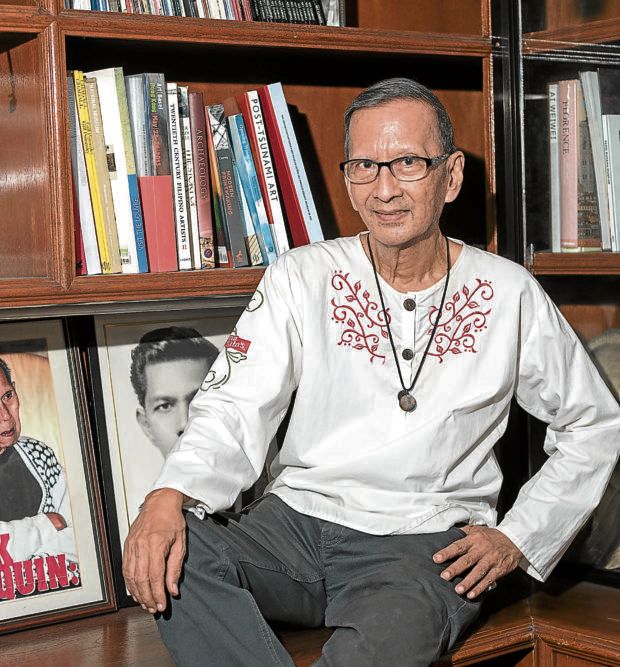
Photos from the author’s collection
Amadis Ma. Guerrero died on May 13, 2026 and left behind his only sibling Claudette G. Silerio.
The recently deceased cultural journalist Amadis Ma. Guerrero used to say that you dated yourself if you called him by his childhood nickname “Sluggo,” after the cartoon character created by Ernie Bushmiller. When he was a toddler, his hair was as spiky as Sluggo’s, thus the nickname.
Those from the pre-martial law Graphic weekly magazine, like the writers Rosario A. Garcellano, Ninotchka Rosca, Petronilo Bn. Daroy, and Cristina and Antonio Hidalgo called him by that name. Some time in the 2000s, he went by Mads, Madz, or Dis.
To the environmentalist Odette Alcantara, he was Mozizart after the composer Amadeus Mozart. He was a fixture at her Heritage Art Center, originally in San Juan, then in Cubao, along with chess players like the late Leonides Benesa, Nestor Mata, and Alex Dacanay. To Odette’s atchi (older sister), the legendary English professor Nieves Benito Epistola, he was her Le Cheri Guerrier, the cherished and lovable warrior as opposed to the revolutionary Amado Guerrero’s beloved warrior.
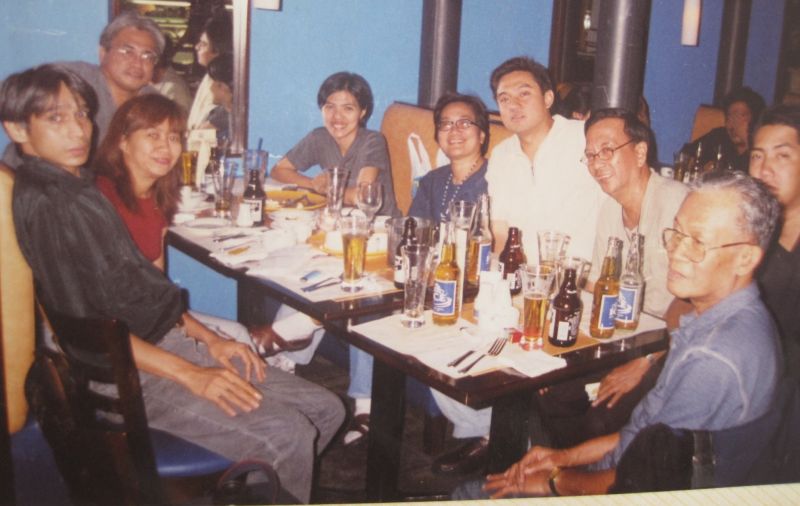
The Friday Club with Amadis (third from right) that used to drink and sit in the smoking section
But to me, he will always be Amadis, friend, colleague, co-singer, and godfather to my youngest child, Miranda Bituin (“Ida”), who never quite forgot the 20-peso handouts she would receive from him during Christmas. Well, one time when she was still a baby, he gifted her with a white cotton onesie with a lace trim, his most expensive investment in her, a gesture never to be repeated.
But we (Ida and I) never begrudged him that. We understood that he was a salaried man who freelanced furiously the way our other friend, Pablo Tariman, did to keep the wolves at bay.
We began as officemates in 1981 at the former Population Center Foundation (PCF) at the boundary of Makati and Taguig. He lived in Taguig at the Bagong Lipunan Condominium with his mother and some help. By then we were both contributors to Thelma San Juan’s Family Journal section in Times Journal.
During lunch breaks, he’d slip away to submit his typewritten article to Thelma’s Port Area, Manila, office. I felt sorry that he had to commute. I advised him, why not send your stuff when the office driver makes deliveries of the news and feature packet PCF News Service to newspaper row in that part of Manila? Tip the driver when he returns.
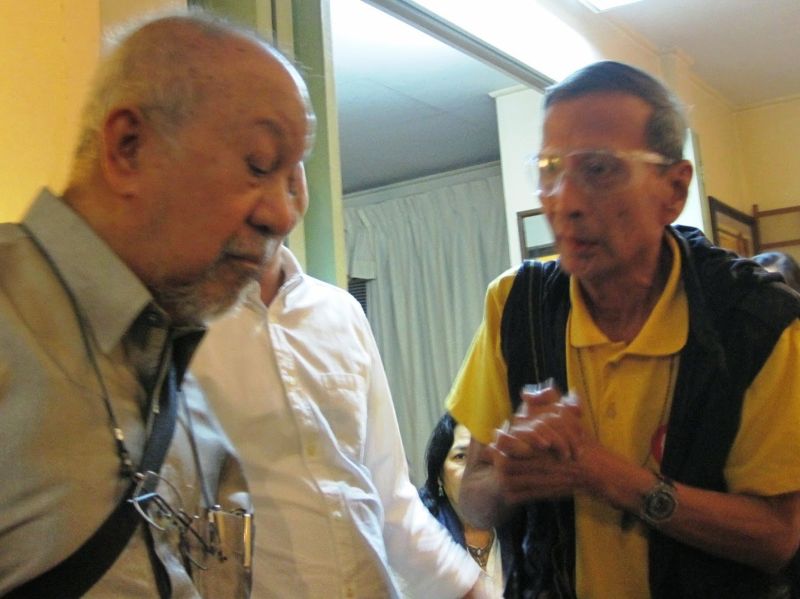
With literary critic Elmer Ordoñez
At that time, these packets of articles were all mimeographed hard copies; there was no internet yet. When the world wide web happened, Amadis continued typing his pieces on a portable Olivetti, going to National Bookstore to replace faded ribbons, then hiring an encoder to encode the soft copy, and sending it forthwith to whoever his editor was. Laborious indeed, but that was how much of a Luddite he remained, as the late poet Mila D. Aguilar described him.
He was the most senior, age-wise, in that publications group led by Vicente G. Tirol and which included Alejandrino Vicente, who went on to become ambassador to Spain, Lebanon, among others countries, Virgilio “Billy” Lacaba, Eric Caruncho, Roderick L. Toledo, Marissa Dames, and myself. We put out bi-weekly and quarterly publications, which left Amadis and me with hours to write our freelance stuff, he for the Journal, me for Who Magazine.
When Lorna Kalaw-Tirol birthed her second son, she initially wanted to name the child Amadis, but Vic put his foot down. The one and only Amadis said, “Thank God he had some sense!”
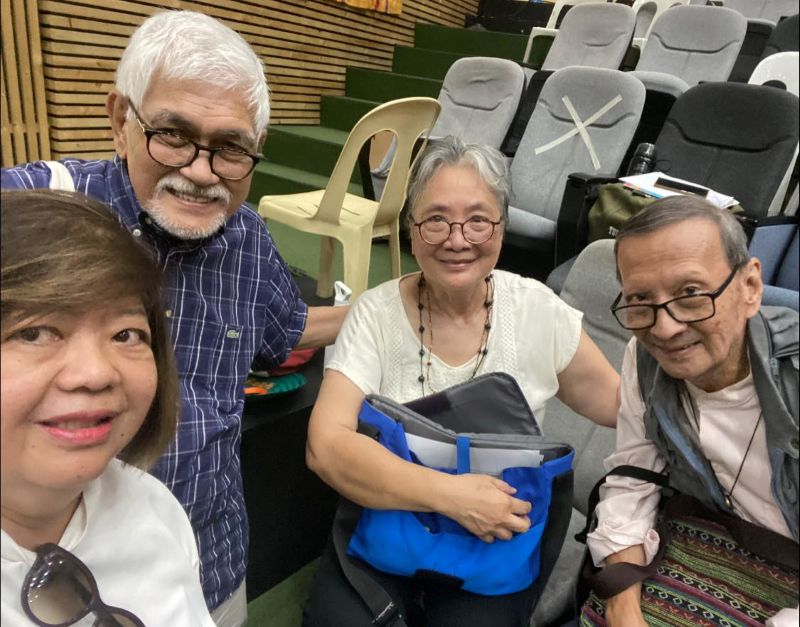
Mita Dimalanta, Rolly Fernandez, the author, and Amadis after a forum at UP Baguio
But this seems an apocryphal story that the fictionist in Amadis concocted. According to Lorna, “I never thought of naming my second son Amadis. From the moment I saw Paulo, I told Vic we would name him Vicente because the baby looked like him, and we added Paulo and Jr.”
Many decades later, when he dropped by Baguio in 2025 to cover a University of the Philippines Baguio (UPB) forum on National Artists F. Sionil Jose and Cirilo Bautista, he asked me the favor of encoding a theater piece and send it by email to his then Philippine Daily Inquirer editors Cheche Moral and Pam Pastor.
When I looked at his raw copy, I could sense the pressure he applied on the old typewriter keys. There were holes on some spots of the bond paper, and he had to pencil in the letter “t” as it wasn’t working anymore. I showed the copy to my husband Rolly Fernandez. He shook his head, amazed at how his kumpare coped with the digital demands of newsrooms.
While UPB Prof. Grace Subido and I were onstage as speakers and another confrere from another university was making her presentation, Grace leaned to ask, “Who is that mestizo in eyeglasses in the audience?” I whispered back, “The great Amadis Ma. Guerrero.” And he was busily taking copious notes in a notebook while garbed in his signature T-shirt underneath a photographer’s vest.
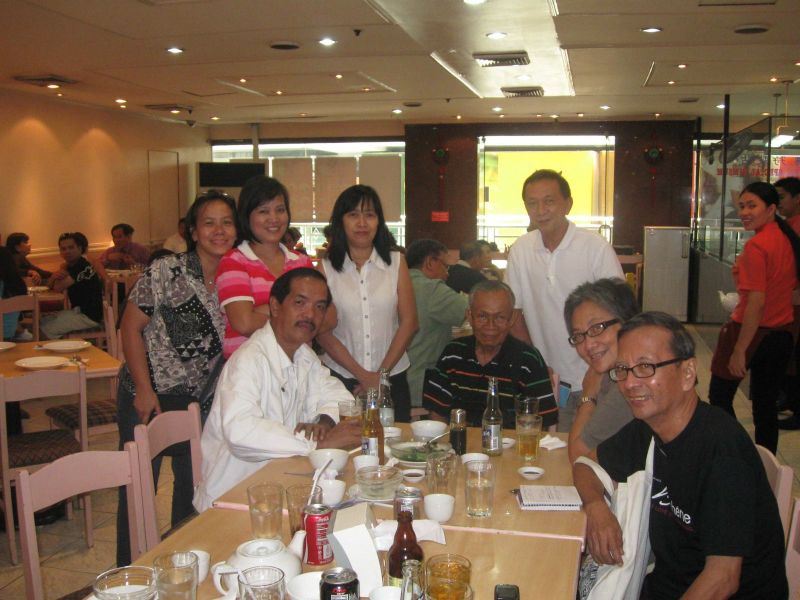
Lunch with the old Raya Media Services gang with the late Pablo Tariman (seated leftmost), Bob Navarro, Rustie Otico, and Amadis joining in
That practical, multi-pocketed vest took him everywhere, to the point that our office secretary at Raya Media Services Inc. (RMSI) volunteered to wash it. It was beginning to smell of dry sweat. He refused but promised us he would have it laundered thoroughly.
The RMSI days were perhaps our best days together. Our desks formed an “L” shape so when I turned to my right, he would be in the range of my sight, singing in a low key in his tenor voice some Spanish or French ditties.
Our desks formed an ‘L’ shape so when I turned to my right, he would be in the range of my sight, singing in a low key in his tenor voice some Spanish or French ditties
By this time he was taking French lessons from the redoubtable cultural worker Jenny Juan, followed by Sorbonne-trained Carolina “Bobbie” Malay. Or was it Bobbie first, followed by Jenny? Even my memory is unsure about that detail. But Amadis’ memory for trivia was fantastic.
The private lessons happened, usually in a coffee shop, when he flunked a year in his Alliance Française course and was in near despair over what he felt was a dashed dream of learning to speak and read French fluently. I suggested that he seek out Jenny or Bobbie for more relaxed lessons in conversational French instead of rigid oral and written tests. He listened to my advice.
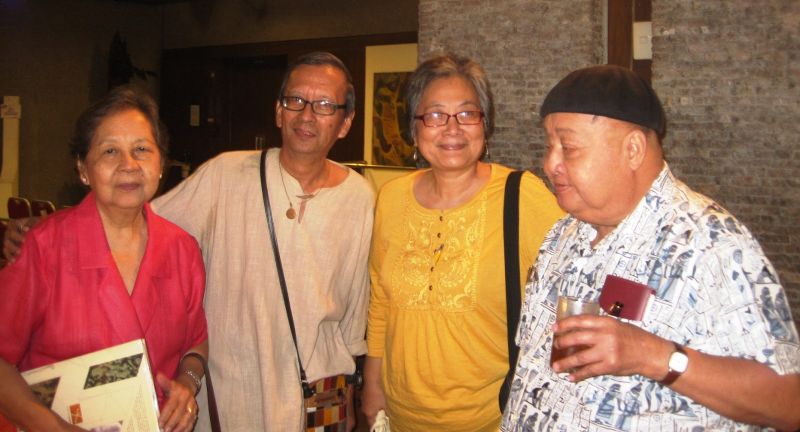
Tessie Jose, Amadis, the author, and Frankie Jose at the launch of Amadis’ book on Teatro Pilipino
Before long, he was reading Le Petit Prince and several other novellas in original French. When I was twiddling with something on my desk, he would gently inquire, “Qu’est-ce que c’est?” or “What is that?” In broken French, I’d answer, “C’est un livre” or “It’s a book.”
The clients of RMSI were not controversial, mainly development-oriented agencies like the United Nations Development Program, the Metrobank Outstanding Teachers project, and the like. Amadis confessed to being practically bored out of the skull with the copy we were either writing or editing, and dreamt of leaving his desk job to travel the archipelago and write about his experiences in book after book. Which he did, by the way, despite RMSI duties. He would take off for the province on a Friday afternoon and be back Monday.
But RMSI business became hard. Billy took in the Armed Forces of the Philippines as client. Initially, Amadis and I decided to wear blinders while writing up copy about AFP officers. At some point, we threw in the towel, alternately declaring to Billy that we were withdrawing participation in the project. I said, “I cannot bear dealing with information about generals and their anti-dissident campaigns. ”
Amadis voiced his objections more dramatically and tossed the papers aside. We couldn’t adopt an approach of considering everything as just trabaho lang (work only). It may be laughable looking back, but at that time, principles counted for something, even if it meant a cut in pay.
And did you know that he and I used to sing together with the PCF Chorale, followed by the Philippine Media Choir? The chorale had its grand debut at the old Ayala Museum, with our honorarium going to our guitarist Alex Bite, who was scheduled for a leg operation (shot by a military man for no reason. See ? I have Amadis’ memory for detail!).
The media choir sang in anti-Marcos rallies and cause-oriented occasions, once on the steps of the Philippine Postal Office while massive street action was going on. That hardy choir was conducted by Felipe “Jun ” de Leon Jr., and had for its members the two Alexes (Bite and Dacanay) and familiar bylines like Ruben Alabastro, Cristina del Carmen Pastor, Leonor Aureus Briscoe, Fe Zamora, Ester Dipasupil ,and myself. We rehearsed at National Press Club after work and would pass the hat for all the trouble Jun took to train us.
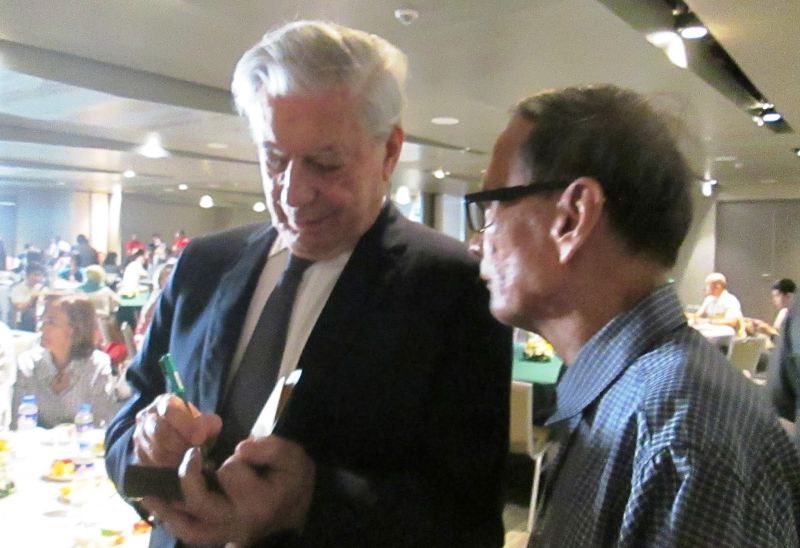
Mario Vargas Llosa signing Amadis’ copy of his book ‘The Green House’
Amadis took his singing seriously and became active with the Andres Bonifacio Choir of Jerry Dadap, performing with it, not just singing but acting, too. I have a picture, obviously misplaced, of him in camisa chino with a red kerchief around his neck and he holding up an itak or bolo. The picture made the rounds of Facebook, but for some reason, I can’t find it anymore.
In that picture, he was a Guerrero to a T.
Amadis Ma. Guerrero died on May 13, 2026 and left behind his only sibling Claudette G. Silerio, nieces and nephews, and grandchildren.


