
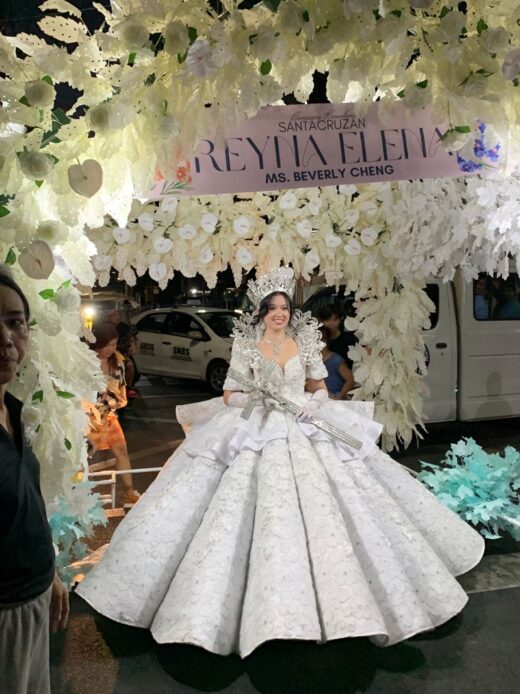
Maytime in the Philippines is punctuated by a series of town fiestas celebrating different saints. The whole month, however, is dedicated to the Virgin Mary, with children offering flowers daily at the foot of her image in churches.
The Flores de Mayo (Flowers of May) is sometimes mistaken for the Santacruzan (Holy Cross) that commemorates the finding of the True Cross by Queen Helena. The Santacruzan is the culminating celebration of the Flores de Mayo, a Catholic devotion introduced by Spanish missionaries in the 19th century.
While the daily floral offerings are smaller in scale, the Santacruzan is a grand procession of young women dressed in Filipiniana representing biblical characters, Christian virtues, or Mary’s different appellations. They walk under elaborate arches, usually escorted by young men known as consorts.
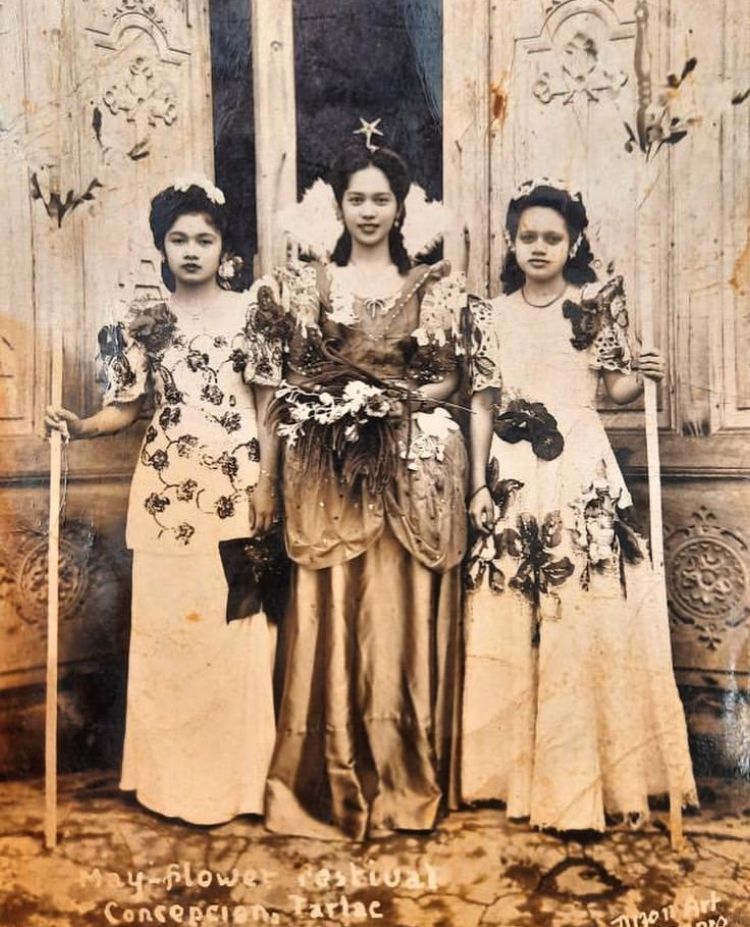
In 1947 photo taken in Tarlac, three women wear ternos with upright collars and capes. (IG: Fashionable Filipinas)
My first encounter with Santacruzan was through author and playwright Nick Joaquin’s The Amazing History of Elang Uling, his mesmerizing retelling of the age-old Cinderella story. It was one of the titles in his Pop Stories for Groovy Kids, a series of books published in 1979 by Mr. & Ms. Publishing Company, and one that I’ve kept and still treasure.
“Maytime came and with it the nightly Mayflower pageants,” Joaquin writes in the book. “You didn’t need to be invited to join in as zagala or escort. The young people of the locality came to town all dressed up for the procession. Every night a girl was picked to head the evening’s procession as Queen Helena.”
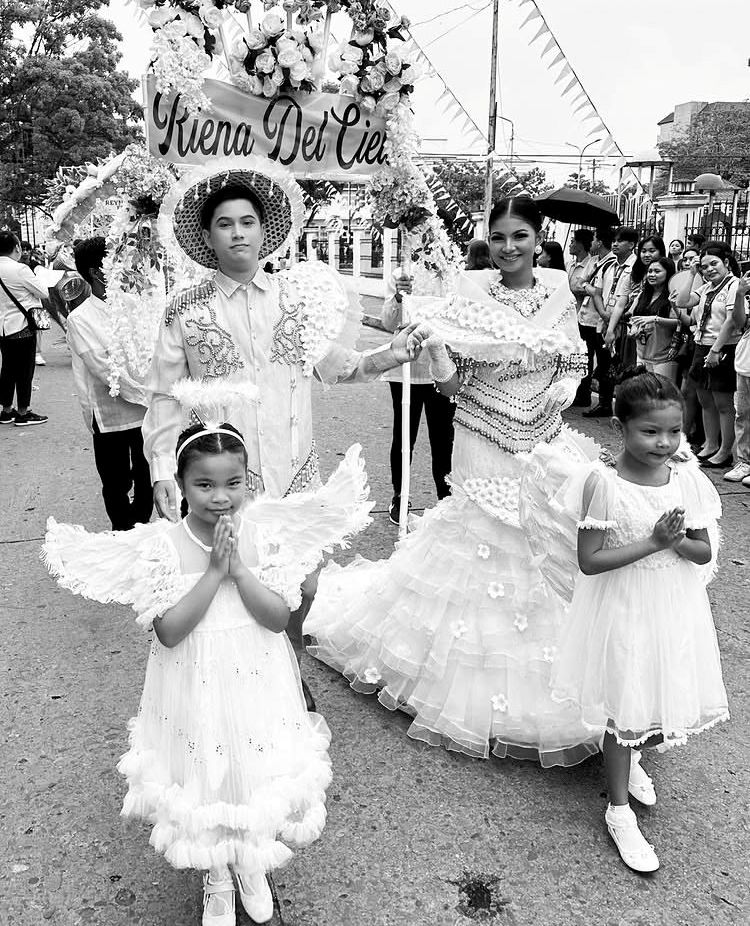
‘Reina del Cielo’ or Queen of Heaven with barong-clad escort and children dressed as angels (IG: Fashionable Filipinas)
The author plays around with the concepts of Flores de Mayo and Santacruzan, mixing and matching elements to move his story forward. Traditionally, Helena is accompanied by a boy representing her son Constantine, but for Joaquin’s purposes, his protagonist Ela is paired with “the richest heir in the province,” who informs her she has been chosen Queen of May.
To be chosen as Reina Elena was a huge honor for the young woman and her family, as she would be the latest in a long line of zagalas and reinas. Interestingly, the first character in the Santacruzan is a man, Methuselah, a biblical patriarch and the oldest man who is said to have lived several centuries. In the May procession he is followed by Reina Banderada bearing a yellow flag representing the growth of Christianity, Aetas who represent the indigenous people of the Philippines, Reina Mora representing Filipino Muslims in Mindanao, and Reina ng Sheba holding a jewelry box and representing the queen who visited King Solomon.
‘What entranced the Pinoy about Catholicism, however, was not its essence but its stupendous trappings….’
Then there’s Reina Judit holding the head of Holofernes, Cleopatra, and the Samaritana bearing a water jug and representing the woman at the well. These are followed by the female saints beginning with Veronica, and the three Marys: Magdalene with a perfume bottle, Cleofas with a bottle of oil, and Salome with a jar or a handkerchief.
Next are the theological and queenly virtues symbolizing faith (Reina Fe), hope (Reina Esperanza), charity (Reina Caridad), and followed by the embodiments of the different names of Mary such as Mirror of Justice (Reina Justicia), Seat of Wisdom (Luklukan ng Karunungan), Mystical Rose (Rosa Mistica), and Queen of Peace (Reina Paz).
Even with calls from church leaders to remember the real reason behind the event and hopefully tone down ostentatious displays of wealth and prominence, the Santacruzan can often look like a beauty pageant played out on the city streets instead of onstage.
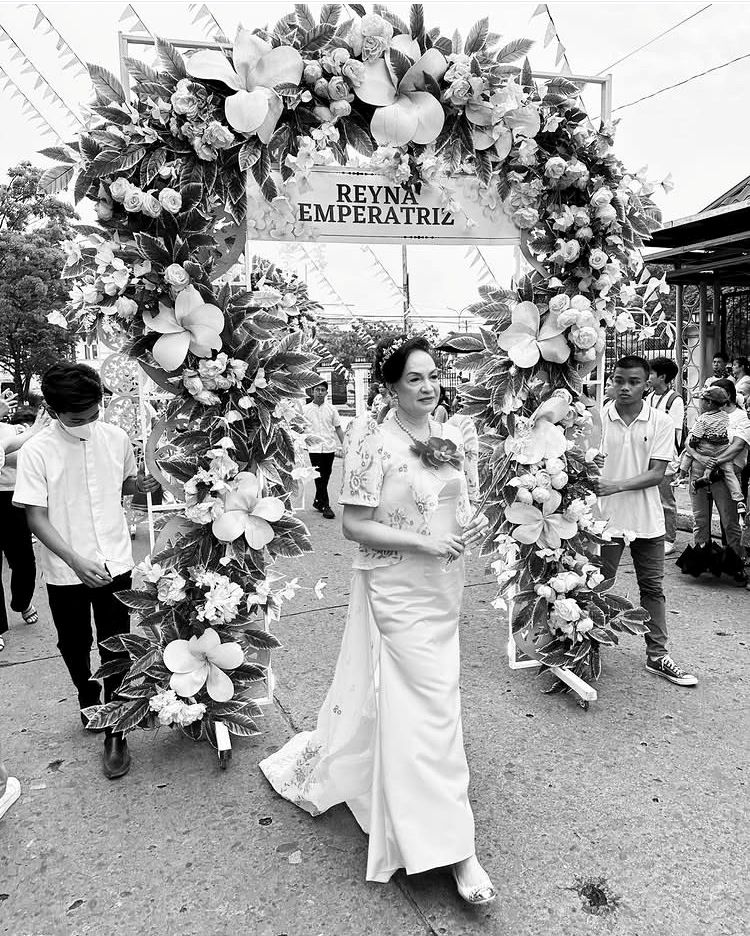
Reyna Emperatriz or Queen Empress is often a mature representation of Helena who found the True Cross. (IG: Fashionable Filipinas)
In a 2017 column in the Philippine Daily Inquirer, historian and professor Ambeth Ocampo wrote that when viewed through a beauty pageant lens, the “winner” in the Santacruzan is Reina Elena, with the first runner-up being Reina Emperatriz.
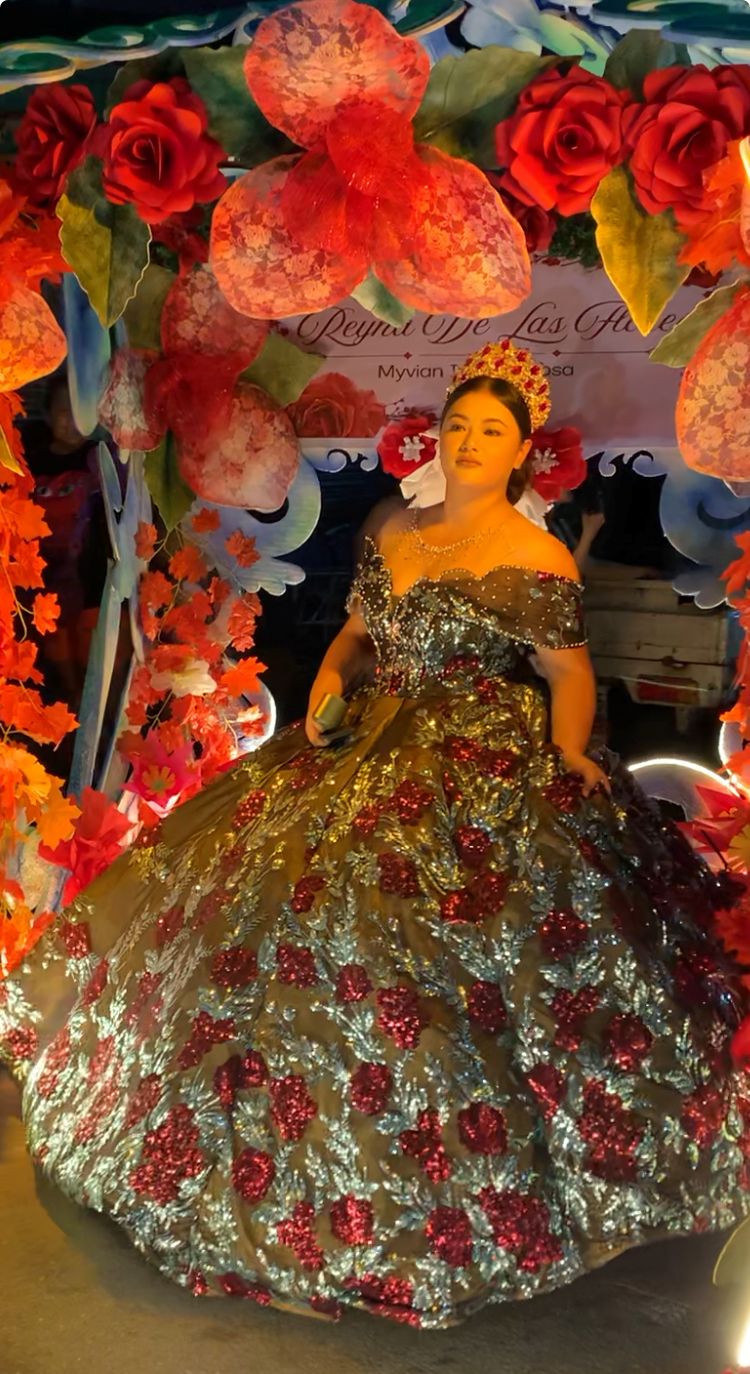
Reina de las Flores of Bgy. Kaunlaran, Quezon City, in capacious ballgown decorated with roses (Photo by Raoul Chee Kee)
During the recent Santacruzan in my barangay in Quezon City, the organizers saw fit to limit the queens to three: Reina de las Flores, Reina Emperatriz, and Reina Elena. All the remaining characters preceding the queens were cherubs, the neighborhood kids wearing simple white smocks and tinsel halos.
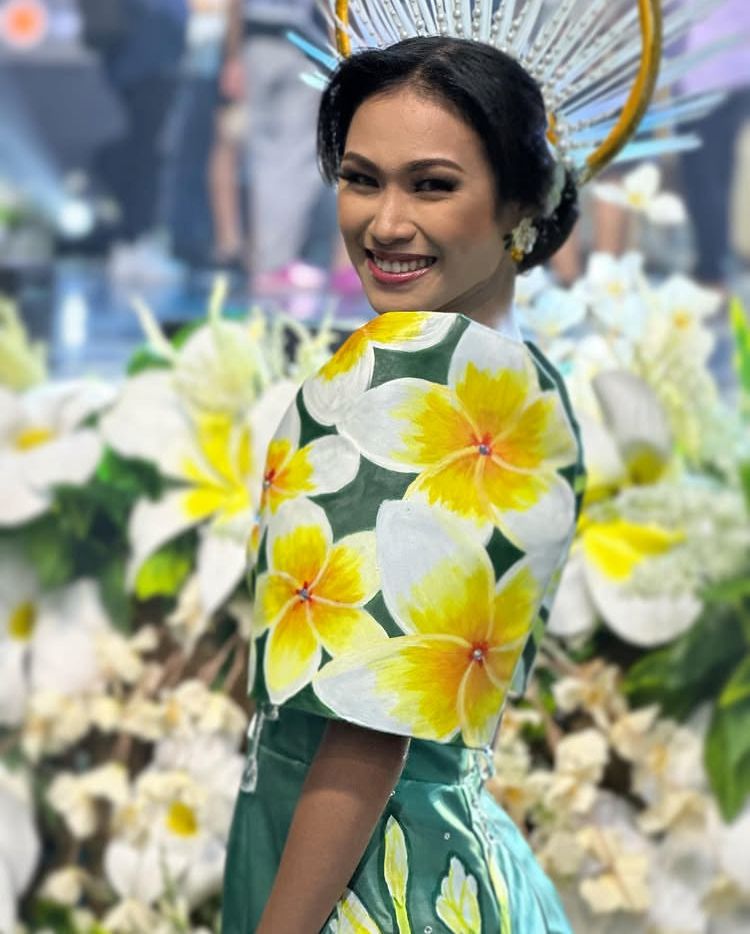
The ‘Kalachuchi de Mayo’ of Ormoc is the city’s take on the Santacruzan. (IG: Fashionable Filipinas)
The queens, however, were something else. They wore giant ball gowns with huge Michael Cinco-inspired skirts. No consorts assisted them as their skirts were already as wide as the arches they walked under. Instead of jars or crosses or rosaries, in their hands they clutched Jisulife fans, the better to ward off the heat.
Author Gilda Cordero-Fernando put it succinctly in Pinoy Pop Culture (Bench/Suyen Corp. 2021), the book she authored with Manny Chavez. “What entranced the Pinoy about Catholicism, however, was not its essence but its stupendous trappings: the huge silver altars, the High Mass, the lighted carrozas with quivering, costumed saints on top.”
Maybe the Santacruzan processions in the smaller towns are less gaudy, more fervent in devotion. We only need to seek them out and plot our visits.


