
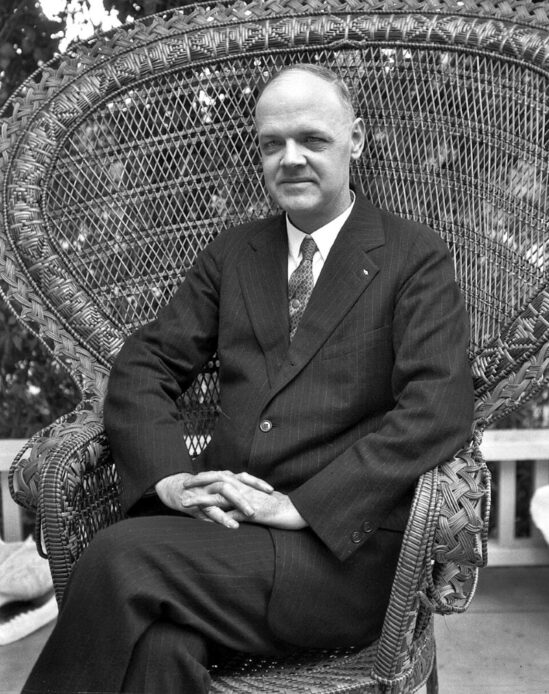
The collection of Fernando Amorsolo paintings of the Hon. George Arthur Malcolm, the founder of the University of the Philippines (UP) College of Law and eminent Supreme Court Associate Justice, is the highlight of Leon Gallery’s The Spectacular Mid-Year Auction 2026 on Saturday, June 13, 2026, Saturday, 2 pm. Malcom’s landmark rulings have a deep imprint in contemporary jurisprudence.
“One needs only ordinary perception to realize that the Filipinos are endowed with skilled hands and aesthetic temperaments,” wrote Malcolm in his 1957 memoirs, American Colonial Careerist. He was one of the most influential figures in Philippine history, a key to nation-building and the constitutional and legal development of the Republic. Malcolm was also an art collector with an eye for everything beautiful and Filipino.
“In the modern era, the foremost Filipino painter is Fernando C. Amorsolo, the foremost sculptor Guillermo Tolentino, and the foremost muralist Carlos V. Francisco,” he added. “They are the gifted successors of Juan Luna and Felix Resurreccion Hidalgo who, in Spanish times, were the Filipino artists who rose above mediocrity to win international acclaim.”
In his memoirs, he paid tribute to the Philippines’ most celebrated painter of his time. “The premier Filipino painter is Fernando C. Amorsolo. He has been able to catch the spirit of scenes among his countrymen and make them live on canvas. As I write, an Amorsolo painting of a lavandera, in whom is reflected the brilliant color of the tropics, looks down on me…This quiet genius of a man still lives among the people.”
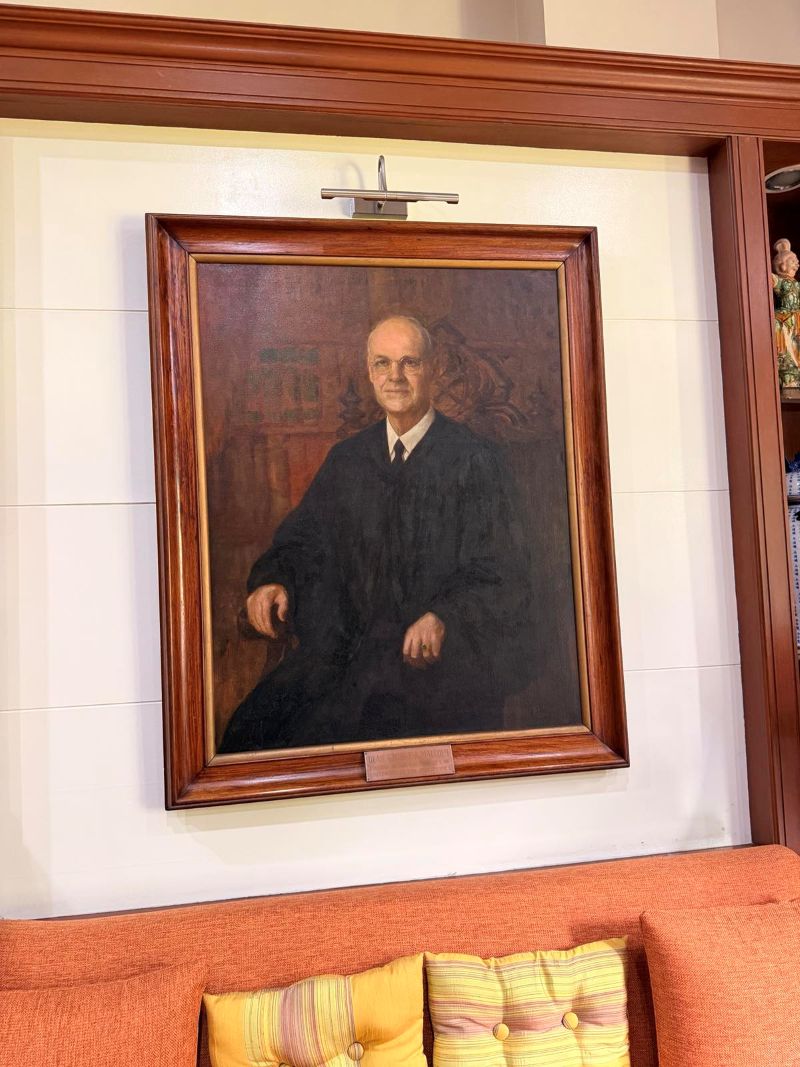
Fernando Amorsolo’s portrait of George Malcolm hangs at Malcolm Hall of the UP College of Law.
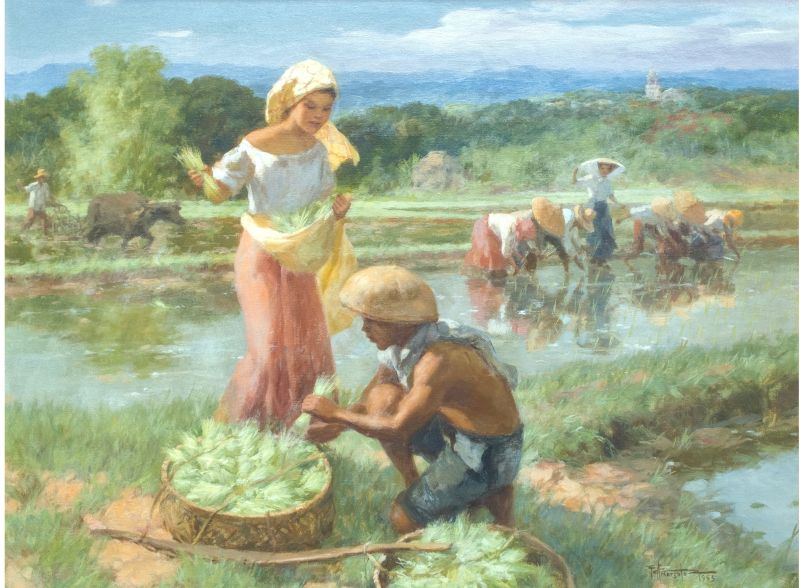
‘Planting Rice,’ Fernando Amorsolo (1892–1972), signed and dated 1954, oil on canvas, 20″ x 26″ (51 cm x 66 cm) (From the Hon. George A. Malcolm collection)
Amorsolo painted a portrait of the honorable justice, which now hangs at Malcolm Hall, the home of the UP College of Law and Malcolm’s brainchild. One of the Amorsolos in Leon Gallery’s upcoming Independence auction, Planting Rice (1954) was a gift of the Philippine Congress to Malcolm upon his conferment of honorary Philippine citizenship in 1955. Another work, Baguio Trail, painted in 1940, immortalizes Malcolm’s enduring love for Baguio, a city he helped to transform into the nation’s summer capital.
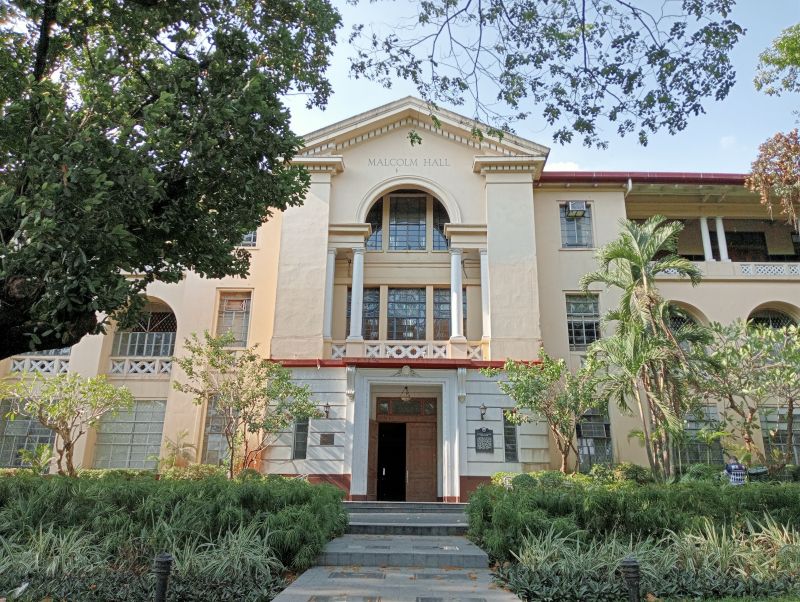
Malcolm Hall at the University of the Philippines Diliman, home to the UP College of Law, is a historic building named in honor of Hon. Malcolm. (Photo taken and uploaded by Ralff Nestor Nacor)
Who was Hon. George A. Malcolm, and what were his contributions to Philippine nation-building?
The late Jesuit lawyer, priest, and academic, Fr. Joaquin Guevara Bernas, S.J., a member of the 1986 Constitutional Commission that drafted the present 1986 Constitution of the Philippines, called Malcolm “the man who, more than any single American, contributed most to early constitutional development in the Philippines.”
Born Nov. 5, 1881, in Concord, Michigan, George Arthur Malcolm obtained his law degree from the University of Michigan. Malcolm was a descendant of Major General Sir John Malcolm, who served as governor of the Bombay Presidency (1827 to 1830), one of the three major centers of British power and influence in South Asia during its colonial era. Upon his graduation in 1906, Malcolm sailed to the Philippines, hoping to build his career as colonial officer.
Malcolm had humble beginnings, climbing the bureaucratic ladder slowly. He started as a temporary voucher clerk in the Bureau of Health, then civil service clerk in the Executive Bureau, a clerk in the reporter’s office of the Supreme Court, a secretary of the Code Committee, a teacher at the Philippine Normal School, then a law clerk, before being promoted to First Assistant Attorney General in the Bureau of Justice.
Malcolm was first and foremost a mentor at heart. In 1910, Malcolm wanted to establish a law school under the newly established UP and approached its Board of Regents. The board initially rejected his petitions, as it did not see the need to establish a school. Nevertheless, Malcolm established English language law classes that same year at Manila High School in Intramuros, under the auspices of the education department of the Young Men’s Christian Association.
Malcolm was first and foremost a mentor at heart. Among his mentees were future Supreme Court Chief Justice Jose Yulo, Sr., and pioneer industrialist Eugenio Lopez, Sr.
Seeing the fruits of Malcolm’s efforts and given his persistence, the Board of Regents finally affixed the stamp, establishing the UP College of Law on Jan. 12, 1911. By this time, the American colonial government had also acknowledged the necessity of involving Filipinos in the bureaucracy. What better way to achieve its goal of molding and assimilating the Filipino into a new system of Americanized reforms in culture, society, and civil administration—and to solidify the Philippines’ reputation as the bastion of American democracy—than to establish its own state-run law school in the islands, training future Filipino leaders in the American civil and legal tradition, which Malcolm had already envisioned beforehand?
Despite being the brains behind the UP College of Law and the pioneer of secular law education in the country, Malcolm had to start as college secretary. Sherman Moreland, an associate justice of the Philippine Supreme Court, became the UP College of Law’s first dean, albeit only “acting.” When Moreland resigned, Malcolm was promoted to acting dean, concurrent with his duties as college secretary. He would become the first permanent dean of the College of Law on Nov. 10, 1913, appointed by the Board of Regents.
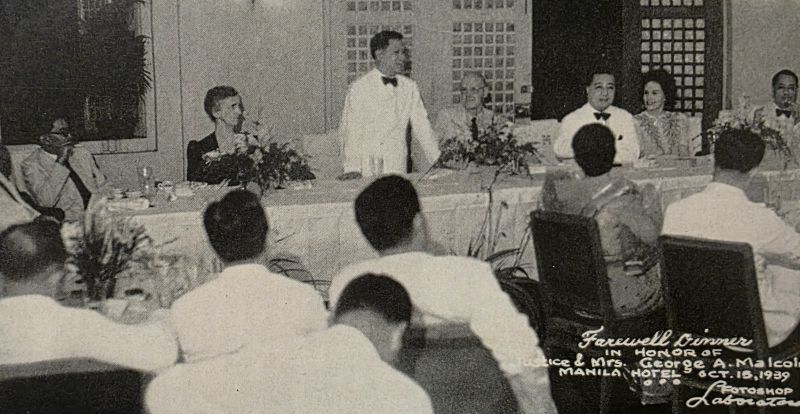
George Malcolm (fourth from left, seated) at a ‘despedida’ organized by his former students. At the head table, from left, Jose P. Laurel, Mrs. Vickers, Speaker Jose Yulo Sr., Malcolm, Elpidio Quirino, Malcolm’s wife Lucille Margaret Wolf, and Manuel Roxas (From ‘American Colonial Careerist’ by George Malcolm)
Malcolm mentored many of the Philippines’ future presidents: Manuel Roxas, whom he spoke of warmly as “the one nearest to me…of the many Filipinos whom I counted as friends,” and classmates Elpidio Quirino and Jose P. Laurel, in both of whom he saw early on, “a promise of future greatness.”
Malcolm also mentored future Speaker of the National Assembly and Supreme Court Chief Justice Jose Yulo, Sr., and Eugenio Lopez, Sr., the pioneer industrialist and media mogul, behind Meralco and ABS-CBN.
In 1917, US President Woodrow Wilson appointed a 35-year-old Malcolm as the 17th Associate Justice of the Supreme Court, the youngest ever to be named to such a prestigious position, the highest tribunal of the land.
Malcolm then resigned as dean of the College of Law in July 1917. Malcolm would be instrumental in penning landmark rulings and ponencias that are still referred to and held in the highest standard as authoritative jurisprudence in contemporary legal practice.
One of Malcolm’s most important rulings was Villavicencio v. Lukban (March 25, 1919), which has become among the most significant decisions in habeas corpus cases.
Approximately 170 women, who had lived and worked in a Manila red-light district, were forcibly transported to Davao under the orders of then Manila Mayor Justo Lukban, who wanted the district closed. The ruling clearly established the principle that public officials lack the legal authority to forcibly relocate or deport citizens without obtaining their explicit consent. This principle unequivocally extends to marginalized sectors of society, affirming their fundamental constitutional rights to liberty and the freedom to choose their place of residence.
Malcolm’s decision in United States v. Bustos (March 8, 1918) was also important for its landmark ruling on freedom of speech and to a greater extent, press freedom, holding that public officials must not be “too thin-skinned” when criticized, especially when done in good faith, as this is an unequivocal consequence of their responsibility and power. The ruling stemmed from a libel case against Felipe Bustos and fellow Kapampangans accusing Roman Punsalan, justice of the peace of Macabebe and Masantol, of malfeasance, and therefore, demanding his removal from public office.
“Men in public life may suffer under a hostile and unjust accusation, the wound can be assuaged with the balm of a clear conscience,” Malcolm wrote. “A public official must not be too thin-skinned with reference to comment upon his official acts. Only then can the intelligence and dignity of the individual be exalted. Of course, criticism does not authorize defamation.”
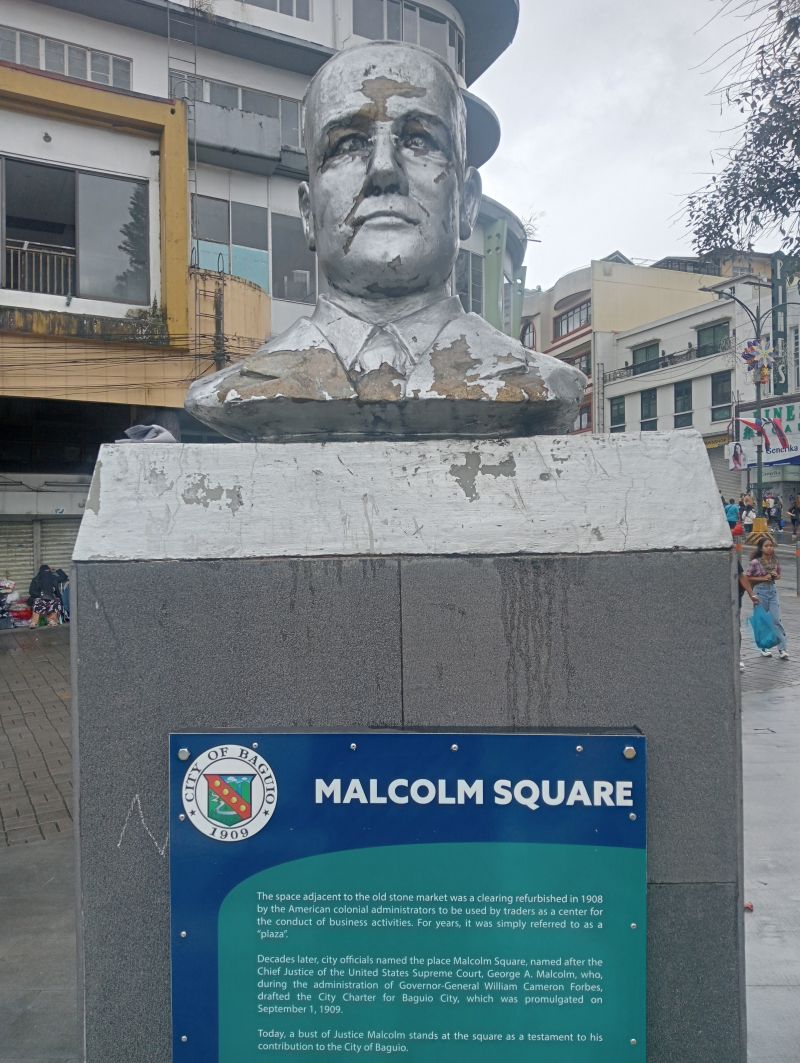
Bust of the Hon. George Malcolm at Malcolm Square in Baguio City, a place he called ‘my favorite city.’ (From Wikimedia Commons, photo taken and uploaded by Ralff Nestor Nacor)
‘A public official must not be too thin-skinned with reference to comment upon his official acts,’ Malcolm wrote
Malcolm was also instrumental in drafting the City of Baguio’s charter in 1909. Malcolm was a fledgling lawyer in the Bureau of Justice when he was handpicked to write the city charter and to travel up north to the Cordilleras to help plan the city government. In his memoirs, Malcolm recalled how Gov.-Gen. William Cameron Forbes summoned him to his office and told him, “I want you to proceed to a place called Baguio and make of it a city.”
Malcolm’s city charter explicitly specified “a city manager form of government adapted to local conditions…The local administration functioned through a Mayor, a Vice Mayor, and a City Council composed of these two officials and three other members…This is an encomium of which I am proud,” Malcolm wrote in his memoirs.
On June 18, 1855, the Philippines Congress, as approved and signed by President Ramon Magsaysay, whom Malcolm lauded for his efforts towards a clean government and austerity, conferred upon Malcom honorary Philippine citizenship, naming him an adopted son of the Philippines and granting him “all the rights, privileges, and prerogatives of Philippines citizenship” for his invaluable contributions “as the principal expounder of the fundamental law of the land, and as author of books on the laws and government of the Philippines.”
Leon Gallery’s The Spectacular Mid-Year Auction 2026 will be held Saturday, June 13, 2026, 2 pm. The preview exhibit will run from June 6 to 12, 9 am to 7 pm, at G/F Eurovilla 1, Rufino corner Legazpi Streets, Legazpi Village, Makati City.
To browse the online catalog, visit https://leon-gallery.com/. For further inquiries, email info@leon-gallery.com or contact 8856 2781. Follow León Gallery on their social media pages for timely updates: Facebook: www.facebook.com/leongallerymakati and Instagram @leongallerymakati.


