
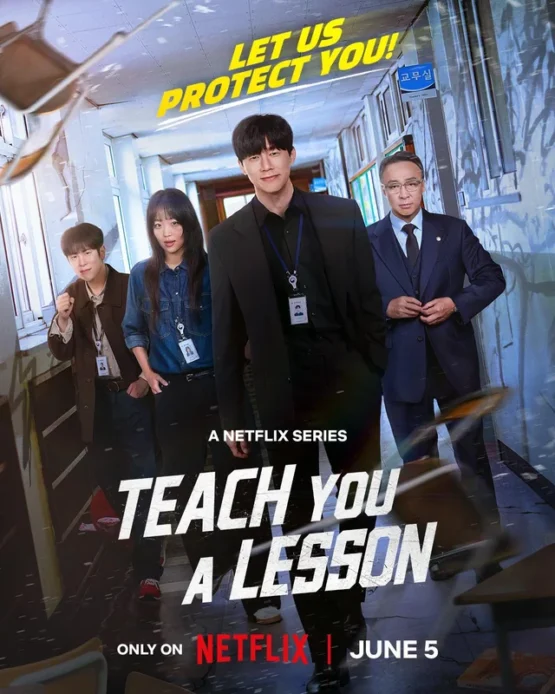
The premise of Teach You a Lesson that bullies should face the consequences of their deeds is why viewers binge-watched the 10-episode series, landing it on the Top 10 list of Netflix Philippines. Viewers were drawn to its relatability and its invocation of justice and hope; it also stirred deep emotions, i.e. empathy for the victims and indignation towards the persecutors. It had the best course of action for a society that protected bullies and left victims to suffer: Give the bullies a taste of their own medicine.
It’s misleading to say that the series, as Internet chatter goes, glorified corporal punishment as a means of disciplining wayward students. In fact, it didn’t. It clearly emphasized that seeking justice was taking just revenge, which Minister of Education Choi Gang-seok (Lee Sung-min) recited to his inspectors and IT expert like a mantra every so often.
Undoubtedly, the series is based on the controversial Naver webtoon Get Schooled, with its content of bullying, corporal punishment, and excessive violence that led to its removal from Naver’s North American platform in 2023. However, director Hong Jong-chan, per www.koreaherald.com, said he and screenwriter Lee Nam Gyu approached the story through “a more refined lens and created something meaningful,” and focused on “the fantasy of the Educational Rights Protection Bureau, or ERPB, itself.”

The cast of ‘Teach You a Lesson’, from left: Jin Ki-joo, Lee Sung-min, Pyo Ji-hoon (aka P.O), and Kim Mu-Yeon (Image from @pyojihoon_official)
Bullied students found an ally in the ERPB, a new organization founded and headed by Choi investigating school violence and decline in school authority, and protecting students from any form of violence by introducing reforms within legal bounds. The ERPB trio comprised Na Hwa-jin (Kim Mu-yeol), Im Han-rim (Jin Ki-joo), and Bong Geun-dae (Pyo Ji Hoon aka P.O), all under Choi’s authority.
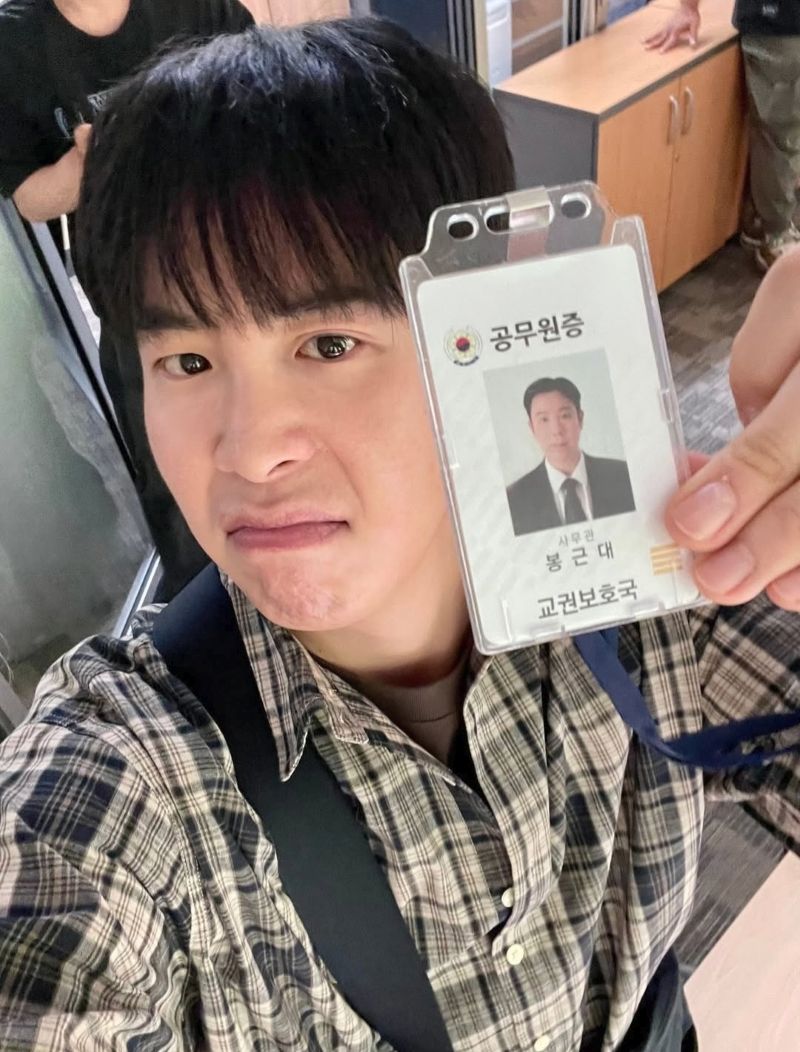
The name is Bong Geun-dae from ERPB. (Image from @pyojihoon_official)
Hwa-jin and Han-rim were inspectors, and Geun-dae was the one-person IT team who occasionally went undercover. Hwa-jin was the de facto leader of the trio that started as a duo (himself and Geun-dae, an egghead and fifth-grade civil servant). Geun-dae was inept at fieldwork so Hwa-jin recruited Han Rim, his unhinged former Special Forces sergeant, who he always had to remind that she shouldn’t kill the suspects. He and Han-rim went way back: He rescued her in her teens from bullies assaulting her mercilessly.

ERPB Inspector Na Hwa-jin reporting for duty (Image from @m00ut)
With Choi, they were a huge part of the show’s success. They were inspiring, overcoming their tragic pasts and dedicating themselves to helping the weak and downtrodden. Choi and Hwa-jin’s shared a loss—the former lost a daughter and the latter a fiancée—and led them to honor Ga-yun’s legacy of helping bullied students get justice.

Minister of Education and ERPB head Choi Gang-seok (Image from @kim_mu_yeol)
The team was also very likable. Choi was every employee’s dream boss—caring, protective, and a listener. As it stood, he was James Bond’s M to his ERPB agents, shielding them from attackers, detractors, and political games. His relationship with Hwa-jin tugged at the heartstrings because they were like a family despite the cancelled marriage to his daughter Ga-yun, who was murdered.
Han-rim and Geun-dae, the highly skilled colleagues, were dependable and funny. Geun-dae’s intelligence and calmness—suggestive of Dr. Spencer Reid from the American series Criminal Minds—softened Han-rim’s craziness. Conversely, Han-rim’s gutsiness helped Geun-dae handle social cues with more panache. On the whole, their idiosyncrasies provided hilarity, countering the seriousness of the series.
Hwa-jin was the Punisher without the anti-hero, one-man vigilante complex. He had the tenacity and approach of Baek Kang-hyuk, the trauma surgeon in The Trauma Code–Heroes on Call, who was unfazed by fancy titles. He possessed Vincenzo’s cool-as-a-cucumber demeanor, thrilling viewers to see him mow down gangsters without breaking a sweat. It was riveting to watch him go about his business without hesitation, putting to practice the ancient Hammurabian lex talionis on the unrepentant tormentors.
Hwa-jin possessed Vincenzo’s cool-as-a-cucumber demeanor, thrilling viewers to see him mow down gangsters without breaking a sweat
In the era of cancel culture, Hwa-jin was the welcome antithesis of Gen Z: unruffled even if a reel of him smacking a student went viral.

Former Special Forces sergeant Im Han- rim (Image from @kim_mu_yeol)
Teach You a Lesson narrated the violence that students and teachers experienced, which were investigated and resolved within each hour-plus episode. Interestingly, an all-encompassing storyline tied up the cases that served to challenge one’s deductive reasoning. If you’re quick on the uptake, connecting the dots added to the overall satisfaction of watching the series.
Significant issues were spotlighted in the series—the injustice brought about by the disparities between socioeconomic classes, the prejudices against poor students, and suicide. One episode showed a politician’s child lording it over the school, with students and teachers kowtowing to him; other episodes had bratty troublemakers manipulating meek classmates and soft-hearted parents. But the series didn’t leave frustrating open endings. It presented the bullies’ just deserts, with Hwa-jin et al., showing the defiant students and permissive parents the errors of their ways.
Teach You a Lesson also showed the flip side of a situation: the teacher as the bully. A popular, respected teacher colluded with a wealthy mother to have the top student—who was destitute and without social capital—replaced by the mother’s mediocre daughter. The teacher was paid handsomely and even promised a lofty position in a government department. Like the rest, the once-revered teacher fell from grace.
Students weren’t necessarily always the victims. Burnt-out teachers were pushed to the edge of sanity on top of being harassed and disrespected. A male high school teacher ended his life after being falsely accused of sexual abuse by a student-influencer. A female elementary school teacher plunged into suicidal depression after being hounded and gaslighted by her student’s mother.
That parents could be the biggest bully was also suggested in the series, such as parents fixated on their children and their children’s future, to the detriment of their children’s mental health. An episode cleverly narrated how a mother’s fixation with prestige—she wanted her son to get to study medicine—nearly wrecked her son’s life, moving viewers to loathe her. Similarly, another episode showed how a mother’s ridiculous nitpicking eroded the wellbeing of both teacher and student.
The line was razor-thin between fiction and reality, so when fiction crossed over, it didn’t seem surprising. Who would think innocent students could be murderously cruel? Apparently, they could be. Schools were presented as faced with constant bullying, with hardly any attention paid to it.
Still, one must remember that the series is fiction, despite the many details giving it verisimilitude. Nonetheless, fictional justice is cathartic, and the hope that it brings is balm for the troubled soul.
Teach You a Lesson was a reminder of forgotten lessons: that injustice mustn’t be swept under the rug; that justice is impartial; and that karma packs a mean wallop. It also carried a subtle dig at keeping quiet all the time, the point being that taking abuse won’t make the problem go away.
Viewers are keeping their fingers crossed that the quartet will return to help the wounded get justice. At least justice wins, even if in fiction.


