
NOT to say that I have a direct line to Mama Mary, but—she’s been quite an undeniable presence in my life over the years. Last experience was when I was waiting for a friend to secure us BTS tickets in Singapore (I know, I know). The block rosary image of Mama Mary was in my house, so I lit a candle and asked her, kung puede lang, please. Less than a couple of hours later, I had my ticket. Yes, little things like that, because she gets it. Maybe Mama Mary is ARMY, too—just sayin’.
(Before Christian friends and readers freak out, please know that yes, Catholics understand that we ask Mama Mary for intercession with her son, the big guy, Jesus Christ. Still, she is an extraordinary mediatrix who never fails to put in a good word for those who come to her. Well, maybe Jesus is ARMY, as well.)
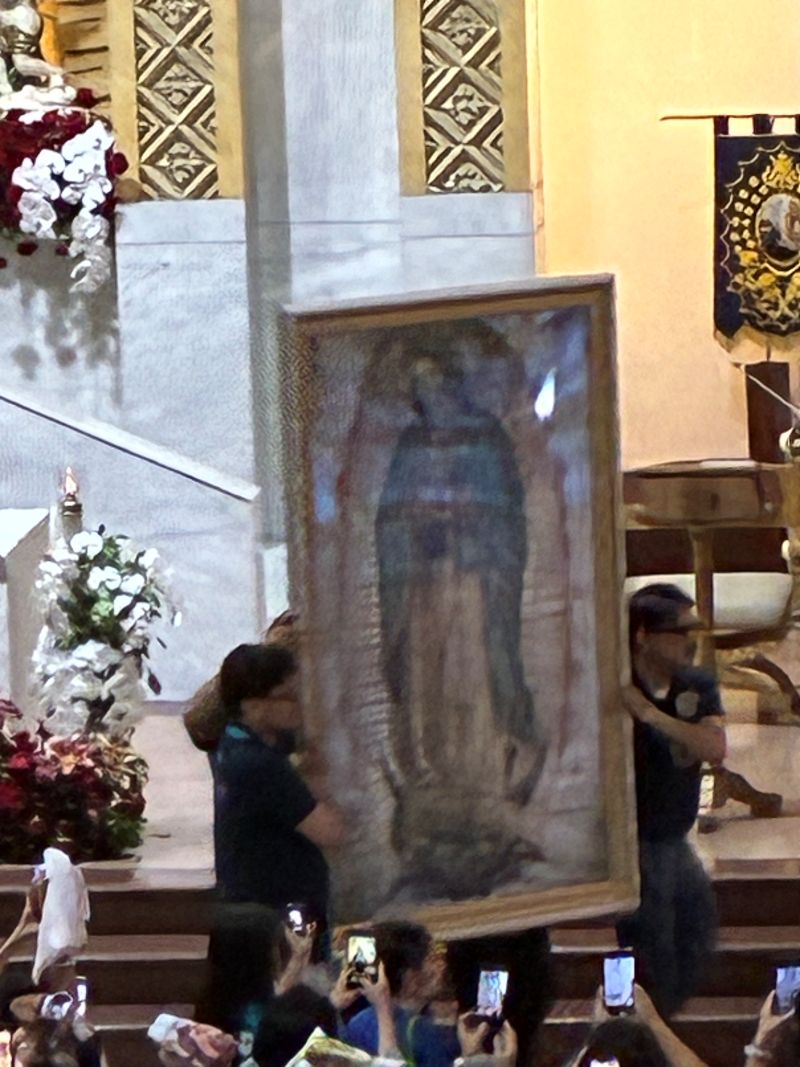
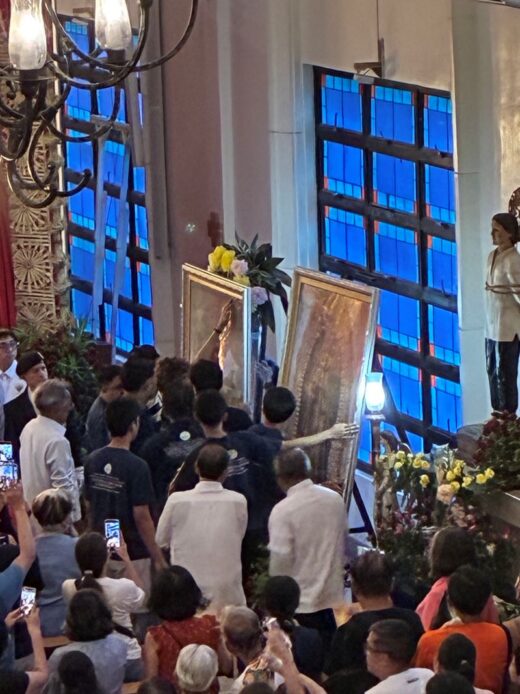
The pilgrim ‘tilma’ is carried inside the shrine as phones capture the occasion.
In 2023, in my first major trip out of the country since COVID closed so many doors, my friend Christine Chua and I had swung by Mexico City after a dive trip to Revillagigedo, Mexico. It was a very emotional experience for me, and Christine actually took a picture of me sobbing outside the shrine gates. We attended Mass, gazed upon the miraculous tilma, and just soaked in the powerful energy of the most visited shrine of the Blessed Virgin in the world.
Our Lady of Guadalupe is a special representation among Mama Mary’s many images the world over. The apparition came to a Mexican Indian peasant named Juan Diego in 1531 on Tepeyac Hill; the site of the original appearance is still preserved high above the grounds of the shrine, a small chapel where Juan Diego would sleep to guard the tilma, the cloth where the Virgin’s image was imprinted.
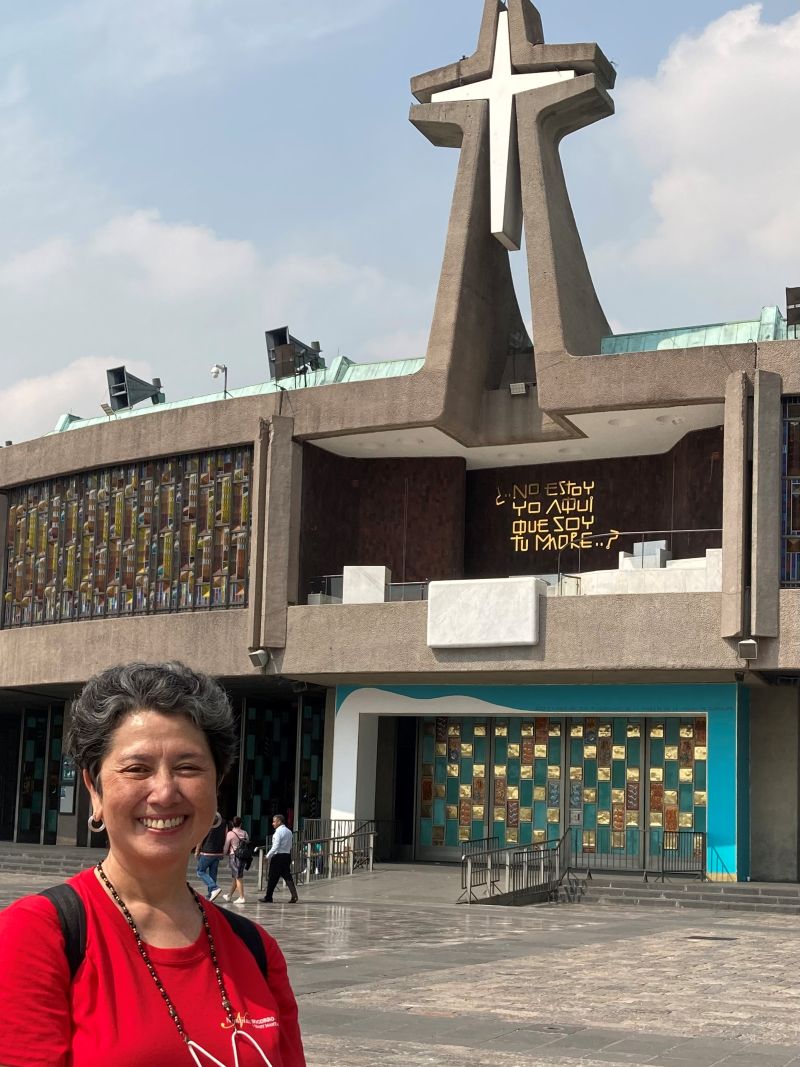
The author at the Basilica of Our Lady of Guadalupe in Mexico City, 2023
So imagine this: An uneducated peasant encountered this vision, and ran back to the city to report it to the then Archbishop of Mexico, Juan de Zumarraga, who was kind enough not to throw Juan Diego in jail, but instead asked for proof. Juan Diego reported this to Our Lady, albeit apprehensively, which was when she uttered the now famous words that have given Catholics worldwide so much comfort: “¿No estoy yo aqui, que soy to madre? (Am I not here, who am your mother?)” She also instructed him, in the dead of winter, in the harsh Mexican desert, to gather roses from a nearby bush and bring them to the Archbishop.
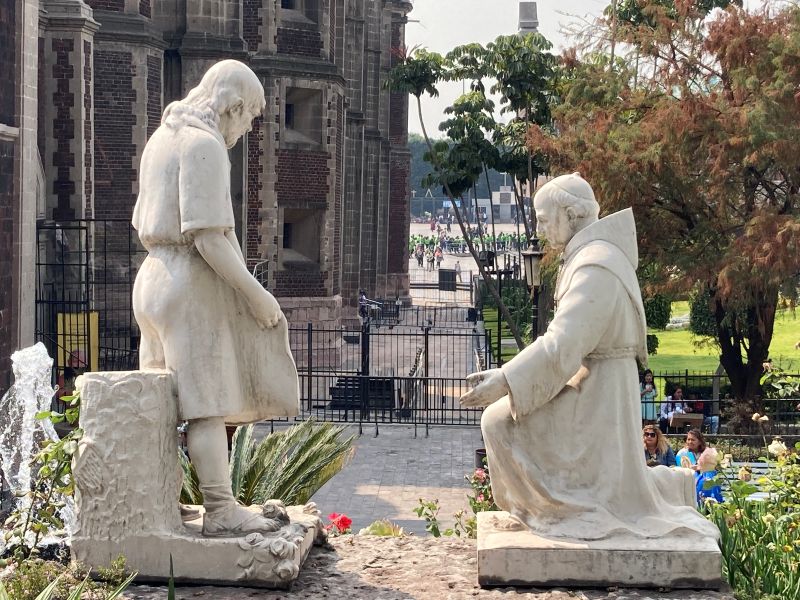
A statue on the grounds of the basilica, showing Juan Diego revealing the roses and the ‘tilma’ to Archbishop Juan de Zumarraga
When Juan Diego opened his tilma, the all-purpose woven cloth that indigenous people used as a blanket, cloak, raincoat, or whatever they needed, the red roses poured out and brought the Archbishop to his knees. More important, an image was seared onto the tilma—a portrait of Our Lady with brown skin, and possibly one of the few depictions of her pregnant. At a time when most known images of the Virgin Mary were markedly Caucasian, this was a reminder that she was indeed a mediatrix for all people, especially the poor. She is considered the Patron Saint of the Americas and Mexico, protector of the oppressed and the unborn, and her feast day is December 12.
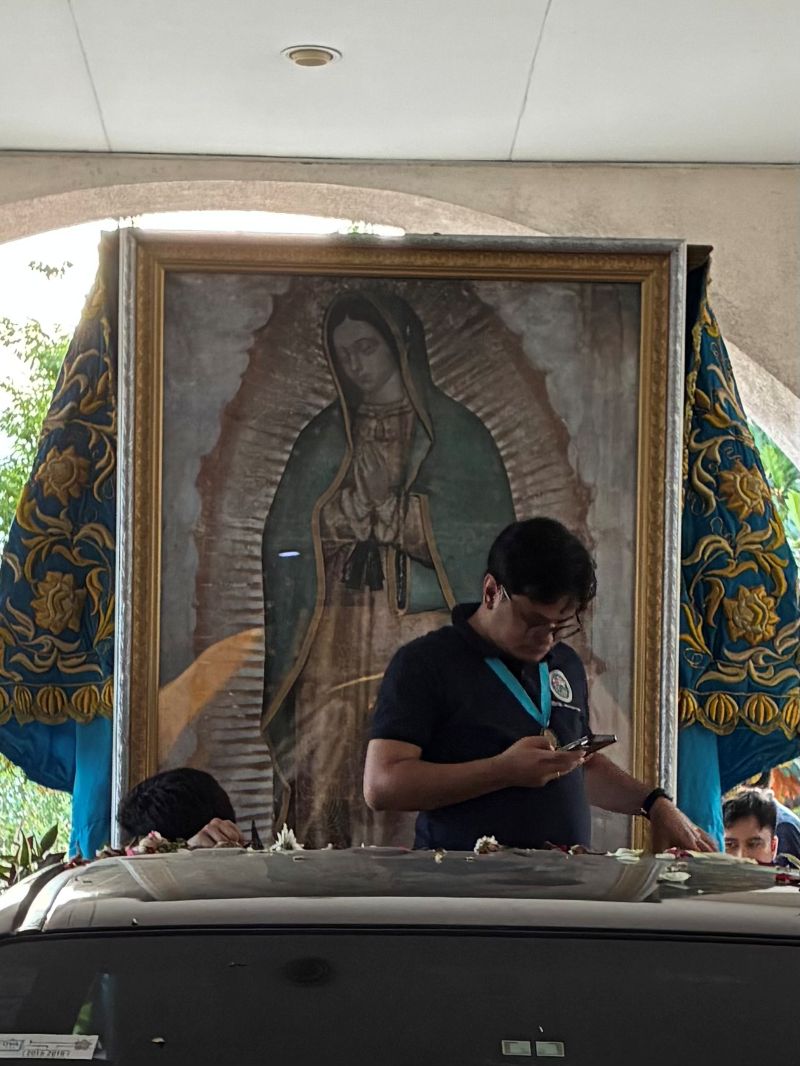
The pilgrim ‘tilma’ waiting to be brought into the church, while an attendant catches up on text messages
The tilma is likewise a miracle in itself, having survived fires, acid, and all kinds of disasters intact. It has been examined and re-examined dozens of times by experts; whereas a regular tilma is made of plant fibers that should have disintegrated years ago, this one is turning 500 years old in 2031, the quincentennial anniversary of the apparition. The pigments were determined to be made of substances not known on this earth, making it the only image of Our Lady that was literally made in heaven—a mind-boggling realization. In the Virgin’s eye, magnification has revealed 13 people, including the likenesses of Juan Diego and Archbishop Zumarraga, along with a family. Because of his acceptance of the miracle, the street where the Basilica is located in Mexico City was also named after Zumarraga.
The pigments on the ‘tilma’ were determined to be made of substances not known on this earth, making it the only image of Our Lady that was literally made in heaven
Today, the tilma must be the most sacred object in Mexico and one of the most venerated in the world. The Catholic Church officially approved the apparitions of Our Lady of Guadalupe in 1555, 25 years after they happened—express recognition for the Catholic church. By contrast, it was only in 2000 when Saint (then Pope) John Paul II canonized Juan Diego as a saint—a recognition that was, in my opinion, a very long time coming, a ridiculous 495 years.
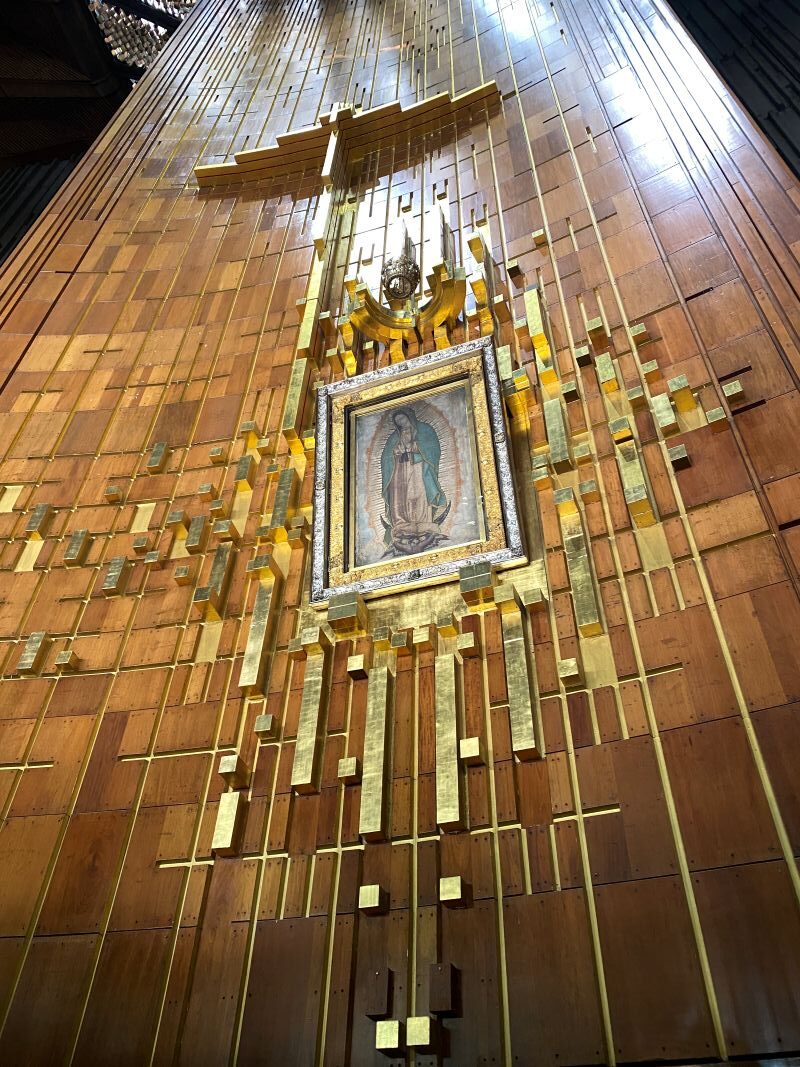
The venerated, miraculous original ‘tilma,’ wonderfully intact after almost half a century, enshrined at the Basilica in Mexico City, 2023
The Shrine in Mexico has devised an ingenious way to keep people from crowding under the image: Visitors get on a walkalator that keeps them moving under the image, which is enshrined some 10 feet above you on the wall. If you want another look, you have to get back to the beginning of the line.
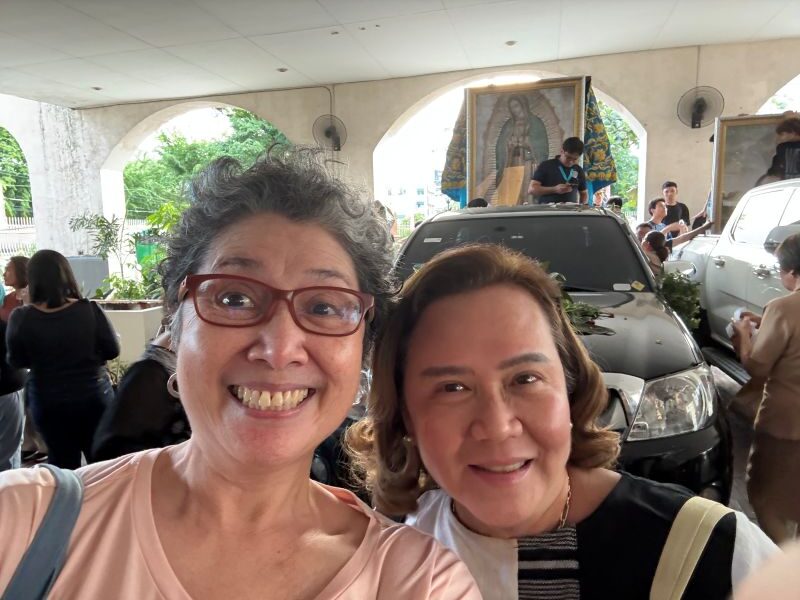
The author and friend Kathy Oppen in front of the pilgrim ‘tilma’ that had just arrived in the church driveway in Makati
When news that a traveling pilgrim version of the tilma was coming to the Philippines, friends and I quickly decided we had to visit. Our target date was the afternoon of June 21, Sunday, at the Santuario de San Antonio in Makati. For some strange reason, when I couldn’t sleep on Thursday night, I chanced upon an updated online schedule that revealed that by June 21, the tilma would already be headed to Zamboanga! A quick change of plans was in order, and my friend Kathy Oppen and I opted to catch the 6:30 pm anticipated mass on June 20 at the National Shrine of Our Lady of Guadalupe on Orense St. in Makati.
We arrived at 5 pm, just in time to see the image parked in the driveway after a motorcade around the narrow streets and some villages of Makati. Thus, we got really close; people were already asking the attendant standing on the back of the pick-up truck carrying the tilma to wipe handkerchiefs and other personal items on the framed image, a very Pinoy way of making contact with the divine. Also, Mama Mary was not alone: accompanying her was a framed image of St. Juan Diego himself.
The church was already packed, but just as Kathy and I were resigned to stand through the Mass, a lady started ushering people to the choir loft to occupy seats. We ended up in the first row, with a view of the huge church. I had never been to this shrine, and the grandeur surprised me. The church already had its own gorgeous statue of Our Lady, despite its being a bit too pale for my liking; I always get a little perturbed when she is represented as less brown than the original image depicts.
Still, it hit different to be in the same place as the pilgrim tilma and a church full of my countrymen. When the images were carried to the altar, accompanied by incense and song, the crowd waved their small tilmas, handkerchiefs, and anything in their hands, and phones rose into the air to capture the event. The sheer energy of Filipino faith was enough to make my knees weak and my eyes water.
Parish priest Rev. Fr. Carlos Reyes gave an engaging (albeit long) sermon, mentioning Juan Diego’s hesitation, and repeating how the tilma was “made in heaven.” Even the aisles between the four rows of pews were crammed with people, and Fr. Reyes joked about how the shrine’s airconditioners (I counted 12 big ones) weren’t equipped to handle this big a crowd. Notably, there were many men in attendance, as well, proof that piety—and devotion to the Virgin Mary—is no longer just be a woman thing.
Kathy and I were grateful that an entire barangay of special ministers of the Eucharist was fielded, so one came up to the choir loft to distribute Holy Communion. All in all, it was a very organized visit. We squeezed our way through the crowd on the way out, giving thanks to Mama Mary for the impeccable timing, and for facilitating our visit. It was heartwarming to know that, even as I had already visited her in her home, La Guadalupana (as she is called in Mexico) was also willing to fly across the sea to grace us, her children in the Philippines.
The pilgrim ‘tilma’ of Our Lady of Guadalupe will visit Mindanao (Zamboanga, Ipil, Pagadian, Dipolog, Misamis Occidental, Cagayan de Oro, Malaybalay, Kidapawan, Cotabato, Gen. Santos, Digos, Davao City, Tagum, Mati, Prosperidad, and Butuan) and the Visayas (Loboc, Dumaguete, San Carlos, Bacolod, Iloilo, Roxas City, Kalibo, Cebu, Maasin, and Palo), before she returns to Luzon (Sorsogon, Gumaca, Pagsanjan, Infanta, Antipolo, Taytay, Cabanatuan, San Jose City, Tuguegarao, Laoag, Vigan, La Union, Baguio, Urdaneta, Binmaley, Alaminos, Tarlac, Olongapo, Subic, Pampanga, Bulacan, Lipa, Gen. Trias, Parañaque, Muntinlupa, Pasay, and Cavite), before wrapping up at Santuario de San Antonio in Forbes Park (Dec. 7-9) and the Manila Cathedral (Dec. 12), where the visit was launched. For names of churches, visit the Facebook page Our Lady of Guadalupe – Philippine Pilgrimage 2026. Please note that the schedules may be subject to change.


