

Love Between Lines
C-drama
28 episodes
Starring Chen Xingxu, Lu Yuxiao
Streaming on Viu
If you want a love story that is sweet but not cloying, a love story that doesn’t dumb you down, Love Between Lines is it. If you want a respite from the day’s yucky political news, this entertaining and escapist C-drama is it. If you want eye candy, actor Chen Xingxu is definitely it (as the fans who mobbed him in Bangkok and Paris recently must believe)—not pretty-boy idol looks, just manly handsome. He brings mature machismo—and charm—to the role.
Definitely he’s one of the best romantic leads in today’s dramaland, and this is one of the most kilig love stories of 2026.
It’s a story between a young woman (Lu Yuxiao as Hu Xiu) determined to pursue her passion for architecture and design, and a self-made architect (Chen Xingxu as Xiao Zhiyu), who, from scratch, builds an upstart firm that now pits itself against the giant firm in Shanghai’s architecture industry, a firm that, it turns out, is tied to his tragic past.
Architecture brings the couple into each other’s life—that and Shikumen (the Shanghai heritage lane house). How ingenious of these drama writers to put Shanghai heritage architecture in a starring role—right in the heart of the love story. The couple share a love of architecture, but unbeknownst to them, they also share a tragic past that would test this brewing romance.
How ingenious of these drama writers to put Shanghai heritage architecture in a starring role
The series begins with a pretty but stressed Hu Xiu being stood up by her fiancé at their engagement, where the couple’s friends and families are already gathered. This social disaster leaves Hu Xiu depressed. She holes up in her room and would have done so forever, had her best friend (played by Li Tingting) not dragged her quite literally to the role-playing club across the best friend’s coffeeshop. Here she immerses herself in fantasy roles—with goodlooking actors at that. Role-playing game clubs must be a big thing in China, with anonymous actors who are called NPC (Non-Player Character) having their own fanbase.
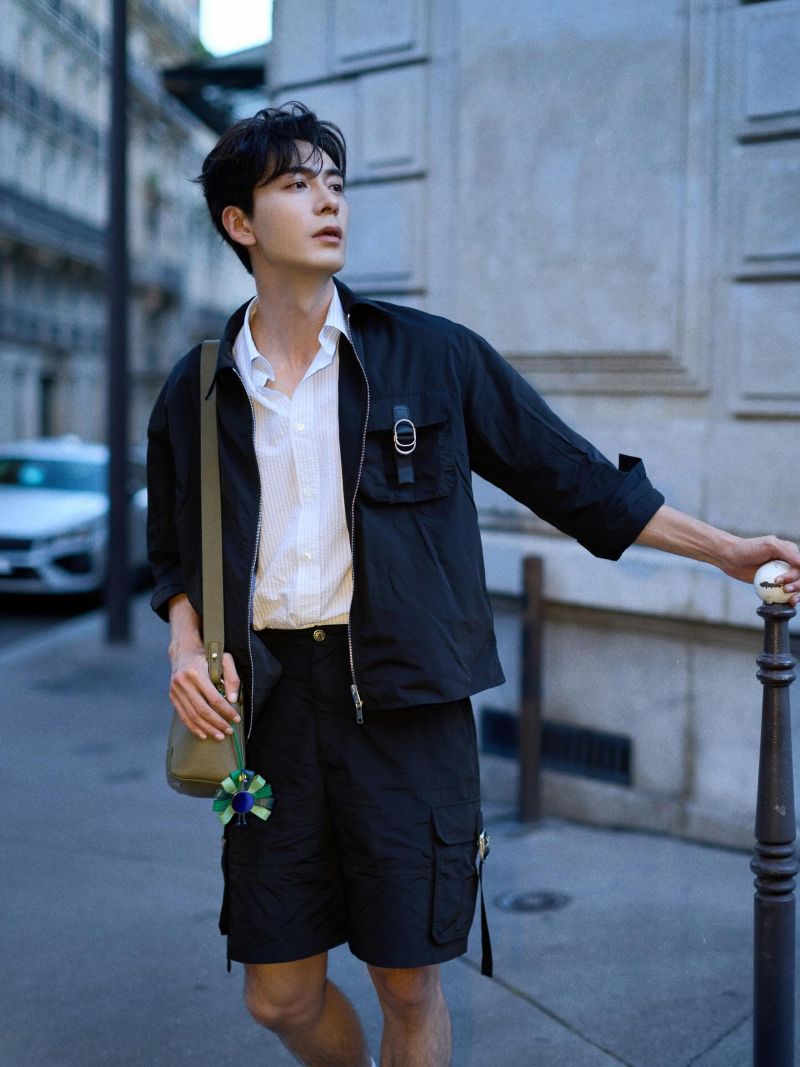
Chen Xingxu in the recent 2027 Paris Fashion Week (IG @chenxingxu_0331)
Joining the club and slipping into a fantasy role allow the female lead Hu Xiu to forget her ill-fated engagement temporarily, even if she also ends up a loser betrayed in her role game—while pitting wits against the top NPC actor, who happens to be Chen Xingxu’s character Xiao Zhiyu. As in their role-playing, the real life of this couple would swing from trust to a feeling of betrayal, and ultimately trust again.
Fed up with her menial job, she quits it, and needing income, she decides to sublet her loft. At around this time Xiao Zhiyu is looking for a lane house to rent, but he wants to conceal his identity as head of the architecture firm. The comedy begins when the landlord Hu Xiu and this tenant in disguise discover each other’s real identity, and worse, when she ends up working in his architecture firm. Even more hilarious is when and how she tries to convince him, now her boss, to let her live with him in her own lane house.
It’s when they’re forced by circumstances to live together that the funny sizzling romance ensues. Their relationship evolves, with kilig moments, like when he injures his hand trying to save her while role-playing in the club. They start doing small gentle deeds for each other, and try to integrate themselves in the lane-house community life. This gives the series a cozy cultural vibe. (Why can’t Filipino teleserye writers go beyond poverty porn when depicting local neighborhoods, leaving us viewers no other choice but to wallow in self-pity? But that’s another story.)
View this post on Instagram
Interestingly, the series has a subplot—life in the Shikumen or Shanghai lane house, how not to tear it down but have it repurposed for contemporary lifestyle. Chen Xingxu’s romantic character Xiao Zhiyu—the architect—has to live in it so he can draw a concept for the winning bid for his architecture firm. In their idle but honest chat, Xiao Zhiyu learns from Hu Xiu that the lane house is not only about aesthetic, but also taps into the collective memory of the old Shanghai neighborhood. The architect in Xiao Zhiyu conceives a concept drawn from a bygone era yet contemporized through the use of virtual technology. He will submit it as the concept of a hotel project he is determined to blow away his stepfather’s firm with.
Why he obsesses over winning this project, you find out, is not only due to his love of architecture, but also because of a consuming desire for revenge.
Underneath this sweet love story unfolds his tragic childhood. The only child, he lost his father, an architect himself, when the latter committed suicide—or so the report stated—during the collapse of a landmark construction under the watch of his father. The father’s name bore the shame, such that his only son had to grow up living under an assumed name, Xiao Zhiyu. His father’s firm was taken over by his partner—who would marry the widow, Xiao Zhiyu’s mom. Xiao Zhiyu grows up estranged from his mother even after he moves with her new family to the US. Xiao Zhiyu fends for himself through architecture school in the US, not wanting to have anything to do with his stepfather and stepbrother.
He returns to Shanghai to put up his own firm, an upstart that becomes known for its hotshot architect founder. His stepfather and stepbrother now run the giant firm (the same one they took over from Xiao Zhiyu’s late father) that Xiao Zhiyu plans to bring down.
With a close friend, he puts up a role-playing game club, where in the fictitious role, he can use his real name, Qin Xiao Yi—it’s his escape and his only tenuous link to his real identity. In this club, as a popular NPC actor, he meets Hu Xiu, the down-on-her-luck female lead.
View this post on Instagram
The plot unravels how Hu Xiu herself—she’s an only child whose father has been left impaired in a construction mishap—is linked to Xiao Zhiyu’s tragic past. Her father unable to work, Hu Xiu, even with a college diploma, has to give up a dream career in architecture and just settle for a menial administrative job. Her decision to apply in Xiao Zhiyu’s architecture firm is her feeble attempt to return to design.
There she comes onto her own, an empowered architect who overcomes her antipathy towards her handsome but stern boss, and eventually becomes his ally, especially when they’re forced to live in the same lane house, ostensibly for research.
This love story is unembellished and simple, yet touching and suspenseful—what happens when the female lead finds out the real identity of Xiao Zhiyu, and how his father was behind the disaster that left her father handicapped for life? How she reacts is a very good portrayal of women who are not blinded by romance. Our female lead is a thinking young woman, not ditzy.
The confrontation scene of Xiao Zhiyu and Hu Xiu—the moment of truth—is a high point that brings out the highly nuanced acting of the lead couple. Just when he is outgrowing the need to continue his assumed name as NPC and just when he’s beginning to muster the strength to reveal his own identity—thanks to the warmth provided by Hu Xiu—a plot twist comes.
C-drama presents women as gritty, not bungling airheads
The character development in this series is well done. We notice how C-drama doesn’t condescend to woman characters. It presents women as gritty, not bungling airheads, empowered, with their own pursuit of self-fulfillment, independent of their men. They don’t need validation from anyone to know their real worth.
Chen Xingxu’s male lead has arrogant charm, is stern and cynical, while Lu Yuxiao’s female lead is gracious even as she flirts, warm and caring even as she bites back. On New Year’s Eve, as he’s consumed with the desire for vengeance, he is accidentally drawn into joining her and her family for dinner in the lane house, and ironically, enjoys family bonding.
So touching is the rooftop scene where she tries to comfort him and he turns away as she tries to kiss him, because he doesn’t want to lose his thirst for vengeance. He terminates the lease on her flat, his heart filled with hatred hardly having space for her. Their confrontation is an intense scene.
But then comes the irony of love—he feels jealous when an office project puts her in the company of his nemesis, his stepbrother. This yields some really funny scenes—this is a romcom, you get reminded—such as when he shows up from nowhere to pick her up after her cafeteria dinner with the stepbrother.
This love triangle lightens up the drama. Likewise, how this couple in love is caught in the act right in the lane house by their best friends is a romantically hilarious scene you’ll want to replay. And before that, how their passionate run-in in the game club is discovered by the staff is another pause moment for the viewer.
Will the couple beat the fate that plays tricks on them? This is the love story that gets you hooked, enough to make you Google Chen Xingxu and Lu Yuxiao. Your search will leave you rewarded with many reels of Chen in Dior in the 2027 Paris Fashion Week, or in Budapest for a reality show series. Handsome has just turned global.


