

TO call On Your Feet! a jukebox musical is an understatement; I would rather call it a dance-o-rama, to resurrect that term. While the sequence of songs arguably seems to be in chronology with the storytelling on how Gloria and Emilio Estefan succeeded in penetrating the American
soundscape, from start to finish, each dramatized sequence, followed by a rhythm-heavy song, is dominated by a dance explosion of about a dozen dancing pairs. They dance in a high-energy cross-section of Latin styles from salsa to rhumba to zumba, and down the line, cross-bred with modern ballet moves.

The show goes on its final run this weekend at the Proscenium Theater in Rockwell.
Act One concentrates on a flashback to Gloria’s childhood in Miami’s Little Havana, a section of the state where Latinos, mostly Cubans, had migrated from 1959 onward. Reese dela Vega Iso and Althea Ruedas alternate as the young Gloria. Both have well-placed voices and charming signature Latin hip movements that are hard to ignore. Gloria Fajardo, Gloria’s mother, feisty, judgmental, racist, and highly opinionated, is convincingly portrayed by Ayen Laurel in her comeback theater appearance after an absence of some years. Her strong opposition to Gloria’s musical ambition is driven by her own resentment because of her own unsuccessful attempt at a music career in Cuba, before she migrated her family to Miami. Ayen comes off more than confident in her acting as a frustrated singer secretly envying her own daughter’s more successful attempt. Her unspoken bitterness and envy, if you may, festers down to her harsh treatment of Emilio, who is instrumental in recognizing Gloria’s talent. Ayen’s characterization is clear, while the cause of it is not defined until she herself verbalizes it in the end.
Pinky Marquez plays abuelita Consuelo Garcia, a stage granny, so to speak, enthusiastically permissive and ambitious for her granddaughter, “Glorita.” In the theater piece, it is she who introduces Gloria to Emilio Estefan, a keyboardist and bandleader for his group. Her enthusiasm over her granddaughter’s pending success clearly runs opposite her own daughter’s, showing recognizable characteristics of proud grannyhood which Pinky carries well.
Impressed by Gloria’s singing voice and talent, Emilio immediately invites Gloria to his band rehearsal, much to the delight of abuelita. Pinky’s delightful portrayal of “una abuela consentidora” is likewise an amusing highlight, just as Ayen’s portrayal of the mother is. For Pinky, comedy is like a second skin after years of theater and television acting roles as well as live concerts, rounding off her characterization of her role.
From this point, the plot seems to just flow from that backstory, as Emilio’s and Gloria’s courtship and eventual marriage are just glossed over, focusing mostly on the couple’s endurance and persistence in selling Gloria’s songs and the band, now known as the Miami Sound Machine, with Gloria as the lead singer. The plot line becomes a rapid-fire sequence of scenes followed by a song-and-dance number until Emilio’s triumphant goal is achieved, introducing English lyrics into Latin rhythms. In reality, most if not all those recordings topped the charts, successfully sealing their intended fusion. Act One ends with Conga, the song which piloted Gloria Estefan and the Miami Sound Machine to fame in 1985. As the rhythm rises, the cast invites the audience to join the conga line.
With Act Two comes the transparency of characters, concentrating on a more layered plotline, exposing more emotions and sensitivities instead of just the factual narrative. By this time, Gloria would have released over 100 million records, and Emilio, extending his prowess as a talent producer to other Latino artists like Ricky Martin, Marc Anthony, and Shakira, marks that segment of pop music history as Latin Pop, distinguished by Cuban Salsa and Afro Cuban rhythms like son montuno, guajira, and conga. And at the top of the heap is Gloria Estefan, Queen of Latin Pop. Filipino British artist Molly Langley (who alternates with Kyla Rivera in the role of Gloria) tirelessly performs song after song that fits in well with the storyline, highlighted too by Jason Canela’s multi-range pop placement, peppered by his machine-gun delivery of lines, characteristic of Spanish speaking individuals. Of course, his accent when speaking English with a Latin staccato is authentic, marking a searing contrast with the rest of the cast’s studied American/Cuban delivery. But to be fair, one just needs to ignore the accent slips of the local cast and concentrate on the dialogue content.

Jason Canela as Emilio with alternate Glorias Molly Langley and Kayla Rivera
The numerous hit songs that comprise Gloria’s repertoire are played, sung, and danced to in the musical, underscoring Gloria’s success, which comes to a screeching halt with the near fatal car crash in 1990, when the band’s touring truck collides with another truck in the middle of a snowstorm. Facing probable paralysis from a fractured spine, Gloria is required to undergo major cervical surgery, followed by major rehabilitation. It is in this atmosphere of uncertainty that a special segment is added to the musical, when Emilio and Gloria Sr. meet by Gloria’s bedside at a New York hospital. The song If I Never Got to Tell You, especially written for the musical, has lyrics by Gloria herself and music by her daughter, Emily Estefan. Here, mother and son-in-law set aside their differences, expressing the vulnerability of life and the possibility of not expressing one’s love for another (Don’t think you have all the time in the world to tell someone the reasons that you love them…. Until it’s too late, forever, we run out of forevers…and this just might be our last goodbye…) After all the rhythm thumping, this song hit hard enough to elicit held-back sniffles from the audience.
The recovery of Gloria is so theatrically fast that the next scene has her in five-inch wedge platforms, which produces a giggle from the audience, breaking the heart-wrenching effect of the emotionally driven If I Never Got to Tell You. Sure, an imaginary passage of time should be considered, but perhaps the daringly posh footwear on someone who may have become permanently paralyzed lacks a subtle transition. These details, however, are drowned out by the performance of highly energized dancers, whose moves never skip a beat nor a hip twitch. Although they all seem to tackle dual roles, they are as a whole a united moving ensemble.
Richardson and Macel Yadao, both former lead dancers of Ballet Philippines and Alice Reyes Dance Philippines, with Richardson cited as a Gawad Awardee for Best Male Dancer some years ago, can’t be ignored with their precise moves and confident lifts and splits.
Special mention too must be made of the two young boys who played young Emilio. Both, despite their youth, show their stage experience from a young age, which is clear in their commanding stance and non-wavering voices. Multi-talented Vien King, playing the injured father of Gloria, may have a cameo role, but the mastery of his voice in enhancing emotions cannot be ignored.
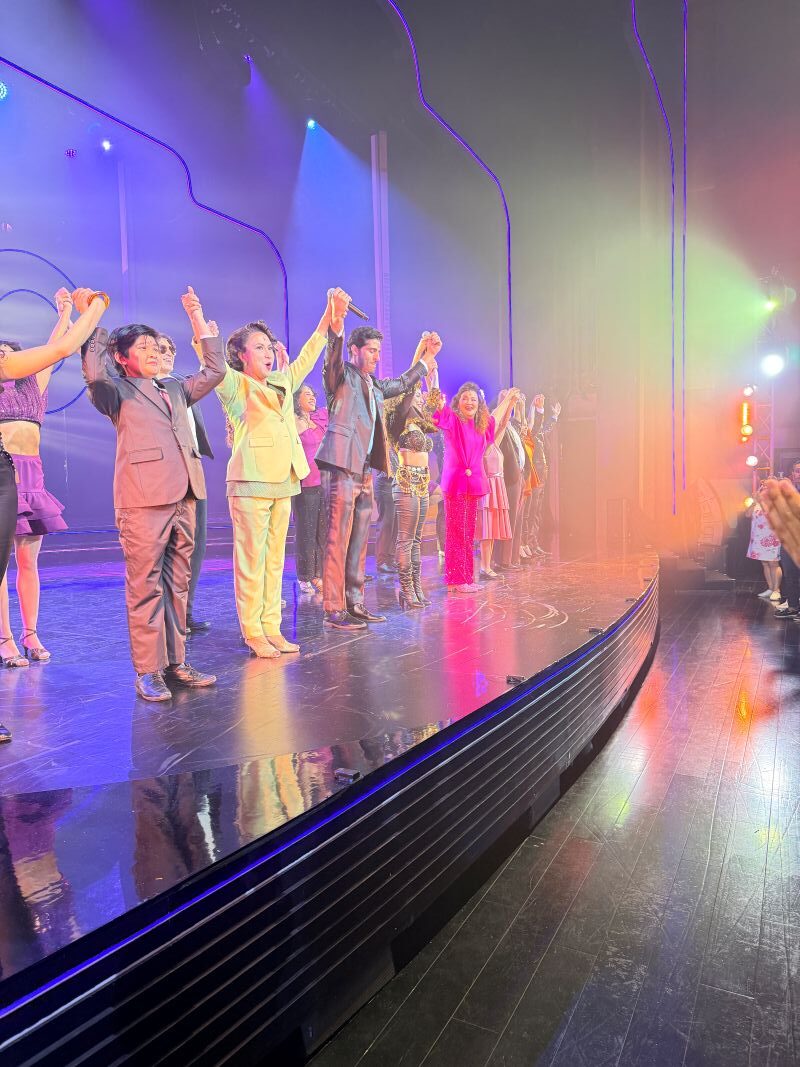
The cast at curtain call
At first viewing during the premiere night, there seemed to be a shortness of confidence needed to boost energy. However, a later viewing proved more than satisfactory when the fire was lit from the bottom up, leading to a standing ovation amidst cheers and applause at curtain call.
‘On Your Feet!’ runs until this weekend, July 26, at the Proscenium Theater. Tickets available at Ticketworld.


