
Text and photos by Angela Pauline De Guzman
I was told that the people in Sagada ate dogs. I had to take a second look at the museum owner, wondering if I heard him correctly.
“The people of Sagada used to eat dogs, but of course we don’t do that anymore. There’s a lot of laws about it now and such,” he said, laughing. I didn’t know whether to be convinced or not. I got a bit of a chill down my spine, because I love dogs.
We continued our tour. I hadn’t known the museum owner for long but I already felt comfortable around him—except for the dog thing, of course. He had this transparent way of speaking, which gave the impression that he never felt like he needed to prove himself to anyone. It lined up with everything I’d observed about the people of Sagada.
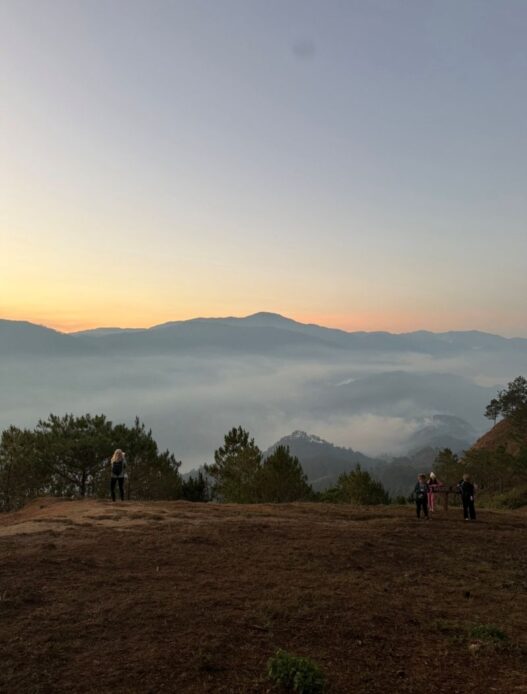
I didn’t subject myself to a bumpy 12-hour bus ride to Sagada for nothing—I came here to hike. Along with experiencing the cold air, the sunrise, and the sea of clouds at Marlboro Hill, I also observed the culture of the people around me—the tour guides, the vendors, even the golden retriever who followed us on the hike.
One of the things I noticed about the people of Sagada was that they were not pushovers. They didn’t accommodate the tourists and change their culture for them—the tourists were the ones who had to adjust to their ways.
During the hike, we got to learn so much more about Sagada as a municipality. I pretended that I wasn’t almost dying by catching my breath as casually as I could. It was stupid of me to think that the underpasses of Makati were enough training grounds for hiking more than four hours in these mountains.
‘The people of Sagada, we never sell land to outsiders….’
“The people of Sagada, we never sell land to outsiders. It’s either we keep the land and pass it on to our family, or we sell it to someone who is also from here,” the hiking tour guide said. He was dressed the same way the museum owner was: in simple, comfortable clothes practical for the cold weather. I felt a bit ridiculous in my new hiking outfit, which I impulsively bought at the mall in Makati.
I noticed that the people who lived here had a different relationship with fashion. They didn’t treat you differently if you weren’t wearing designer outfits, which gave me the impression that they had a different idea of what wealth looked like. The fact that they refuse to sell their land to big corporations might be one of the indicators.
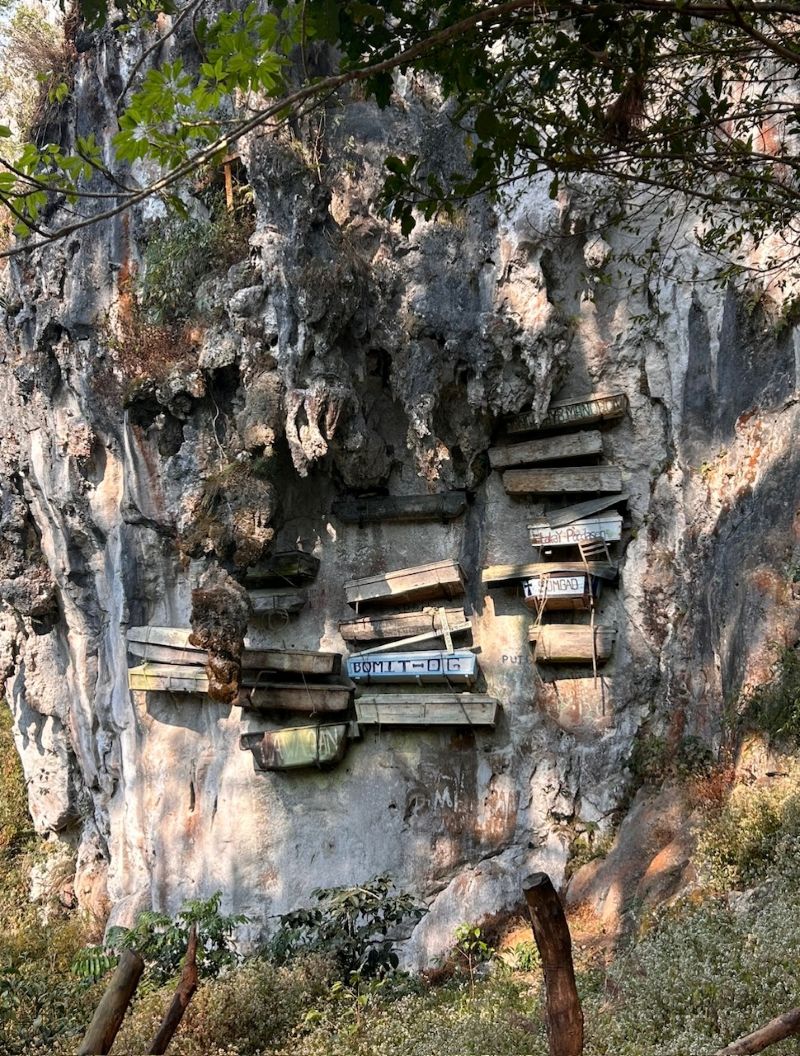
Hanging coffins
The tour guide did not explain things in an overly cheerful or loud way, as most tour guides I encounter do. Instead, he helped us when the trail got difficult and stopped from time to time to share the history of how this particular plant was able to make its way to these highlands. I saw how proud he was of the way they took care of nature, as nature took care of them in return.
I was barely able to walk after the hike. We sat in the van, and the radio was playing a slow and somewhat eerie traditional song. I couldn’t identify it, because I didn’t speak their language. Watching the pine trees and mountains pass, I realized how ironic it was that we live in the Philippines but I understood the language of people from London better than the language of the people from Sagada.
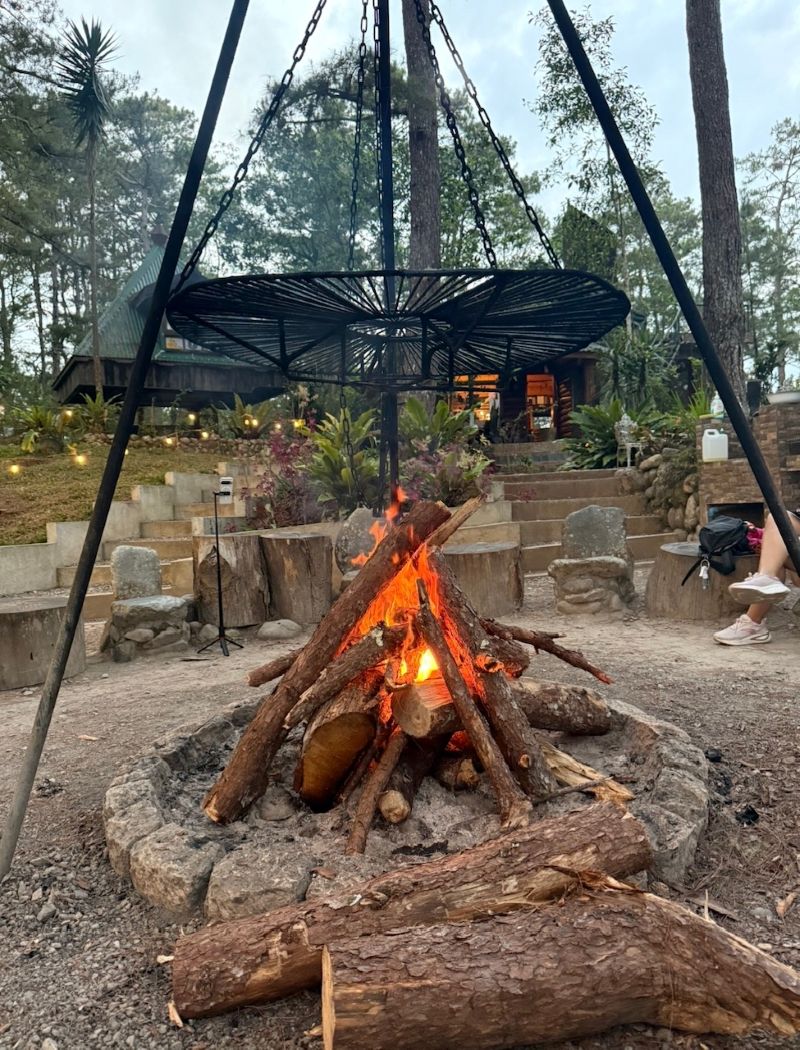
Bonfire
In the evening, the smell of smoke and burning wood was all around the forest. In a place called Cellar Door, we were sipping on warm drinks and gathered around a bonfire. Throughout the night, some cold smoke was sometimes coming out of our mouths as we spoke, at a volume just loud enough to be heard by whoever we were talking to. There was something unsettling yet comforting about the quietness of evenings in Sagada. The darkness seemed endless along the pine trees, but there was also peace. I felt something brush against my leg and I became startled because I was deep in thought. It was just a dog. I looked around to make sure they weren’t going to be roasting him tonight because, well, you never know.
The sun was bright by the time we had breakfast. I sneakily fed some pinikpikan, a local soup made with chicken and etag, their version of preserved pork, to the cute little dog hanging around by the restaurant.
Most of the restaurants in Sagada are small, family-owned businesses. There wasn’t a fastfood restaurant in sight, which showed their protectiveness of their land and cultural identity. Despite their strong boundaries, the people of Sagada were still warm and welcoming. They made me realize that strength does not always have to be loud or arrogant. It can be humble, it can be quiet, but it is always here. The way that they are in touch with nature, quietly thanking Mother Earth for providing them with food and harvest, made me realize how important it is for us to stay grounded.
I cried for two weeks after getting home to Makati from Sagada. While it is possible that I may have idealized the place a little bit, it made me feel safe in a way that I haven’t since I moved to the city. I didn’t feel the need to dress better, raise my chin a little higher, walk a little faster, prove myself a little more. I felt my existence validated in Sagada in a way that I never felt anywhere else.
Staying in Sagada for four days also made me realize and question what it means to be Filipino. It made me see what pre-colonial Philippines in the north may have looked like. It made me think about how the things we are known for, like hospitality and caregiving, may be blinding us from developing the kind of quiet strength that we need in order to protect what is ours.


