


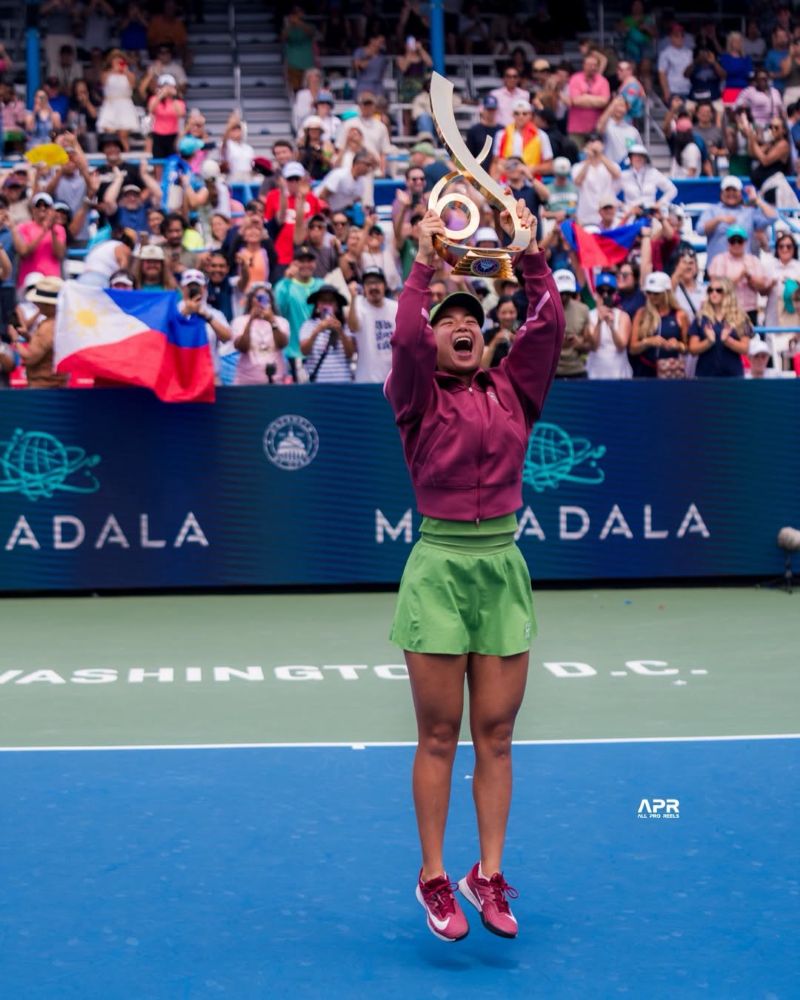
Eala holds her trophy after winning the WTA Tour-level and WTA 500 title at the Mubadala DC Open in Washington, D.C., last Aug. 3.
With uncharacteristic promptness, I wake up at 5:25—in the morning!—Tuesdays, Thursdays so I can call our country club at 5:30 and book a tennis court for Saturday, Sunday (the rule states three days before the desired day). Good luck. I get only a busy signal, no way to get through, until perhaps 5:45 or 6 am, by which time all covered courts are booked. I’m left with only the outdoor courts to choose from, and with fingers crossed that we won’t get rained out on those days.
Honestly, I and my tennis buddies call this early morning race the Hunger Games. Has it always been this hard to book a tennis court? Yes and no. Even in pre-pandemic or way back in the 2000s, booking a court wasn’t easy for me, but it’s only the past year or two that I’ve noticed courts being occupied from day to night, even at noon, and with mostly young people playing. Time was, this demographic was usually in badminton, and tennis was a poor cousin to this racket sport. Not anymore.
I asked around and my tennis friends say they experience the same race to book tennis courts. My former tennis coach Dustin de Torre calls it the “Armageddon” court booking: “Club online opens 6 am for three courts, all courts gone 30 seconds after 6.”
More and more Filipinos must be playing tennis, although I don’t know of any empirical data to prove this. But based on what we experience, see, and hear, there must be a resurgence of tennis in the Philippines—to play it or simply to watch.
This is the Alex Eala Effect. No doubt.
Coach de Torre told me: “Since the Miami breakout last year, there’s the local tennis industry boom: kids and adults picking up tennis anew, horrific court traffic, tennis coaches’ rates gone up yet still fully booked, some pickleballers trying out tennis, non-tennis players (executives, drivers, riders—all walks of life) watching and following the game.
“And most importantly, Alex is the only breath of good news in the Philippines.” Unfortunately, many agree to that.
De Torre noted how Filipinos living abroad attend tournaments—“They’ve exchanged their barbecue days with their fellow Pinoys, with traveling to Alex’s matches.”
De Torre, an industry insider, added a curious development: “Plus, she’s somehow unified the different tennis bodies operating independently before this.”
Since this Filipina started dominating the sport on court and off it, Filipinos have rediscovered the sport, as if borne on the belief that “yes, we can.” More strangely important, yes, we can rally behind the flag, and be “one” as a people. Vergel Santos, veteran journalist and tennis player (his daughter Tracy used to be number one in women’s tennis in the country), wrote in TheDiarist.ph about the “gift, grit and grace” that is Alex.
At last, after an armageddon of political scandals and a parade of jesters in what used to be the country’s august chambers, the country has someone to be proud of. The Associated Press’ Jordan Fendrich writes about her victory in the DC Open: “Eala arrived at Stadium Court as the story of the tournament, carrying the hopes of her nation.”
Her win in Washington made this 21-year-old the first Filipina to win a WTA tour title. She has beaten nine of the top-10 ranked players on the tour, risen to number 20 in WTA (in 2025, she was ranked outside of the top 50 on the WTA tour). She is arguably the most popular player on tour—a compliment coming from her opponents themselves. Jessica Pegula, after losing to Alex in the Washington final, said in post-match interview: “…this is the best Monday final crowd I’ve seen…To all the Filipino fans that came out and have supported, you guys are helping grow tennis around the world…”
‘She is fearless, she takes the ball early, she is a lefty’
Former Canadian-British No. 1 tennis player Greg Rusedski said in his popular podcast, “The most exciting player on the WTA tour is Eala because of the way she plays…She is fearless, she takes the ball early, she is a lefty.”
2003 US Open champion Andy Roddick, in his popular podcast Served, called Eala “the real deal” and described her ability to change her game, off-putting her opponent, and her mental toughness to face the top seeds. Roddick even went so far as to call the “Eala mania” a “movement,” not only a story.
In our chat, Santos said of the Eala-Pegula match that roused Filipinos worldwide: “Analysts missing the point ascribing Pegula’s loss to bad breaks or bad day. Alex actually made everything bad for her. She was trying to hit deep and hard so as not to give Alex any chance to mount an attack, a main foundation of her aggressive game which forces opponents to err.
“Hit early and deep, placed well, running her opponents around, rushing them, setting herself up for the kill.
“That’s Alex, cool, strategic, methodical.
“She reads both her opponents and the court well. That’s tennis intelligence.”
Santos said there’s only one way to beat her: “Blow her out of the court with big, controlled power.”
‘She reads both her opponents and the court well. That’s tennis intelligence’
And Alex has a weapon that must be the envy of any athlete/celebrity in this social media era: a fiercely committed Filipino fanbase worldwide. It doesn’t hurt that Filipinos love to engage in social media and in streaming sites. This most hospitable race turns into natural digital natives. Filipinos love to share anything and everything—physically and digitally—and their latest “like” to offer the world is Alex Eala.
The Alex Eala Effect also has what I call the BTS (as in BTS) effect, this time in tennis—she sells out tournaments, and stays humble while doing it.
It doesn’t hurt that Alex has innate charm and communication skills. She is so relatable. She knows what to say, when to say it, and how to say it. She is one tennis player with empathy—win or lose. And what audience or fanbase wouldn’t love that?
A triple-threat phenomenon, she is: champion, communicator, charmer.
(from All-Pro Reels facebook)
And most important—she proclaims to and reminds the world that she is Filipino. She never fails to raise the Philippine flag, speak the language, and greet the “kababayan.” She even put chicken adobo on the world menu; it was the starring-role dish in the Toronto tournament this week. What I most admire is how she’s always thanking the Filipinos and the people who have set out on this journey with her. This young role model could teach the young generations the sense of “utang na loob”—the Filipino value much overlooked, if not forgotten, in this generation. Alex can show her co-GenZs and the millennials how to look back on, respect, and be grateful for the past.

Bestseller food at Toronto Open
Santos believes the Filipino’s renewed interest in tennis “could only be largely vicarious and spectator, given the cost of playing the game and the limited facilities.”
He has a point (yes, very limited facilities, and how could potential-prodigy kids in poor communities afford rackets?). But still, a people betrayed and sold out by its leaders cannot be choosers. For now, we’ll take an Alex Eala and her lefty forehand—our soft power before the world.


