
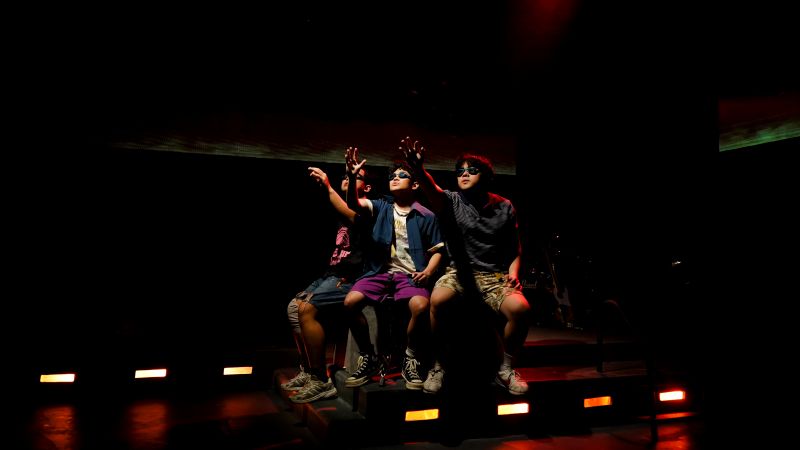
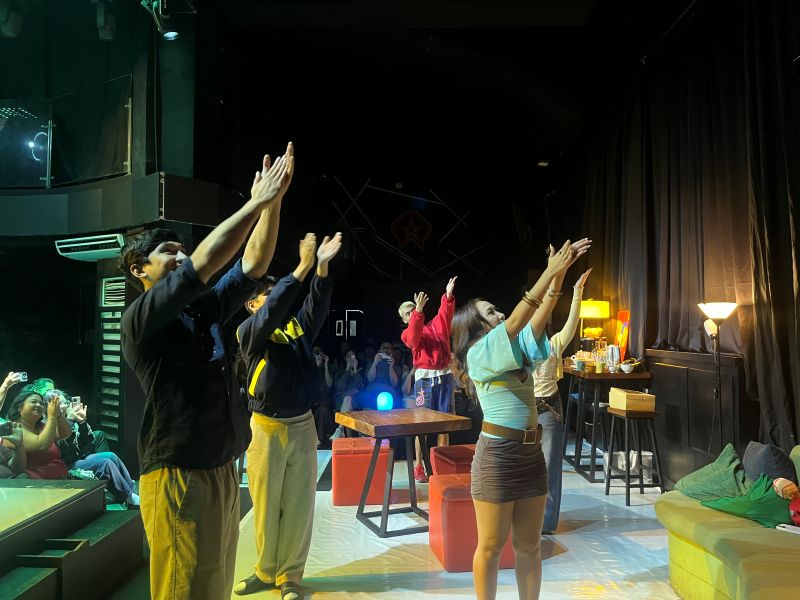
Cast of ‘Tagay Para Sa Ex’ (Photo by Vincen Gregory Yu)
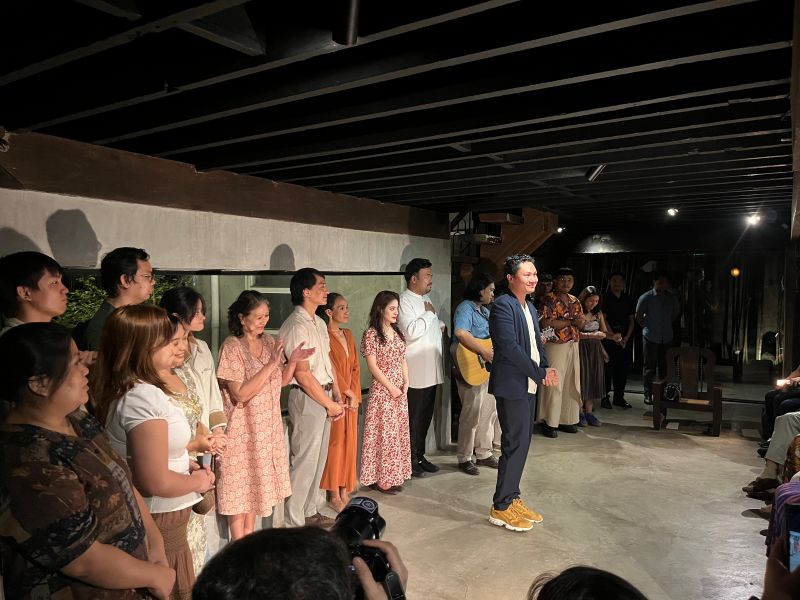
Mark Mirando (center stage), cast and crew of ‘El Fuego del Alma’ (Photo by Vincen Gregory Yu)
‘Tagay para sa Ex’ will run one more weekend, Sept. 4–5, 2026, Far Eastern University Center for the Arts, Nicanor Reyes St., Manila.
‘Mga Binago ng Araw’ runs until Aug. 30, 2026 at the Old Communication Black Box, Ateneo de Manila University, Quezon City.
‘El Fuego del Alma’ will return in September and October.
Three new Filipino plays of exhilarating artistry and complexity, all staged by fledgling companies in small fringy spaces of Metro Manila, and offering possibilities for the art form that extend beyond what splashier mainstream fare tends to offer—there’s my latest weekend of theater in a nutshell.
At Rampa, the Quezon City nightclub renowned as bastion of drag performance, I saw Tagay para sa Ex, written and directed by Dudz Teraña for Boxstage Manila, the unofficial alumni arm of Far Eastern University Theater Guild (Teraña is artistic director). To call this play the pinnacle of chismis theater is to pay it the highest compliment.
Tagay para sa Ex is structured as an inúman of five friends: ex-lovers Mark and Liz, current lovers Benj and Mich, and party organizer Poch. Unsurprisingly, the party devolves into a glorious mess, this confluence of fiery friends, tempestuous romantic entanglements, and free-flowing alcohol reopening old wounds and inflicting new ones, in the process whipping up the kind of show you simply can’t stop watching.
Thematically, Tagay para sa Ex belongs to that continuum of distinctly Pinoy art interrogating what it means to love under 21st-century neoliberalism, like a marginally more affluent sibling of the films Endo, Never Not Love You, and Third World Romance.
As an examination of Filipino urban middle class precarity, the play unfolds through frenetic, razor-sharp writing. Not all of its points are original, it bears mentioning, but all of them are incorporated in the play’s intermission-less 90 minutes in so organic and lived-in a manner—exactly like a rambling partygoer who’s had one too many shots of tequila and far too many things left to say.
When we first meet them, the characters have already attained some degree of financial security in life—for starters, the story takes place in the condo of Mark, now a BPO team leader. It’s a fragile freedom to which they have been clinging, though. Someone declares what anyone who hasn’t been living under a rock in the Philippines should know fully well—that the middle class is the new poor, oftentimes just one health emergency away from debilitating poverty. In any other context, that declaration would feel borrowed, predictable even. But here, it lands with surprising visceral force as uttered by Teraña’s characters, whose condo-living aspirations and talk of elusive, keep-up-with-the-trend vacations to Japan make their economic precarity all the more tangible.
Teraña weaves all that talk into what feels like an unparalleled feat of playwriting in recent memory. His characters frequently speak at the same time, their conversations sprouting in unison and running in parallel, precisely as they would in an actual party, that you sometimes find yourself at a loss for where to look or whom to listen to. Yet, miraculously, what could have easily devolved into Babel instead becomes something resembling a chorus, the disparate conversations harmonizing into this sobering picture of a generation flailing and failing and fighting for its life.
I cannot imagine how the play must look like on the page, but Teraña has made sweet, captivating music out of this mess in real time. (It’s his funniest and most confident work yet.) And the production has the good fortune of being brought to life by a superb ensemble—on the night I watched, AJ Sison (Mark), Yesh Burce (Liz), Jel Tarun (Benj), Karyl Oliva (Mich), and Jonas Cunanan (Poch)—whose greatest achievement is coming across like they’ve been actually living in this space long before the audience walked in, making us feel less like ordinary spectators than unwilling eavesdroppers.
The condo set feels just as alive—there’s even real food being prepared and consumed onstage, as in an actual inúman—that you actually forget the show is taking place in a repurposed nightclub. If there’s any complaint to be made, it’s that the sound at Rampa is far from ideal and tends to dampen the experience. ‘
Bad sound notwithstanding, however, there’s no mistaking it: Tagay para sa Ex is a sublime feat of writing, directing, and acting, and easily ranks among the most impressive things I’ve seen pulled off in all my years of theatergoing.
‘Tagay para sa Ex’ is a sublime feat of writing, directing, and acting, and easily ranks among the most impressive things I’ve seen pulled off in all my years of theatergoing
If Tagay para sa Ex makes magic out of colliding conversations, Mga Binago ng Araw manipulates time itself to make sense of the world its characters inhabit and are forced to reckon with.
Staged by Mad Child Productions at Ateneo de Manila University’s Old Communication Black Box—which now feels worlds apart from the swanky Areté complex—the play marks Guelan Varela-Luarca’s third new work to receive a full staging this year, following Scene Change’s Ang Linangan and Ateneo Entablado’s Santa Juana ng mga Katayan.
On the surface, Mga Binago ng Araw may strike you as a run-of-the-mill coming-of-age story, centered on a barkada whose signature stomping ground is their most privileged member’s backyard swimming pool in a plush Makati City subdivision. The question it thrusts upon its characters—and, by extension, the audience—seems in line with this simplistic exterior: Kailan ka unang tumanda?
Obviously, that question is anything but simple. And so is this play, which, by intermission, proves itself to be far from an easy watch. Like Tagay para sa Ex, Mga Binago ng Araw is a refreshingly difficult work of art that rewards discerning, attentive viewers.
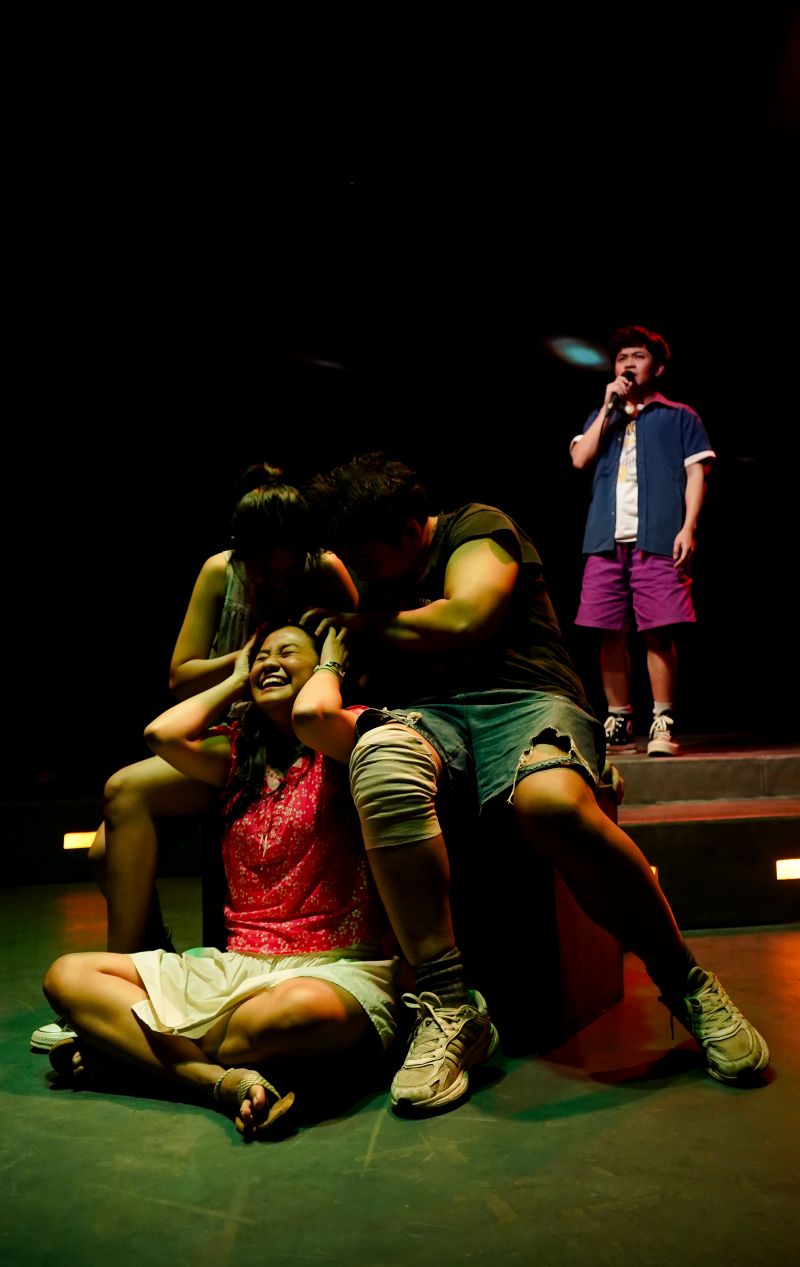
Jam Binay (seated, foreground) and cast of ‘Mga Binago ng Araw’ (Photo by Myra Ho)
By setting the play in the Pinoy summer of 2005, Varela-Luarca has made a love letter of sorts to his fellow millennials, the play animated by the material and audiovisual idiosyncrasies of that era. But the play’s foundational impulses transcend generations: Mga Binago ng Araw is about the confusion that comes with growing up, about contending with big feelings and finding meaning in small ones, about defying or surrendering to the little cracks that eventually splinter even the oldest friendships and relationships.
It’s about family—the biological, as well as the chosen—and about parents failing their children, and children barely surviving the world their parents have built for them. Above all, it’s about memory—as in Varela-Luarca’s 3 Upuan—and grasping for a vocabulary in the future with which to understand the once-unfathomable past.
Varela-Luarca explores all that through his middle-class characters by fracturing their timelines, using the fragments to (re)assemble these shifty attempts at comprehending their emotions and their anxieties, and why they made the decisions they made at the time. It may sound deceptively simple, but it really isn’t: The genius of this play is in how it conjures such vivid, delicate memories for its characters not through straightforward linear recollection, but through a painstaking jigsaw-like piecing together of bits and pieces of incident and feeling as it flits back and forth that crucial summer in the story.
At a couple of points, including one where he sends the characters into outer space and hurtling toward the sun, Varela-Luarca even punctuates his realistic narrative with disruptions of form and style that are honestly such breaths of fresh air when situated against the broader tapestry of playwriting in Manila.
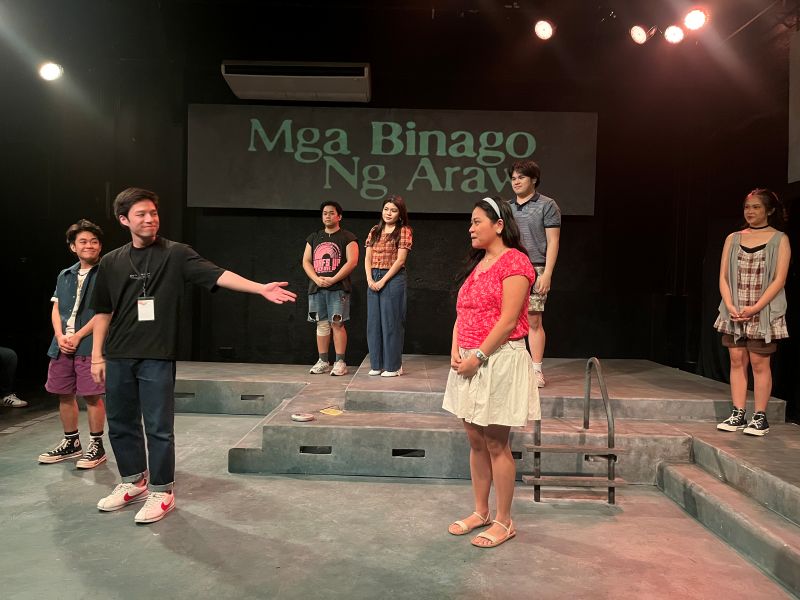
Director Monty Uy (second from left) and cast of ‘Mga Binago ng Araw’ (Photo by Vincen Gregory Yu)
Thank the theater gods Mga Binago ng Araw found a director more than up to the task of doing it justice in newcomer Monty Uy, who has summoned what theater critic Gibbs Cadiz perfectly describes as the play’s “dreamily exquisite” quality. This production feels coated in sepia, the viewers—through the mere act of witnessing—effectively becoming co-creators of its versions of the past, helping will the characters into walking, breathing, speaking shape.
In scene after confident scene, Uy’s production brims with admirable intelligence, invention, and imagination, equally at ease with moments of unrestrained noise and those of crystalline quiet; with youthful exuberance, teenage longing, and piercing sadness.
All his artistic elements, from Michelle Cornejo’s music and John Lucing’s movement to Sarah Facuri’s set, Uriel Tibayan’s sound design, Jethro Nibaten’s lights, Sofia Santelices’ costumes, and Teia Contreras and Julia Vaila’s video projections, are always in sync, reaching their apotheosis in a scene set at a swimming pool that’s quite frankly the coolest, most BDE-filled thing I’ve seen onstage this year.
And there isn’t a false note from the cast comprised of Jam Binay, Zöe de Ocampo, Maliana Beran, Rafael Jimenez, and Vino Mabalot as the teenage protagonists. Binay and Mabalot, in fact, are turning in their best and most affecting performances to date here, playing two versions of adolescents completely unprepared for the hormones-saturated inevitability of growing up. And, as the sixth character in the story, Francesca dela Cruz does a bit during the latter part of intermission that had me completely fooled—and which I won’t spoil here—that might just go down as the year’s most fun piece of acting.
All things considered, Mga Binago ng Araw is a constellation of deftly executed artistic choices. And I haven’t been this excited for a new director in quite some time.
‘Mga Binago ng Araw’ is a constellation of deftly executed artistic choices. And I haven’t been this excited for a new director in quite some time
Meanwhile, at Sine Pop in Cubao, Porvenir’s production of El Fuego del Alma is the very definition of peak theater.
Much has been written in The Diarist.ph about this adaptation of Tennessee Williams’ Summer and Smoke—the original Southern American setting swapped out by playwright Eljay Castro Deldoc for a rural Philippine town, and the length pared down to a compact 75 minutes—so I will say this: Where Tagay para sa Ex harnessed the power of language, and Mga Binago ng Araw that of time, this last play turns toward space as bedrock for its theatrical magic.
Every inch of the converted old house that serves as this play’s venue has been evidently put to good use, from the bamboo garden that audiences view from inside through a glass panel, to the upper level whose wooden floor becomes a conduit for sounds both literal and metaphorical, and even the glass doors and windows that turn into mirrors in the most consequential moments, casting light, fire, and ghostly apparitions back to the small stage.
Doing justice to Williams’ signature themes, El Fuego del Alma is about the repression of sexuality, pitting its santa-santita protagonist Alma against her worldlier, more liberated neighbor, the physician Juanito. The implosion of their “spiritual romance,” to borrow from Tats Rejante Manahan, becomes the driving force of the play, as the two grapple with the repressive religiosity, stifling conservatism, and suffocating provincialism of their small world.
By all accounts, this is a short play—which makes Castro Deldoc’s adaptation all the more triumphant for preserving and conveying the essence of Williams in so little time. And the production directed by Mark Mirando is a stunning, electrifying thing: swirling with high style and elevated gestures; alive with pitch-perfect shifts in mood and ambience; and pulsing with the unmistakable throb of all-too-human desire, buried and quelled before eventually being unleashed. I first took note of Mirando’s work in the 2019 thesis musical Hanggang Isang Araw at the University of the Philippines Diliman; seven years later, he’s now firmly in the big leagues as director.
When I saw the production on a Sunday evening, it was the play as a thing of shadows—a haunting in real time—in contrast to the matinee performances that Cadiz describes as bathed in “a faint buttery yellow patina, like a color-graded cinematic reel or a faded TV melodrama.”
Opaline Santos and Vincent Pajara were an intoxicating pair as Alma and Juanito, respectively, the slow decay of their spiritual romance buttressed by a reliable ensemble who seemed to decay alongside them. The smoke of the title alludes to fire, but through the performances of Santos and Pajara, it may as well signify the gradual snuffing out of their passions en route to genuine spiritual and carnal liberation.
We rarely get productions of Tennessee Williams’ plays in Manila—but here, in this out-of-the-box space down a narrow street in Quezon City, we have a production as good as any for introducing theatergoers to the unadulterated potency of his work.
‘Tagay para sa Ex’ will run one more weekend, Sept. 4–5, 2026 at Far Eastern University Center for the Arts, Nicanor Reyes St., City of Manila. Tickets are available via https://ticket2me.net/event/22957.
‘Mga Binago ng Araw’ runs until Aug. 30, 2026 at the Old Communication Black Box, Ateneo de Manila University, Quezon City. Tickets are available via https://ticket2me.net/event/23002.
‘El Fuego del Alma’ will return in September and October, with further details to be announced via their social media pages. Follow them on Facebook at https://www.facebook.com/porvenirph.


