
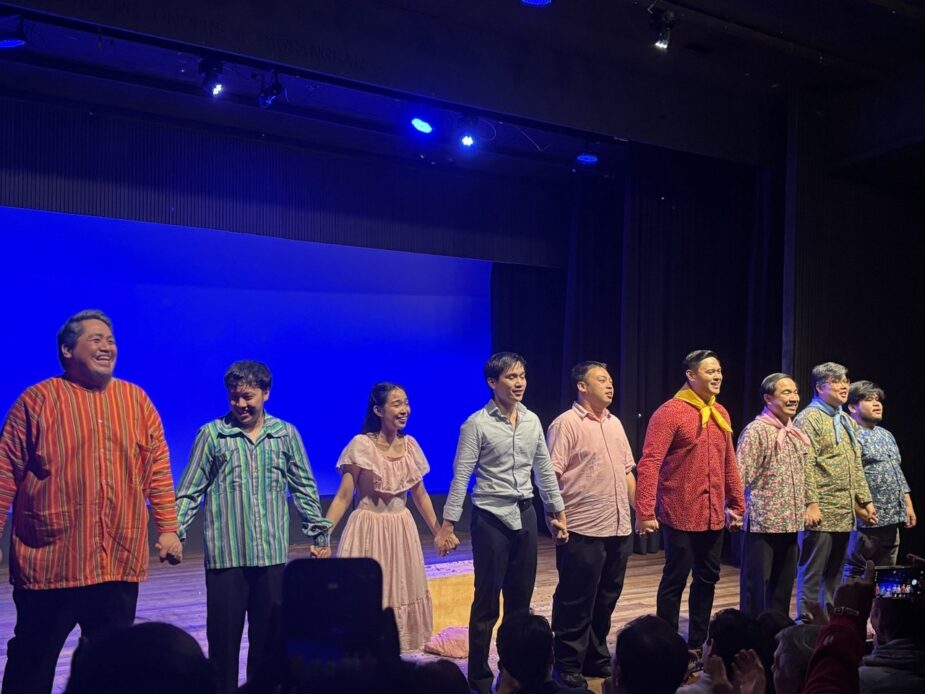
First presented as a two-act play on Aug. 14, 1976, Sinta is considered the country’s longest-running musical. With book and music by Onofre Pagsanghan, it has been described by National Artist Bienvenido Lumbera as “a story of young love told in verse and song, steeped in nostalgia for simpler times.”
This year marks its 50th anniversary. Onofre R. Pagsanghan is founder of the Ateneo de Manila High School’s repertory theater company Dulaang Sibol. A “transplantation” of the 1960 Off-Broadway show ‘The Fantasticks’ (written by Tom Jones and composed by Harvey Schmidt), this Filipino retelling follows the coming-of-age of the innocent young woman Sinta and her equally naïve suitor-next-door, Narding.
This year’s golden anniversary staging features a cast of Dulaang Sibol alumni:
Meynard Campanilla and Mikkel Valencia as Narding
Malaika Paculan, Ara Rioflorido, Chloe Abella as Sinta
Dino Santos and Kent Alonzo as Anding
Joer Palma and Diego David as Pedring
Ernest Sto. Tomas, Diego Alcudia, and Joshua Guerrero as Matanglawin
Oliver Quintana and Kurt Rivera as Redentor
Miggy Leyson and Djanggo Alagar as Tibo
Picoy Cruz, Kiko Aurellano, and Justice Bacorro as Pader
Performances at Dulaang Sibol, Ateneo de Manila University:
August 14–15 | 7:30 PM
August 21–23 | 7:30 PM
August 28 | 7:30 PM
August 29–30 | 2:00 PM, 7:30 PM
Tickets are priced at Php 500.00 and are also available at bit.ly/WatchSinta2026
Performed as Dulaang Sibol’s annual Valentine’s offering, the show makes a strong claim of being the country’s longest-running musical. It is a production that I’ve seen at least five times in the last 15 or so years, most recently during this 50th-anniversary run this August.
It is also a show that I absolutely cannot be objective about in the slightest—it is simply too close to home, in a literal sense.
It is no secret that my father, Jimmy Hofileña, originated the role of Narding, when he was a 14-year-old high schooler in 1975, and that he would go on to play the role for the next 15 years. If it feels like there is any sense of secrecy surrounding that fact, that is simply the result of my dad’s humility, more than anything. Even with pictures of him (with original Sinta actresses Cathy Melendrez and Stella Pagsanghan-Deriquito), occasionally pulled out of the Sibol archives for promotional use, he has never claimed ownership of the role or the production—which is why I half-jokingly do all the bragging for him.
My dad’s deep fellowship with Mr. Pagsanghan (more fondly known as Mr. Pagsi) and the “Sibolistas” has translated into warm welcomes for me, my older brother, and my mom every time we encounter them or whenever we return to Sibol’s home theater. Consistently, I am asked if I, too, joined Sibol in high school, or if I took after my dad’s inclination to the performing arts. Apart from a brief but happy stint as the vocalist of my high school cover band, I always say, regretfully, no.
My dad performed in plays, and now I simply criticize plays. (Again, I mean this in jest.) But after nearly a decade of writing about Philippine theater, I still find it nearly impossible to review Sinta, at least not in the traditional sense. What I can share, instead, is how much my perception of the show has grown up, too.
I don’t know what Ateneo High School traditions are like today (especially with female students finally being allowed to enroll), but everyone in my batch was required to watch Sinta at some point. And when you’re roughly the same age as Narding, you can’t help but center his experiences in your mind—and to view the musical as a stern cautionary tale about what awaits you beyond high school. There is the promise of romance and adventure, but also the threat of losing one’s way for those who don’t keep their wits about them.
Every step of the way in my Ateneo school life, whether as a function of Catholic education or of just our capitalist world exerting pressure on the education sector, it felt like we were already being warned about and prepared for the stages ahead. There was expectation of us to decide what we wanted our role in society to be, and from there could we draw our sense of value.
Mr. Pagsi may or may not have intended this, but in some ways he did perfectly capture—in breathtaking beautiful Filipino verse—that adolescent restlessness of wanting to prove the cynics and realists wrong, before one slams into the limits of one’s idealism.
Sinta struck me as a tender, achingly sentimental production right from my first viewing, even before I really learned to understand theater as an art form. The simplicity of its direction—the bareness of its set, the humorous pader coming to life, the fake moon hung up on a wire in the background—matched my romantic view of the world when I was a teenager. And Mr. Pagsi’s compositions were warm and poetic in ways that my classmates and I wished we could be as we held impromptu jam sessions wherever instruments were available.
In the years following my first experience of Sinta, it has gone through significant updates. Its language has remained unchanged, but its more lighthearted first act now often leaves much room for contemporary, semi-improvisational comedy often touching on current events and issues—ostensibly to offer the audience easier access to the original text.
Perhaps the biggest change (which The Fantasticks also underwent) has been the near-total purging of the word “gahasa” from the libretto, and from the entire song of the same name. It is meant here as another term for “kidnapping,” but the humor attached to its use is clearly meant to play on the shock of misinterpreting its definition as a more serious crime. The word’s removal is the one change I wholeheartedly agree with.
Otherwise, productions of Sinta have remained remarkably loyal to Mr. Pagsi’s vision. Every time I watch it I am transported back in time: the set is always identical in its emptiness, every gesture and tableau made through blocking is immediately familiar, and the direction (for this most recent run, by Giancarlo Abrahan) maintains that same precise, earnest tone. And yet, as with many enduring pieces of art, the impression it leaves changes depending on what you bring to it.
When I settled into my seat at the Ateneo High School theater on August 15, knowing that I would be watching a 50th-anniversary performance, I was expecting to feel nostalgia for youth. But to my surprise, my focus was no longer on Sinta and Narding. After all, I already understood the heartbreak and disillusionment they were about to go through; I had experienced it myself countless times. Instead, my attention shifted to all the adults surrounding them. And for the first time, I started to recognize them as the future versions of the young lovers—people who once had the hope to be the heroes of their own stories and to be the makers of their own happy endings.
There are Mang Pedring and Mang Anding, who spur on their children’s courtship by fabricating a neighbor’s feud, which, of course, backfires when the ruse is revealed. There are the actors-for-hire Redentor de la Rosa and Tibo, whose livelihood is built on a loss of personal identity, most useful when playing villains to be battled and killed in other people’s stories. And there is the gallant yet morally ambiguous Matang Lawin who, despite his omniscience in the story, knows that it is his job to hurt and betray Sinta and Narding in order to set them on their paths to adulthood. For the first time, these adults and their reluctant but hopeful acceptance of the roles they’re saddled with, is, to me, the greater yet concealed tragedy of the story.
When Sinta and Narding find each other again, as the last wisps of their childhood are shed, she asks him, “Ano ang nangyari sa iyo?”—and he replies, “Nangyari sa akin ang mundo.” What I once perceived as expression of immeasurable change now strikes me as a refrain that all the other characters must have told themselves once upon a time. The world happens to us and turns us into people whom our younger selves likely never wanted us to become. But we nevertheless take on the responsibility of shepherding those who will succeed us. Sometimes we play the false villains in their story, but sometimes we can still lead them in song and celebration.
But without fail, every time I watch Sinta, I think of my father. I think of him and my mother, Jojo, and all the growing up they had to do and maybe still go through. I think of my late tito, Joey Hofileña, whom I was able to see play Matang Lawin once, years ago. I think of what it must have been like for them to accept the roles they had to play, to realize there was no perfect moon illuminating the night. But they built a home and a community for their loved ones anyway.
I think of myself, and I hope for the strength and the wisdom to one day be able to do the same.


