
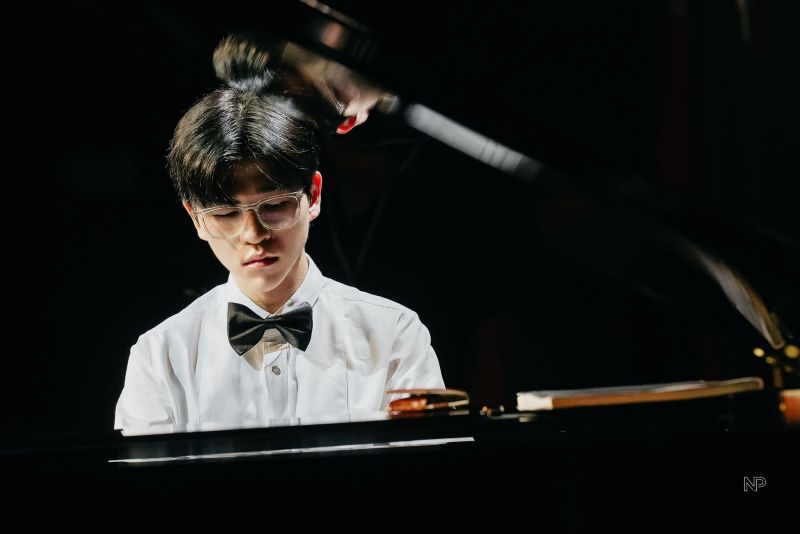
For many young concert pianists, entering university means reaching a fork in the road: continue toward the world of professional music, or leave the concert stage for another career? For William Matthew “Matty” Lim, however, the road ahead looks less like a fork than an algorithm—one designed to accommodate more than one direction at once.
A young Chopinist who recently gave his first solo recital at the Carlos P. Romulo Auditorium in RCBC Plaza, Lim is now entering his first year of general science at the Hong Kong University of Science and Technology (HKUST), where he will eventually choose a field such as computational or data science. On paper, the move from Chopin to computation may seem like a sharp turn. For Lim, it is not. He approaches both with the same instinct: to look closely, find patterns, and understand how the pieces fit together.
That approach to music is also reflected in how Lim sees his place within it. He is not particularly concerned with being remembered for technique or competition titles. Asked what he hopes people will remember about him as a pianist, he offers a single word: “communicator.”
For Lim, “communicator” extends beyond the keyboard. It encompasses his work as a performer and teacher, as well as his studies in science. He draws little distinction between the different ways he communicates; playing a melody, teaching a student, or writing a Python script to edit sounds from scratch are all part of the same impulse.
That instinct also shapes his view of music education. Lim pushes back against what he calls a “boxy,” overly academic approach to playing, arguing that a performance should stay grounded in the score without becoming too bound by it. “Brilliant playing” can be impressive, he says, but what holds his attention is music that feels “human” and “not replicable by robots.” Technique, in his view, is the foundation—not the destination.
Lim’s first solo piano recital at the Carlos P. Romulo Auditorium in RCBC Plaza, Makati City, on July 31 was as much an occasion as it was a performance. Karlyne Kimberly Tan, who attended the recital, called it “the ultimate recital experience.” It was indeed an evening marked by careful attention to both performance and hospitality.
The evening began at the registration table, where guests received assigned seats and stubs for grazing plates, pastries, coffee, mocktails, taho, ice cream, a 360-degree photo booth, and souvenirs. From cocktails and photo booths to plaques and parting gifts, the evening offered guests an experience that extended well beyond the music. By the time they took their seats, the recital had already begun to feel like an event designed to linger beyond the music.
The recital opened with Bach’s Partita No. 1, followed by Chopin’s Scherzo No. 2 and two Chopin waltzes.
The second half brought Chopin’s Piano Concerto No. 1, performed with the H.R. Orchestra under the baton of Maestro Herminigildo Ranera.
The evening then shifted from the formal program to a tribute to the mentors who have shaped Lim’s musical journey. Ms. Hyun Joo Lee, whom Lim calls Teacher Julia, and Dr. Raul Sunico delighted the audience with a four-hand performance, adding a personal touch to the recital.
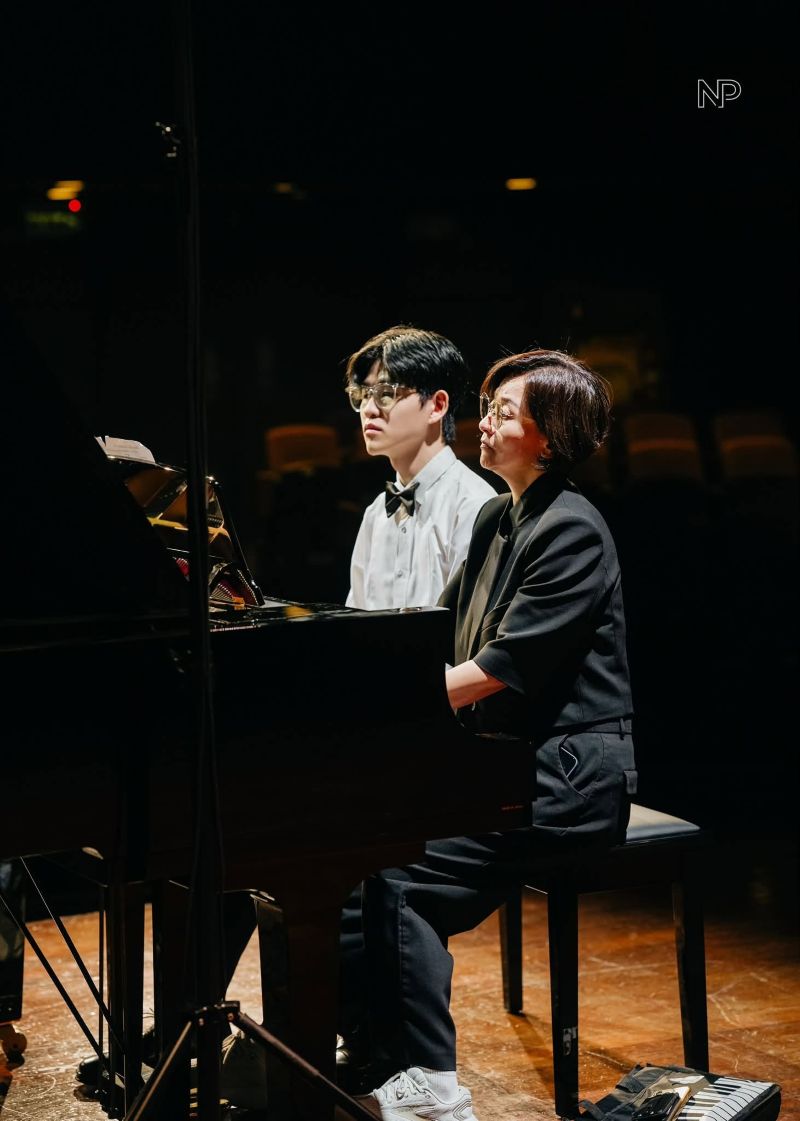
Johann Sebastian Bach’s ‘Gottes Zeit ist die allerbeste Zeit,’ performed in a four-hand arrangement by Lim and his teacher Julia, Hyun Joo Lee
Lim closed the evening with two encores. The first was Dr. Sunico’s arrangement of the Filipino folk songs Bahay Kubo and Leron Leron Sinta, interwoven with the familiar opening motif of Beethoven’s Moonlight Sonata. The second carried a more personal significance: Johann Sebastian Bach’s Gottes Zeit ist die allerbeste Zeit (“God’s time is the best of all times”), also known as Actus Tragicus (BWV 106), in a four-hand arrangement by Lim’s late mentor, Seymour Bernstein, performed by Lim and Ms. Lee.
The repertoire traced Lim’s development as a pianist, but the way he talks about it reveals how he hears music. He does not begin with the notes alone. He begins with what he imagines behind them.
He does not begin with the notes alone. He begins with what he imagines behind them
Lim often listens for what he calls the “singing” line—a quality that, he says, can disappear when music is approached too rigidly. When he plays the second movement of Chopin’s Piano Concerto No. 1, for instance, he pictures the scene in Tangled when thousands of lanterns rise over a quiet lake. “That’s how Chopin music sounds,” he says. For Lim, the image is not separate from the music; it is part of how he finds its atmosphere, movement, and sense of life.
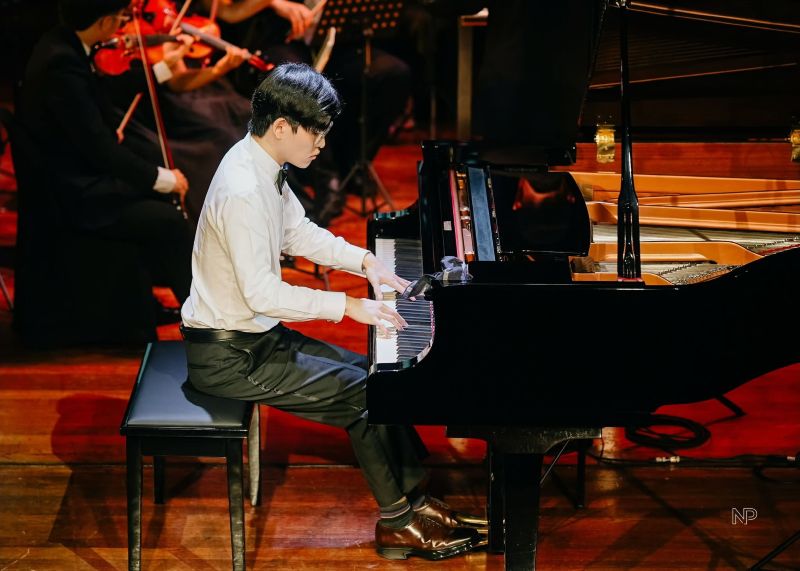
The more closely he studies the architecture of a piece, the more room he has to make it breathe.
That freedom of imagination, however, was built through years of discipline. Growing up in Cebu, Lim and his family flew to Manila every weekend for lessons. Under the tutelage of Teacher Julia, he moved away from what he describes as “rushing into reading a piece like a magazine” toward a slower study of harmonic direction, structure, and the interplay of voices. The result is a contrast at the heart of his playing: The more closely he studies the architecture of a piece, the more room he has to make it breathe.
That freedom was built on structure. One of the most distinctive elements of Lim’s training was his use of icons from Dr. Song’s Gift of Piano Technique books—visual stickers placed directly on the score to guide hand structure and interpretation. The “heart within a heart” icon, for example, represented a principle central to his playing: Emotion could move freely, but never at the expense of rhythm. With that balance in place, Lim learned to “stretch and compress” a phrase without losing sight of the composer’s intent.
His repertoire became another measure of that independence. Lim describes the Scherzo he performed in Japan as his “baby breakthrough,” when he began to see that technical control and musical expression could not be separated. Chopin’s Ballade No. 1 pushed the idea further. Its opening—just a single octave—was “dauntingly simple,” he says, because there is nowhere for the pianist to hide. The music “forces you to interpret it.”
By then, Lim had begun to question the idea of simply reproducing what he had been taught. “You can’t follow your teacher and follow a script,” he says. The technique was there. What remained was deciding what to do with it.
Today, he defines success as “having a better understanding of music.” It is a measure with no podium and no final score. A competition ends when the results are announced; understanding only opens the door to another question. For Lim, even mastering a piece can reveal how much more there is to hear.
That curiosity is now following him into his first year of general science at HKUST. He has not yet decided which field he will eventually pursue, and he seems in no hurry to choose. For now, music and science give him different problems to work on—and different ways of looking for patterns within them.
At this point in his life, Lim wants to be remembered as a “communicator.” The word may change with him, just as his definition of success has. For now, though, it captures what connects the different parts of his life.
Whether he is tracing a harmonic structure or working through a data set, Lim is looking for the same thing: a clearer understanding of how something works, and a way to make that understanding meaningful to someone else. In music, that may mean finding the line beneath a phrase. In science, it may mean finding the pattern within the numbers. In both, he is still trying to make sense of what he sees—and communicate what he finds.
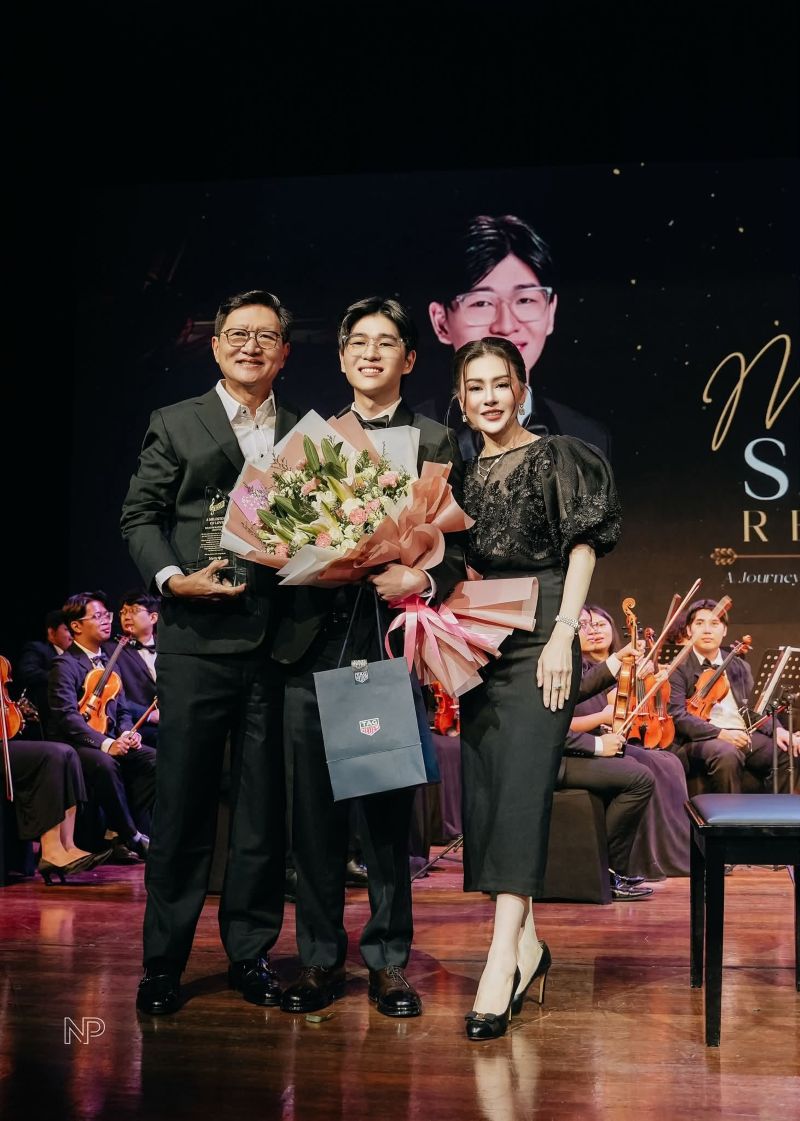
Matty Lim with parents Wilky and Michelle Lim
Matty Lim’s proud parents are Wilky and Michelle Lim.


