
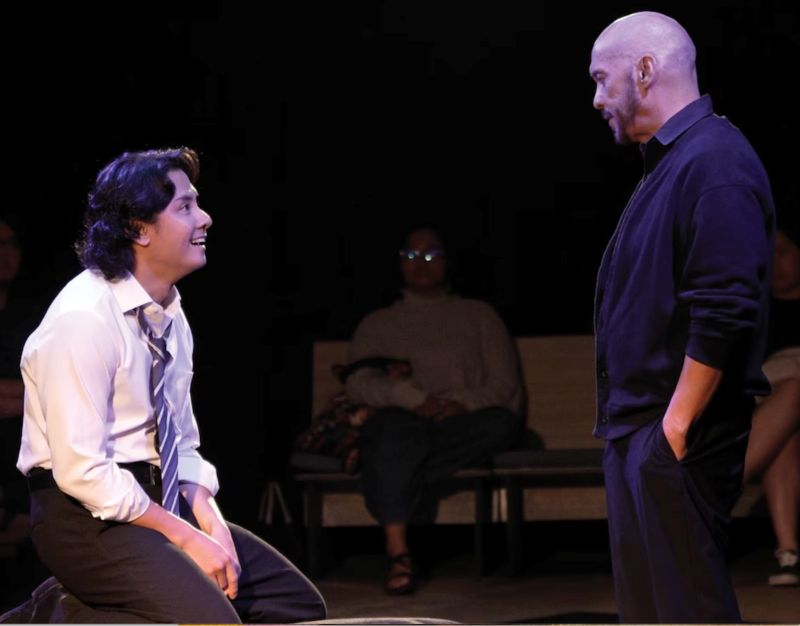
Leave it to Bart Guingona to deliver kilometric lines infused with varied emotions with nary a punctuation mark, and yet get to the point loud and clear for a perfect “aha” moment” for the audience. Like his signature delivery, in his latest theater appearance, directed by his co-star, JC Santos, the plot starts off mid-point in the narrative and slowly, within the hour or so of the play’s progress, the story unravels in an unconventional manner of storytelling, which is typical of Caryl Churchill’s writing style, and a match for Bart Guingona’s theatrical signature.
What holds the audience in suspense is that, because Ms. Churchill does not follow a logical timeline, the dialogue likewise takes on a non-linear, off-sequence development, such that the rise and denouement of the narrative flow is not predictable. Acting-wise, it would demand that the actors read and re-read the lines, analyze them, to make sense of the emotional flow, while figuring out what is required to deliver the lines logically in a non-logical flow. Complicated as it sounds, Bart and JC were up to the challenge, and as Bart described the rehearsal journey, “Most of the work, because of multiple readings, was table work” between the actors.
The play, apart from being JCs directorial debut, was also his choice of material, stemming from his classes in script analysis at New York’s Circle in the Square Theater School, where focus is on “emotional truth with imagination.” Among other things, this emphasizes inner preparation, emotional memory to trigger reactions, and discovering hidden meanings and unspoken thoughts that may relate to the written dialogue. JC’s choice of A Number fell right into that category to realize tangibly what he had learned. His choice of Bart Guingona was also spot on.
From Bart’s own account, upon first reading the script as Salter, the father, he found it complicated, fragmented, perhaps difficult to realize, but in the end, he wholeheartedly took on the challenge precisely because of those reasons. Apart from the role of the cloned sons, Bart also challenged JC to take on the directorial task, which JC accepted under the mentorship of Bart.
Multiple readings after, accompanied by verbalized ruminations between the two actors, the plot materializes clearly and audibly. It goes off on a simple tangent, but with a postmodern sensibility and subject: a dialogue between a father and his sons. It sounds simple and may call for emotional dialogue, but because the twist is that the son is cloned—not once but three times—this complicates the conversation. After a family tragedy, the father realizes his mistake and is feeling guilty, and the original son is angry. The fragmented and overlapping dialogue goes through bent timelines, moving to and fro through the years as the original son and his two clones’ stories unfold, and each son’s character demands a change JC’s interpretation.
Production-wise, the plot is supported by the ingenious use of mirrors positioned, like the hall of mirrors seen in a circus, multiplying the image of the original son. Simple geometric hanging sets and projections overhead of DNA nucleotides artistically reproduced using artist collaborator/set designer Michael Uy’s own DNA contrast in simplicity to the complex spoken word.
Numerous lessons can be learned from the play, which in the end are relatable to in “regular” life. But the essence and manner in which they are presented, dealing with the uniqueness of human identity, created the significant intellectual depth, as characterized by Ms. Churchill’s signature style, and performed with the sharpest interpretation by two of Philippine theater’s most laudable actors.


