
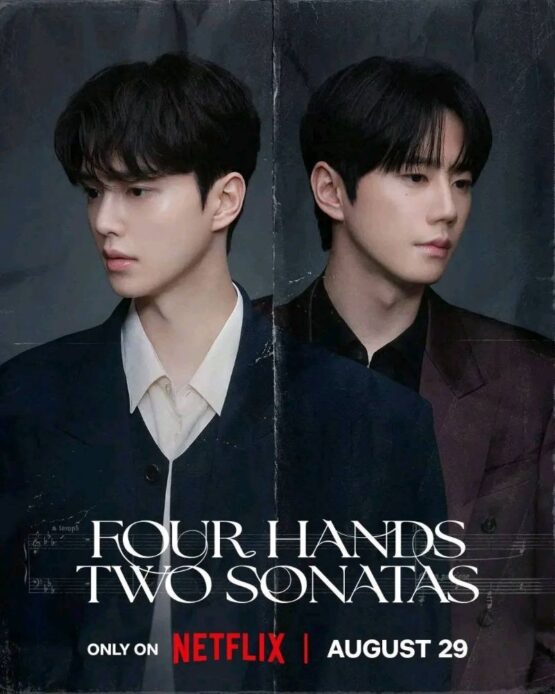
12 episodes
Starring Song Kang, Lee Jun Young, Jang Gyu Ri, Yoon Se Ah, Jung Jin Young
Netflix
Finding a truly original K-drama experience these days could be impossible, so it’s cause for celebration when a new series can reorganize and rearticulate familiar genres into something unpredictable. tvN’s Four Hands, Two Sonatas mixes romance, family drama, thriller elements, and music into a drama that also leaves the door wide open for queer interpretations.
It revolves around piano prodigies Kang Pi-o (played by Song Kang) and Choi Jeong Yo (Lee Jun Young), who form a close bond in high school—but are then forced apart and pitted against each other in the ruthless world of classical music.
The series’ quality isn’t simply a result of its relative uniqueness; it’s that the show is able to persuade its viewers to accept its narrative choices, even with some admittedly ridiculous twists and turns. This is a drama that trusts its audience’s capacity for storytelling, positioning itself a little further away from K-drama norm. All the while, it showcases two lead performances that mirror each other in compelling ways, finding affection and resentment within the same charged moments.
To address the elephant in the room—this is not explicitly a queer drama. However, it is still undeniably a love story, the main characters sharing a special intimacy through music that both heals and hurts them.
The series keeps subplots to a minimum, devoting time to drawing connections between the protagonists, each of whom takes on qualities from the other to navigate their dysfunctional family lives. But the show is also edited like a psychological thriller—the characters’ emotional currents are always in sync (even when events skip ahead by years), and the musical sequences are made especially urgent, transforming piano performances into either shared adventures or duels to the death.
In fact, Four Hands is so focused on developing this rivalry that the elements outside the protagonists’ dynamic occasionally lack the same kind of meticulous design. The narrative isn’t immune to slow patches and easy outs, and seemingly important supporting characters such as Jang Gyu Ri’s hopelessly romantic Hong Jae In, and absentee father Choi Gi Taek (played by Seong No Jin), are left as afterthoughts.
And yet, Shin Yi Won’s script always finds its way back to its central relationship, painting an increasingly visceral picture of the unconventional bond between the two prodigies. As their respective careers go through peaks and valleys, Pi-o and Jeong Yo respond to each other through their performances and compositions.
Much of the show works because the cast also takes the material seriously. There are no unnecessary comic relief characters or one-dimensional villains, and even the non-Korean actors who pop up aren’t out of place.
Among the supporting performances, Jung Jin Young’s portrayal of Pi-o’s grandfather, Seung Woon, becomes the drama’s most surprisingly emotional ingredient—at first as a disdainful traditionalist with an unfounded hatred for his grandson, but slowly growing into a man burdened by whatever legacy he may leave behind. Yoon Se Ah (playing Pi-o’s domineering mother, Ji Hye) borders on being comically shrill and antagonistic, but even her character’s drastic actions stem from emotional truth, as yet another link in a chain of neglect.
Song Kang’s measured performance gives the character anxious energy; Lee Jun Young again displays remarkable versatility
On the receiving end of this harsh treatment, Pi-o thankfully isn’t depicted as a stereotypical tortured genius. Song Kang’s measured performance gives the character an anxious energy that one would expect, but beneath his standoffishness is a clear portrait of a young man trying to reprogram his self-worth.
Lee Jun Young once again displays remarkable versatility, his Jeong Yo going through more extreme but always coherent changes. Jeong Yo is repeatedly betrayed by all the people he comes to consider as his loved ones, and his evolution into someone colder and more controlling is as impressive as it is intimidating.
These mirrored journeys of self-determination are what define Four Hands.
It’s a testament to the actors that the performances still resonate, especially because neither Song Kang nor Lee Jun Young is even remotely convincing as high school students at the beginning of the series. The helplessness that Pi-o and Jeong Yo are supposed to feel here never fully lands because the show doesn’t make much of an effort to have them act younger. This is the one glaring odd choice in a drama that otherwise succeeds because of how seriously it takes itself.
Director Park Hyun Seok accepts the story’s melodrama and never makes fun of it—instead, giving it a sleek visual style that reflects the upper-class spaces where classical music has become an expensive indicator of culture.
And in these music halls, classrooms, and before the pianos in various locations, Park Hyun Seok stages the musical numbers not only as battles to prove oneself worthy of preserving classical music tradition, but as a way for the characters to wrestle with each other’s emotions. The selection of classical pieces in Four Hands feels particularly curated, favoring more intense compositions: Camille Saint-Saëns’ Danse macabre is especially prominent, as is an original work entitled Nemesis.
The series never attempts to over-explain any specific meanings to the music, but the way it compels us to listen with more intention—to hear anger, betrayal, even forbidden love, in every variation—makes it a uniquely challenging experience among K-dramas this year.
Four Hands, Two Sonatas is streaming on Netflix.


