
It’s always a heady experience to cover Manila FAME, especially with 360 exhibitors filling the World Trade Center. First held in 1983, the twice-yearly fair takes its name from Furnishings and Apparel Manufacturers’ Exchange, and is now on its 74th edition, with “Bloom” as its theme to celebrate the flourishing of creative talent, artisan communities, and enterprises.
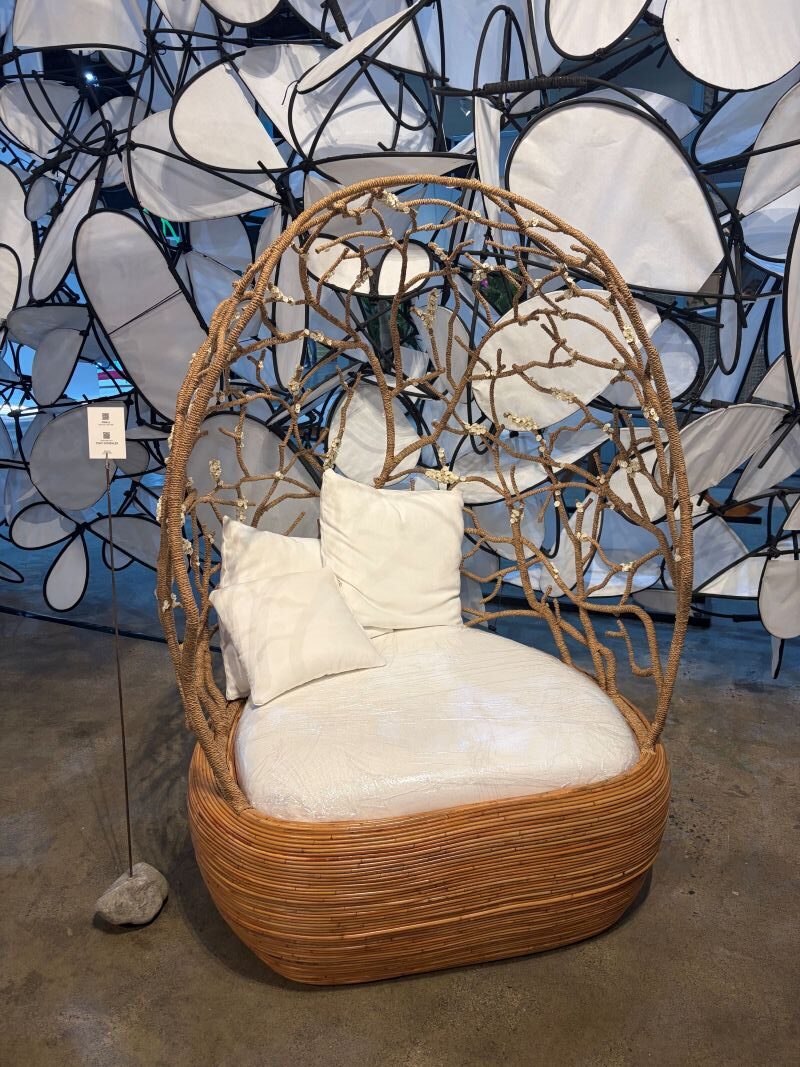
Tony Gonzales’ signature pod
At the heart of the fair is the Design Commune, where five rising designers mentored by Tony Gonzales have worked with 20 manufacturers to create 90 original home pieces. Gonzales says they share the drive to excel and make innovative designs the old-fashioned way.
Complementing their work is curator Milo Naval’s Home at FAME, where he has designed furniture and lighting with 10 partner manufacturers, including pieces for his brand, OMO. In separate exhibits, Naval highlights his advocacy for mangrove preservation and presents another group of mentees from Design Center Philippines (DCP), who have collaborated with Bicolano craftsmen.
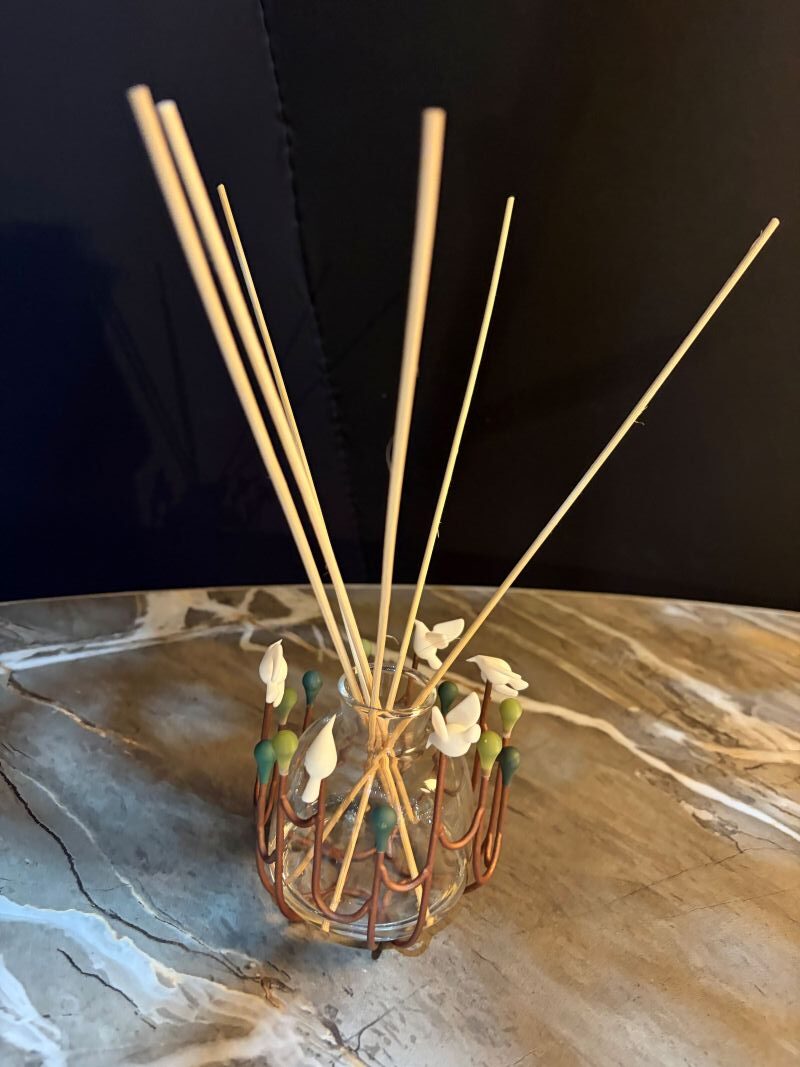
Kenneth Cobonpue’s brand launches fragrance sticks and aroma diffuser accessories.
And Manila FAME wouldn’t be complete without designer Kenneth Cobonpue, who is making news this edition with a home fragrance line that really works, and aroma diffuser accessories for the hospitality industry.
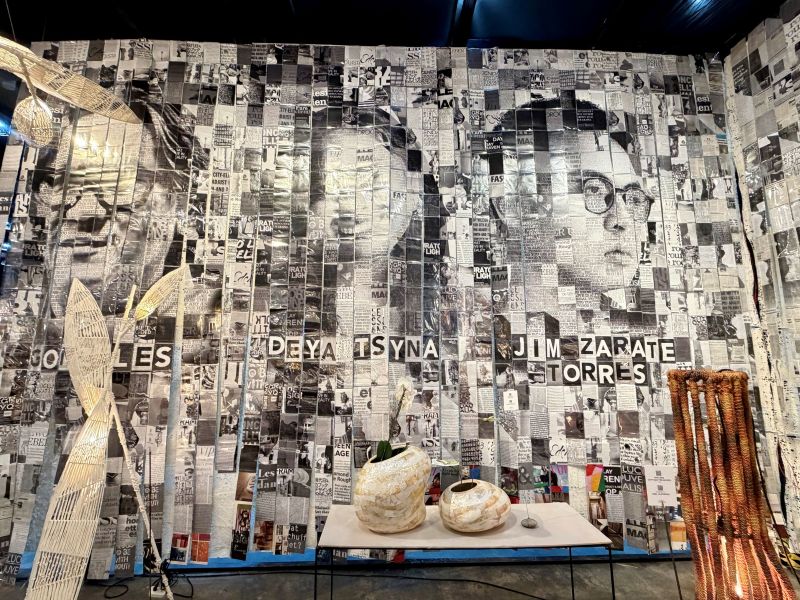
The Design Commune is created like a room within a room, with mosaic walls of Gonzales’ and his wards’ portraits.
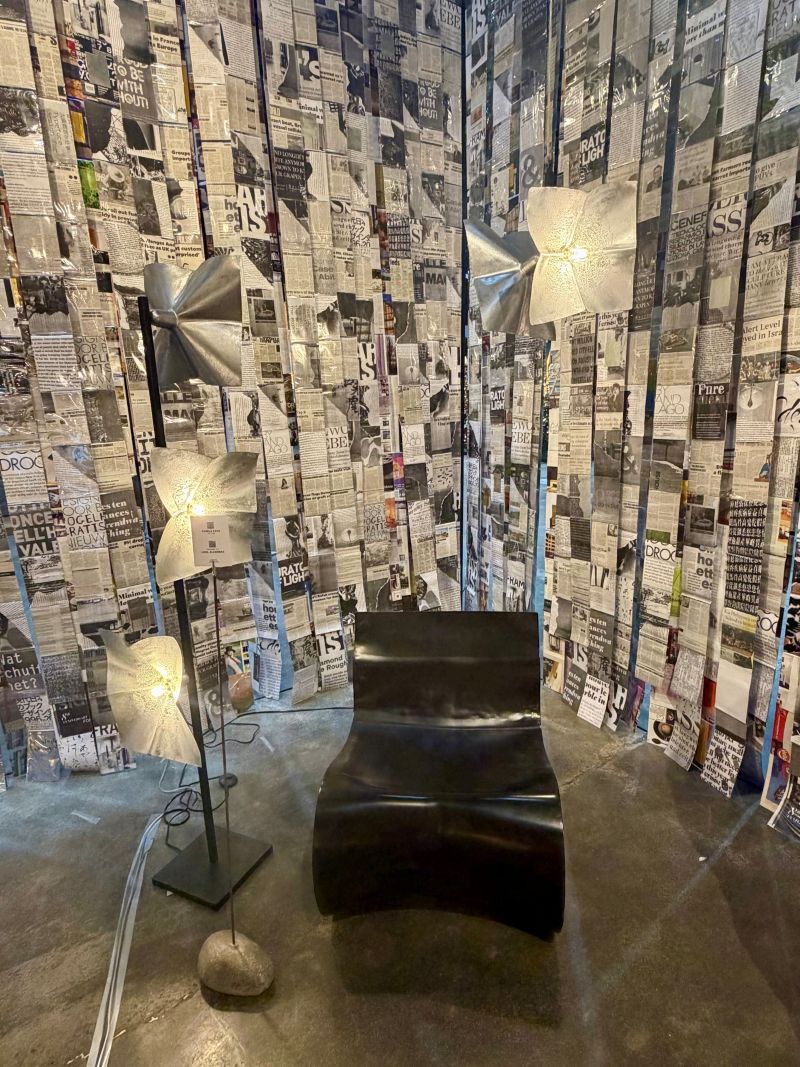
Uzel Alconera’s chair and lighting
Uzel Alconera – This creative moves between interiors and product design, guided by a human-centered approach. Her work is thoughtful, tactile, and grounded in the belief that design should be experienced, not simply appreciated for aesthetics. Empathy is central to her philosophy. Early projects for the visually impaired taught her to consider how people navigate, feel, and interact with spaces and objects. That sensitivity continues to inform her work, from interiors to furniture and products.
Alconera’s style is shaped by a close relationship with materials. Rather than imposing a fixed vision, she responds to each material’s natural qualities, allowing texture, craft, and process to influence the final form. Her designs balance contemporary elements with cultural memory, ecological awareness, and the character of Filipino craftsmanship. Sustainability, for Alconera, is a basic design consideration. She thinks carefully about materials, production, longevity, and impact from the outset.
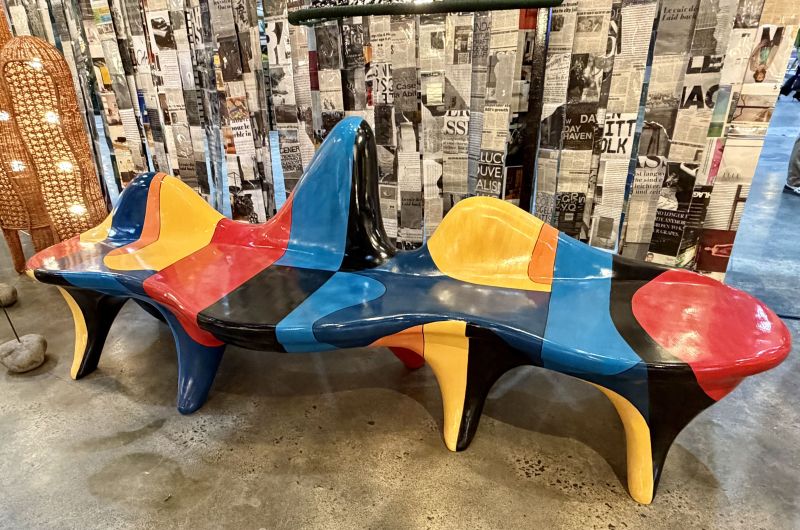
Jim Zarate Torres’ seater
Jim Zarate-Torres – Since founding Zarate Manila in 2015, Jim Zarate-Torres has built his practice around bold geometry, graphic lines, and sculptural forms. He distorts familiar shapes, shifts proportions, and reworks recognizable design elements into furniture, lighting, and home accessories that command attention without sacrificing function. His pieces pair crisp silhouettes with tactile surfaces and finely-worked details, giving industrial-looking structures the character of handcrafted objects. He strips forms to their essentials, then alters their proportions and geometry until the familiar becomes visually arresting.
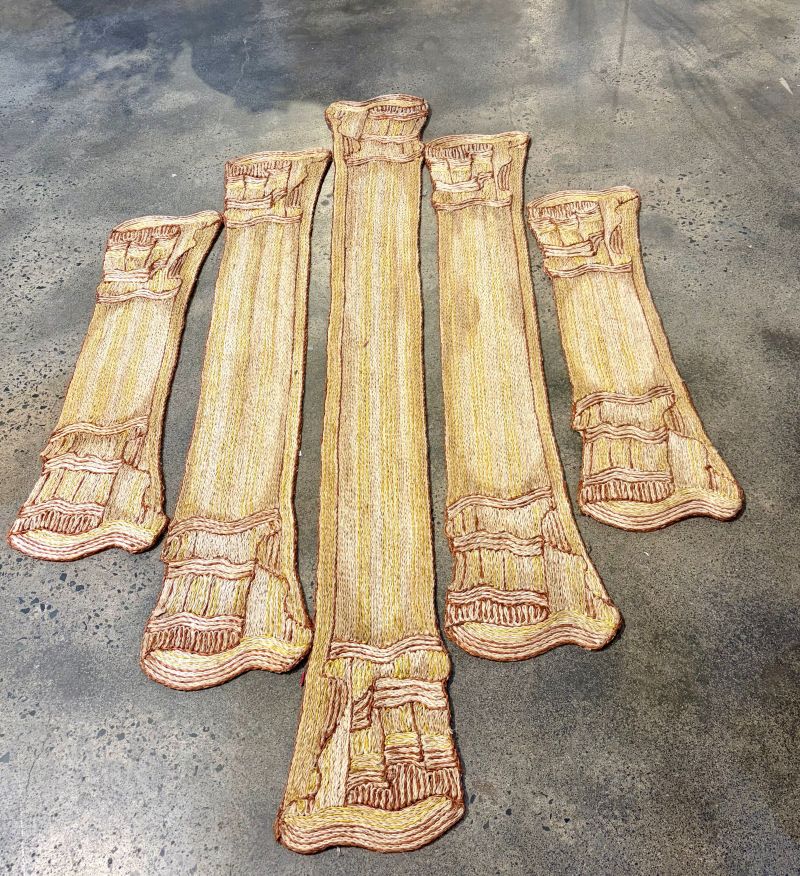
Jaime Brias’ fun area rugs
Jaime Floirendo Brias – This second-generation designer trained in product design at the Rhode Island School of Design (RISD), where he specialized in handmade furniture. He studied woodworking, metalworking, and wood joinery. That training led him to artisan crafts, which now inform his work as a designer for other companies and a lighting designer for his mother Maricris Floirendo Brias’s company, Tagum Agricultural Development Company (TADECO), a major banana producer with a design enterprise that works with Filipino artisans.
Brias did not originally plan to design lighting. After attending trade fairs in Germany and Paris, however, he noticed that lighting fixtures were among the Philippine products selling abroad. He began studying what buyers wanted and designing with a market in mind. For him, a product needs a clear purpose and a potential customer.
His process starts with the material. The Buyod hanging lamps, named after the Bisaya word for a plastic bag, combine abaca and cotton. The materials create contrasting surfaces, one rigid and the other flexible. Another lamp uses banana pulp and abaca to make a floral cover. He also designed cactus-shaped lamps with Maria Vine Craft, which works with a pliable vine native to the southern Philippines. His standing lamps take their form from carnivorous pitcher plants.
Brias’ designs combine function with sculptural forms and a touch of whimsy. “I don’t really like design that’s too serious,” he says.
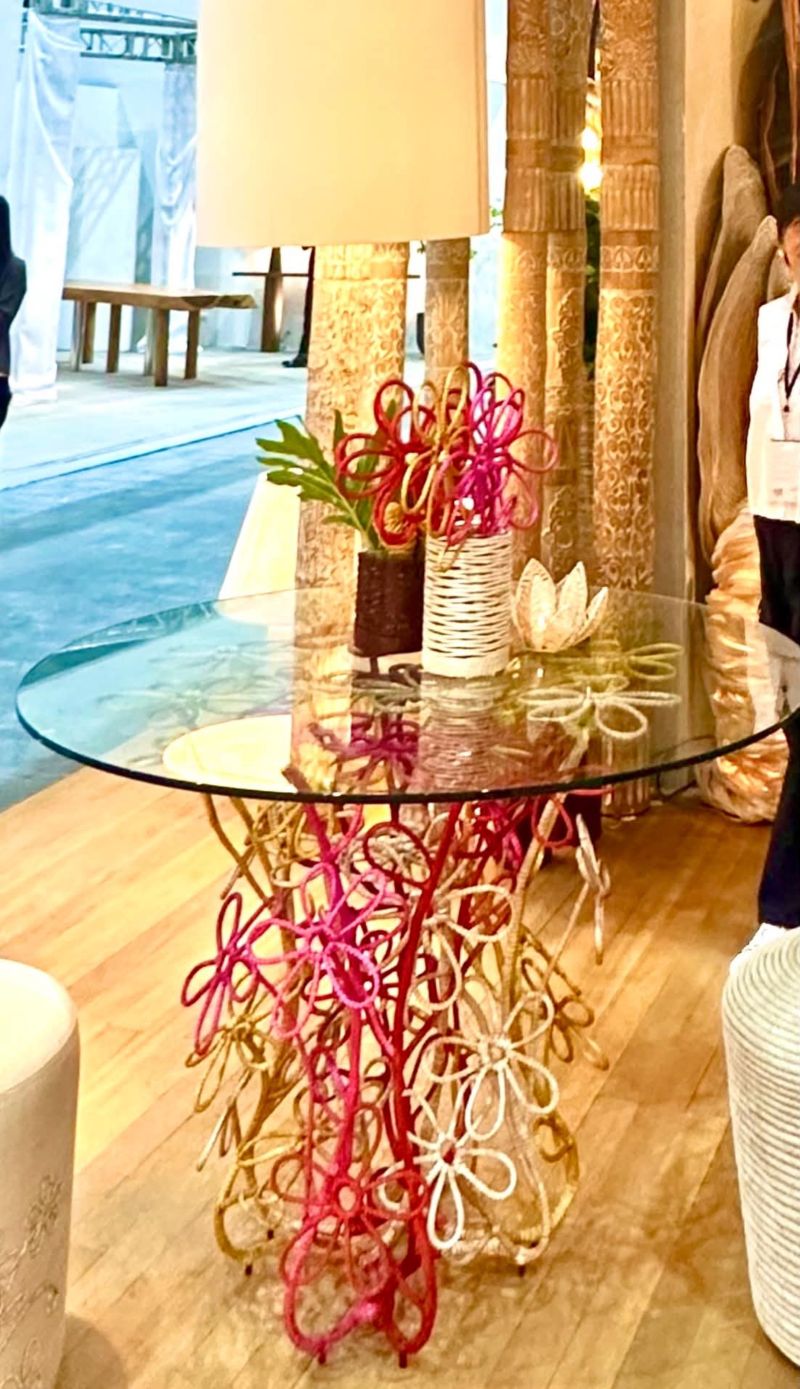
Brias pays homage to his late sister and her floral doodles in this glass and metal table.
Inspired by the floral doodles of his sister Cristina, who died this year, Brias translates her playful lines into a sculptural table base of intertwining loops in pink, red, cream, and natural tones. The intricate, seemingly weightless forms contrast with the circular glass top, which allows the base to take center stage. Matching accessories, including a vase with curled, floral forms, extend the motif to smaller objects. Rather than simply reproducing Cristina’s drawings, Brias gives them volume, color, and a place in everyday life, creating a collection that celebrates her creativity while keeping her memory close.
His approach to materials and craftsmanship owes much to his mother. She taught him to value Filipino artisans and respect the traditions behind their work. The T’boli weavers of Lake Sebu, South Cotabato, are among the communities she has worked with most closely.
Brias has visited Lake Sebu to see the process firsthand, from harvesting abaca and dyeing fibers to weaving on backstrap looms. The experience showed him the skill involved in making traditional textiles. He believes designers can help artisans develop new products without imposing a different style or erasing the techniques that distinguish their work.
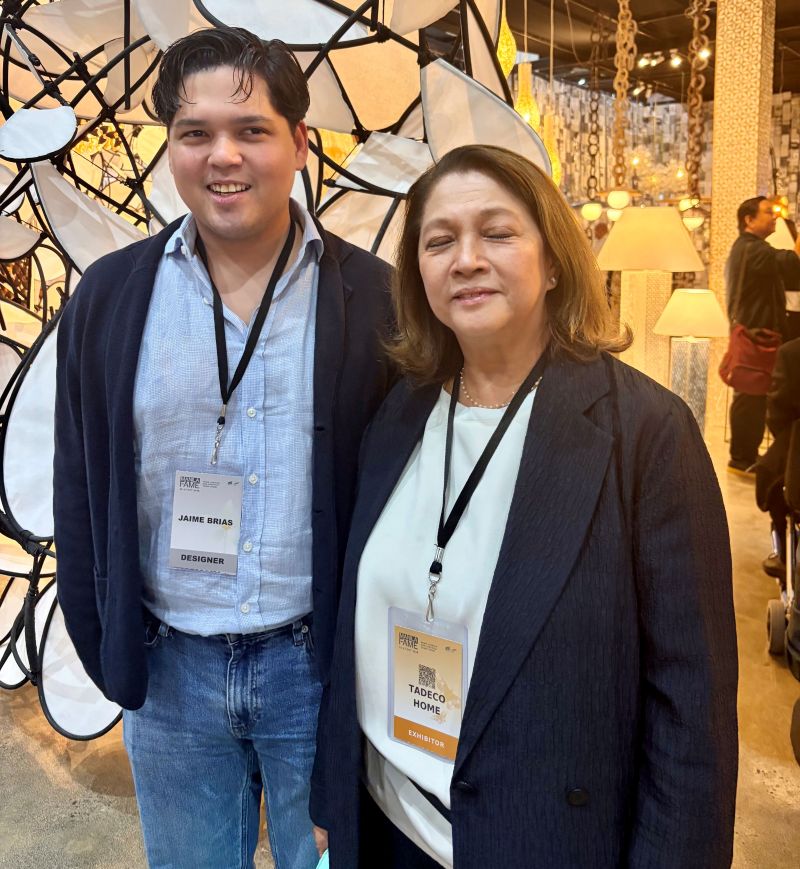
Jaime Brias with his mother Maricris
He has known his mentor, Tony Gonzales, since childhood, and has worked with him on projects for about 10 years. For the current design show, Gonzales has been helping younger designers develop their individual styles while guiding them through design development and manufacturing. His advice to Brias and the others is to avoid copying someone else’s aesthetic, and to find a design language of their own.
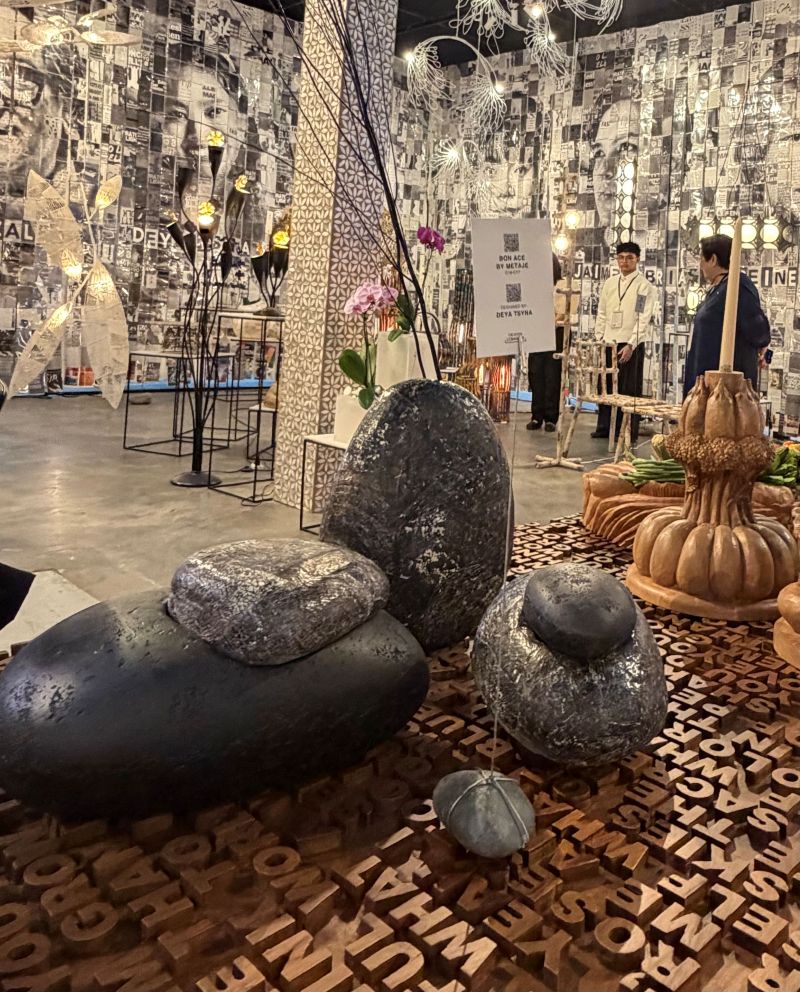
Deya Tsina’s stone-inspired setting
Deya Tsina – Visayan designer Deya Tsina draws on Bohol’s weaving traditions, provincial life, and local artisanship to create contemporary furniture. Her Dioleta accent chair won the inaugural Fashion Aid PH grant competition. Inspired by her grandmother’s long hair and padayon, a Visayan word meaning to keep going, the chair takes the form of an infinite loop woven from abaca rope. Her family, Antequera basket weavers, and local craftsmen helped make it.
Tsina’s Amara Bench, created with Jed Yabut Furniture and Design, won first place at the Masterpis National Furniture Design Competition in March 2025. The following month, it received the Most Popular Design award at the ASEAN Furniture Design Awards in Bangkok. Since entering the industry in 2024, Tsina has trained under designer Vito Selma through Obra Masterclass and learned from exporters Vanessa Gaston and Jed Yabut. She has been exposed to more furniture manufacturing and the realities of designing for the market under mentor Tony Gonzales.
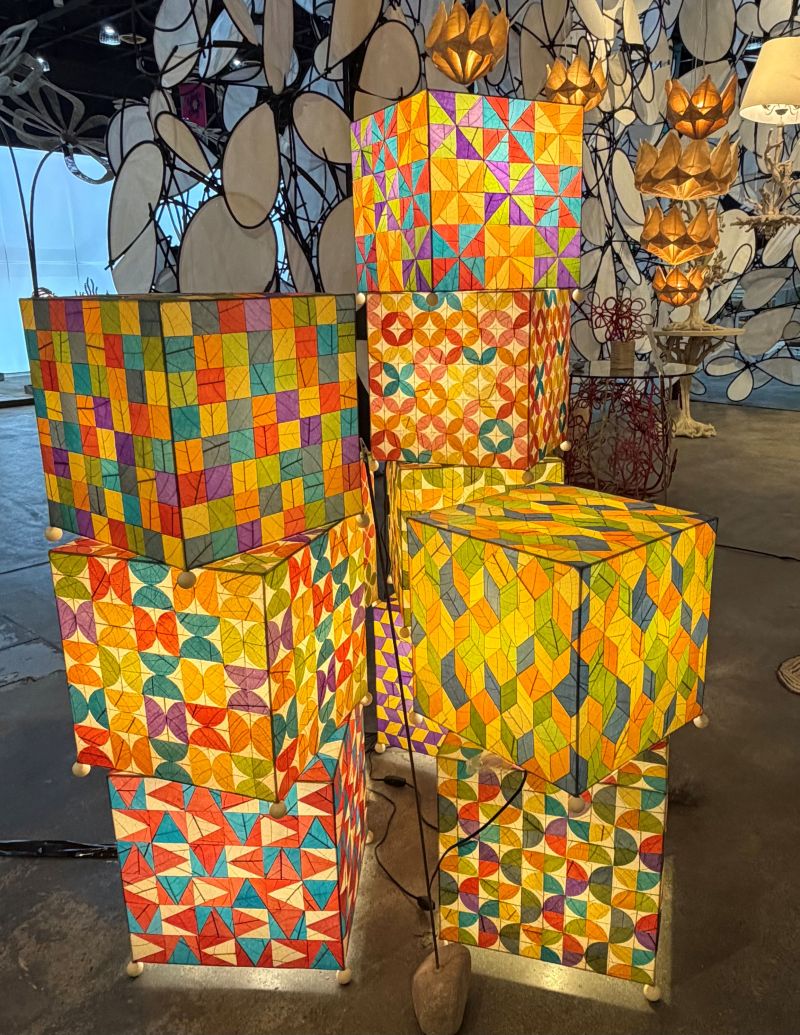
Graphic design lighting blocks by Reine Shih
Reine Shih – Industrial designer Reine Shih is driven by two questions: “What if?” and “Why not?” She challenges the familiar, experiments with everyday objects, and looks for surprising ways to solve design problems. She brings the same curiosity to teaching, while heading the graphic design department at Gonzales’ design firm.
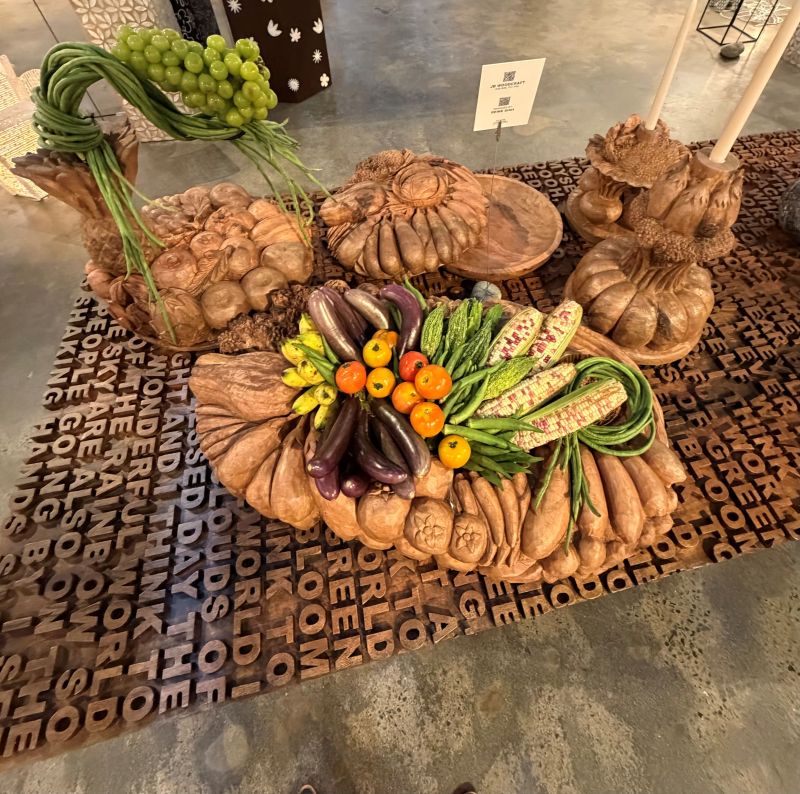
Reine Shih’s food accessories and Jim Zarate’s alphabet table
Milo Naval has his hands full at Manila FAME, designing for 10 companies, mentoring young designers, and showcasing his own furniture and accessories. Across three booths, he brings together Filipino makers, regional materials, and fresh ideas, with an environmental message woven into the mix.
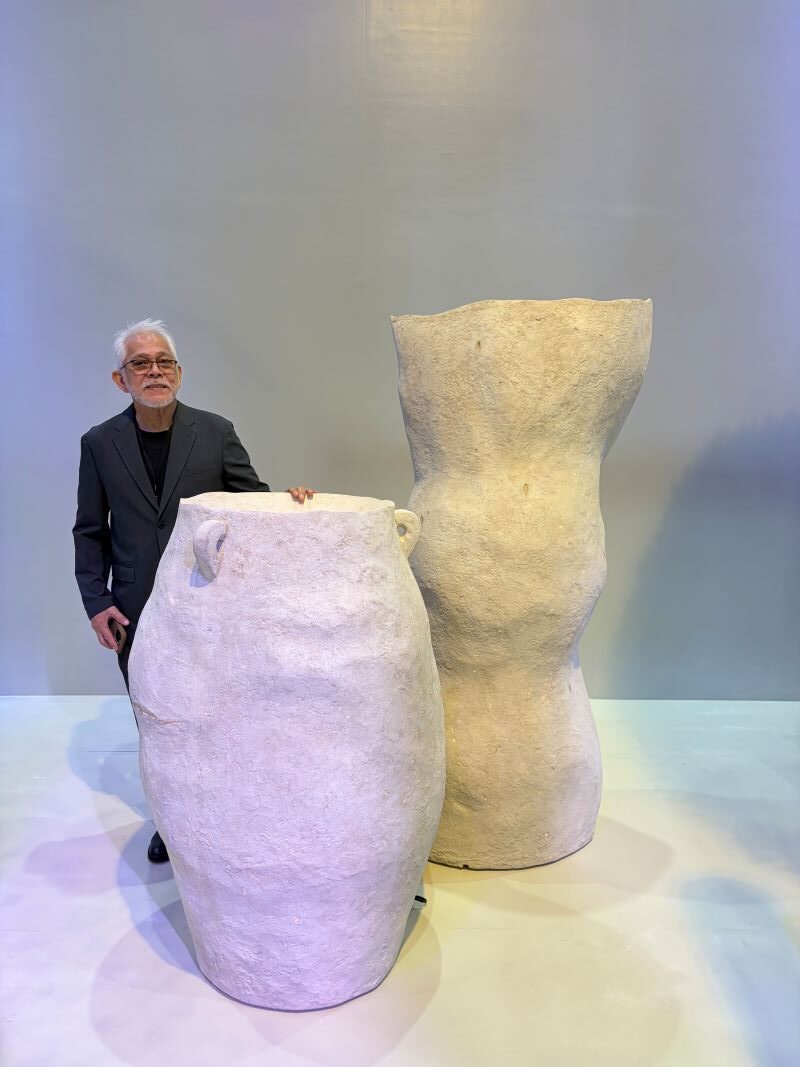
Milo Naval at Home at FAME
At Home at FAME, Naval worked with manufacturers from Pampanga, Cebu, and Manila, including his own company, OMO, to create settings for home and hospitality projects. Naval’s signature style pairs minimalist forms and generous proportions with Filipino materials. His furniture has a clean, contemporary look, while his use of bamboo, rattan, abaca, and other natural materials brings texture and local craftsmanship into the mix. One display contrasts OMO’s bamboo sofa with curvilinear black metalwork by Jed Yabut. A humungous chandelier of rattan strips and capiz shells, which Naval made for his booth when the scale of the original commission proved difficult to execute in time, adds drama to the display.
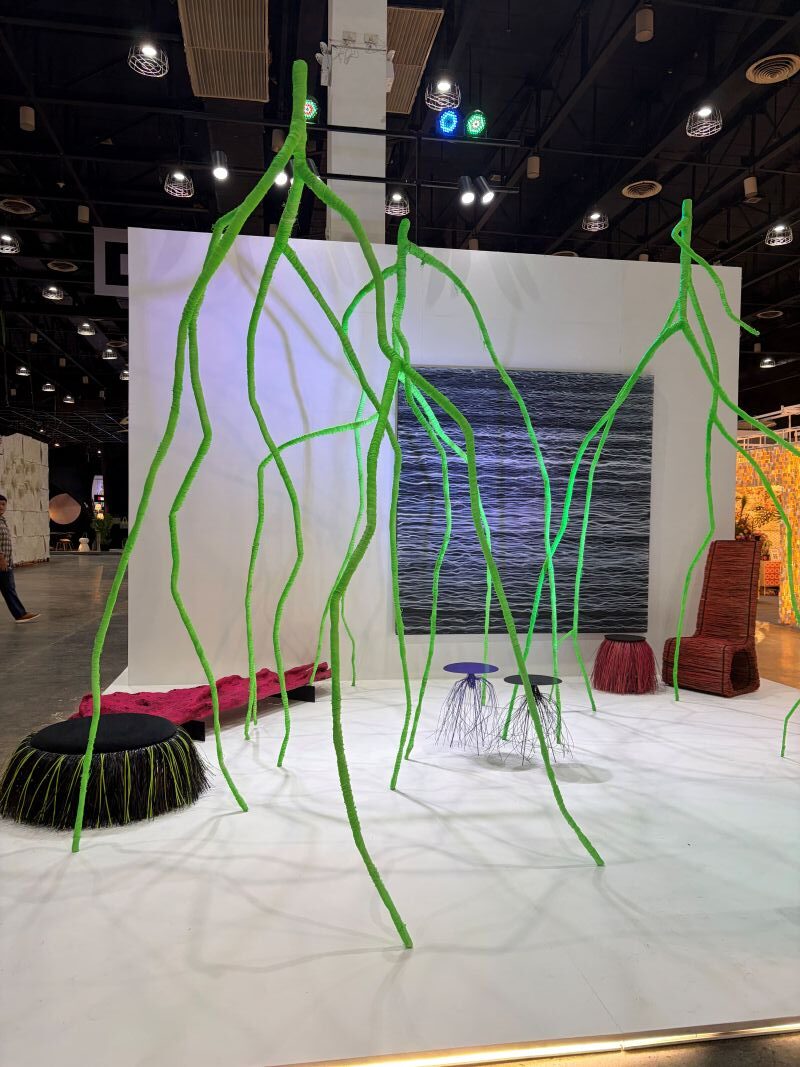
Naval’s advocacy installation of an abstract mangrove sculpture and painting of the sea
Naval also uses another booth to link design with environmental advocacy, The Architecture of Resilience. He transforms the protective power of mangroves by creating a labyrinth of roots that shows how these intricate networks shield coastal communities from storms, erosion, and flooding. The steel mangrove sculpture, wrapped in luminous fabric, and his painting of acrylic waves reinforce his call to replant mangroves. The vivid colors and sculptural elements, show how his pared-down aesthetic can accommodate both artistic expression and environmental advocacy.
His third project, Resi Diseño, put him in the role of mentor. Working with DCP, local governments, and manufacturers across Bicol, he guided young designers in developing products using regional materials and craftsmanship. The resulting collection included abaca and rattan home accessories, decorative pieces, and bags, most made by craftspeople in the region.
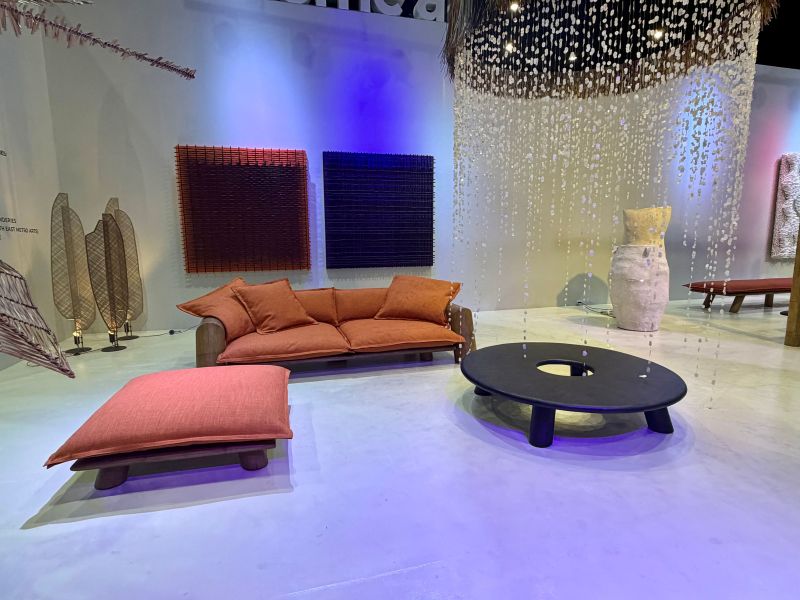
Milo Naval’s signature minimalist aesthetic in the home setting
Through the three projects, he connected established manufacturers, emerging talent, and regional artisans, showing how design can create new products while giving local materials, skills and environmental concerns a wider audience.
Kenneth Cobonpue wants people to experience his designs with more than their eyes. At his booth, the celebrated Cebuano designer unveiled new furniture, lighting, and accessories, then introduced a fragrance collection that adds scent to his signature world of fantasy and playful invention.
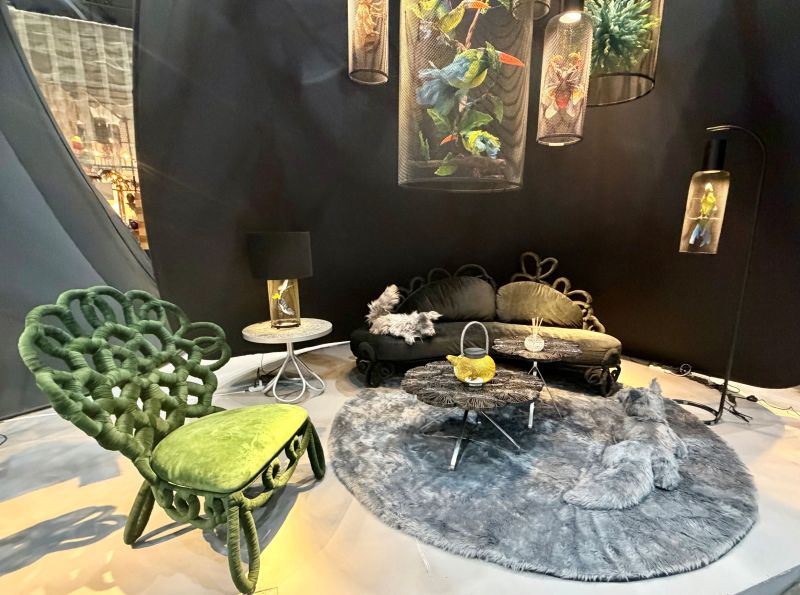
Kenneth Cobonpue’s shaggy rug with dog and Samba chair and sofa
A flower doodled by a child inspired his new seating collection named Samba. Made of wire, metal, foam, and fabric, the freeform shapes blossom into sofas, armchairs, and loveseats. A shaggy rug with a dog on top displayed alongside the pieces proved so popular that Cobonpue began considering how to put it into production.
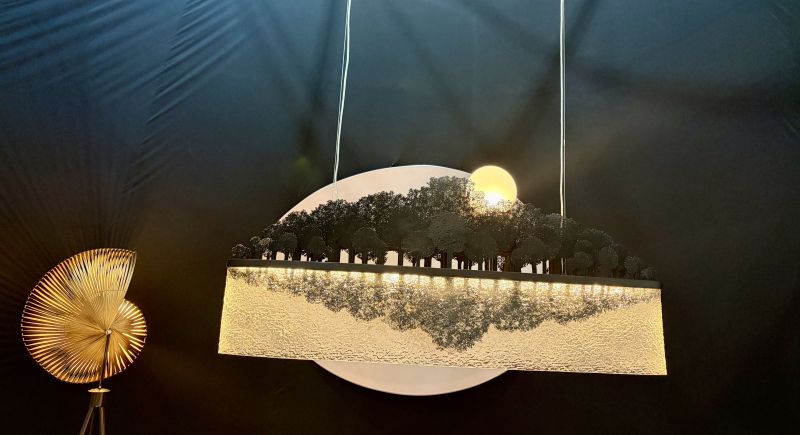
Nautilus-inspired floor lamp and ‘Moon River’ hanging light by Kenneth Cobonpue
Among the new lighting pieces was Moon River, a frosted-glass lamp that evokes the reflection of the moon over a serene lake. Its landscape of trees, made of felt, was created by individually burning the material to form the pattern. Other additions included a shell-shaped lamp in rattan and mango wood, an illuminated bar cabinet combining wood and acrylic, and Wiggle, a mechanical dog made of metal and leather.
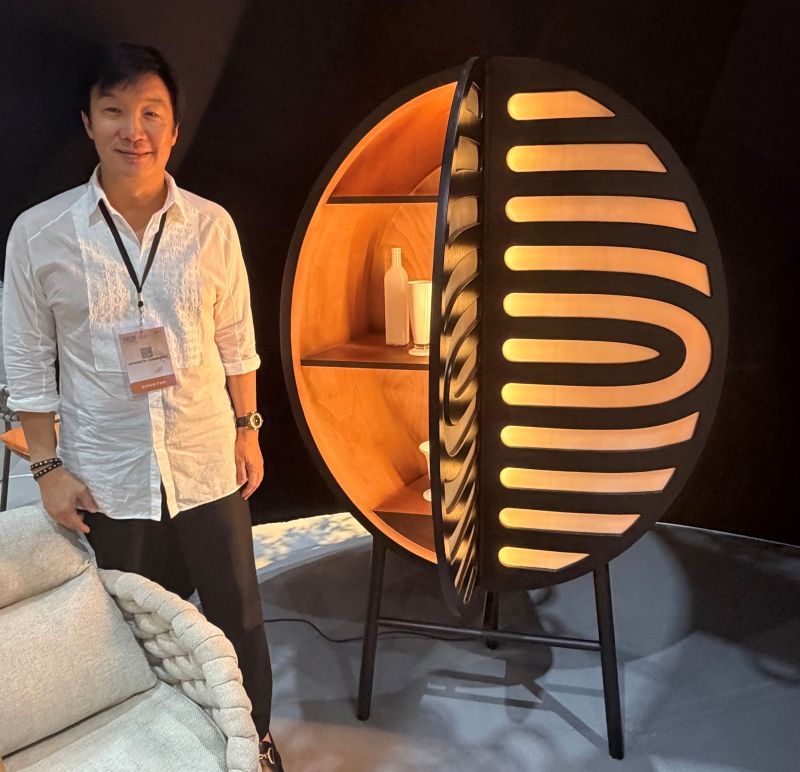
Cobonpue and his new bar cabinet
Cobonpue also introduced bags woven from the durable material used in his outdoor furniture. The collection has grown from storage pieces into tote bags, reminiscent of the bayong, with interchangeable straps.
The most intriguing addition is Cobonpue’s new home-fragrance line, which translates his playful aesthetic into three scents inspired by Filipino life and memories: Hiwaga, Lambing, and Harana.
The idea came from Joey Rodriguez, a business consultant who spent 30 years in the fragrance industry and trained as a perfumer, or “nose,” in France. Having worked with major fragrance companies worldwide, Joey suggested that Cobonpue’s designs, already tactile, colorful, interactive, and sometimes illuminated, were missing one sensory dimension. Why not add scent?
Cobonpue embraced the idea, and spent months testing numerous formulations with one of Switzerland’s largest fragrance companies. Rodriguez introduced the fragrances at the booth, using scented fans to let visitors experience each blend. Hiwaga opens with fruity and marine notes. Lambing, conceived to evoke youth and playfulness, combines plum, pineapple, patchouli, and coconut. Harana brings together black currant, clove, and other notes in a more distinctive combination. The idea of these fragraces is to evoke the idea of a clean house.
Rodriguez said the fragrances were designed to deliver both quality and staying power. The team wanted them to match the oils used in leading reed diffusers, with an added strength suited to Filipino homes, where open layouts and generous living spaces can quickly dissipate scent. The compositions also draw on ingredients such as coconut and vanilla, which feel closer to Filipino experience than the cedar, oak, and smoky notes often associated with European interiors.
The fragrances are presented in reed diffusers housed in vessels designed by Cobonpue, turning the containers themselves into objects of design. The team will also preview vessels for a larger collection intended for hotels, guest rooms, and beach properties. The line is scheduled to launch in November through Cobonpue’s namesake store in BGC and his e-commerce.
With the fragrance collection, Cobonpue extends his imaginative approach to interiors from what people see and touch to what they smell, adding another layer to the experience of living with his designs.
Manila FAME runs through Oct. 17 at the World Trade Center in Pasay.


