
I GREW up and came of age in Manila, but somewhere in my 40s, Rolly and I made the big move to my grandmother’s house in Lower Brookside, Baguio. We left it (reluctantly on my part) in the late ’90s, when the Lolarga clan decided to sell it. Husband and I still wanted to provide our two children a life spent and steeped in Baguio as they entered their teens, so we stayed put in the city.
Brookside also figures in anthropologist-poet-indie bookstore owner Padmapani L. Perez’s paper “Writing Local Futures into Existence,” which she read at last summer’s national writers’ congress of the Unyon ng mga Manunulat ng Pilipinas (UMPIL) at the University of the Philippines Baguio.
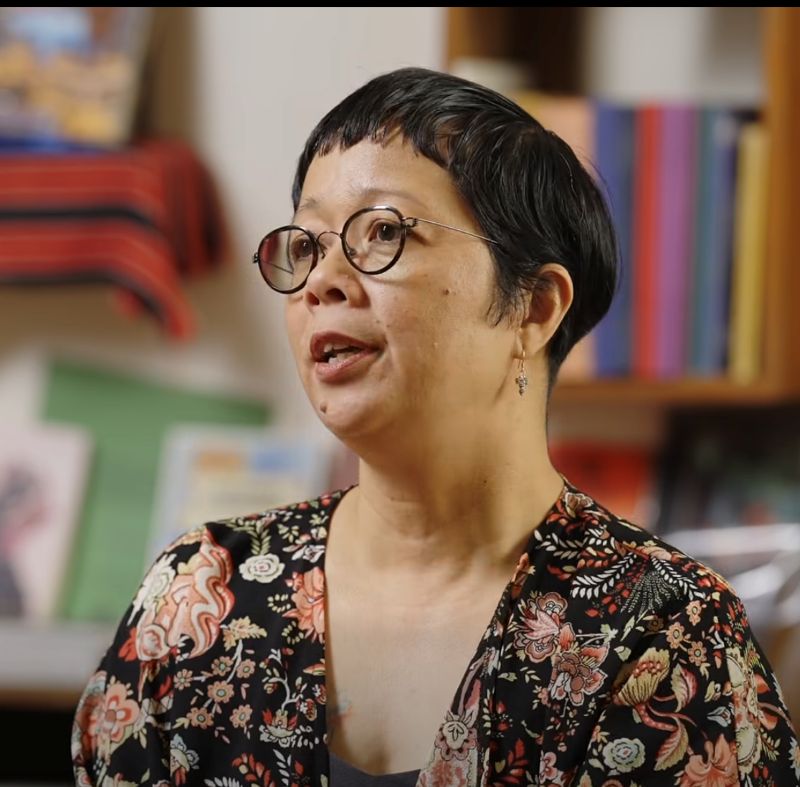
Anthropologist, poet, and indie bookstore owner Padma Perez (Photo from NLEX Lakbay Norte interview)
Towards the end of her presentation that involved the writer’s role in resistance movements, like the successful Save the Public Market protests versus redevelopment moves by a gigantic corporation, an experience that taught her to be more daring, Padma asked the almost rhetorical question that got me reflecting on the bodies of water in my past: “Who are the waters that accompanied you in your childhood?”
She named four and described each: “One is a phantom creek, Brookside, who only shows up at dusk, blackened and reeking of human refuse. In the past, Brookside was clear running water with banks lined by moss-covered boulders. Now it runs through concrete canals built in an attempt to contain the creek’s overflowing in the rainy season. Another is the Bued River running through Kennon Road, the route of my many departures from and returns to Baguio. Bued carries gold dust in their waters. I have also been a student of a revolutionary body of water who was very much a part of my growing up: the Chico River. And finally there is the river that is a cautionary tale, showing what becomes of us when we disregard our beyond-human relationships: the Balili River.”
I’ve seen how that phantom creek could rise to an alarming height, looking like it would spill onto my grandmother’s planted-to-wild chayote backyard whenever the monsoon rains visited like they’re doing now. The waters, with the color of café au lait as I once wrote to homesick poet Luisa A. Igloria, was eating the riprap wall that shielded our family lot from the small body of water and the neighboring Holy Ghost Hill. When the waters subsided, the brook or creek returned to its inky black color.
It wasn’t long ago in the ’60s when we’d cross that creek to climb the hill in our bought-in-the-palengke slippers—there were no branded climbing or sporty rubber shoes then. The current of the creek was so strong that it carried away my slippers. Memory today stops there. So traumatized was I by the loss that I can’t recall if I still joined my cousins during the climb or if I made my way back home on my bare, soaked feet.
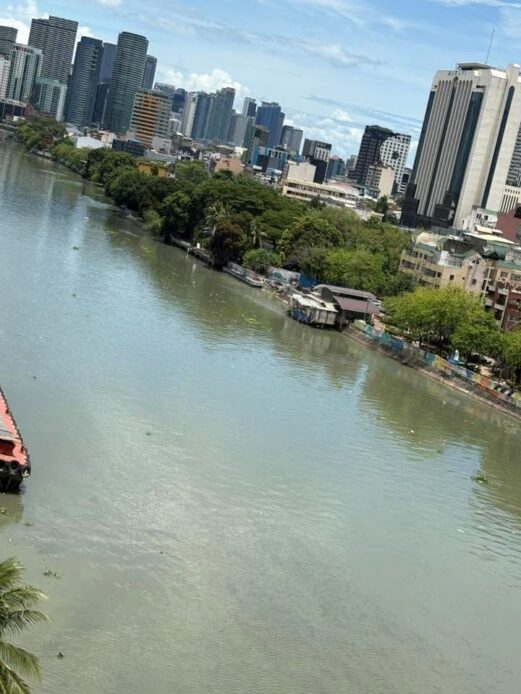
But yes, now that Padma brought up the waters she grew up with and how tainted and corrupted some have become, I must remind my relatives and siblings, my faithful readers, how my branch of the Lolargas grew up almost always not far from a bridge over estuaries of the Pasig or near the Pasig River itself, whether it was in Santa Mesa or Santa Ana in Manila. So when giving directions to persons about to visit our abode, our parents could be overheard saying, “Oo, malapit sa tulay (yes, it’s near the bridge).” Even in urbanized Sampaloc, Manila, there was a bridge (more likely an early flyover) near the house on Pepin Street, Dimasalang that vehicles had to pass by, driving over the roofs of houses.
Even when our family permanently settled in Barangay Kapitolyo, Pasig, the river would remain within sight from the rooftop. I once crossed from the Barangay Pineda settlement below Kapitolyo to get to the Guadalupe, Makati side without taking tricycle and bus rides, saving myself a few pesos and lots of time than if I had chosen to stew along EDSA traffic.
Yes, the river was anything but a clear blue reflecting the sky. It was smelly. It was waterlily season, too, so the boatman had to push the flowers out of the frail vessel’s path. With me were passengers all dressed for office work, the ladies in comfortable shoes, their office pumps tucked somewhere in their bags.
Now that I am rained in (yellow warning so far) and my doctor has cautioned me about slipping and falling if I venture out with the same gung-ho spirit I had in my childhood and youth, I just quietly listen to the pitter-patter of the rain or watch the cataracts of water run along grooves of the cemented road outside the house.
Where we live today, we are near the edge of a sinkhole that is actually the parking lot. Apparently, some bright neighbor—just to smooth out the rough road leading to our units—poured gravel and cement over a delicate spot. The same for another multi-storied condominium not far from us which was built over a running canal where rainwater used to be naturally caught.
I just pray that the waters will flow gently past the humans who made or live by these structures. But as the environmental activist in Padma says, in brave words I cannot hope to imitate, “We are connected by flows of toxins, too. Other beings suffer when we suffer. We suffer when they suffer. I’m thinking of extinctions alongside massacres, destruction of habitats alongside displacement and militarization, pollution alongside so-called development, ecocide alongside genocide, denial of rivers or other species’ right to exist freely alongside the denial of the humanity of other people.”


