
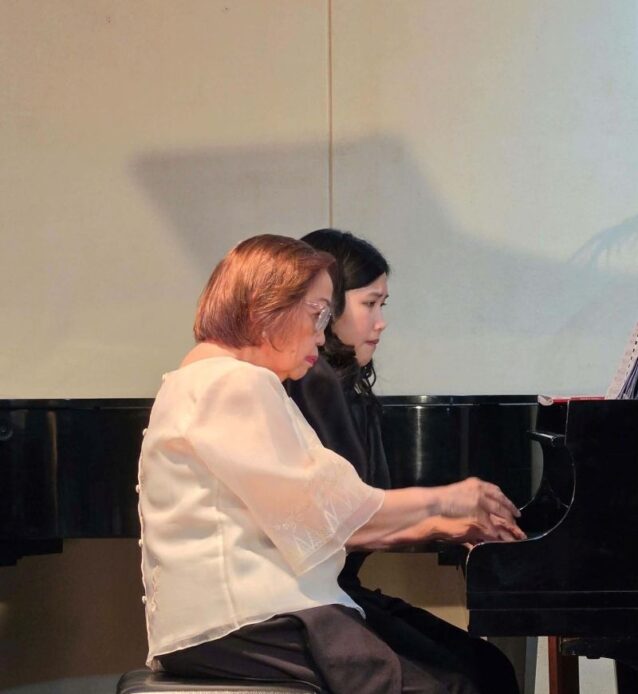
Pianists Cecile Basilio-Roxas and Inna Pangalangan Montesclaros forged a dynamic tandem in a four-hand piano concert billed Genesis, and held at the Sor Catalina Ledesma Recital Hall of Sta. Isabel College last Sunday, November 8.
Dr. Raul M. Sunico, foremost pianist and pedagogue who is Dean of St. Paul University-Manila, led the audience, composed mostly of pianists, pedagogues, and piano music enthusiasts, who came to watch this magnificent chamber concert that is rarely mounted on the local concert stage.
The concert promptly opened with Prof. Roxas giving the welcome remarks. She said the title of the concert, Genesis, was a throwback to when her first meeting with Inna Montesclaros took place. Inna studied with her when she was only 5 years old! Under Prof. Roxas’ tutelage, Inna had shown exemplary dedication to piano playing, marked by her winning top prizes in local piano competitions. From the University of Sto. Tomas, where she initially enrolled for a bachelor’s degree in piano performance, under the tutelage of then Dean Sunico, she went to London, where she earned her bachelor and graduate degrees, at the Royal College of Music and Royal Academy of Music, respectively—with honors, of course. She has performed locally and internationally, and at present, does some impresario work, engaging noted foreign pianists to perform in Manila and give master classes.
Believing that students should be treated as future colleagues, Prof. Roxas emphasized that the teacher’s role is firmly rooted in respect, and strong determination to draw out the student’s potential and hone it to the full.
Truly, the venue, which is perfect for chamber music, became a mute witness to the performances of her students, some of whom had sat in the audience and watched the concert. Prof. Roxas, who was once head of the piano department of Sta. Isabel College, was actively engaged as a teacher, who would present her students in recitals, sometimes at the same venue.
The program featured some of the best-known works for four hands piano playing that included some arrangements of our very own piano pedagogue, Prof. Augusto “Agot” Espino.
The two pianists sat side-by-side on the same bench and ran their adept fingers over the keyboard. Prof. Roxas sat as primo (first) who played the primary part, which usually handles the melody, and Inna as the secondo (second), who provided the foundational harmony and controlled the pedal.
It was such a revelation to hear Cecile, as we fondly call her, now an octogenarian, still forge a collaboration with a much more junior pianist, and endure a full performance such as this concert with undiminished vigor and brilliance.
Leonard Bernstein’s Overture to Candide was a fitting opener. Here, the tandem forged tight rapport that made their entire playing engaging to listen to. They struck punchy chords, and played with cheerful glee.
Next came Edward Grieg’s folksy two numbers from his Norwegian Dances, Op. 35: Allegro Marcato and Allegretto tranquillo e grazioso. Bucolic lyricism reigned as the pianists played the selections, both scored in the ternary or three-part form.
The Franz Schubert opus, the Fantasie in F minor, D. 940 (Op. post.103), was played with solid dispatch. The pianists breezed through the entire four movements of the piece without a break. From the melodic first movement, the pianists passed through the deeply expressive dramatic second movement, then etched an energetic dance-like third movement that was capped with a striking final movement expressed in a fugue, and a passage that recalled the opening themes.
After the interval, the two pianists sat on the same bench with still the same positions: Cecile as first and Inna as second pianist. This time they reveled in a local work, Prof. Agot Espino’s superb arrangements of three Filipino folk songs: Kataka-taka, Ahay Tuburan, and Pandangguhan.
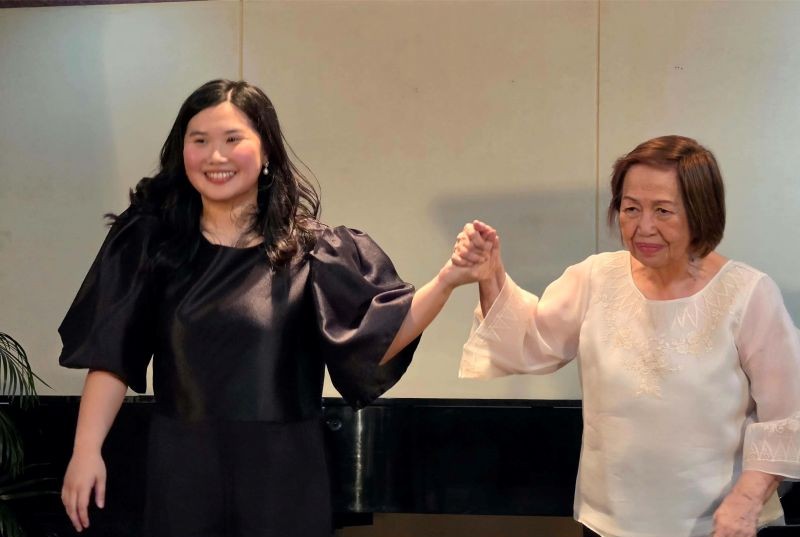
Acknowledging applause: Inna (left) and Cecil
They played these pieces with aplomb. Himself a piano pedagogue, Prof. Espino creates piano arrangements which always find a place in local piano recitals. As a pianist, he has the métier, so to speak, for doing intricate arrangements of the country’s well-loved folk songs for the piano. Of course, the local audience was at once able to identify the pieces, because they are scored in a familiar musical language. On the technical side, the arrangements presented a challenge to the performers, what with the wit infused in them. In Pandangguhan, for instance, one savored the shifting cross-rhythms that the composers employed. The pianists never rushed, but played with dramatic flair. When the last note faded out, long, hearty applause followed.
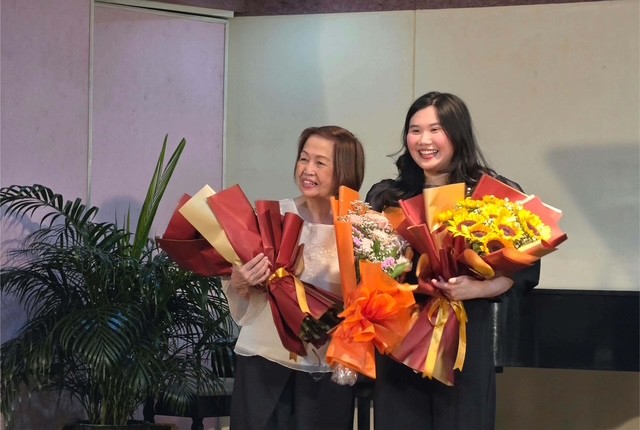
Bouquets for a sterling performance
In the succeeding pieces, the pianists changed positions, with Inna now playing first and Cecile second piano, respectively.
The three selected pieces from Cecile Chiaminade’s Six pieces romantiques Op. 55—namely, ll. La chaise á porteurs; lV. Sérénade d’automne; and V. Danse hindoue, were performed without any let-up. Here the pianists conveyed a sensitive evocation of the piece’s innate character: the march-like sensibility of the first; the guitar-like sonority of the second; and the hypnotic rhythmic drive of the last.
The penultimate number featured selected Hungarian dances from Johannes Brahms’ Hungarian dances. These were the Nos. 1, 3, 4, and 5. Here, one savored a full rich sound of dramatic sonar projection. Familiar, of course was the No. 5 that capped their playing.
Astor Piazzola’s Libertango, arranged for four hands, capped the performance. Here the tango rhythm was expressed in driving syncopations that the two pianists absorbingly played, and that earned huge applause at the end.
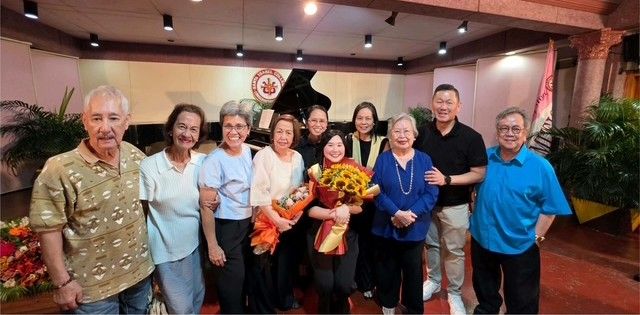
Souvenir pose with some piano pedagogue well-wishers, including Augusto Espino, Anthony Yu Say, Ingrid Chan, Gigi Gomez Arambulo, Richelle Rivera, and Carolyn K. Cheng
Congratulations, Cecile and Inna!


