
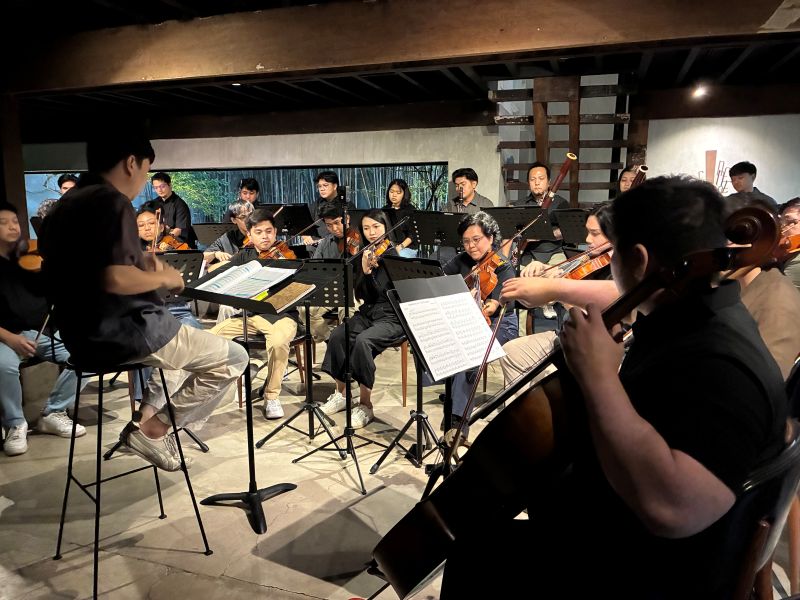
WHAT does it feel like to be literally embraced by music—no microphones, no gimmicks, just a 33-piece orchestra playing romantic classics a couple of feet away from you, in an old wooden house blessed with extraordinary acoustics?
That was what it felt like last Nov. 10, Tuesday, when we attended a performance of the Sine Pop Orchestra at the venue of the same name. Originally a 1948 post-war house on St. Mary St. in Cubao built by Sotero Pasion Eugenio, it was renovated in 2017 by architect Justin Guiab and has since served as a boutique theater and an extraordinary performance venue. It had already hosted performances of the Porvenir theater group’s production of the play El Fuego del Alma earlier this year, as well as regular kundiman nights featuring the music of Nicanor Abelardo, among others.
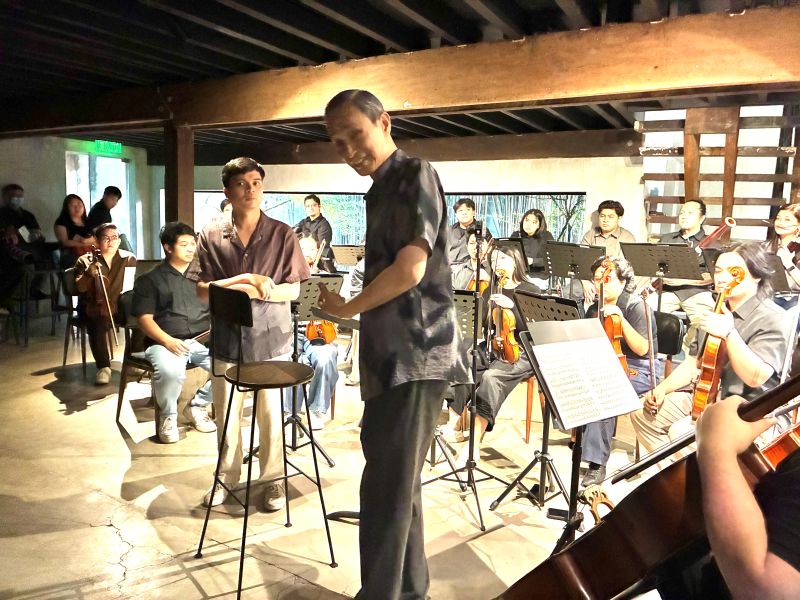
Ramirez and Carlson Chan before the performance
There were two performances that day, at 5 and 7 pm, and Sine Pop’s owner and arts maverick Carlson Chan prefaced the performance by explaining the unique set-up—how the audience of some 33 people would be quite close to the musicians in the 95-sqm acoustic space, how the percussion section would actually be behind us, and how the program of nine pieces would be played continuously, no intermissions (and applause between pieces) necessary. I didn’t realize how difficult the latter instruction would be until the orchestra began playing so beautifully.
Chan introduced conductor Franz Ramirez, also program director of the Orchestra of the Filipino Youth (OFY). Two OFY board members, Charo Santos-Concio and Fr. Manoling Francisco, were in the audience.
Ramirez proceeded to explain how the orchestra worked, such as the roles of the concert master (Gabriel Mendoza, also principal for first violin) and the principals for each section. The four sections were, first, the strings, the biggest in number, comprised of the violin, viola, cello, bass. “Sila daw ang backbone ng orchestra,” Ramirez said. “Hindi makakatayo yung orchestra kung walang strings, because they give texture.” Orchestras had originally been composed only of strings, he revealed, until the second section, the woodwinds, were introduced during the classical period, with credit given to Wolfgang Amadeus Mozart for identifying the woodwinds as solo instruments. These include the flute, oboe, clarinet, and bassoon, all of which give color to the sound—“very interesting, because they are all one family, but different.”
Then they wanted louder sound, Ramirez added, so came the next section, the brasses, the outdoor music makers like the French horn. Finally, the percussion instruments are the shy guys, like the triangle and timpani, but the piano is also a percussion instrument, Ramirez noted, because a hammer inside it hits the strings to produce the music. “As the conductor, I talk to the composer to know what he wants, and the concert master and I coordinate. In the words of the late Floy Quintos, in an orchestra, with all of this perfection and discipline, the aim of the artists is to create beauty.”
The old 1970s technology of “Sensurround” couldn’t hold a candle to the wonder of being encircled by such a wall of sound. Indeed, we were close enough to hear the soft pizzicatos of the strings, but could also feel our hair stand when the orchestra swept into moving crescendos that brought the dramatic pieces home.
The program began with Ludwig van Beethoven’s Symphony No. 7 (2nd Movement), and we realized how sitting so close gave us a perfect view of the musicians’ faces, all showing their rapt concentration. This was followed by the ethereal Intermezzo from Cavallleria Rusticana by Pietro Mascagni, which had the strings soaring. Exquisite solo performances highlighted the next two pieces, by Arvin Medrano in Johann Sebastian Bach’s Adagio for Oboe in D Minor, and by Kier Manimtim in Mozart’s Clarinet Concerto in A Major (2nd Movement).
Expressive piano playing by Mika Lastrilla was showcased in Dmitri Shostakovich’s Piano Concerto No. 2 (2nd Movement), as well as in Claude Debussy’s Reverie.
The last three pieces included two pavanes, music written with a solemn mood, one by Gabriel Faure, and another by his student Maurice Ravel, Pavane pour une infante défunte (Pavane for a Dead Princess), primarily a haunting piano piece. Finally, the concert ended with Ravel’s The Fairy Garden, the climax of his Mother Goose suite based on fairytales.
Chan ended the show with a request for feedback, and for continued patronage of the orchestra’s performances. We actually asked the musicians if they were comfortable having viewers so close, and apparently it wasn’t a problem; the woodwind guys even joked that there was a space right in front of them, but it would command a premium price.
The performance was short and sweet, but was enough to lift our spirts, the way great music always does. Whether you’re already a classical music aficionado interested in this new presentation, or a newbie exploring this genre, Sine Pop is a perfect welcome.
More performances of the Sine Pop Orchestra are scheduled on January 9 and February 6, 2027, both Saturdays, at 4 and 6 pm. Check out Sine Pop on Instagram and Facebook for details.


