
Cultural heritage, beyond history, is the invisible thread that weaves identity and world view together. All desired behavior—each shared meal, every unspoken rule passed down through generations—bears the imprint of those who have preceded us.
Half a world away from the Philippines in Texas, I explore my Filipino heritage by engaging in endless give-and-take with family members. Even while away from the land of my birth, the interplay of my cultural beliefs, behavioral patterns, and traditions continuously shape me as a Filipino.
My family’s cultural identity derives from my mother’s lineage, as she has raised me. By digging into the roots of our customs, examining personality traits, and reflecting on family values, I uncover how these factors influence my life. A highlight of my exploration comes from exchanges with my maternal grandfather, who lives in the Philippines. His experiences and recollections serve as a bridge between our family’s past and present. Through his stories, I gain insights into how cultural values were instilled in him and, in turn, passed down to his children, then to my generation.
Peeling back these layers of heritage, I honor my forebears and learn about the dynamic nature of cultural identity—how it shifts and adapts, even while enduring across generations.
My middle name, Ocampo, from my matrilineal lineage, is nominally Spanish. With much trade and cultural interaction with China since pre-Hispanic times, our country was ruled by Spain for over 300 years, then by America for half a century. Our history has resulted in a primary mix of indigenous, Chinese, Spanish, and American cultural imprints. From my family members, I have learned that our lineage includes native Filipino and Spanish ancestors, enriching our traditions, language, and religious beliefs. Many Filipinos, including my family, bear surnames of Spanish origin from the decree issued by Spanish colonizers requiring standardized family names.

‘Pagmamano’ remains a gesture of respect. (Photo from Instagram @bayanihanhub)
Our traditional Filipino family structure has centered around large, extended groups with members providing strong emotional and financial support to one another. Over generations, some cultural practices have remained intact, while others have evolved. For example, my grandparents emphasized strong family ties and respect for elders, which is deeply ingrained in Filipino culture as signified by the practice of pagmamano, a gesture of respect in which a younger individual takes the hand of an elder and touches it to his forehead. While this tradition continues, younger generations including myself express respect more informally, such as with verbal acknowledgment and acts of service. Similarly, extended families living under one roof was more common in earlier generations, but in these times, economic and societal changes have given rise to smaller, nuclear family units that, however, maintain strong connections.
Another key cultural tradition that has evolved over generations is the use of language. Filipino families historically spoke their regional dialects or languages such as Tagalog, Cebuano, and Ilocano. With globalization and other cultural influences, English has become a dominant language in the Philippines, particularly in urban areas. While my grandparents primarily spoke Tagalog and a southern regional dialect, my parents and I are now more accustomed to switching between Tagalog and English, a linguistic adaptation reflecting contemporary Filipino identity.
The family lies at the heart of Filipino culture, often extending beyond the nuclear unit to include strong connections with extended relatives. My family prioritizes unity and close communal ties. Even today, it is not uncommon in Filipino households to have generations sharing one roof, emphasizing the collective rather than the individual. Even among relatives who live separately, close familial ties are maintained through regular gatherings, celebrations, and constant communication. This interconnectedness strengthens familial bonds that enable a sturdy support system, particularly in challenging times.
Another distinctive tradition in our family is extending warm hospitality to visitors. We welcome guests with open arms, ensuring that they feel at home, with food as a highlight. This behavior stems from the Filipino cultural value of kapwa or shared identity, which fosters a sense of belonging and empathy towards others. An individual’s well-being is linked with that of the community, reinforcing a collective cultural identity that emphasizes connectedness.
An individual’s well-being is linked with that of the community, reinforcing a collective cultural identity that emphasizes connectedness
Beyond hospitality, interdependence among family members is a defining feature of Filipino households. In my family, it is not uncommon for siblings to support each other financially, even well into adulthood. Younger family members often assist in caring for elderly relatives, in the belief that elders are to be honored and cared for within the home. This cultural expectation extends to educational and career aspirations, with family members contributing materially for schooling or helping younger generations to secure better life opportunities. This sense of shared responsibility fosters resilience and collective, upward mobility.
Celebrations play an important role in reinforcing our cultural identity. Whether a birthday, a town fiesta, or a religious holiday, gatherings are special occasions that strengthen family ties and reinforce traditions that preserve family unity. My family takes great pleasure in preparing traditional dishes such as lechon (whole roast pig), pancit or a variety of Chinese noodles signifying the wish for long lives, and bibingka (a native selection of sweet rice cakes) that have been staples for generations. These gatherings are more than simply festive occasions, because we are reminded of our shared heritage and values.
Even with the prevalence of international travel mobility and migration, out cultural practices remain a constant in my family’s life. Technology may have changed how we stay connected, with video calls and group chats replacing handwritten letters, yet the central sentiment remains: family defines us.
Filipinos are widely recognized for their resilience and optimism in the face of life’s challenges; my relatives emphasize the importance of maintaining a positive outlook, a value commonly referred to as bahala na, which signifies faith in the future. Although this phrase is sometimes viewed as a form of fatalism, it also reflects a mindset of adaptation and courage in times of uncertainty. A noteworthy Filipino personality trait is hiya, a deep sense of social propriety that governs behavior. My family instilled in me the importance of how my words and actions reflect our good name. This guidance influences decision-making and social interactions.
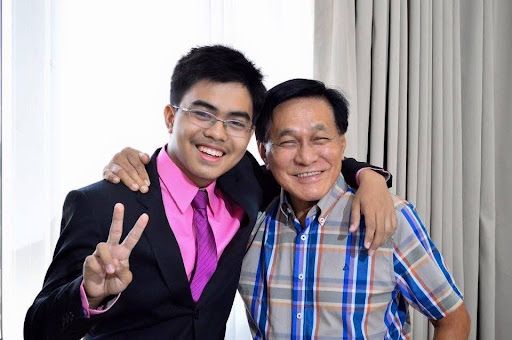
Recently, my grandfather Oscar Ocampo and I spoke about our family’s past. At 83 years old, he has seen the world change in ways I can only imagine. Growing up, I have always known him to be reserved and intelligent, choosing his words with care, always with an insightful story to share. He spoke to me of the achievements, the lessons, and the struggles that have shaped him.
Born on New Year’s Day in 1942, Oscar grew up in a home where the value of education was non-negotiable. His parents, both educators, instilled in him the imperative that learning was not just a means to a better future, but a lifelong responsibility. This mindset propelled him to pursue a medical degree at the University of Santo Tomas in Manila. His journey took him beyond the Philippines when, at 27, he moved his family to Liberia in West Africa, where he practiced medicine for over a decade. He describes this period as one of the most challenging yet rewarding times in his life—pursuing a demanding profession in an unfamiliar culture, providing for his family, while maintaining their Filipino identity because it was important.
Even as his children grew up and built their own lives and careers, retirement has not been an option for him. When I asked why he continued to work hard despite his achievements, he said, “I couldn’t just do the easy thing.” Instead of slowing down, he specialized further in his work, training in neurosurgery, continuing his practice until the COVID-19 pandemic forced him to step back in 2020. In his case, retirement was not about quitting; it was about passing on the torch. Most important to him are not his accomplishments, but rather, how his children and grandchildren uphold his values that give meaning to life.
Learning about my identity as a Filipino continuously deepens my appreciation of the rich culture with its traditions, priorities, and resilience that have shaped my family. The lessons my grandfather has shared with me are not his alone; they are a legacy that I respect with pride. As a Filipino living halfway around the world, I strive to carry into the future my heritage, one that makes me uniquely who I am.


