
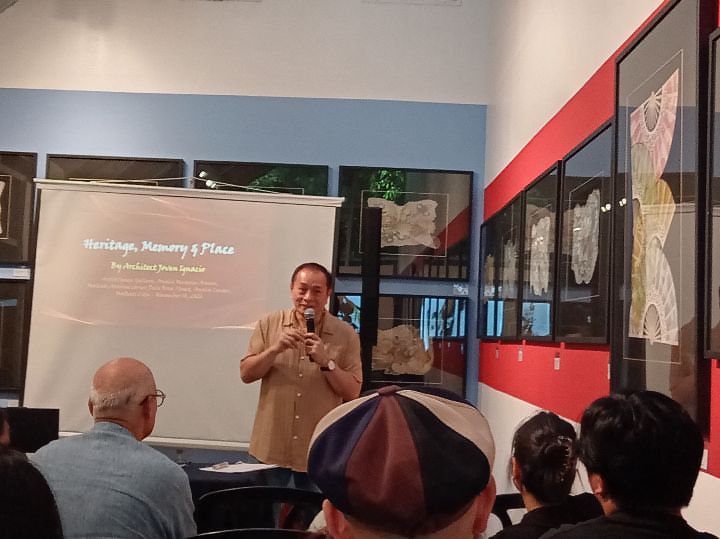
Photos by Sinag de Leon
I thought that it was suicidal thinking on the part of architect-painter-heritage conservationist Jose Ramon “Joven” Ignacio to schedule his lecture on “Heritage, Memory and Place: The Artist’s Journey from Batanes to Contemporary Art” at the same time and place as historian Ambeth R. Ocampo’s take on “Pre-colonial Gold.” That was the cultural double whammy one recent Saturday afternoon at the Ayala Museum complex. Joven spoke to an intimate crowd of 30-plus persons at ArtistSpace, while Ambeth addressed multitudes on the museum ground floor. Hard choice for the culturati.
I chose Joven over Ambeth because the architect, a retired professor from the University of the Philippines, rarely gives one, while the latter’s lectures are ubiquitous in social media announcements. Catch him at a museum or school near you.
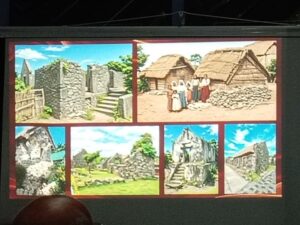
Samples of vernacular architecture still prevalent in Batanes
Early in Joven’s architectural practice, he met clients who would bring him glossy magazine pictures of houses and their interiors and request a Mediterranean look.
Joven would smile to himself and call the look, after considering the climate and landscape factors in this country, the “Medyo-terranean” look. He would convince these clients to study Philippine culture and temperature first.
In one instance, the client told him that she would buy an entire old house in Laoag, Ilocos Norte. Joven was aghast, since he was into heritage conservation.
But the homeowner, who was Chinese, said if they weren’t going to buy her house, she would burn it down and build a warehouse instead. Joven agreed to his client’s plan to buy the salvageable parts of the house for adaptive reuse.
When the client’s husband saw the many pieces of old wood and other materials, he freaked out and cried, “What did you do to my money?”
Joven and crew proceeded to strip the layers of paint from the wood, assuming that what lay beneath was narra. To his pleasant surprise, it was rare, hard-to-source ipil with the color of blood. Furthermore, the planks of wood measured 10-12 inches wide and were very thick.
Part of the wood went to the making of a four-poster bed. The Vigan and Machuca tiles were laid on the floor. The husband admired Joven’s handiwork so much that he moved his office into the house. He appreciated how his money didn’t go to waste.
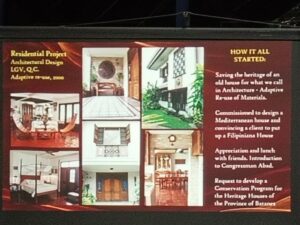
Slide showing Joven Ignacio’s residential project using materials from an ancestral house
During one of the housewarming lunches, Florencio “Butch” Abad was a guest who looked pleased with the bagong luma house. He invited Joven to visit Batanes and to look into its native architecture.
At the time, Batanes wasn’t in tourists’ consciousness. Joven also felt that he was innocent about the seriousness of heritage conservation and deemed himself lacking in necessary knowledge. He sought out Tina Torralba, then dean of the University of the Philippines (UP) College of Architecture, who helped turn his ignorance into an “exciting journey to a province that I can only describe as, ang ganda-ganda.”
Batanes had just experienced a strong earthquake and typhoon, so the old houses and buildings were in near collapse. Joven said in the vernacular, “Sayang kung hindi maalagaan.” He saw how people were replacing thatched roofs with GI sheets which, he said, would do more damage to the natural architecture.
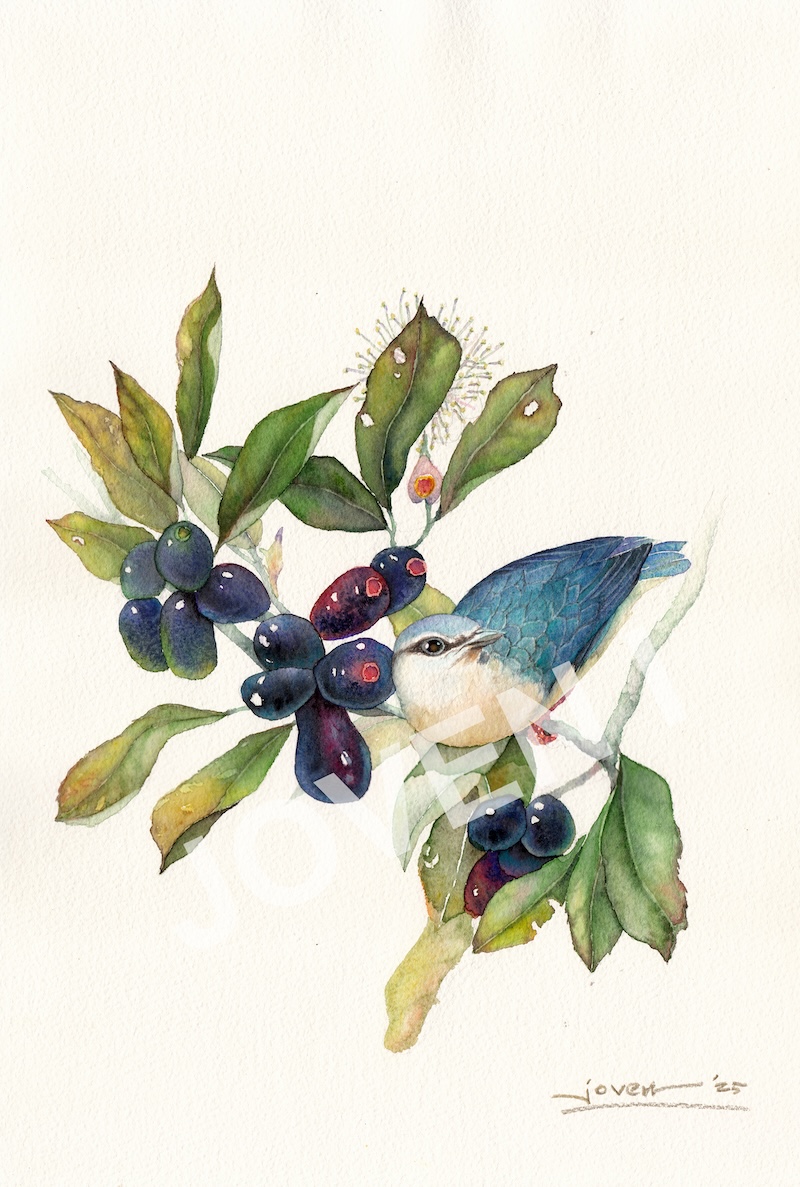
‘Sulyap,’ 18”x12” inches, a 2025 work by Ignacio using watercolor and ground stone, previously featured in TheDiarist
He wondered why there were Scottish-style huts, beautiful though they are, in tropical Philippines. When he received grants for heritage conservation, he was able to study vernacular houses that use thatch for roofing, stone for walls that were a half meter thick, and did not use nails. Because of their weight and gravity, the sturdy materials can withstand typhoons.
The Batanes community members had no building funds. It was up to the homeowners to source funds from cooperatives or rely on the bayanihan system. The barangays help one another to build or retain the houses. It is the homeowner’s responsibility to see to it that neighbors are helping each other out.
They don’t use steel. They locally source the stones and use lime, a purer form of cement when mixed with sand and eggshells, as glue. This type of gluing helps the structure adjust to quakes and typhoons.
Joven admires the absence of nails. Instead, the Ivatans use joineries, an interlocking configuration that holds everything together.

‘Liwliwa’,’ 18”x12” inches, another 2025 work by Ignacio using watercolor and ground stone, previously featured in TheDiarist
He and his researchers got most of their information from centenarian inhabitants of the northernmost island province. He remains indebted to them, and is humbled by the trust they gave him.
How does this experience inform his artmaking? He is aware that architecture is guided by rules, strict ones at that. In art, however, no rules apply, so he is able to enjoy, like in his recent exhibition of watercolors that had heritage items like combs, flora, fans, jewelry, etc. as subjects.
Joven is happy that he can connect both worlds, earn money from them, and see pleasure in the eyes of beholders of his works.


