
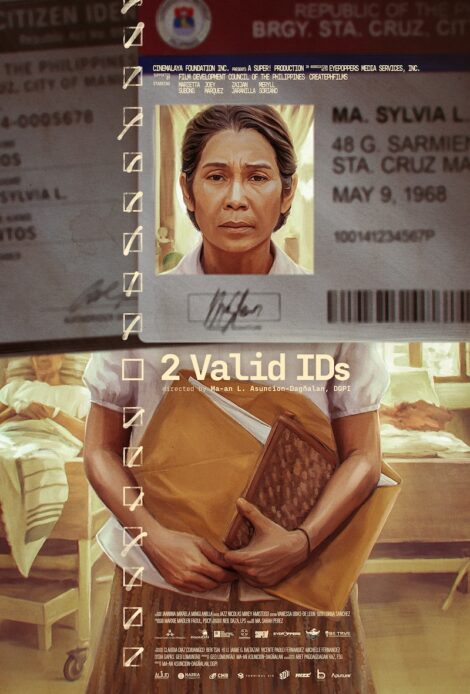
The biggest box office hit of the 2026 Cinemalaya Independent Film Festival, Ma-an Asuncion-Dagñalan’s 2 Valid IDs, really doesn’t show us anything that so many Filipinos don’t already experience every single day. One could say that the film is standard fare even just for Cinemalaya, which has just concluded its 22nd season: a dramatization of the injustices faced by ordinary underprivileged people, their struggles left largely unresolved.
Here, we follow Sylvia (played by Marietta Subong, more popularly known as the comedian Pokwang), as she tries to secure the money necessary to get her husband transferred from a public hospital bed to a private room with access to better care. To do this, she must first obtain proper government documentation.
As banal as this premise might sound to some, the universality of the scenario the movie depicts clearly resonated with audiences; it enjoyed a sold-out run and won Cinemalaya’s Audience Choice Award—in addition to Best Actress for Subong (tied with Ruby Ruiz for Status: Rejected) and a Special Jury Award.
And it just so happens that the film is also a tightly made, very well-acted drama that finds effective ways to express the despair of Filipinos trapped in the web of cruel bureaucracy and a barely functioning public health system.
From its very first scene, 2 Valid IDs seems to be aware that there isn’t anything particularly novel about its story. Asuncion-Dagñalan doesn’t start the movie with any primary character; it takes time for the wandering camera (Neil Daza as cinematographer) to decide who to eavesdrop on. What we get instead is a long tracking shot that starts with a seriously wounded man and his wife rushing to the emergency room in a tricycle. The camera then breaks away from the couple to focus on Liza (Chase Salazar), who navigates her way through the hospital to a shared room, where we finally meet Sylvia and her bedridden husband Ramon (Joey Marquez).
The film never uses this device of a long, unbroken shot in motion again, but this sets the tone for the “ordinariness” of the narrative.
Throughout the movie, Asuncion-Dagñalan maintains this clinical distance. When tragedy befalls other patients, her direction stays sober no matter the characters’ outbursts. We never see where Sylvia lives or what her undisturbed status quo was before; instead we are dropped right in the middle of an already stressful situation where the makeshift visitors’ area has now become Sylvia’s temporary home. And when she learns that she needs to apply for IDs before she can claim a remittance, much of her time is taken up waiting in lines, filling up forms, and moving around to retrieve documents.
The camera looks at her objectively, deliberately uninterested in seeing too much of her inner life. She is meant to be a mere face in the crowd.
This distancing is by no means perfectly utilized. Although Abet Pagdagdagan Raz’s writing eventually unearths just enough detail to establish strong bonds between the regular visitors of the shared hospital room, the script often forces itself to lay out clunky exposition to make up for the direction’s objectivity. The recitation of facts and obvious feelings about the circumstances the characters are in end up breaking the film’s spell—and by the final cut-to-black, the lack of sufficient internal characterization can’t but make the story feel like it’s missing something greater than the sum of its parts.
Still, there’s something touching about how much casual kindness Raz chooses to show us: fellow faces in the crowd patiently assist Sylvia in completing her forms, and hospital visitors such as Liza and Denver (Zaijian Jaranilla) become a sort of found family for Sylvia and Ramon.
It isn’t just Subong who takes up the spotlight
Even if 2 Valid IDs doesn’t really provide new insight into Philippine bureaucracy or public health, editor Vanessa Ubas-de Leon nevertheless finds a strong, steady pulse. The movie proceeds with barely stifled anxiousness and builds a sense of indignation at the way these government procedures are performed in the same bland, humid rooms every time. As Sylvia gets closer to obtaining the necessary IDs, there’s no feeling of satisfaction or fulfillment—how could there be, when Filipinos are made to suffer the most inefficient systems just to prove that they exist and are worthy of receiving care?
The movie repeats its points over and over, but it almost seems to believe that so long as things don’t improve, this repetition is necessary.
By design, the character of Sylvia also isn’t meant to change through these repeated trials; bureaucracy robs her of any time for introspection or any greater release of emotion. And yet, Subong easily creates a sense of a rich, busy inner life in the role, revealed through subtle but remarkably clear choices.
Sylvia still appears dynamic because the audience can readily read into her exhausted, blank expressions; we all know how waiting in line or in a hospital corridor can be fraught with profound fear and frustration. Ever since her strikingly dramatic turn in Dwein Baltazar’s 2018 independent film Oda sa Wala, it’s remained a pleasant surprise to see just how good the actress is at restricting her performance to specific areas of her face or to her thousand-yard stare.
It isn’t just Subong who takes up the spotlight in 2 Valid IDs. With at least one other moving performance this year (in Irene Emma Villamor’s still-underseen Midnight Girls), Jaranilla acts as a sort of surrogate son to the central couple, offering them tender support and a more determined, youthful perspective as time passes in the hospital. Meanwhile, as Marquez’s character Ramon deteriorates in bed, his homesickness worsens and the love with which he gazes at his wife only deepens. During a powerful scene when he snaps at Sylvia about wanting to return to their province, regret and helplessness immediately tinge his expression. Tears stream down Sylvia’s face in response. All they can do at this point is delay the inevitable, and be there for each other even at their most afraid.


