
‘Onib & Me,’ a memoir by Bettina Olmedo, will be launched Saturday Sept. 21, 2024, at Leon Gallery International, with ‘Home at Last,’ a homecoming exhibit of Onib Olmedo’s iconic ink wash paintings from a distinguished American collection.
I am neither an artist nor an art critic. So, if you came for a learned dissection of Onib Olmedo’s art, you’re in the wrong class listening to the wrong teacher.
Forget even that I’m a journalist, because I just cannot be objective about Onib. I’ve been a fan of his since I first laid eyes on his art, and we had been fast friends to his dying day. Yes, this is a devotee speaking.
I’m just here to tell stories about him in the context of our relationship, which ran through the latter half of his short life. If telling those stories contributes something, anything, to a deserved appreciation of a major yet overlooked artist like Onib Olmedo, I’d be happy enough.
To an incredible degree, the relationship between Onib and me was driven by happenstance. Thrown out of work when martial law shut down my newspaper, in 1972, I got rescued in time from imminent penury, hired to edit copy for a woman’s magazine. It was one of the first publications certified safe by Ferdinand Marcos’s censors, although, of course, it continued to be watched — dictators take no chances.
Onib himself drew for that magazine, illustrating articles and stories, and we found ourselves working side by side. As early as then, I felt I was witnessing, right at my elbow, the unfolding of Onib’s genius. I saw it in the sureness to his strokes and in the subtlety in his work — a subtlety that flavored its humor as well as its darker sentiments. To have witnessed that promise come to fulfillment through the eyes of a fan and a friend was a special privilege indeed; in circumstances less intimate, the thrill could not have been the same.
My association with Onib‘s art that might pass for something legitimately professional has to do with presumably my published writings about him, and, possibly in addition to that, some tendency to draw a comparison between us about things we did on the side that crossed into each other’s main line of work.
Onib is a published writer himself, notably in profoundly funny verse. His poetical portrayal of the love between him and Bettina, as polar opposites, in “Sago’t Gulaman” is simply a classic.
For my part, I happen to dabble in pen and ink, or should I say doodle in it. My doodling itself is an abysmal comparison to Onib’s verse-making, but I did get some of it published all the same. One was a caricature of Onib that accompanied a piece I wrote about him for a newspaper.
Anyway, it was precisely in that form — pen and ink — that I was introduced to Onib. And I made it a devotion to follow his artistic journey, only to feel grievously shortchanged in the end — he was only 59 when he left us, in 1996.
In power and freshness and originality, I dare say that the best by Onib Olmedo compares with the best of the best. I still keep pictures in my phone of some of Onib’s most recently exhibited pen-and-inks for me to take an assuaging glimpse of in those nostalgic moments.
And to think that Onib could have been lost to architecture — he placed seventh in the board. He showed me the first house he built — he did it for an obviously captive client, a brother. I saw no hint in it at all of anything out of the pages of Architectural Digest. In fact, I seem to recall seeing things atypical, even strange, for a dwelling. Whether with or without predisposition, what I did see in Onib’s architecture was a foreshadowing of his art.
Daughter Bambi, who got his father’s sense of humor and got him down to a tee as early as when she could begin forming conscious sentences, gave us an idea of that foreshadowed quality. In words proud and lovable for their prescience and innocent candor, Bambi proclaimed:
“Ang galing ng tatay ko’ng magpinta nang pangit.”
A dark painter whose work I won’t dare hang on my wall — indeed, it was the run of remarks upon Onib’s art that I often heard. I don’t know, but I’d have hung Edvard Munch’s “The Scream” on my wall even if it had not earned any acclaim — I’d have hung it for my own pleasure, not for the pleasure of others whose taste is validated by interior decorators.
As it happens, I’ve seen Onib’s own “The Apartment” and “Concert in the Alley,” and, if those works had been mine to hang for myself too, I’d have done so; I’d have even moved “The Scream” aside for them.
Both “The Apartment” and “Concert in the Alley” are in ink wash, my own sentimental preference of medium for Onib, along with pen and ink. Both won the critics’ vote in an international art exhibition in France. And both are dark all right — if you ask me, perfectly dark, literally and thematically.
“The Apartment” is a social commentary, a telling satire of subhuman living among our teeming poor. “Concert in the Alley” is more personal-dark than social-dark; it’s a violinist’s lonely recital, audience-less but for a front row of riderless bikes parked under his balcony, which serves as his stage. Onib did both works in 1992 and won that critics’ prize for them in the same year.
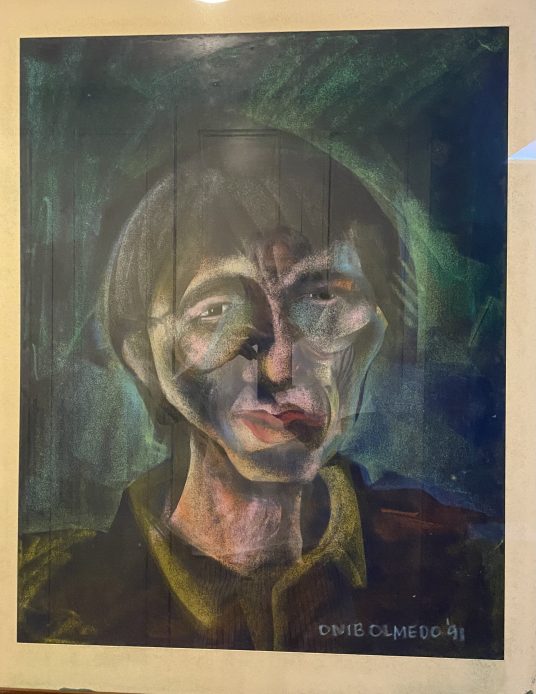
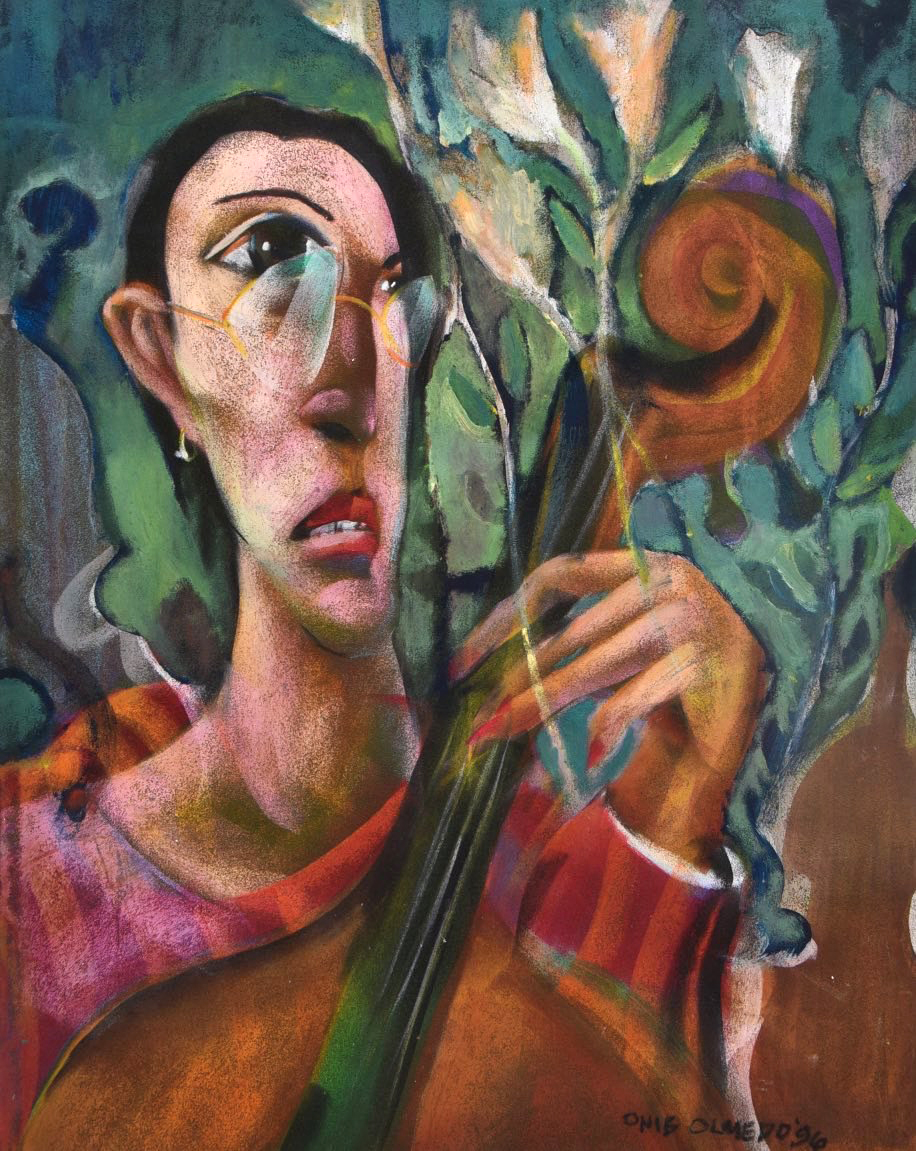
My own prized Onib is from the year before. It’s the first thing that might catch your eye coming in through our front door: a portrait of myself in pastel looking my darkest, an absolute decline from my normal look in another Onib pastel, from only the previous year. Talk about depth of artistic vision! I took the hint from Dr. Olmedo: I quit editing newspapers to live happily normally ever after.
There, you got it not only from a good fan and a good friend of Onib’s, but also from a good patient of his.
*An adaptation from a talk the writer gave at an exhibit of Onib Olmedo’s works and the launch at the same time of the book Onib & Me, by Olmedo’s wife, Bettina, on September 21, 2024, at Leon Gallery, in Legazpi Village, Makati.


