
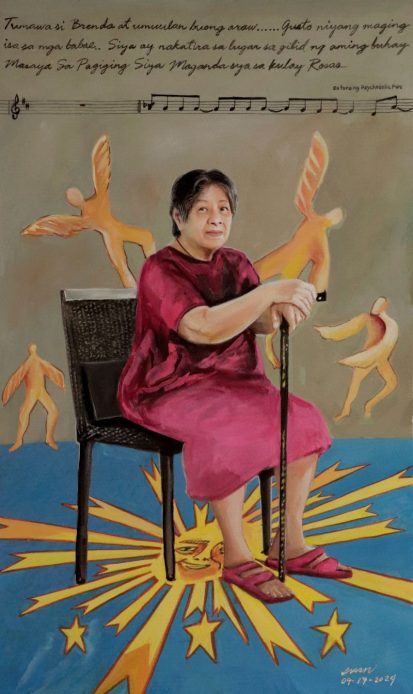
The announcement of Brenda V. Fajardo’s death Saturday night (Sept. 14, 2024) sent the visual arts world into a tizzy. In life she had touched thousands as visual artist, teacher, printmaker, theater artist and community organizer.

A laughing Brenda V. Fajardo. (Photo cortesy of Irene Macabane)
The last description may come as a surprise for she was, on the Villanueva side, to the manor born. She loved visiting Bago City, Negros Occidental. Belonging to the landed gentry, she would take a stroll, and the workers were said to nearly bow their heads or walk backwards in deference to her. That may have been an exaggeration or a “Marites” disinformation from the few detractors she had, but it is a fact that her nephew, multi-media artist Noel Soler Cuizon, her former apprentice, attested to.
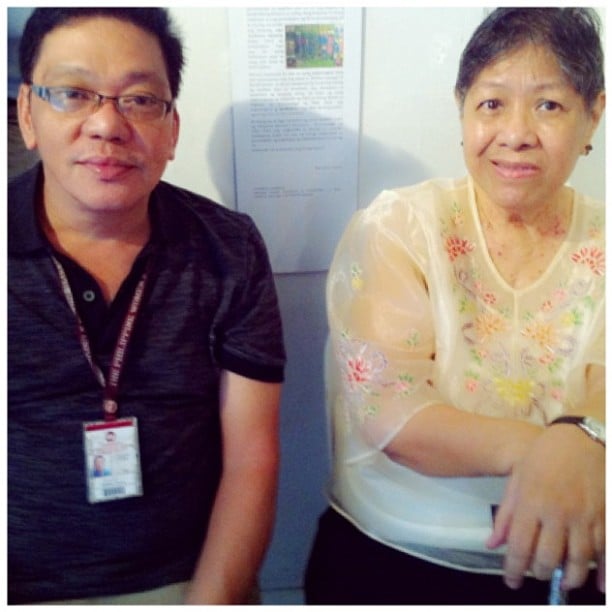
Noel Soler Cuizon and his tita Dida
She often was dismayed by his dark sense of humor like when he witnessed one instance at the Villanueva hacienda in Sitio Hanao Hanao, Negros, where 20 neighboring villages gave honor to their “Inday Dida.” He commented, “Nasaan ang kabayo (Where is the horse, a reference to royalty)?” She responded by cussing him, “P__ang ina mo (son of a bitch you are).”
Cuizon, who teaches fine arts at Philippine Women’s University, credited his aunt for teaching him “a multi-disciplinary approach in art” and influencing him more in “creating my interactive assemblage as a way of engaging the audience in my work.”
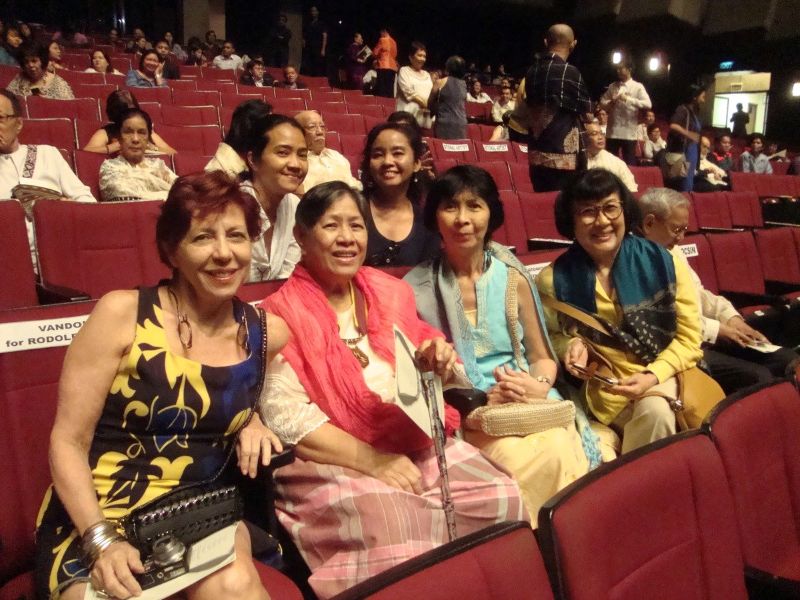
With Silvana Diaz, Imelda Cajipe Endaya and June Dalisay
Sculptor Julie Lluch, one of the founders of the feminist art organization Kasibulan along with Fajardo, Imelda Cajipe Endaya, Anna Fer and Sr. Ida Bugayong, said she mourned “with deep sadness and loss, the passing of Brenda, an extraordinary artist, friend and colleague. Brenda has stature in Philippine art that very few women, and men, have attained. Her works, which have been emulated internationally, touch roots with Philippine folk history, psychology, mythology, beliefs, etc., in her passionate examination of the Filipino ethos and identity.”
She continued, “I am in awe of her art! She was so many things together as painter, printmaker, television and stage actor, professor, activist that I thought she had little time for carefree get-togethers. I had wanted to have closer friendship with her. We had a few sessions together in Nicanor Perlas’ anthroposophy lectures with Gilda Cordero Fernando and other friends.”
Putting up Kasibulan was their response to the call of the Motherland in 1987. This organization has grown in membership with the younger artists “actively pursuing the goals envisioned by the founders,” Lluch said.
Cajipe Endaya called Fajardo “a compassionate friend, a good example to me as an organizer and educator. We know how to enjoy our advocacy. When we work, whether in Kasibulan or the print association, she is always businesslike: vision and goals must be clear followed by a plan of action.”
Fajardo’s feminism was ‘quiet but powerful through the art she makes…’
She said Fajardo’s feminism was “quiet but powerful through the art she makes, a feminism founded on indigenous woman’s power, historical research and current issues.”
Writer Mariel N. Francisco, co-author of A Spiritual Pillow Book, gave a background on the anthroposophy that the Fajardo sisters, Brenda and the late Mary Joan, believed in and adhered to.
She said, “Anthroposophy is an ancient word that means the wisdom of the human being. Rudolf Steiner took it to name the spiritual philosophy he developed and espoused, which asserts that through clear thinking and training of the faculties of perception, human beings can know the spiritual world as precisely as we can know the natural or material world through the natural sciences. Anthroposophy is also known as spiritual science. Steiner wrote dozens of books and delivered thousands of lectures elucidating the evolution of mankind through various planetary and earthly stages before and after each earthly incarnation. Human life is therefore a lifelong process of self-development and transformation that benefits not only the individual but also society.
“Steiner was no mere egghead. He was a visionary and a teacher. His insights led to various practical initiatives in modern life such as Waldorf education, biodynamic farming, anthroposophical medicine, biography work art therapy, eurythmy (body movement), art and architecture. These are all founded on the understanding of the human being as body, soul and spirit therefore any meaningful endeavor must take all three into account.”
Francisco confessed that she was not close enough to Fajardo to know how she applied anthroposophy in her life and work. “Though I am the proud owner of her pangalay dancer painting and some prints from her babaylan series, I am not familiar enough with her work, both in academe, theater and visual arts to discern if there was any kind of evolution that could be ascribed to her spiritual studies. I am aware that the ‘elders’ of the Anthroposophical Group in the Philippines (AGP) underwent deeper initiation through special study sessions called ‘First Class,’ not open to newbies like us. I can only surmise that such enduring dedication to a spiritual path must have borne inner and outer fruits—witness the loving tributes to her.”
She admired the Fajardo sisters’ ‘courageous and generous offering of their home to start Waldorf education in the Philippines….’
She admired the Fajardo sisters’ “courageous and generous offering of their home to start Waldorf education in the Philippines. After a year or two in the garage, makeshift structures quickly overran their garden as a new grade level was introduced. Now there are Steiner-inspired schools in Metro Manila, Davao, Iloilo and perhaps more that I don’t know of. The Manila Waldorf School, which started in the Fajardo garage, now occupies a sprawling campus in Timberland, San Mateo, Rizal. My three grandchildren go to school there.
Francisco couldn’t estimate when the Fajardo sisters, with Jake and Bella Tan, Manny Pambid and others, and led by Perlas, started studies that led to the founding of the AGP in 1990. “When Gilda stumbled upon a lecture at the University of the Philippines that led her to Perlas’ doorstep, she pulled me in with her. The group had apparently been studying the teachings of Steiner for a couple of years. They met every week, tackling esoteric topics which fascinated Gilda, who was always in search of intellectual moorings to solve the riddles of existence. She developed genuine affection for them all while I was more stand-offish. Gilda became comfortable enough with them to try to lighten things up with her irreverence and kookiness. Long after I had distanced myself from the group, she continued to attend gatherings at the Fajardos’ home in Rolling Hills, Quezon City, such as for Easter and Michaelmas (Sept. 29).”
Fajardo’s instruction for her wake, coursed through a niece, is for it to be held at Arlington Memorial Chapels on Araneta Ave., Quezon City, starting on the evening of Tuesday (6 p.m.-12 midnight) until Friday (Sept. 17-20 9 a.m.- midnight). Cremation is on Saturday at 2 p.m. (Sept. 21). Before her cremation, last viewing will start at 11a.m. Mass will be celebrated at 1 p.m. Should visitors wish to send flowers, they are requested to make it colorful. Her wish is to have multi-colored blooms for her funeral. Fajardo’s body will only be open for viewing on Sept. 21. She did not wish to be embalmed but instead be placed in a freezer.
Francisco said these instructions on Fajardo’s wake “are according to anthroposophical teachings. Steiner, as did many ancient cultures, taught that the etheric or life body still hovers over the seemingly lifeless corpse for three days, thus immediate cremation is a no-no. The wake must be at least three days. The body must be kept intact (no embalming), compelling us here in the tropics to resort to freezing or use of dry ice. I guess this was how Mary Joan’s wake was, too.”
Cuizon said, “I remembered what she told me after my mother died. She said my mother did not choose me as her death companion so it would be less painful for me, having been death companion to my lola and my father. My aunt reinforced in me lessons in detachment.”
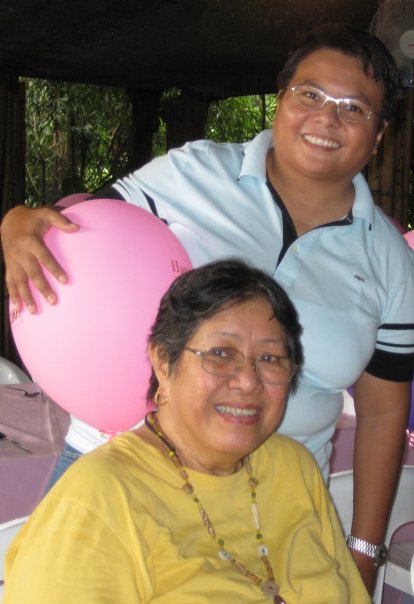
Student and teacher Eloi Hernandez and Fajardo at the former’s birthday last year
Prof. Eloi Hernandez of the UP College of Arts and Letters recalled how Fajardo was her teacher in Modern Art, but “I failed most of her exams. I was always absent because of CAL student council work. She castigated me, saying, ‘Student ka muna bago maging student leader (You are a student first before you’re a student leader).’” That woke Hernandez up, and she passed the subject by the skin of her nose.
When another professor, Dr. Zeus Salazar, caught Hernandez and her best friends smoking inside Palma Hall, he threatened to kick them out. She ran for help to Fajardo who was chair of the Department of Humanities then. She bluntly told them, “E, ano ngayon? Probleman nyo yan (So what? That’s your problem).’”
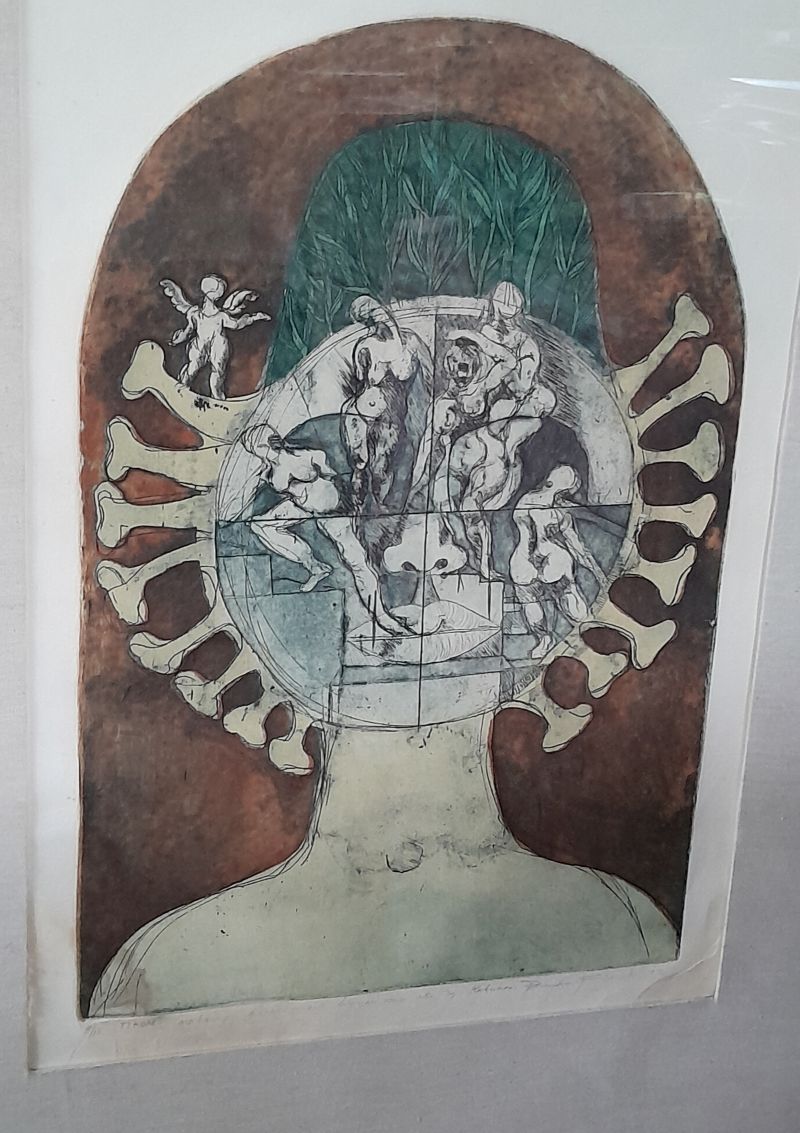
1976 Fajardo print ‘Tikom…Mahirap Sinag-araw Bigyan Ako ng Kabuuan’ (From the collection of Rolly B. Fernandez)
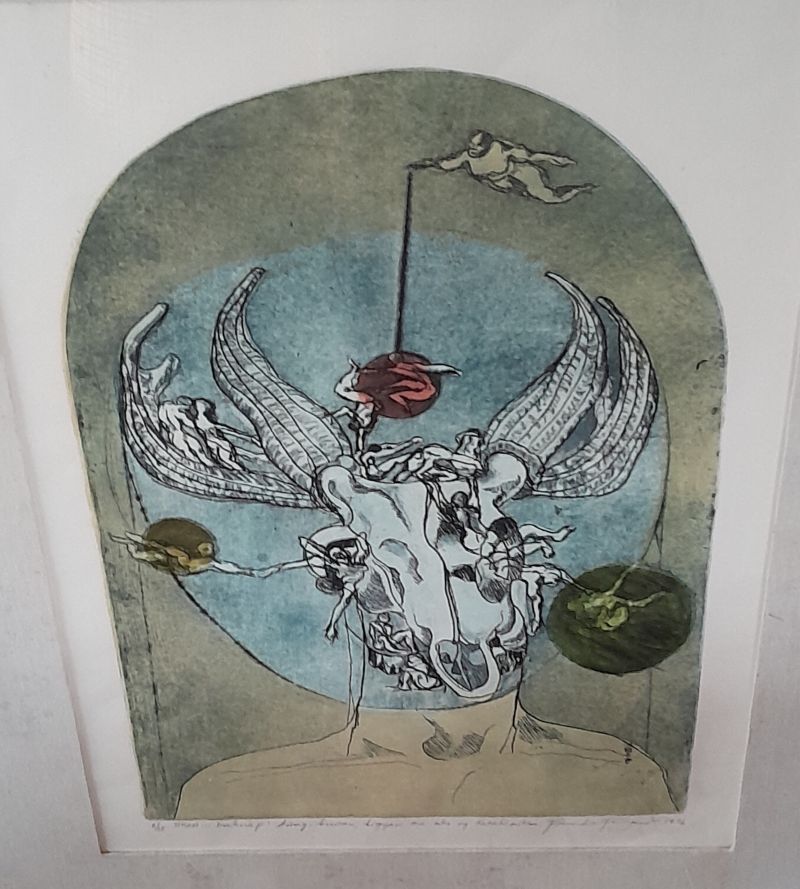
1976 Fajardo print entitled ‘Tikom…Mahirap Sinag-buwan Bigyan Mo Ako ng Katahimikan’ (From the collection of Rolly B. Fernandez)
Hernandez said her teacher wouldn’t brook any “BS, no crap, (she) calls it as it is.” She continued, “We started working together when I was with the Cultural Center of the Philippines Visual Arts Department. I learned discipline and dedication from her, but also learned about rewarding ourselves after a job well done. She would always treat us to the yummiest food. Food became our shared love.”
She said, “Because of our size, friends would kid us as mag-ina (mother and child). It’s true. I consider Brenda as my academic mother. But more than that, she guided me and raised me from that undisciplined, brazen undergrad to who I am now. I will not be where I am right now if not for her.”
About their shared meals, Hernandez couldn’t forget the beef pochero prepared by the Fajardo kitchen under Manang Tising complete with chorizo de bilbao. “We usually had it for Christmas Eve or New Year’s Eve which I used to spend it with them. Whenever she asked me what my special request was, I quickly replied ‘Pochero!’” It came with a mashed eggplant and chopped onions side salad with vinaigrette.
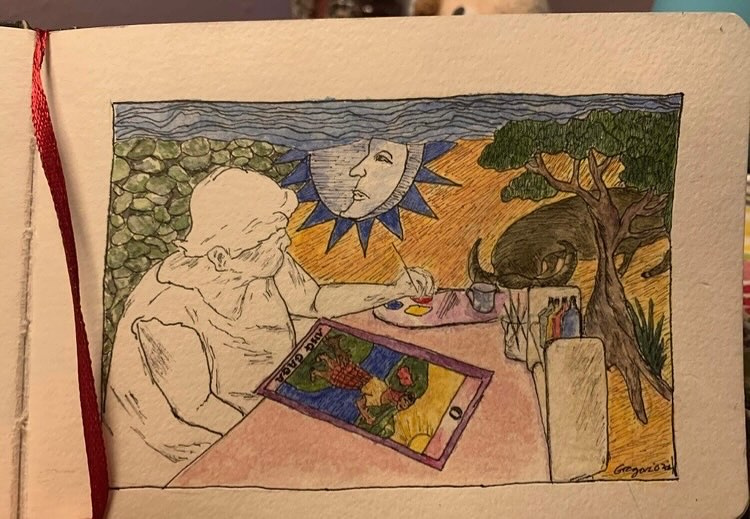
Prof. Grace Gregorio’s tribute to Fajardo
It was Hernandez who introduced Estrel’s caramel cake to Fajardo, a diabetic who enjoyed it nonetheless and expected it on special occasions. The late teacher would also request for the rosemary chicken and pasta puttanesca prepared by Hernandez’s partner, Dr. Grace Gregorio.
Irene Macabane served as Fajardo’s death companion during her last days at Cardinal Santos Hospital. She had been with the family for 16 years and knew Fajardo during her stronger, better years when she was always out of the house, unaccompanied. They would only travel together when the teacher needed to go out of town.
Fajardo fell seriously ill in 2009, but even before that, she would travel for conferences abroad. Macabane said they’d fetch her at the airport, and if she was struggling to catch her breath because of a heart condition, they’d bring her to the hospital.
She kept her employer company while confined in the hospital for sometimes as long as three weeks. When Fajardo got better, Macabene was assigned to accompany her to her classes at the UP, or escort her to the occasional exhibition opening receptions.
Macabane recalled traveling by bus from Baguio once after Fajardo administered an exam for students. Then the latter felt dizzy and asked for a plastic bag so she could throw up. After Macabane brought out the bag, she herself vomited into it, leaving Fajardo laughing and choking back her own vomit.
The students were ferried from Makiling to the Fajardo residence where they’d hold classes in the garden
Fajardo also taught at the Philippine High School for the Arts in Mt. Makiling, Laguna, and was fetched from and brought home each time until she wearied of land travel. Instead, the students were ferried from Makiling to the Fajardo residence where they’d hold classes in the garden up until the teacher also grew tired of the kids’ noise.
Macabane never forgot Fajardo’s favorite food: “Lechon palagi maski na may sakit na. Gusto rin ng kare-kare. Hindi yan kumakain ng isda kundi pritong dilis. Hindi yung malalaking isda. Malansa raw dahil nung giyera, ang ginagawa ng Lolo niya, pinaiinom sila ng cod liver oil. Kaya napapangitan sa lasa (Lechon always even if she was sick already. She also liked kare-kare. She didn’t eat fish, except fried dilis. Not the big fish. It’s slimy for her because during the war, her grandfather made them take cod liver oil. That’s why she didn’t like the taste of fish).”
Fajardo also relished Cuizon’s callos until even Macabene learned to cook it to satisfy her employer’s cravings along with kare-kare and special molo.
Every December 31, the kitchen help would prepare hot chocolate, sometimes under Fajardo’s supervision. Macabane laughed when she said her employer hardly entered the kitchen and only did so three times in the years that she had known her. And that was just to wash her hands.
“Walang pakialam sa kusina,” Macabane said. “Sa kuwarto kumakain, bihira sa comedor (She had no business with the kitchen and preferred to eat in her bedroom, not the dining room).”
She didn’t like recycled leftovers, too, but she stressed that whatever she ate, the help also ate. Fajardo would say, “Kung ano nasa bahay, sa atin lahat (Whatever is in the house is meant for all of us).”
Macabane remembered also that Fajardo liked to dress in 100 percent white cotton at home. The pet dogs, whom Fajardo spoiled, knew when she was going out—she put on a colorful dress, and they protested noisily.
Macabane said she missed everything about Fajardo, even as she struggled with gallstones, pneumonia, diabetes on her worse days. It was the employer who spent for the education of Macabane’s son all the way until he was 17. She would have him fetched, brought to her house, and she’d measure how tall he had grown by taking a ruler and a pencil and marking his height reading by the bathroom door.
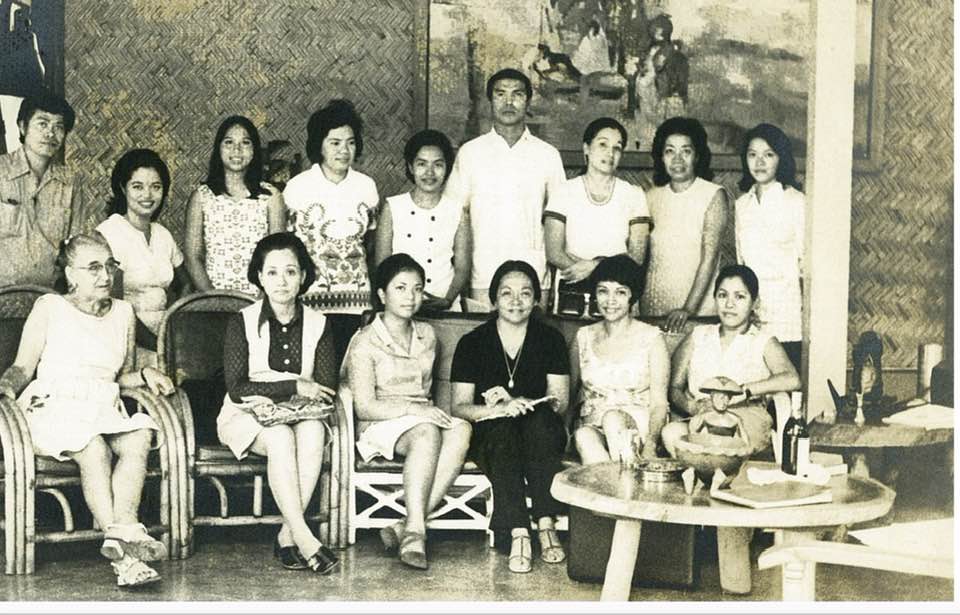
PAEA in the ’60s with Fajardo seated rightmost
Theater and film artist Anton Juan spoke for all when he wrote in his Facebook about Fajardo: “My art teacher in grade school who shared quietly and committedly without sound and fury nor self-promotion, whose art served our nation. I, together with other artists, educators and cultural builders, honor and esteem Brenda Fajardo, true artist of and for the people. Into the Light, now…”


