
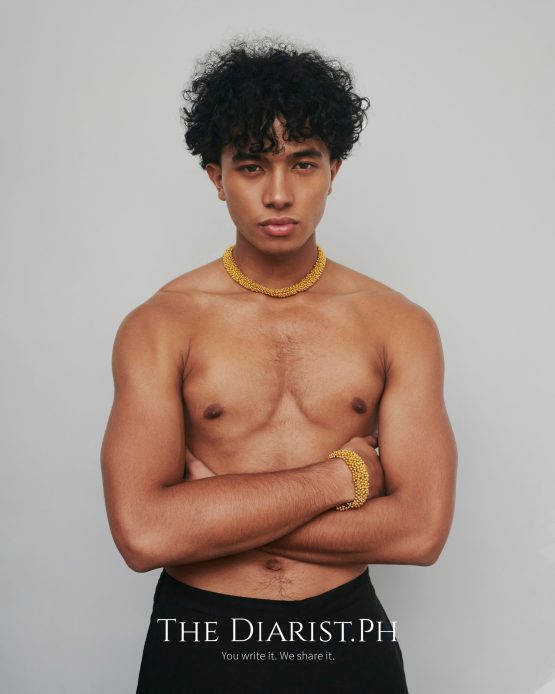
Usually, jewelry is an extension of a person. It is a show of culture—of taste. Yet most of the time, I sketch “solely” for the object. I usually don’t imagine a person while I sketch. I think of the piece’s silhouette, the intricate matching of stones, its array of colors, and how the choice of metal and its color or sheen will determine if the design will work.
Once production is over and the pieces are in the showrooms, it’s usually a surprise when a person magically matches with a piece. Our clients’ personal stories tell us why a certain piece resonates with them. For instance, we had a client who acquired a collar that took six months to create. The neckpiece’s name is Sinag, or ray of light. After a few weeks, we learned that the client’s name, Iliana, also meant “a ray of light.”
We would discover this serendipitous matching afterward— the most pleasurable moment for us as designers and artisans.
My partner artisan, Ely Arcilla Jr., also known as Oslog, gives us a show-and-tell of all the parts that could be made by hand. These parts—for instance, a small barrel cap made of gold—could be embellished with minuscule spheres arranged in triangular pattern. We usually ideate from the parts, more than from the concept. This results in a more original interpretation of a concept.

Reproduction of ancient beads and chains by Ely Arcilla Jr. and original ‘Ala-Ala’ lock designed by Adam Pereyra (Photograph by Borgy Angeles)
Oslog and I begin with a familiar Filipino object in mind, like food or fruits we usually eat, or even ordinary things we often take for granted. In this instance, Oslog chose the bilao, a humble, flat, round item used as a winnower of rice or to hold pancit.

Grand peacock necklace
Oslog studies the weaving pattern and does something bold: He cuts small strips of flattened 18K gold and weaves them together exactly as you would a bilao, only this time in the size of a P10 coin—a feat in itself.
Fruits such as grapes, or ubas, take form in jewelry by hand-hammering half-spheres of gold and soldering them together one by one.
Today, we usually find machine-made jewelry cast from a mold, but not this one. The result is a finely crafted piece of jewelry that animates with every movement.
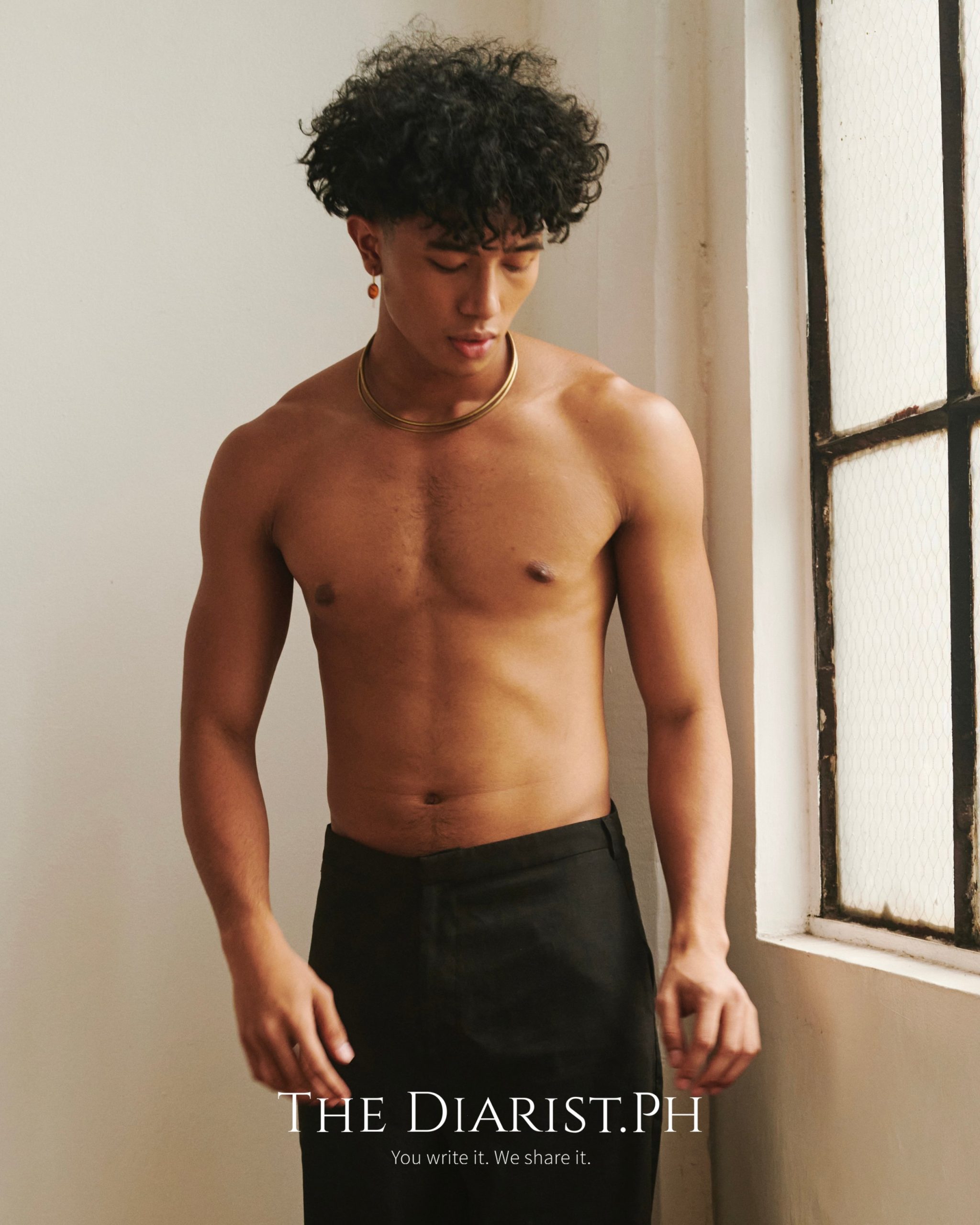
Deira drop earrings and choker
Our designs strive to find delight in every piece we create. Our basic criterion is that it brings out simple joys whenever it is worn.
Every piece is painstakingly made manually. In its purest sense, we find joy in assembling something that has been created over many days, weeks, or even months. There’s something earnest about having hundreds to thousands of individually made pieces come together in one simple silhouette. It’s honest and a result of genuine skill and hard work.
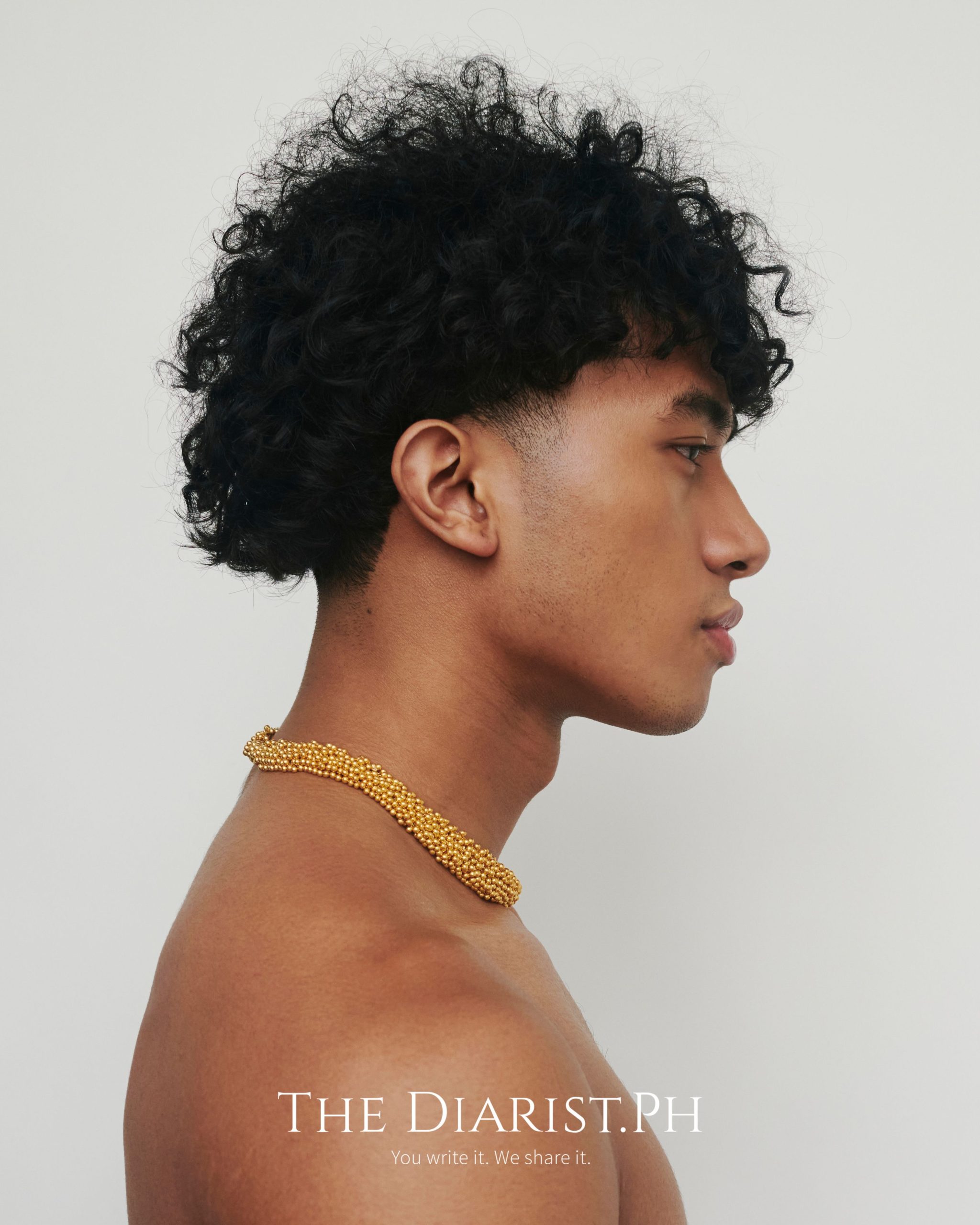
‘Bilo-bilo’ necklace
Our goal is to keep discovering what Filipino jewelry looks and feels like. This can be done through masterful reproductions or perceiving a concept in a new light—an angle of a familiar story that’s not visited as much. Our goal is to put the Philippines on the map again, while holding one of the most rarefied crafts in the world.
———
For more information, contact Adam Pereyra at @adamppereyra, @adampereyrajewelry, Telegram +63998889 7964
Photography Walter Maurice
Styling and Art Direction Luis Carlo San Juan
Makeup Chuchie Ledesma
Hairstyle Kim Echavia
Model Jubei of IM Agency Manila
Shot on location Espacio Creativo Escolta special thanks to Belg Belgica


