

Forty years ago, I walked into the church wearing a wedding gown that was a throwback to another time. My idea of bridal finery had been changing as I transitioned from childhood to pre-teen, adolescent to adult. It started with princess-like frocks embellished with jewels, all sparkly and glimmering on a voluminous white skirt.
This was pretty much the style I requested Aureo Alonzo to make for my prom dress. He had just won the Cavalier Camel Award in Cervinia, Italy, the first Filipino and only Asian designer distinguished by the international high fashion awards body. I recall how he chuckled when I handed him my drawing and turned to Mamang, my grandmother and his regular client, saying, “She made her own design.”
Aureo indulged my fantasy and when I came for the final fitting; the image reflected my dream gown come true. There was no beadwork, but shimmer from the delicate, handwoven gossamer fabric with rose patterns did the same magic. It was part of Mamang’s collection which she had acquired from Iloilo and happily gave to her favorite designer for her granddaughter’s fantasy ballgown. The finishing touch was a blue cabbage rose resting where the lines of the V-neckline converged. It was different from the slinky sheaths of my classmates, but I was happy. My impeccably dressed prom date said I had the best-looking gown that night.
My fairytale dress was stored in a huge box, never to be seen again. The favored silhouette evolved to something more sedate, close to the figure but billowing out into a soft A-line. Off-the-rack options came in heavy crepe, chiffon, and jacquard silk. There was always the neighborhood modiste to do the alterations on the RTW party gowns for debuts and weddings. When denim and chambray became popular, I drew my matrimonial dream dress, specifying to mom that I wanted the look to be executed in those fabrics. She merely said, “You will probably change your mind.”
When denim and chambray became popular, I drew my matrimonial dream dress in those fabrics. My mom merely said, ‘You will probably change your mind’
She was right, as mothers normally are. My imaginings shifted with the changing fashions, and I became enchanted with layers of soft tulle that captured the suggestion of limbs moving slowly down the aisle. Then it was the crinkle of taffeta or the richness of brocade that conjured images of lavish overskirts on pencil-cut skirts. Sometimes, I daydreamed of handmade lace that covered the sleeves and bodice, spreading across a full skirt with petticoats underneath to create a dramatic entrance under the arch of the church door.
Then I met Chito, a man who deeply admired Jose Rizal, championed the cause of the underserved, and opted to work in the Philippines rather than accept offers for big-earning jobs abroad. When we got engaged, the imaginings of previous gowns were dispelled. None seemed to match his choice of a simple jusi barong Tagalog for our wedding day.
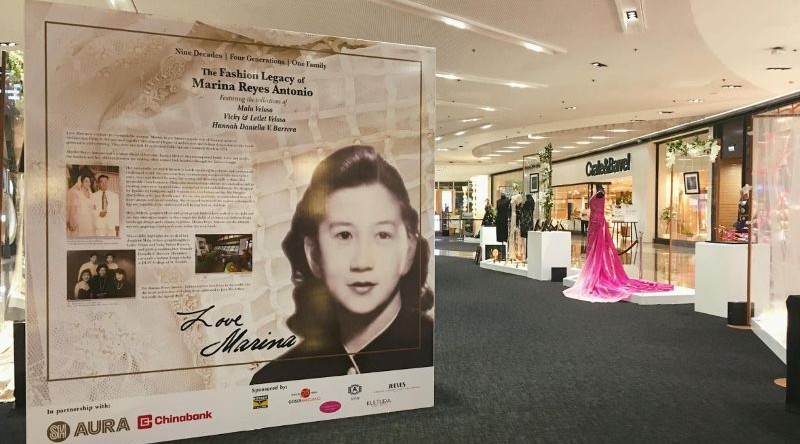
Marina Antonio exhibit at SM Aura
It was a dear friend, Dr. Belen “Neng” Isidro, who introduced me to Marina Antonio. Mrs. Antonio had made the beautiful maria clara-style gown Neng wore for her wedding. It seemed appropriate to don a Filipina-theme dress owing to the Philippine weather in June. Air-conditioning was not the norm then, and churches only had electric fans. Also, my groom was predisposed to the terno, which his mother wore elegantly to many of the functions she attended with his father.
Neng accompanied me to Mrs. Antonio one afternoon, to the residence on Zamora street in Pasay. The house had been built by her late husband, National Artist for Architecture Pablo Antonio. It was a gracious home, with air and light filtering into a spacious living area. The house was nestled amid greenery that seemed to extend inside, framed by the slanting, screened windows.
Mrs. Antonio received us kindly and for almost an hour, chatted with Neng, served us breadfruit from her garden which she had made into a sweet dessert, and annotated photos displayed on side tables with vignettes. It was reminiscent of genteel times, when the only business at hand was to make the other feel welcome and comfortable.
It was only in the last 20 minutes before we took our leave that she began to ask what I wanted to wear for my wedding. Did I have a color theme? Was there a particular design? This time I had no drawings to show, nothing specific other than it had to be a Filipina dress to match my fiancé’s barong. I was undecided on a color for the entourage, and said maybe rainbow hues, for lack of a clear idea. She patiently listened to my uncertainties and softly suggested a light gold in slipper satin. It appealed to me immediately, and I nodded with satisfaction and relief.
Things moved smoothly after that. I was sure about a gown in the mode of a maria clara and left the details entirely up to Mrs. Antonio. Though we had just met, I was confident that she would make something more beautiful than I could describe to her. The time we had spent since we sat down together was all the time needed to know that I could trust her. Her home, her kindness, her unaffected and gracious manner conveyed sensibilities of an inborn beauty and grace. I felt she would create from that intuitive artistry and appreciation of fine things. And I was right.
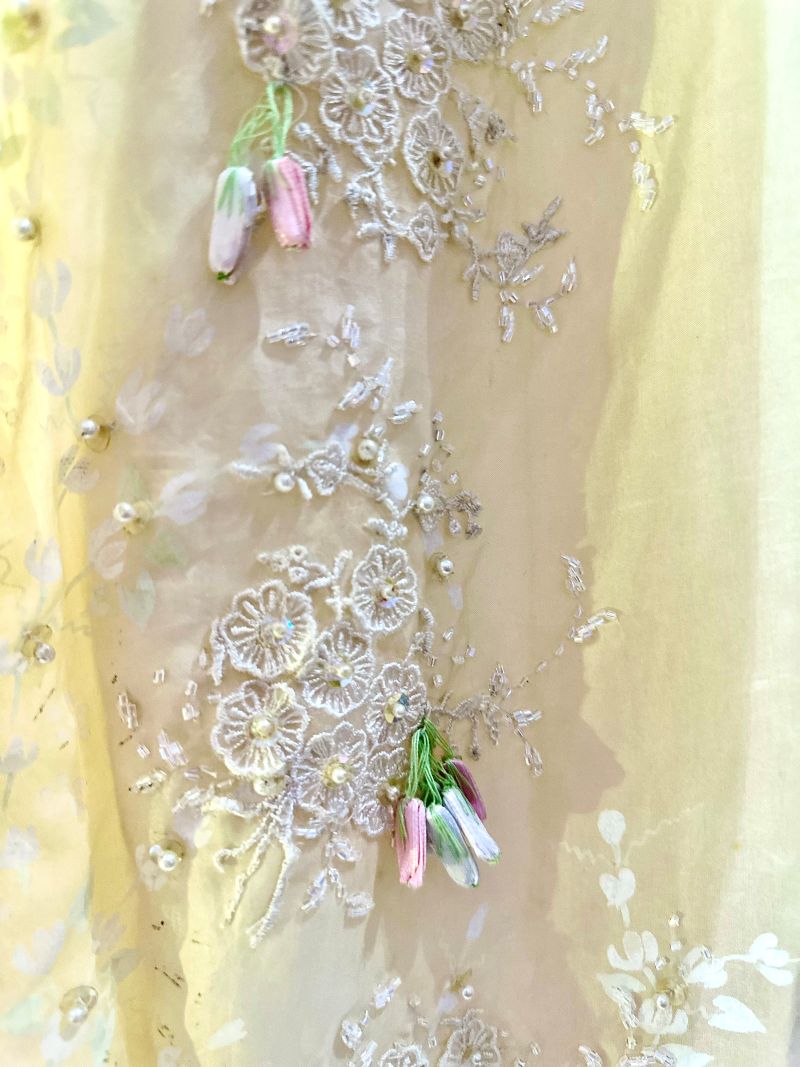
Mrs. Antonio’s signature satin ‘sampaguita’ buds
It was three months before the wedding when Mrs. Antonio began to work on my bridal apparel. I donned a mockup for the first fitting to ensure the right measurements. It was the basis for the gown that began to materialize on a mannequin. Jusi fabric was cut into panels for the skirt and joined together by delicate lace insertions. The blouse, called camisa or baro, had bell-shaped sleeves, otherwise referred to as angel wings. Over the camisa was a panuelo, a stiff kerchief worn over the shoulders like a shawl. She added lace on the baro and the camisa and embellished it with her signature, handmade satin sampaguita flowers that dangled in clusters.
During the Holy Week before my wedding, Mrs. Antonio sewed the sequins and the satin pink and white sampaguita herself
Enchantment grew with subsequent fittings as her trusted assistant Mameng pinned and tucked the parts together on my frame. It glimmered with sparks of light reflected on the beadwork scattered across the skirt. During the Holy Week before my wedding, Mrs. Antonio sewed the sequins and the satin pink and white sampaguitas herself as her workers were off during the Triduum. I was profuse in my thanks for the personal touch, to which she good-naturedly replied that she had nothing to do, having been debilitated by a sprained ankle. Besides the application of the embellishments, she hand-painted graceful vines with delicate mint green leaves that added a subtle touch of color. Her artistry was not bound by conventions that eschewed anything other than white for wedding gowns. She even added soft pink tulle that could be espied beneath the underskirt and the short train I had requested.
The rest of the entourage wore a jusi camisa with lace cutouts over light gold, slipper satin skirts with a bustle. Both my mother and my groom’s mother had similar panuelos. Neng, who stood as principal sponsor, with another ninang, Eva Violago, also wore maria clara-styled gowns made by Mrs. Antonio. My Mamang had decreed that I was to wear a diamond tiara which she had made for my aunt on her wedding day. She intended to start a tradition in the family, and I had to oblige, as the eldest granddaughter. We managed to tone down the crown on my head with the illusion tulle Mrs. Antonio prepared.
The day of our wedding, Chito and I walked into the church together. My father had passed away, and the place beside me belonged to the man of my life. We strode in together, he in his Ben Farrales barong, and I in my Maria Antonio maria clara. That day was captured in photographs and videos that we look at from time to time.
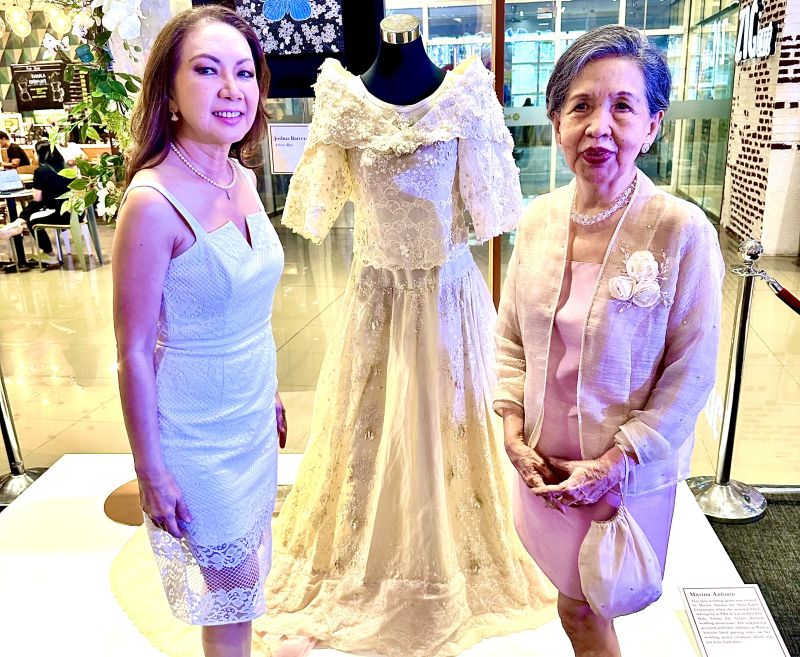
Mrs. Antonio’s daughter Malu Veloso adjusted the original wedding dress for the author’s 30th wedding anniversary.
Fast forward to 2014: Chito and I renewed our wedding vows. Instead of having a new gown made, I went to Mrs. Antonio’s daughter Malu Veloso and asked if she could adjust the gown for the occasion. It was a respectful rework that honored the original handwork of her mother. The jusi was a little brittle and needed gentle handling. Malu dropped the waistline to elongate the figure and accommodate the additional inches of my girth. Spaghetti straps on the upper bodice were replaced with sheer jusi on organdy for the nude look of a sleeveless top. The camisa and the panuelo stayed in the box, where they had been stored with gugo bark to keep away silverfish and discoloration. Malu made new satin sampaguitas which I wore in my hair.
It was the same gown, but not quite. Wearing the same wedding dress that I was married in was as much a statement on still being with the same man who had asked me to be his wife—older, evolved, but still essentially the same.
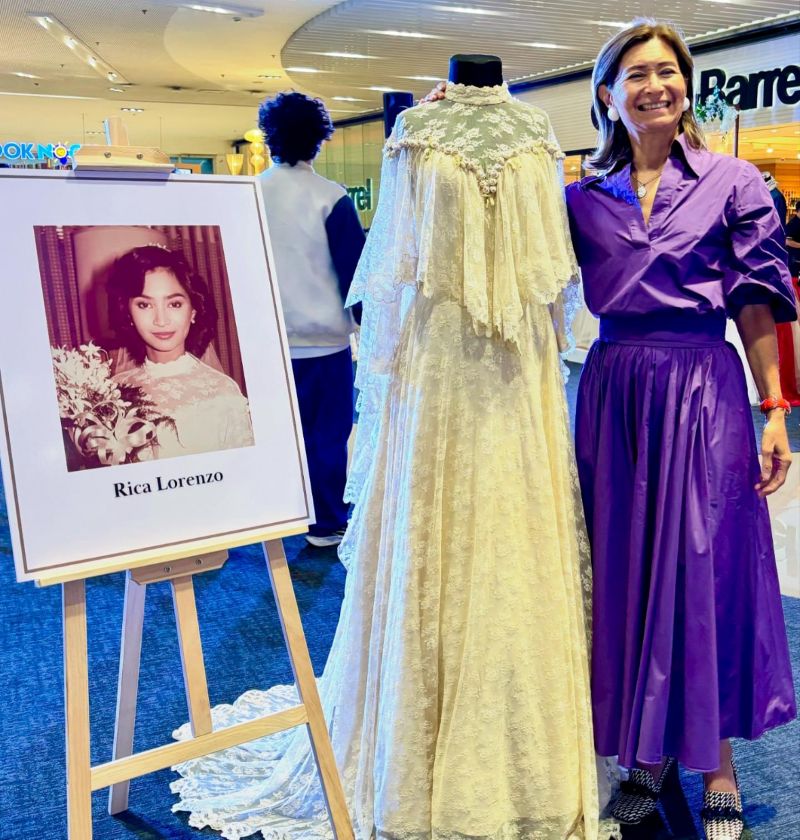
Rica Lorenzo can still fit into her wedding gown.
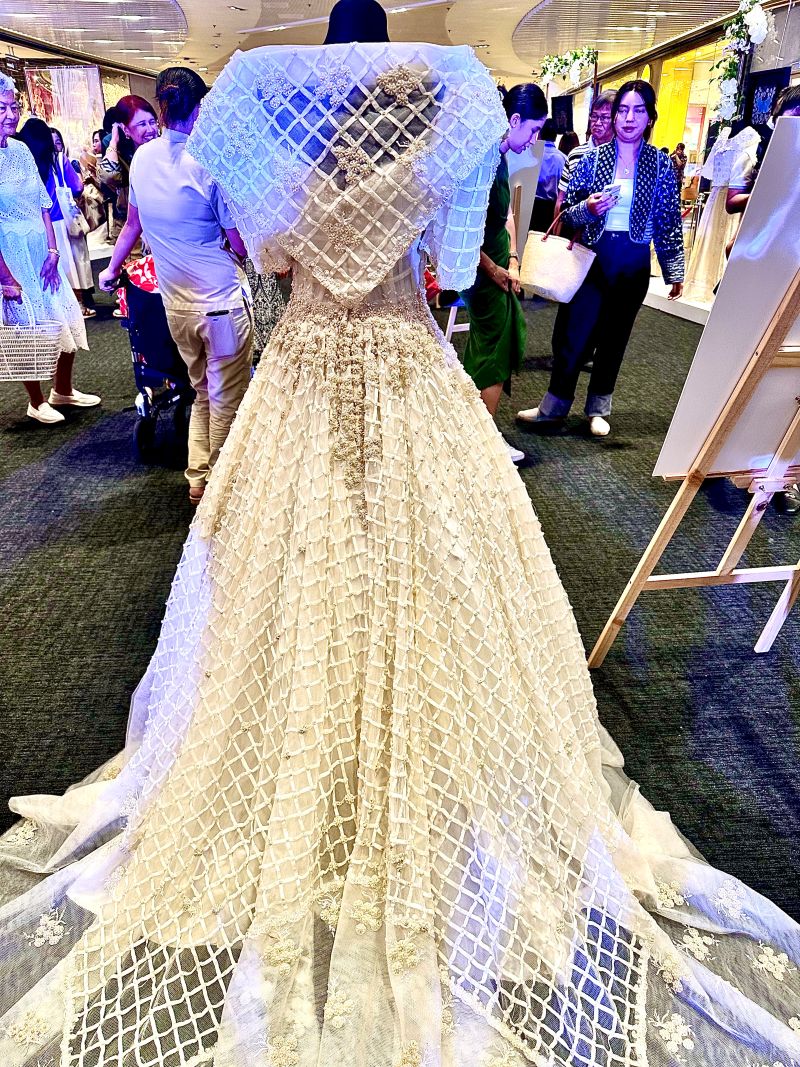
Draftsmen of National Artist Pablo Antonio created the grid pattern for the wedding gown of Alice Paez.
Ten years after it had been returned to the bridal dress box, the gown was once again retrieved from storage. Mrs. Antonio’s granddaughter Letlet Veloso Barrera was mounting an exhibit as the preamble to a book she was writing on her grandmother. The retrospective showcased some of the bridal gowns made by Mrs. Antonio. I was at the wedding of Rica Lorenzo, where she wore a Victorian-style lace gown that she can still fit into today. Her mother, Alice Paez Lorenzo, wore an astounding, well-preserved gown that her daughter Bettina also wore on her wedding, as well as a niece after her. It was a husband-and-wife collaboration between National Artist for Architecture Pablo Antonio and Marina. His draftsmen executed the pattern to form a grid over the entire dress. Tulle ribbons and pearls were sewn on the parallel space bars, crossing each other in perfect symmetry.
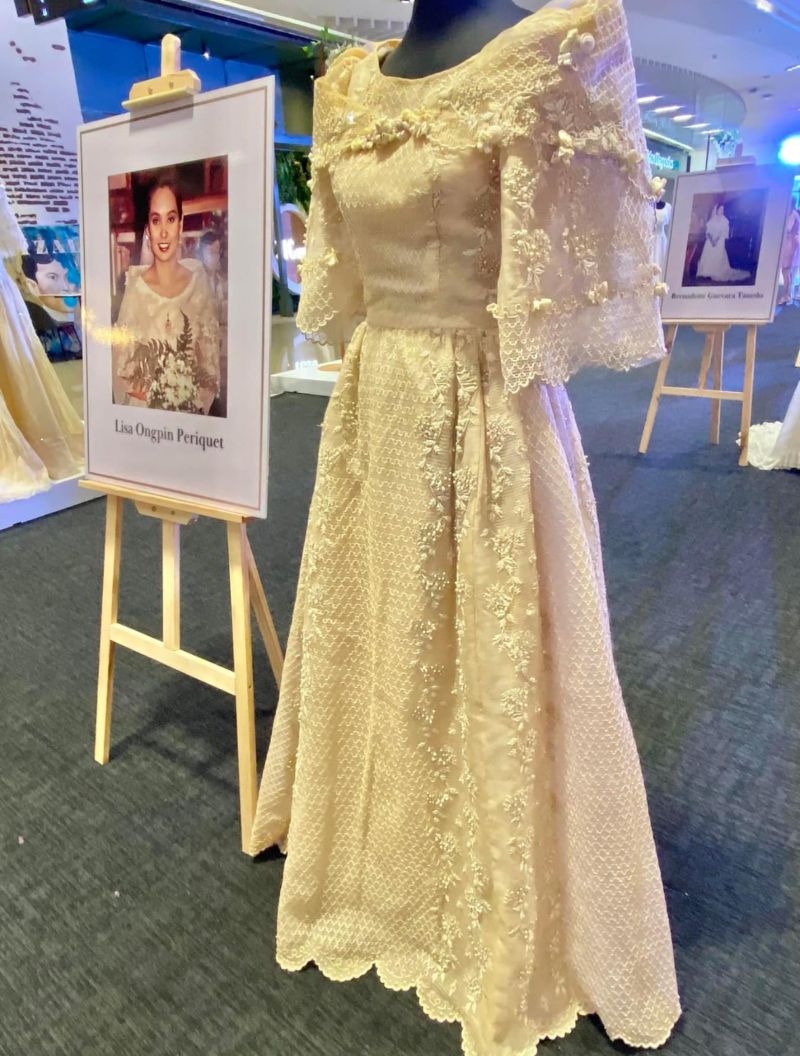
Lisa Ongpin Periquet ‘s wedding gown in ‘piña calado’
My classmate at Ateneo, Lisa Ongpin Periquet, was another bride of Mrs. Antonio, whose piña gown was another version of the maria clara. It had traditional Philippine open thread work called calado covering practically the entire dress. Fibers are pulled apart to create detailed, lace-like patterns done by highly-skilled craftsmen.
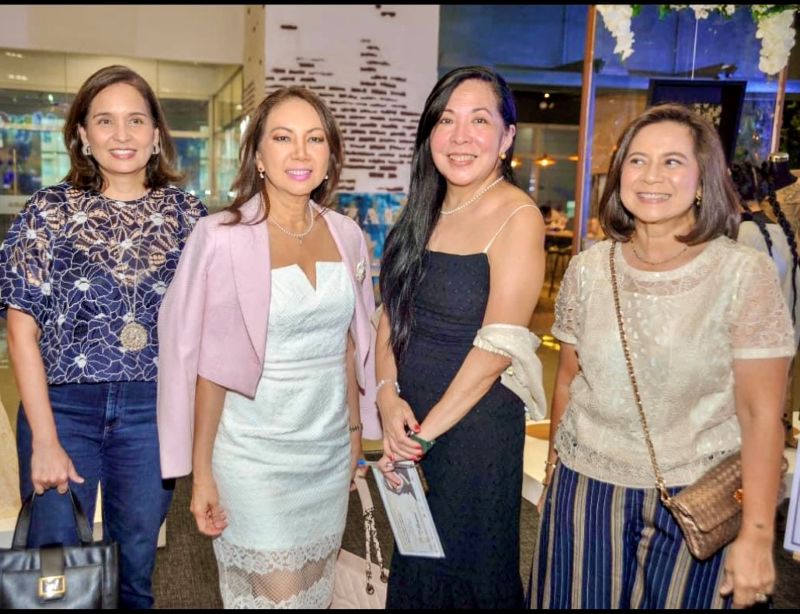
Lisa Ongpin Periquet, the author, Vicky Veloso Barrera, Bettina Lorenzo Benitez
There are others which will be featured in Letlet’s book. I imagine the volume will not just hold memories of the women who wore the gowns, but will also be an inspiration for girls who dream of walking down the aisle in beautiful wedding dresses.


