
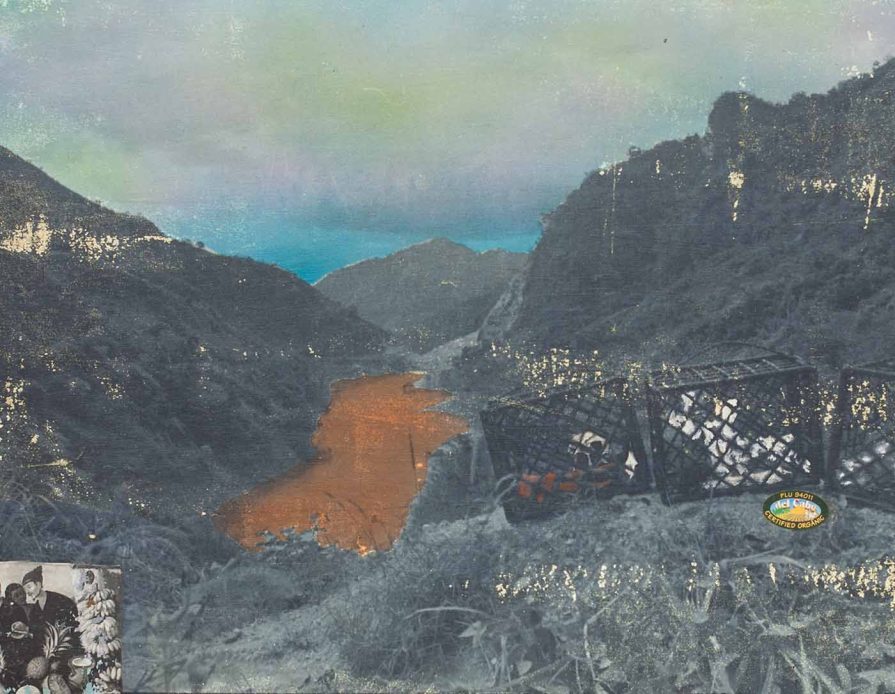
Silverlens New York presents Fugitive Land, opening Oct. 24, 2024. A three-person exhibition organized by Christopher Y. Lew—founder of C/O: Curatorial Office, under whose auspices he has collaborated with Silverlens since 2023, consulting on the overall program and select exhibitions—Fugitive Land brings together works by Santiago Bose, Michael Joo, and Stephanie Syjuco. Through a range of strategies, this intergenerational group of artists examines aspects of history and place that have been obscured by power and empire.
Lew wrote in After Empire: “In his wide ranging 2019 book, How to Hide an Empire, historian Daniel Immerwahr charts how American imperialism eschewed past models of conquest and the US, instead, created a network of small-scale territories and military bases that dotted the globe, without a large colonial enterprise and primarily out of the eyes of its citizens. Certainly, the white settler land grab is very much part of US history, especially throughout the course of the 19th century when indigenous land was brutally taken in the name of progress and westward expansion. So much of the violence, exploitation, and extralegal maneuverings of this period would serve as the foundation for an American version of empire—one in which so-called territories are a grey area in US law, and subsequently, through advancements inncommunications and logistics technologies, those bases can be far from one another and no longer required traditional colonial structures to support them. In effect, most mainlanders had little knowledge of the very people that constituted the country in its entirety—that by 1940, 12.6 percent of the US population did not live in the contiguous states.”
Santiago Bose, who can be regarded as the grandfather of Filipino contemporary art, grew up amid the physical manifestations of this American empire. Born just after World War II, in 1949 in Baguio City, he grew up in a city that was built from scratch in the early 1900s by the US occupation, originally as a summer retreat for the white colonizers complete with “large government buildings, commanding views, a grand axis cutting through the Baguio meadow,” writes Immerwahr. Growing up in this built environment in the 1960s, Bose was first exposed to rock ‘n’ roll as well as American and European art through the nearby American military bases. As his biographer Jonathan Best relates, Bose’s memories of his youth “soured as he grew older and came to feel Filipinos were being treated like second-class citizens in their own country when they visited the American bases.”
In Bose’s assemblage Baguio Souvenirs (1976), the composition is bisected horizontally with an off-white band running across the top and a thin, desaturated red below, to resemble the corridors of an administrative building. Embedded in the “wall” are turn-of-the-century surveyor photographs of his hometown. Acting like windows looking out onto the landscape, the appropriated pictures were taken at a commanding height, depicting orderly rows of buildings along wide streets and green fields divided into crisp geometries by intersecting roads. While they are actual photographs of a real place, they are also a colonizer’s fantasy—a landscape that is organized and pacified, largely devoid of any people. With a trickster’s wit, Bose appropriates the very images initially used to survey and control the land and have them speak back against the legacy of imperial might.
-

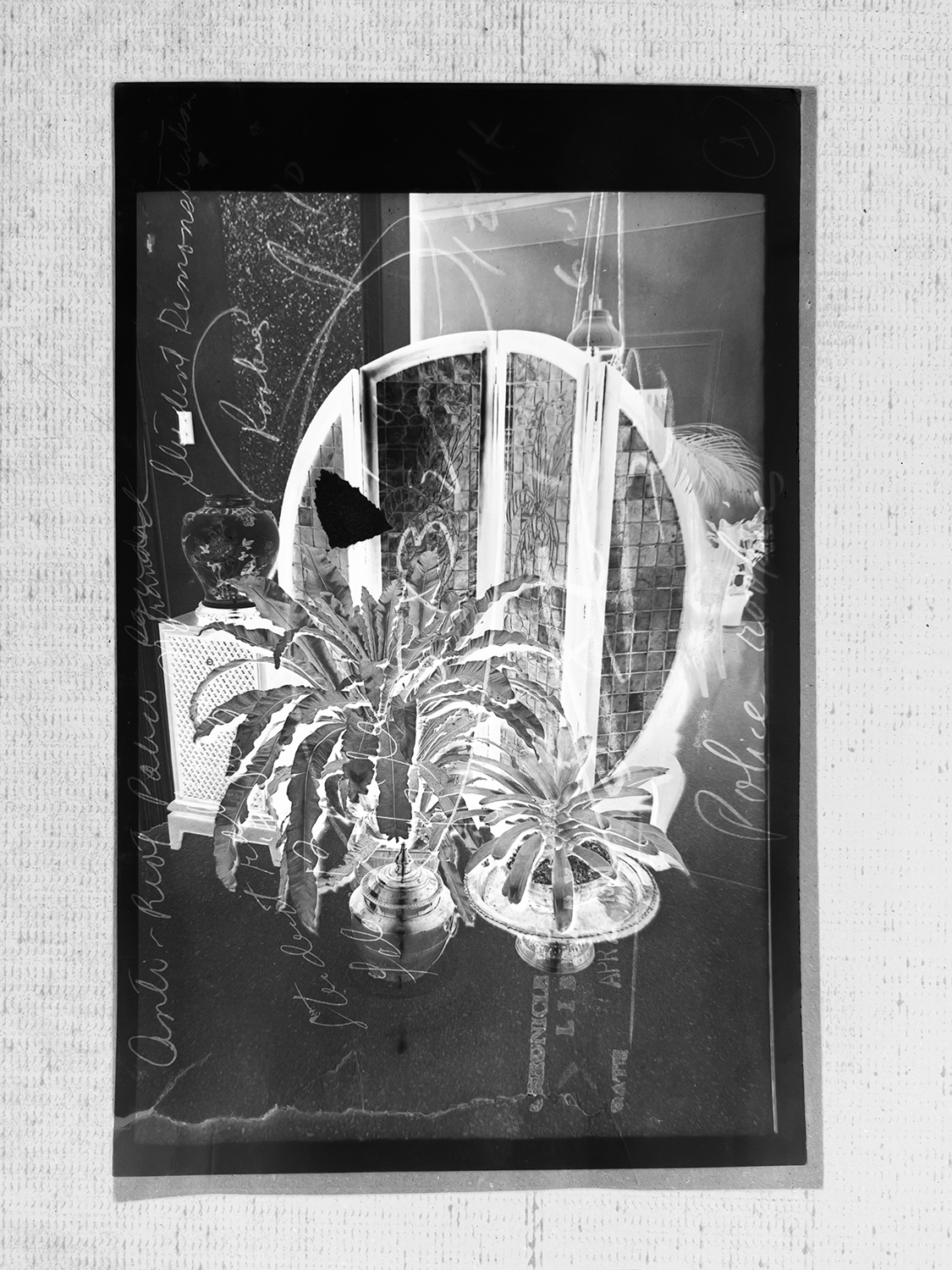
- Stephanie Syjuco, ‘Force Majeure 3″ (Room Divider/Anti-Riot Police Squad), 2023, courtesy of the artist and Silverlens
-

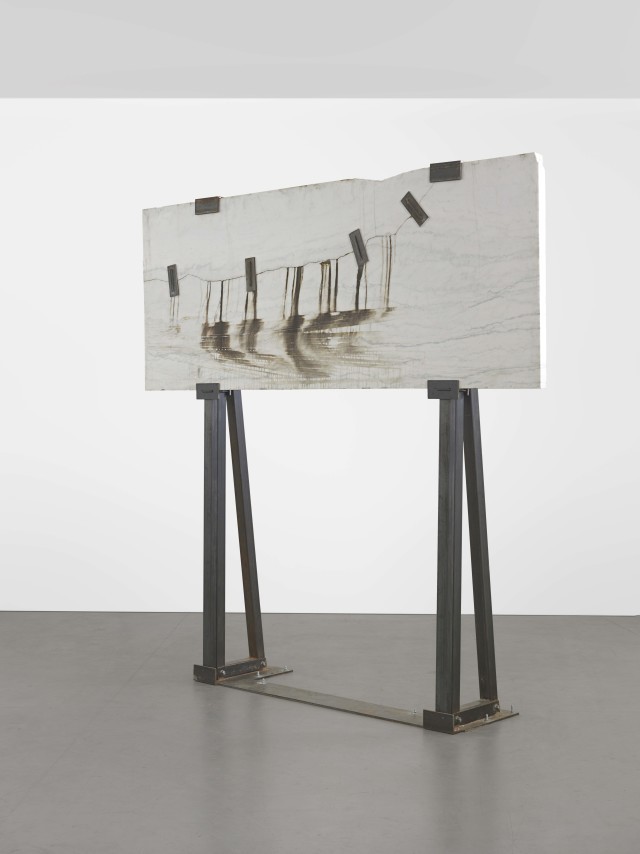
- Michael Joo, “Epi” (Montclair Mariposa Cross-Cut), 2024, courtesy of the artist
Stephanie Syjuco’s early three-channel video Body Double (Platoon/Apocalypse Now/Hamburger Hill) (2007) makes use of an entirely different set of source imagery which, like Bose, the artist turns back on itself. Looking at the three titular Hollywood films about the Vietnam War, Syjuco excises the sections of footage that solely depict foliage and landscape, devoid of humans. Sections of jungle appear and disappear in regular, silent geometries—a rectangular sliver of blurry greenery, a square close-up of grass, a wide shot of the sun piercing the canopy overhead. The three movies were shot in the Philippines to stand in for Vietnam (hence the body double), in a sense producing a colonial ouroboros.
Santiago Bose (1949–2002, Baguio City, Philippines) was a mixed-media artist, educator, community organizer, and art theorist. Co-founder of the Baguio Arts Guild, he is recognized as a pioneer in the use of indigenous materials. His influential assemblages champion the resilience of indigenous cultures within the context of a society inundated with foreign influence. As a widely sought-after artist for public commissions and artist residencies, Bose developed a practice which included extensive international travel and several prominent grants and fellowships. In 1976, Bose was granted the Thirteen Artists Award by the Cultural Center of the Philippines. He has participated in major international exhibitions, including the Third Asian Art Show in Fukuoka, Japan, and the Havana Biennial in Cuba, both held in 1989.
Employing diverse media and materials, Korean American artist Michael Joo (b. 1966, New York, USA, lives and works in New York) draws together creative and scientific modes in innovative conceptual work that reflects on the intersection between technology, perception, and the natural environment. Joo’s materials are as diverse as his body of research, ranging from human sweat, silver nitrate, and bamboo. Major exhibitions include Perspectives: Michael Joo, Smithsonian Freer | Sackler Museum.
Stephanie Syjuco (b. 1974, Manila, Philippines; lives and works in Oakland, CA) is celebrated for her interdisciplinary practice encompassing photography, sculpture, and installation. Her work employs open-source systems, shareware logic, and capital flows to scrutinize issues related to economies and empire. Her work has been exhibited widely, including at The Museum of Modern Art in New York, the Whitney Museum of American Art, The San Francisco Museum of Modern Art, The Smithsonian American Art Museum. A long-time educator, she is an Associate Professor in Sculpture at the University of California, Berkeley.
Christopher Y. Lew is founder of C/O: Curatorial Office, a curatorial consulting firm. Lew has over 15 years of experience working at American museums and arts nonprofits. He had been the founding chief artistic director at Horizon Art Foundation and Outland Art and is also a former curator at the Whitney Museum of American Art, where he oversaw the emerging artist program and was co-curator of the 2017 Whitney Biennial. At the Whitney, he organized numerous exhibitions including Josh Kline: Project for a New American Century (2023), Salman Toor: How Will I Know (2020), Pope.L: Choir (2019), Kevin Beasley: A view of a landscape (2018), Eckhaus Latta: Possessed (2018) and mounted the first US solo exhibitions for Sophia Al-Maria, Rachel Rose, and Jared Madere. Prior to joining the Whitney, he was assistant curator at MoMA PS1 and organized many exhibitions there. Under the auspices of C/O, Lew has collaborated with Silverlens since 2023, consulting on the overall program and exhibitions including Wawi Navarroza: The Other Shore.
Silverlens is an international gallery with locations in both Manila and New York. Through its artist representation, institutional partnerships, art consultancy, and exhibition programming, including art fairs and gallery collaborations, Silverlens aims to place its artists within the broader framework of the contemporary art dialogue. Its continuing efforts to transcend borders across art communities in Asia have earned it recognition as one of the leading contemporary art galleries in Southeast Asia.
Silverlens was founded in Manila by Isa Lorenzo in 2004, and in 2007 she was joined by co-director Rachel Rillo. In September 2022, the gallery opened its doors in the Chelsea neighborhood of New York, broadening its international scope and bringing its diverse roster of artists to a new global
Silverlens Galleries: Manila—2263 Don Chino Roces Ave. Extension, Makati City, Philippines 1231; New York— 505 W 24th Street, New York City, NY, USA 10011; www.silverlensgalleries.com, email inquiry@silverlensgalleries.com


