
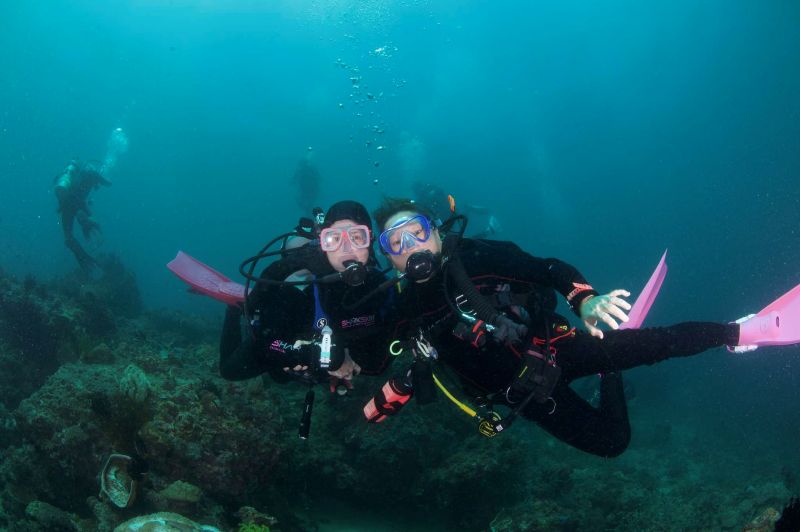
Photographs by Dr. Mike Macrohon
FIRST off, a caveat: I am not writing this to showcase admirable piety or a special designation as a beloved child of God (then again, we all are, of equal importance). But if faith can indeed move mountains, mine kept me surprisingly calm and reassured of my safety during a recent challenging dive that may have ended in a much worse manner for a less experienced diver.
At Canyons, a dive site in Puerto Galera known for ripping currents, I was yanked down 10 meters (some 33 feet) in a matter of seconds, unable to stop sinking until I grabbed a hold in about 31 meters (100 feet) of swirling, silty water. Yet, surprisingly, after my first few exclamations of “Sh-it! Sh-t! Sh-t!”, I quietly whispered, “Help me, God”—and like a cool, calming presence, I somehow heard Mama Mary’s voice inside my heart say, quite clearly, “Not your time yet, my dear.” Maybe it was wishful thinking, but it worked. And I felt utterly protected.
Let me backtrack. My dive tribe and I had headed to Puerto Galera, Mindoro, for a few days of diving during the All Saints Day-All Souls Day holiday. I had visited my parents, brothers, and grandparents that Oct. 30 to pay my respects, and we drove off the next day.
The dive happened on the morning of November 2. I had dived Canyons before, but I don’t remember the visibility being this bad—or the current being this crazy. Since I’m a relatively experienced diver, the first part of the dive, when the current pushed us horizontally over mounds and the eponymous small canyons, was actually fun, like an amusement park ride, with my companions woot-wooting along the way. We even spotted a huge green turtle hanging on to a reef, and small triggerfish fighting in the current, as well. We should have gotten the hint, I guess; I put on my right glove, and handed the other to a gloveless friend who was also having trouble keeping his buoyancy. My buddy Christine was to my left at the time, and I kept an eye on her pink fins.
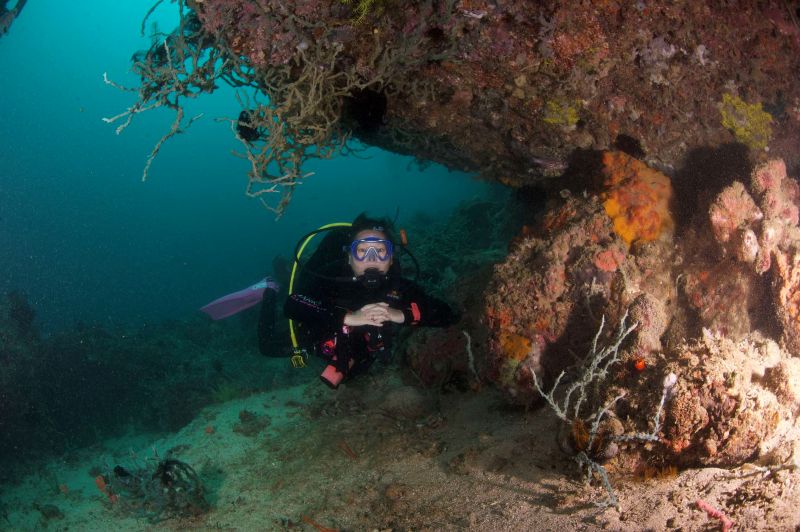
Christine Enrile Chua under an overhang in Verde Island
And then, wooooosh—the onslaught was audible. In seconds I was pulled down by a powerful vertical current over the edge of a large rock, my mask shaking against my face as it often does in the face of current, and I lost sight of Christine and anybody else in the group. I clawed at the face of the rock, but couldn’t hold on very much for a while, mumbling “Sh-t!” all along. All I could really hear was that wooshing sound of water churning around me. “Help me, God,” I whispered.
I clawed at the face of the rock but couldn’t hold on very much for a while, mumbling ‘Sh-t!’ all along. All I could really hear was that wooshing sound of water churning around me
And then, like someone had shifted the current machine into lower gear, the undercurrent slacked somewhat as I held on to the reef. I found myself quite calm, with no scenes of my life flashing before my eyes. I already knew I’d be okay, somehow. I waited a minute and contemplated letting go and drifting slowly up to safety; I did have a surface marker balloon or SMB (which I sometimes left behind, but not this time!), a piece of equipment a diver inflates on the surface to be seen by boats, so I knew I’d be found. Instead, I opted to crawl up to a shallower area and take off from there.
That was when I saw Christine, also hanging on for dear life to some rocks between two larger ones. I crawled up beside her, and the relief we both felt at finding company was almost palpable. We considered crawling forward a bit more, but the current wouldn’t let us.
Slowly, we moved away from the reef before holding hands and letting go of our anchors. It was a blue water ascent, with no reference points in sight, so we had to pay close attention to our dive computers to monitor our depth and rate of ascent. At one point, even as we finned upward, the computer kept showing us going deeper. As we had been trained to do, we slightly inflated our buoyancy compensation devices—those vests you see divers wearing, to which the air tank is attached—but kept our hands on the buttons, ready to deflate when we no longer had to fight a downward current. This was also to ensure that we didn’t shoot up to the surface, which could have been fatal—I’ll explain in a bit.
Soon, we were on the surface, after completing the necessary safety stop to clear our bodies of nitrogen. We still surfaced within view of several boats, so our own ride was upon us in minutes, with some companions expressing how worried they had been. Yet, we managed to laugh about the experience—which happens when you’ve been doing this as long as we have, although this was the first time we were both swept away a distance from our group. Still, we made it up with some air, a lot of lessons, and no trauma.
So I’ve been asked by non-diving friends: What’s the worst that would have happened? If I had been yanked down way below my limits, narcosis could have happened; the depths could have left me dizzy and pretty much stoned, seriously affecting my reflexes. Since I was diving on nitrox, a special gas with 32 percent oxygen (FYI, we don’t dive with oxygen, but with air, which is 21 percent oxygen), I also had a strict maximum depth; much deeper, and oxygen would have become toxic, which could destroy my central nervous system. If I went too deep and shot up too fast, there’s the risk of the infamous bends, otherwise known as decompression sickness (DCS), when nitrogen bubbles form in your tissues and potentially cause damage when they’re not properly expelled through gradual ascent. Then, of course, there’s the minor inconvenience of running out of air.
Which begs the question, in the words of my dear kasambahay Dang: “Ma’am, mag-da-dive ka pa rin? Hindi ka nadala?” Rough translation: Hasn’t this scared you out of the water? Not by a long shot, for a number of reasons.
First, accidents happen in diving when you panic, are careless, or did not get proper training. After 35 years of diving, I have racked up enough experience, I hope, to feel at home in the water. Our instructor friend, Dr. Mike Macrohon, told us that panicked divers tend to do everything to get out of the water and get rid of their gear, including making the deadly mistake of trying to breathe through their noses.
Never did Christine and I think of getting out of the water immediately; breathing deeply and paying attention to our computers, which advised us to take an extra two minutes on our safety stop to get rid of excess nitrogen, we ascended slowly in blue water, observed all the protocols, and stayed close, until Christine deployed her SMB near the surface.
Second, you are still at the mercy of nature’s whims, so you would still do well to be careful and prepared. While some dive sites restrict the use of gloves to discourage touching the reef, Puerto Galera is known for its currents, so no harm in bringing gloves along. Gloves are less for cold and porma than they are for safety; imagine what would have happened to my poor manicured fingers if I had to grasp at sharp rocks without protection.
Third, what can I say? I love diving too much. In fact, Christine and I were in the water again for the very next dive (see smiling picture above), which prompted a friend to comment after I posted it and told the story, “You look happy naman!” We ran into more currents, in fact, on Verde Island, but nothing like Canyons, and we were cool as (sea) cucumbers. We know we are just guests in this magnificent environment, so we will always return with much love and respect. Scuba-diving is just way too much fun.
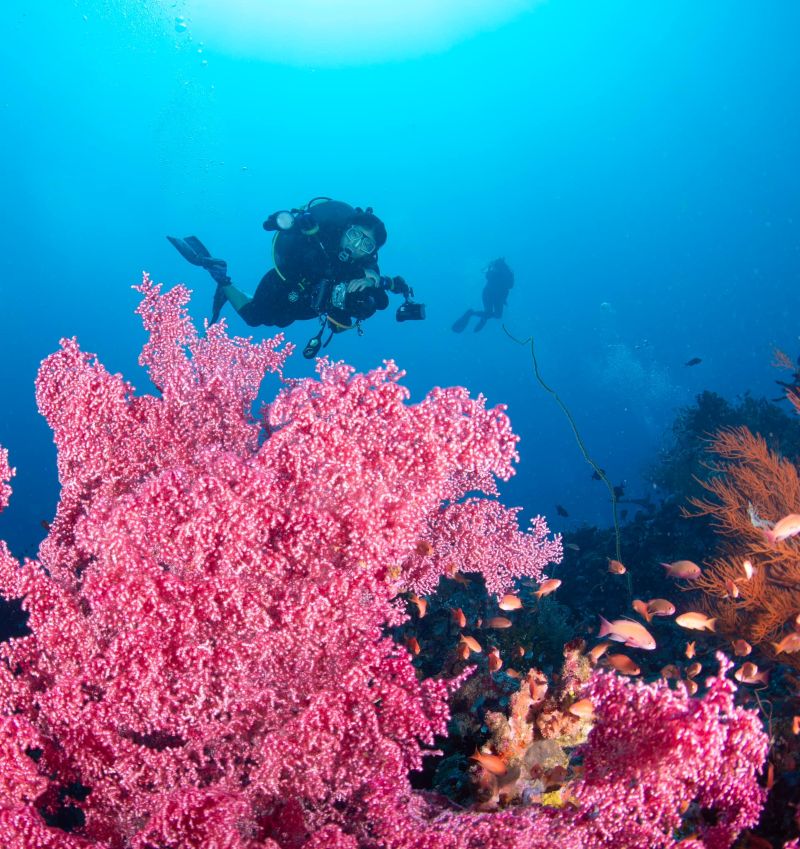
Underwater photographer Yvette Lee gets photographed at work this time.
Finally, there’s the reason I mentioned at the beginning of this story: I do, and always will feel, protected underwater. I am not doing anything foolish or reckless, I believe; millions of people enjoy this sport worldwide, and the Philippines has the best waters for diving, bar none. But knowing that Mama Mary throws her mantle of protection over me, in every situation of my life, is a game-changer. I can only continue to be an advocate for the beautiful oceans that God created.
Meanwhile, as Christine says, after that adventure, we’re now stuck at the hip.


