
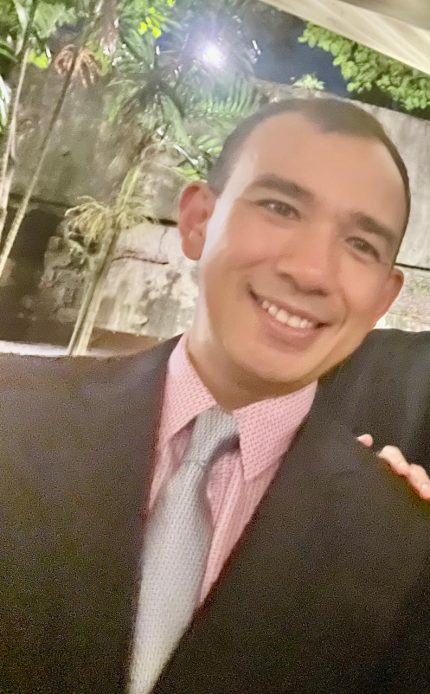
A week before the Kingly Treasures auction, friends of gallerist Jaime Ponce de Leon gathered to preview the prized lots. The Nov. 30, 2024 auction was headlined by National Artist Carlos “Botong” Francisco’s Tinikling 2, from the collection of the first Filipina Cabinet member, Estafania Aldaba Lim. “It’s a once-in-a-decade opportunity for an auction house to handle a work of this magnitude by Botong Francisco,” said Ponce de Leon. Five works by Fernando Zobel, including a Saetas painting from the late 1950s, were also featured.
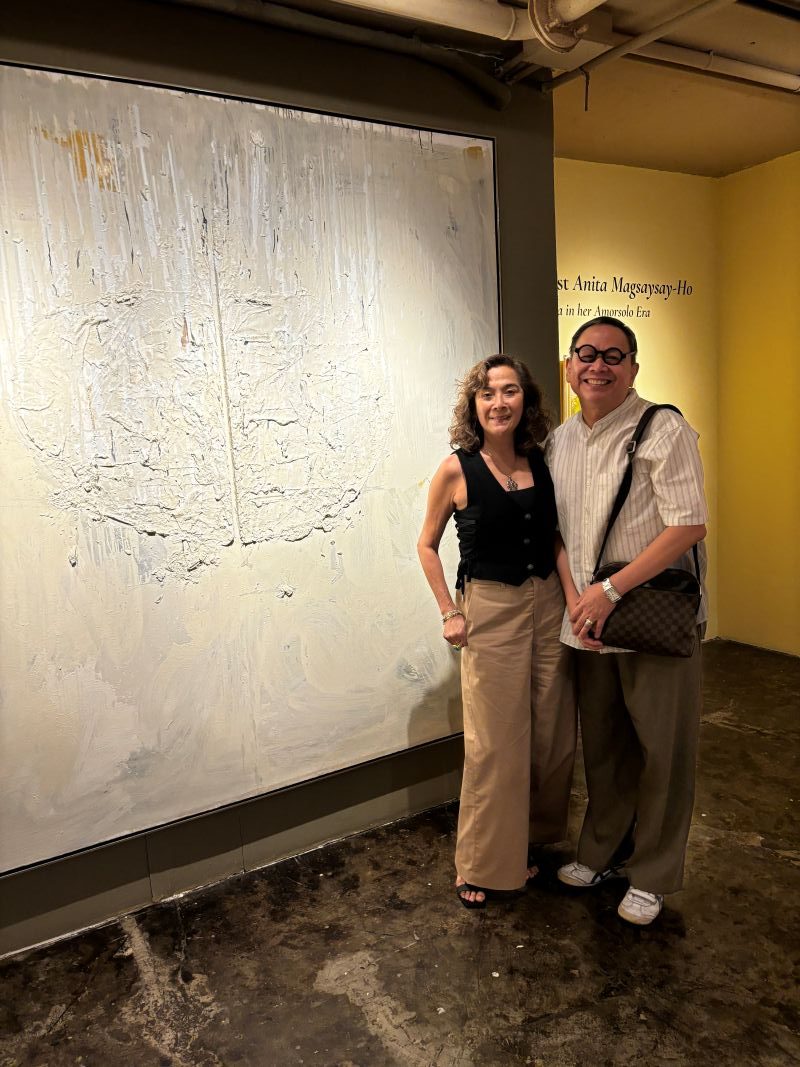
Art collectors Marivic Vazquez and Bien Benitez before Bernard Pacquing’s ‘Tongue of Fire’
That Saturday morning, investment banker Alejandro Zobel Padilla and his son, Alvaro, examined paintings from the collections of the Araneta family, Ambeth Ocampo, and Aldaba Lim. Art collectors Marivic Vazquez and Jomarie Treñas studied Bernard Pacquing’s Tongue of Fire. Ponce de Leon shared a photograph of Felix Resurrection Hidalgo in front of his painting, The Assassination of Governor Bustamante, dedicated to Canadian artist George Peale in 1891. This photograph could correct the misconception that the painting, which won a gold medal at the 1904 Universal Exposition in Missouri, was created in the early 20th century.
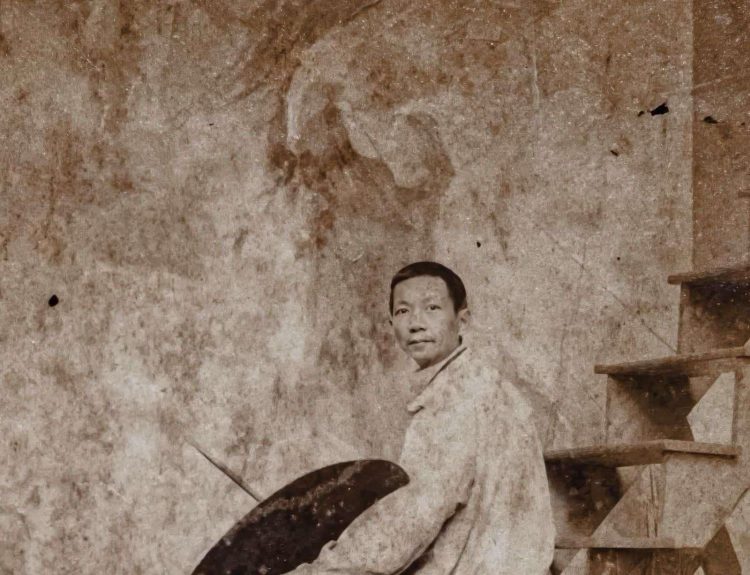
Ponce de Leon shares a photograph of Felix Resurrection Hidalgo in front of his painting, ‘The Assassination of Governor Bustamante,’ with a dedication from Canadian artist Paul Peel in 1891.

Jaime Ponce de Leon (second from left) with Lisa Nakpil, Alvaro and Alejandro Padilla, and National Museum director Jeremy Barnes
Over a lunch delivered by the German Club, Ponce de Leon discussed the collection with this writer, while National Museum head Jeremy Barnes and Leon Gallery researcher/writer Lisa Guerrero Nakpil conversed about art. The meal was capped with a cheesecake, made by architect and interior designer Ramon Antonio himself. Ponce de Leon said that he was expecting TV host Ces Drilon later that afternoon.
Such is a typical day at Leon Gallery auction house in Euro Villa, Makati, which has become a hub for the art cognoscenti, the social set, serious collectors, and writers. It has the right formula: the glamor of the de buena familia set, the shop talk over Starbucks, the variety of artworks, the romance behind relics and mementos, and the hard work that goes into each lot.
Where else in Manila could you find such a varied company of art lovers?.
As an auction house, the gallery meticulously researches each lot to determine accurately its market value. Ponce de Leon has worked with experts to produce the auction catalogues, including the late Floy Quintos, Ramon Villegas, Martin Tinio, Augusto Gonzalez, Lilianne Manahan, Isidra Reyes, and Jorge Mojarro. The process has yielded record-breaking sales of antique furniture, tribal art, and masterworks.
“Luck, hard work, and timing are all crucial factors,” cites Ponce de Leon. “It’s stressful, but essential to ensure the catalogue is not only accurate but also appealing. The information must be insightful and extraordinary enough to pique interest.”
A compelling backstory can significantly boost an artwork’s value. Provenance, or the history of a piece, can generate buzz and give it the element of romance. For The King’s Treasures, for instance, Jose Rizal’s sculpture of his love, Josephine Bracken, is dubbed the Mona Lisa of the Philippines. “She’s down naked. Nothing can be more intimate than a woman enveloped in sheets in the confines of your room. Leon Ma. Guerrero said, ‘Josephine Bracken was the one woman with whom he shared his jealously prized possessions—his name and also his heart’s intimacies.’”
Ponce de Leon tells the backstory of how Bracken came to Dapitan to escort her stepfather, Rizal’s patient, and how the whirlwind romance ensued.
Related Story:
Josephine Bracken: The First Filipino’s last lady
Once, a collector approached Ponce de Leon, motivated by the P112-million sale of Joya’s Space Transfiguration. He claimed to own a similar painting by Joya, also from 1959, and aimed to sell it for the same price. However, Ponce de Leon politely explained that the two paintings were not comparable in terms of impact. “It’s like comparing two sisters—one a Miss Universe, and the other not,” he says.
Some families have adopted a different approach to family heirlooms: sending them to the auction house for interested family members. This ensures fair distribution and prevents potential family disputes. For example, a Manansala portrait of real estate matriarch Carmen Zaragoza Araneta was sold within the Araneta clan.,
Ponce de Leon often quotes the Spanish proverb, “Cuentas claras conservan amistades,” which translates to “Clear accounts preserve friendships.” This wisdom underscores the importance of transparency and fairness in such delicate family matters.
In a different case, a consignor, who sold the prized 1734 Murillo-Velarde map of the Philippines, requested strict confidentiality. It was one of the maps used by Filipino experts to counter China’s claim of ownership of the South China Sea. To accommodate these sensitive situations, the auction house balances discretion with transparency by privately sharing the previous owner’s identity with the winning bidder.
Beyond professionalism and art expertise, it’s Ponce de Leon’s soft skills that have endeared him to the community. “Jaime keeps me up to date and introduces me to his friends. It’s not just business,” says Padilla.
“He doesn’t say anything bad about anybody,” says Nakpil.
Excerpts from our conversation:
TheDiarist.ph: When we first met, you claimed that you were a probinsiyano. Dumaguete City Mayor Felix Remollo said he has known you since your youth. You were into politics, and now you’re in the world of art.
Ponce de Leon: My parents were simple people from Dumaguete. I took up business management at Silliman University. Then I became a barangay captain. I’ve always been ambitious since I was very young. I always wanted to make something of myself. After three years of barangay politics, I wanted to live in the big city and accomplish more.
Your background is more than that.
My maternal great grandfather, Don Demetrio Larena, was the first governor of Negros Oriental. He was instrumental in the establishment of Silliman University in Dumaguete. My grandfather, Demetrio Jr., was mayor of Bais.
My paternal grandfather came from Cuyo Island. He married my lola, an Arnaiz from Bais, she was the sister of Antonio Arnaiz (Pasay Road was named after the first Filipino pilot to fly Manila-Europe). We are descendants of the Felipe el Rey de Espana. Our great-great-great grandfather, Pablo Ponce de Leon, was the son of Antonio Ponce de Leon, 11th Duke of Arcos. Don Pablo was sent by his father-in-law, the King of Spain, to expel the Jesuits in the Philippines. We are the descendants—the Counts with no accounts. If you see the silver altar in Cuyo, it is inscribed “donacion por Don Pablo Ponce de Leon, El Duque dela Arcos.”
‘After three years of being a barangay captain, I moved to Manila’
What was your transition to the big city like?
After three years of being a barangay captain, I moved to Manila working for Megaworld as a property specialist, one of those people handing out flyers. I’d go the extra mile, start at 7 am so I could distribute more flyers. It’s a numbers game. Sometimes the person you least expected to buy, would buy. They are walking down the street with a plastic bag. Once I gave a flyer to a couple in Greenbelt. It was 8 pm. They said, let’s go to the Megaworld showroom on H.V. dela Costa and they signed up that night.
When you make that deal you get that dopamine. I did one-year stint in Malaysia when our team was invited by a contractor. Then I went to Philippine School of Interior Design and graduated after three years. I started doing condos, then I met people who were introduced by a friend through another friend. I fixed up Marivic Vazquez’s original apartment at Twin Towers. Design projects come with hanging up art. Then some clients wanted to let go of an artwork, or a client wanted to acquire something.
By 2010, I got a small space at Corinthian Plaza to sell art for the secondary market. When I joined the first Art Fair, my business needed a name. I could only think of Leon Gallery.
In January 2013, I started doing auctions. By accident, a friend came over and was working for Prudential Life Plans. The company needed to liquidate its collections. I offered to broker everything. However, their mandate required an auction. If I could not get it, someone else would. I took up the challenge. It became a white glove sale. In the auction parlance, it means all items were sold.
This encouraged me to start doing it regularly. I enrolled in courses at Sotheby’s in New York, contemporary art and art law at the University of Arts and Sotheby’s in London, history of modern art at the American University in Paris. I have to learn what I can. I didn’t have the foundation of this business. I’m still learning up to now. I am taking in a three-year Owner President Management course at Harvard Business School. I will graduate next year.
Our style of auction is similar to Spain, which I frequent. Spanish auction houses start with a bid price.
How will your education in Harvard help your business?
Harvard gives you a better perspective and a clearer vision. There are times we have to cut down things. Sometimes we get into too many things that are not beneficial to the business. You get an overview—clients, negotiations. There is even a course in happiness.
What have you learned from this business?
The trickiest part is sustaining. You need to have a mindset that treats every asset in the same way as the first.
Everything involves a lot of work. After the Kingly Treasures Auction, we start doing the catalogue for the Asian Culture Council auction in February. The writing and production of a catalogue takes 45 days. It becomes doubly hard when pieces come late as last-minute additions. Like, this family brought in the Kiukoks. We have to do extensive research. There was also a late arrival of Jerry Elizalde Navarro’s painting, A Foul Wind on the 11th Day of February, the assassination of Antique governor Evelio Javier. We have to research his relationship with Elizalde Navarro. We get information from family and the sellers.
We do the estate sales via online auction. The 600-sqm warehouse at La Fuerza contains sets of home items.. When people downsize their home, they unload everything. Doña Nene Tuason Quimson’s French porcelain dinner service, Serves Vajilla, was sold for P1.8 million, and her Imari plates went for P4 million in April 2022.. The beautiful lampshade started at P4,000 and was sold for P1.5 million.
‘Art has an entire ecosystem. Galleries must see the benefits of having us’
Galleries claim that auction houses grabbed the business from them.
We have to co-exist. Art has an entire ecosystem. Galleries must see the benefits of having us. When a gallery handles a particular artist, and when the artist sells well with us, it increases their interest in the artist that they handle. It becomes a victory for the gallery because it’s only through auctions that there comes an index of price. How can you know the value of a piece if not through auction results? Trading art is very opaque. I can sell something to you for XXX amount. Nobody will know. It’s not on public record, but auctions are on public record.
‘This country needs art critics and art connoisseurs, especially in the ecosystem of the art market’
Share some of your experiences in your pursuit of lost masterpieces abroad, including Juan Luna’s Hymen, oh Hyménée!
I planted seeds and word got around. A gentleman from Uzbekiztan sent me an email saying that he wanted to meet me in London to show this Jose Joya painting. The work was shown at the 1964 Venice Biennale..
A dealer, whom I knew, contacted me to say that this consignor has this painting by Botong Francisco which was in a dress shop in London. I had to handcarry it flying home.
The diplomats carry paintings as their best mementoes. In Brussels, I went around galleries looking for some Filipino works. One gallerist dialed the number of his friend. He asked if I knew of Fabian dela Rosa. My heart pounded. The address was given to me, I saw it in the living room. It was owned by a family whose grandfather was a diplomat in the Philippines in the 1920s. This wasn’t about convincing them, but how they are letting go. The grandchildren don’t have much connection with the Philippines anymore.
With Hymen, oh Hyménée! I got lucky. I was traveling in Europe when I got a call from a gentleman from a certain area in Spain, asking me to be at a certain address. He wanted to show me something. We arrived in front of this huge ornate door. I placed my card on a silver tray. I didn’t know what a salvilla was until I researched afterwards. The master of the house will check who you are, and if you will be allowed entry.
We walked through a long corridor of checkerboard flooring, with walls of Goyas. We sat in the room. A dignified man arrived and we exchanged pleasantries. After a few minutes, he signaled his majordomo to open the curtain. Oh my god! Hymen, oh Hyménée. It is on loan to the Ayala Museum for two more years. It will go back to me. I had to find ways and means to pay for it. But I knew the Filipinos needed this. It’s not about convincing the owner.
Dr. Teyet Pascual used to mention this painting. He heard about it from such friends as socialite Pepita de Ridrueja, who was married to diplomat Mike Stephanopolous. He saw it in Spain in one of those parties. Mrs. Marcos wanted to buy it with her resources, but the family who owned the painting was not yet ready to sell. By the time I was invited to this family, the time had come. It must cede the ownership after 100 years. Their father bought the painting and was attached it. He had passed away.
How is the local art auction scene? What else is lacking?
There is a better price indexing, which is necessary especially when you see things through the eye of the collector. There is a more transparent manner of selling than going to a dealer who may sell a piece of art for much more.
This country needs art critics and art connoisseurs, especially in the ecosystem of the art market. We are getting there as people get grants from the Asian Cultural Council, and there are more scholars in art studies. They guide the ecosystem toward a balanced state of the art.


