
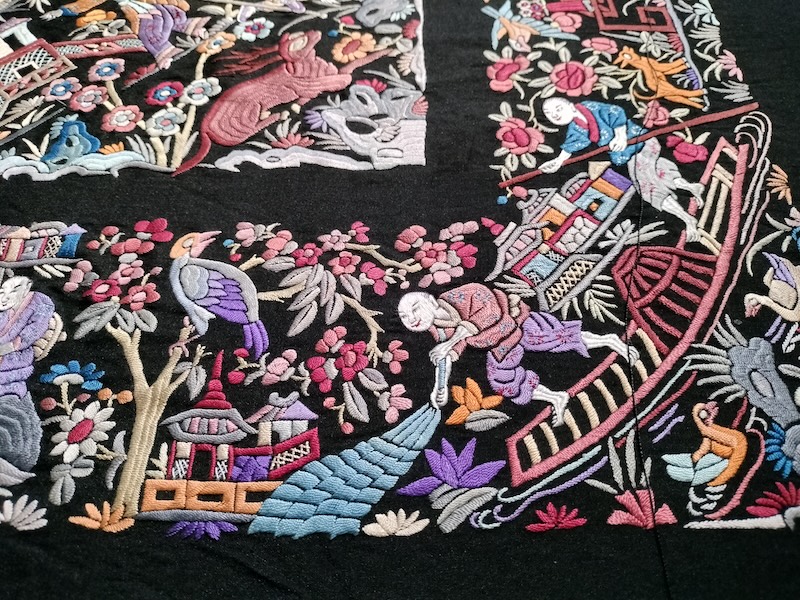
Mantón depicting hunting scenes (early 20th c.) (Photo by Liana Garcellano)
“Mezcla: Interwoven Cultures and the Mantón de Manila” runs until Feb. 22, 2026 at Ayala Museum, Makati Ave., Makati.
With most Filipinos collecting action figures, K-pop merchandise, or mugs, and a few accumulating paintings and other artworks, Veronica Durán Castelló collects mantónes de Manila (aka mantónes de seda or Manila shawls). From her cache, Castelló lent 38 mantónes and some lacquer boxes (where the mantónes are stored) to the Ayala Museum. She flew to the Philippines—“for the first time,” she said—to attend the preview of the exhibit Mezcla: Interwoven Cultures and the Mantón de Manila on Oct. 9.
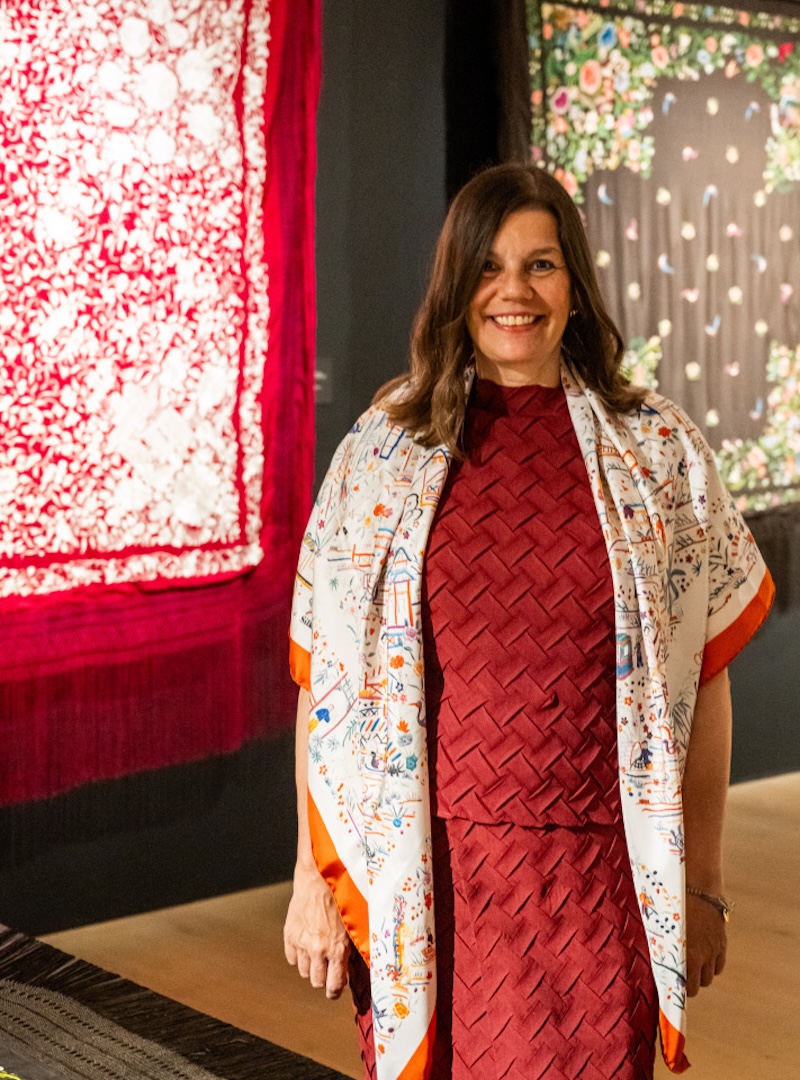
Veronica Durán Castelló (Photo by Ayala Museum)
At Ayala Museum, Castelló, a Columbian journalist who writes on immigration and art and culture, related that she first saw a mantón in a wedding in Spain and was taken by it. “*(A mantón) represents the happy union of (Latin) America, Spain, and the Philippines. We’re not much different. We can…do nice things together,” she said.
Castelló explained that despite the manton’s hazy history, its magical, mystical allure lay in its embrace of a myriad symbols: One always sees something new in it.
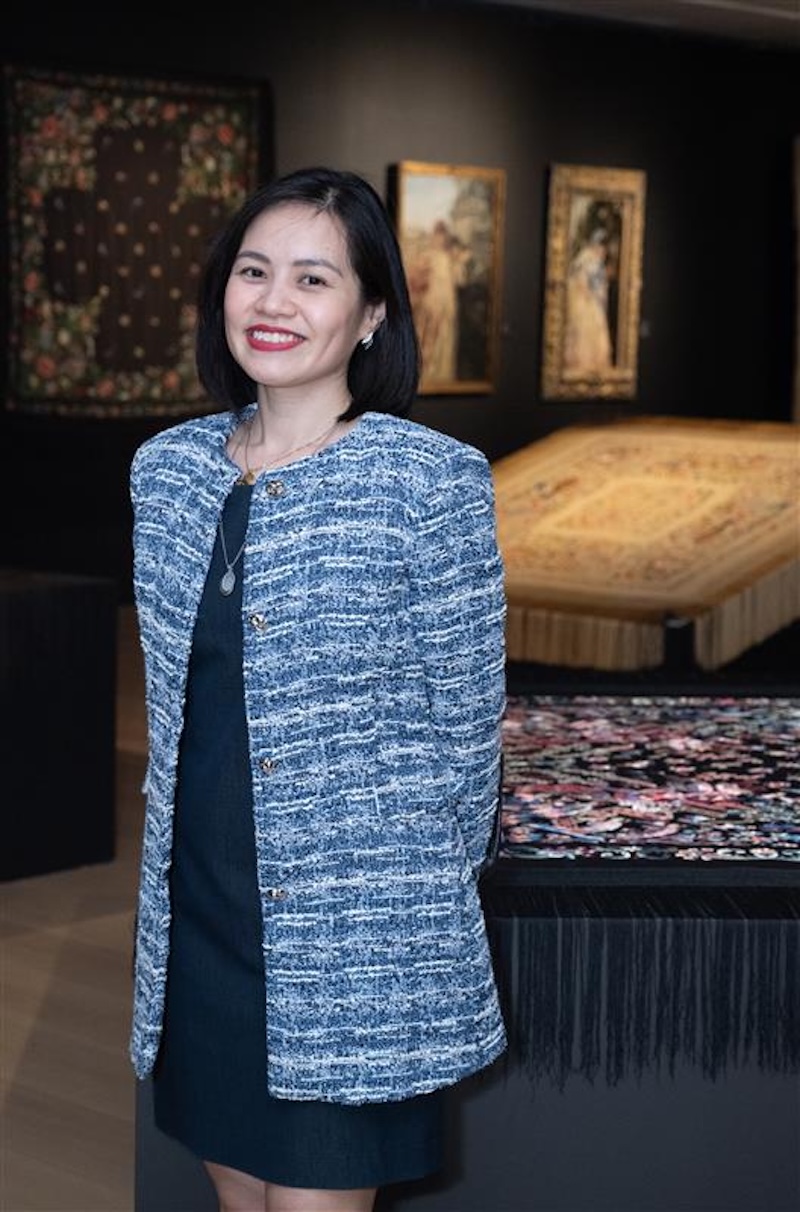
Marinella “Tenten” Andrea Mina (Photo by Ayala Museum)
Mezcla is curated by Marinella “Tenten” Andrea Mina, a member of the museum’s curatorial department since 2012, and features an array of mantónes from the 19th and 20th centuries.
The exhibit is a collaborative effort of the museum, the Embassy of Spain, Instituto Cervantes, and the Spanish Agency for International Development Cooperation (or AECID).
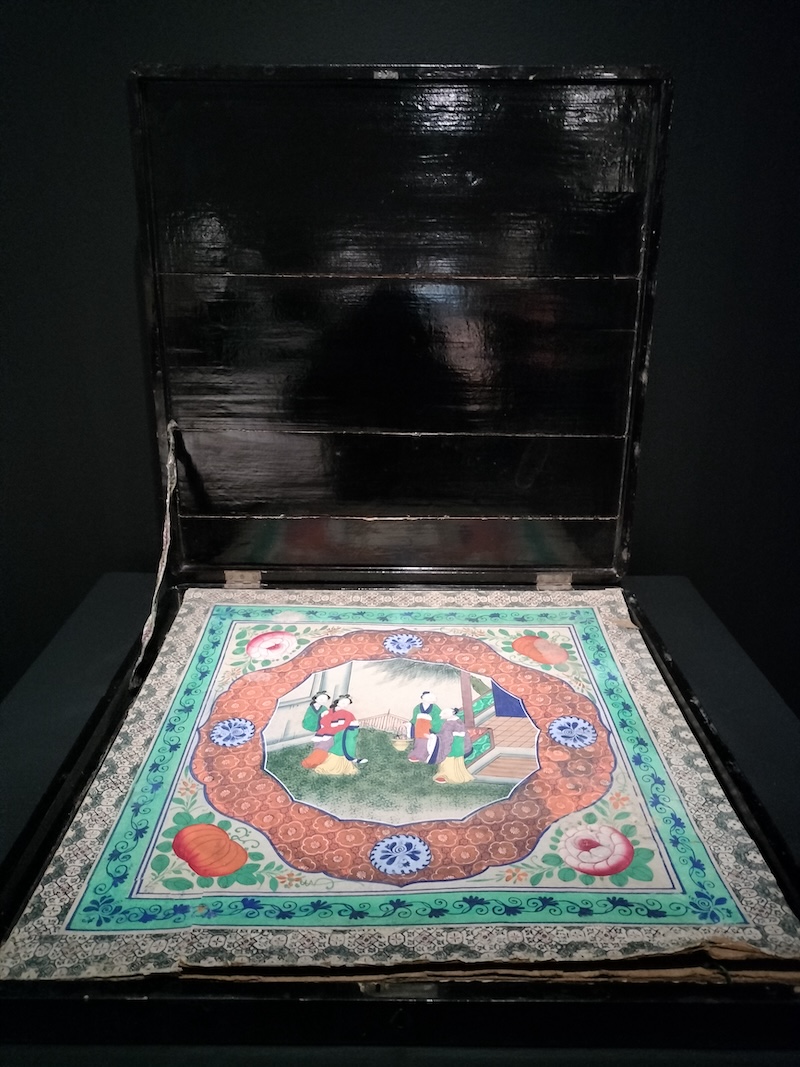
A mantón inside a lacquer box (Photo by Liana Garcellano)
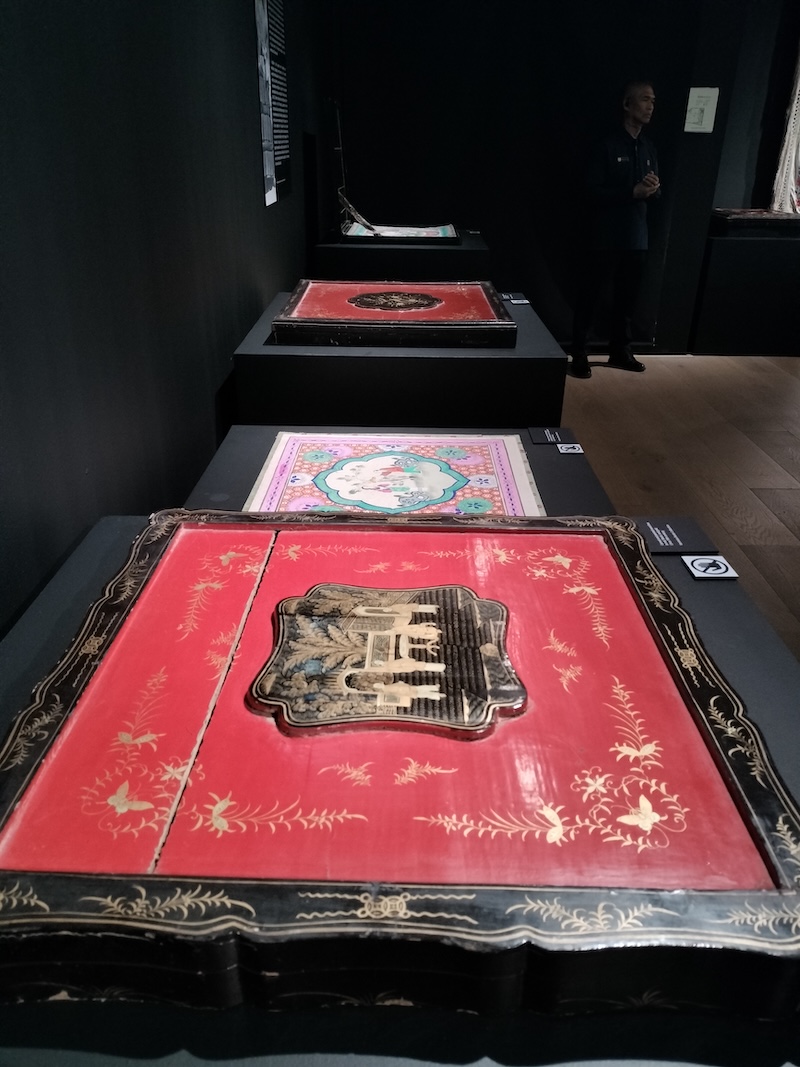
A lacquer box in red, black, and gold with interior carton (circa 19th c.) (Photo by Liana Garcellano)
In her talk titled Curator’s Tale, Mina said the Manila shawl is a vivid symbol of global exchange. She traced its origins to Guangzhou, China, as an exported silk fabric product journeying across the seas via the galleon trade and traded in Manila. The lacquer boxes were also transported via the maritime trade route. (Guangzhou was the manufacturing capital of mantón until the 20th century.)
In the 1800s, the loss of a mantón would lead to advertisements in newspapers, with offers of reward
Mina said the mantón became a symbol of luxury and elegance when it entered Spain, as well as a woman’s fashionable accessory valued like gold. In fact, she said, in the 1800s, the loss of a mantón would lead to advertisements in newspapers, with offers of reward for the finder. The arrest of a shawl thief was reported in the newspaper El Español.
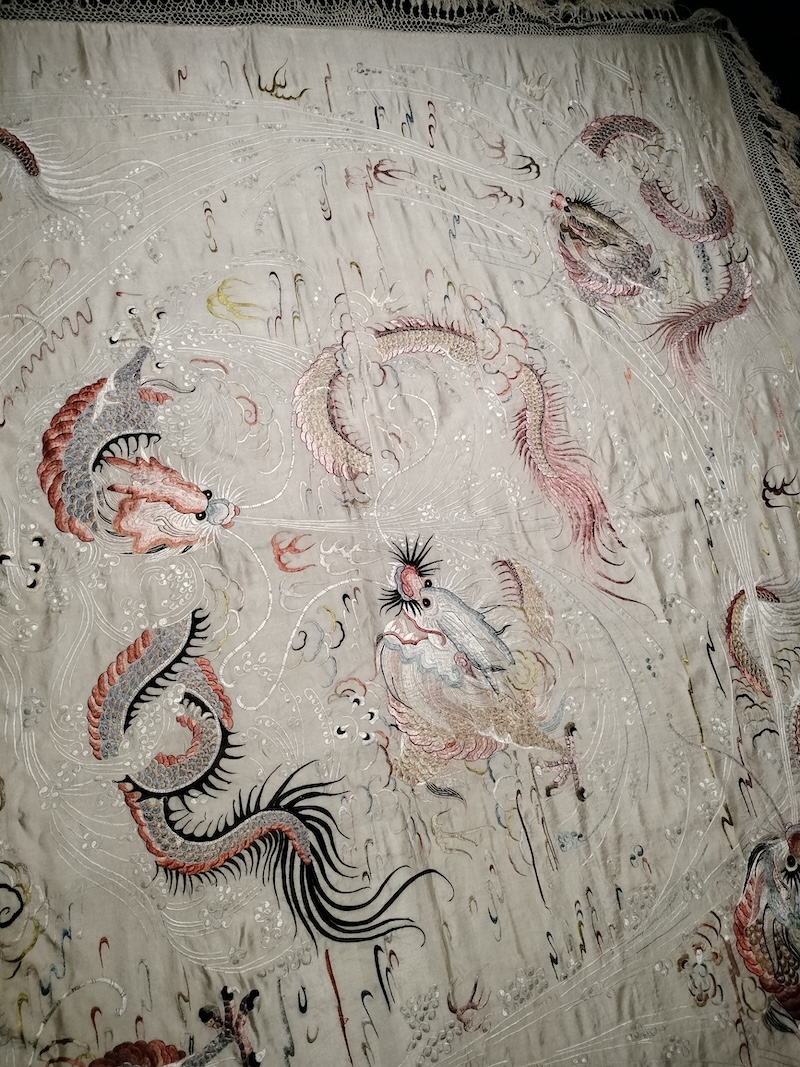
Mantón with six dragons (mid late 19th c.) (Photo by Liana Garcellano)
The symbols on the mantón were varied, showing, for instance, emblems of longevity (dragons, deer, phoenix) and of Buddhism (lotus and twin Mandarin knots), said Mina. The mantón “transcended time and social class,” she said, with working women in Madrid also wearing the shawl, as seen in the paintings of Filipino artist and political activist Juan Luna.
“Quintessentially, the mantón had a Spanish identity despite an Asian origin. It was a mezcla, a mixture of fiber, but in this case, of culture,” Mina said.
The mantón became part of the traje de mestiza (aka maria clara gown) of the women in the Philippines. Mina cited the Filipino elements of the “hanging fringes” (or flecos), which resembled a Tausug sash, and the open embroidery technique. She pointed out that the flecos are one of the four parts of the mantón; the other three are the body, embroidery threads, and macramé motif.
Interestingly, “some mantón share similarities with the batik at the Peranakan Museum in Singapore,” she added.
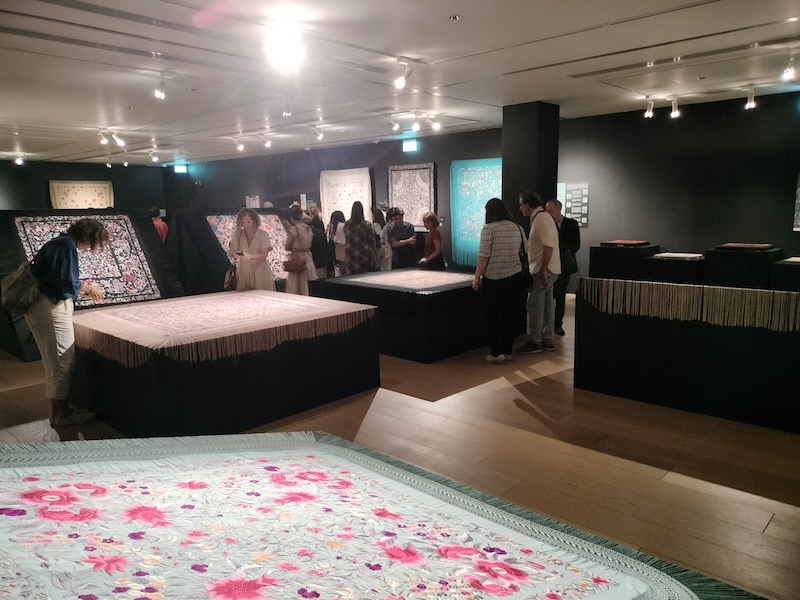
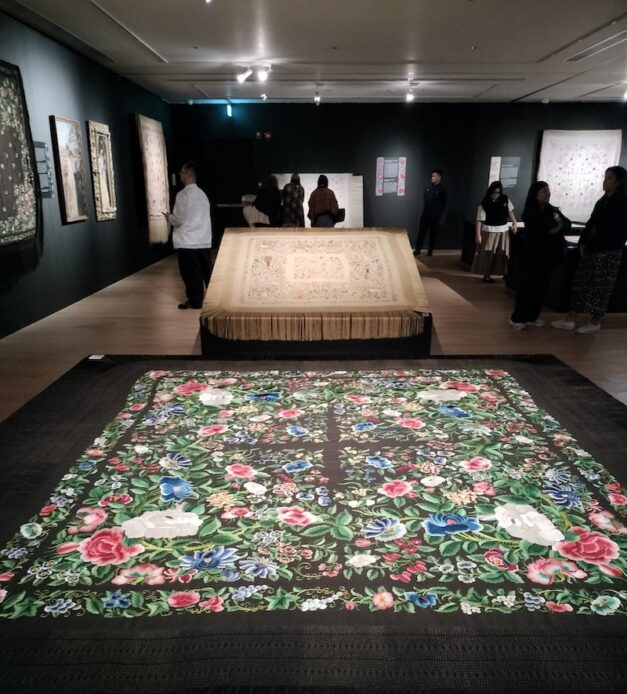
A floor filled with mantónes (Photo by Liana Garcellano)
On the exhibit floor, the walls echoed Mina’s words: “[Mezcla] is an excellent reminder that textiles are part of an intricate network of culture.” Indeed, the subjects stitched on the displayed silk fabrics show the various influences of Eastern culture; their integration with the alampay/panuelo (neck scarf or shawl) showcases the Filipinos’ ingenuity and masterful embroidery skills. (According to a report in the Philippine Daily Inquirer, these embroidery skills are “still practiced in Lumban, Laguna.”)
Simultaneously, the mantón’s Spanish influence that later evolved into Spain’s cultural identity is in the “flamenco song and dance on stage, (the) opera like Carmen, drapery in weekly bull fights, and rituals,” Mina said.
Jorell Legaspi, senior director of Ayala Foundation, echoed Mina’s sentiments. He said, “(Mezcla) is an important presentation of elegance and culture, of materiality and needlework techniques. The intricately embroidered shawls show the (interweaving) of arts and culture.”
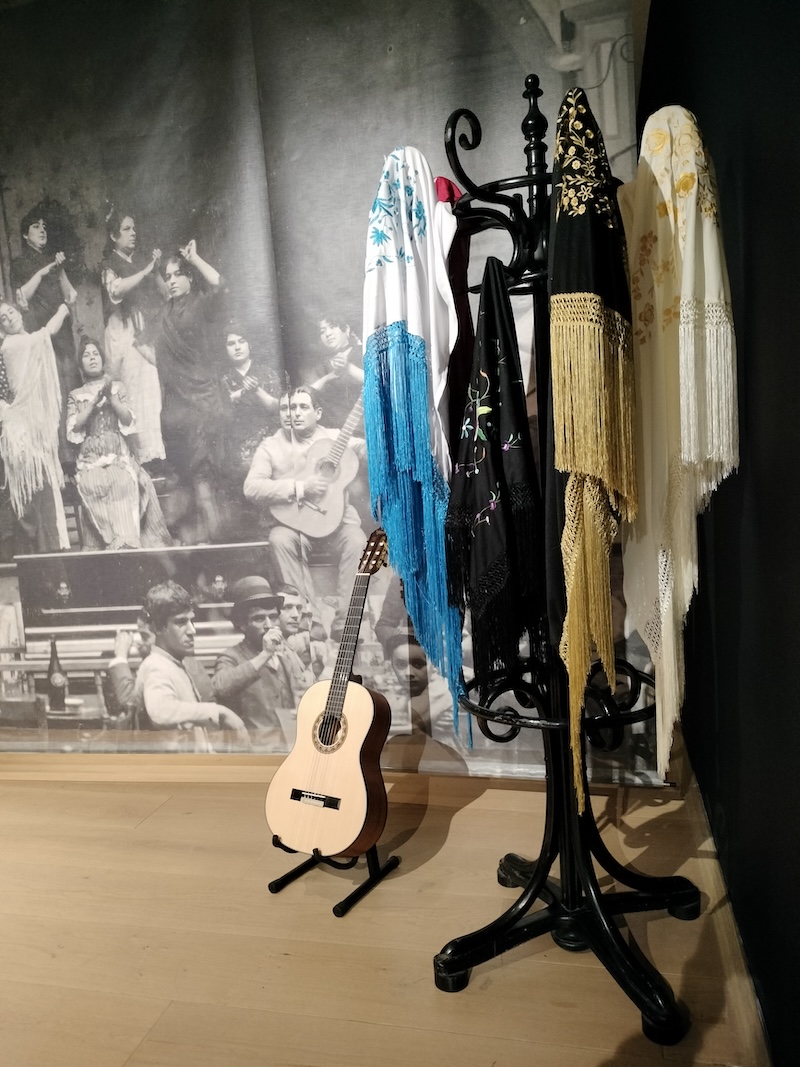
In the interactive space, one can have a picture taken wearing a mantón. (Photo by Liana Garcellano)
To enhance the mantón experience, Ayala Museum has set up an interactive space at a corner of the exhibit floor, for macramé knot tying, paper shawl design, puzzle solving, and photo-taking wearing the shawl.
Looking beyond the exquisite craftsmanship, as history buffs and experts would, the mantón is also a historical narrative of Spain’s colonization of the Philippines and of the Manila galleon trade. In their book A Past Revisited, authors Renato and Letizia Constantino said the trade, which lasted 250 years from 1565 to 1815, was essentially between China and Mexico; the Philippines was the transshipment port of Chinese luxury goods to Mexico and Mexican silver to China, which was immensely valued by the Chinese. Some goods remained in Manila for the needs of the local Spanish community.
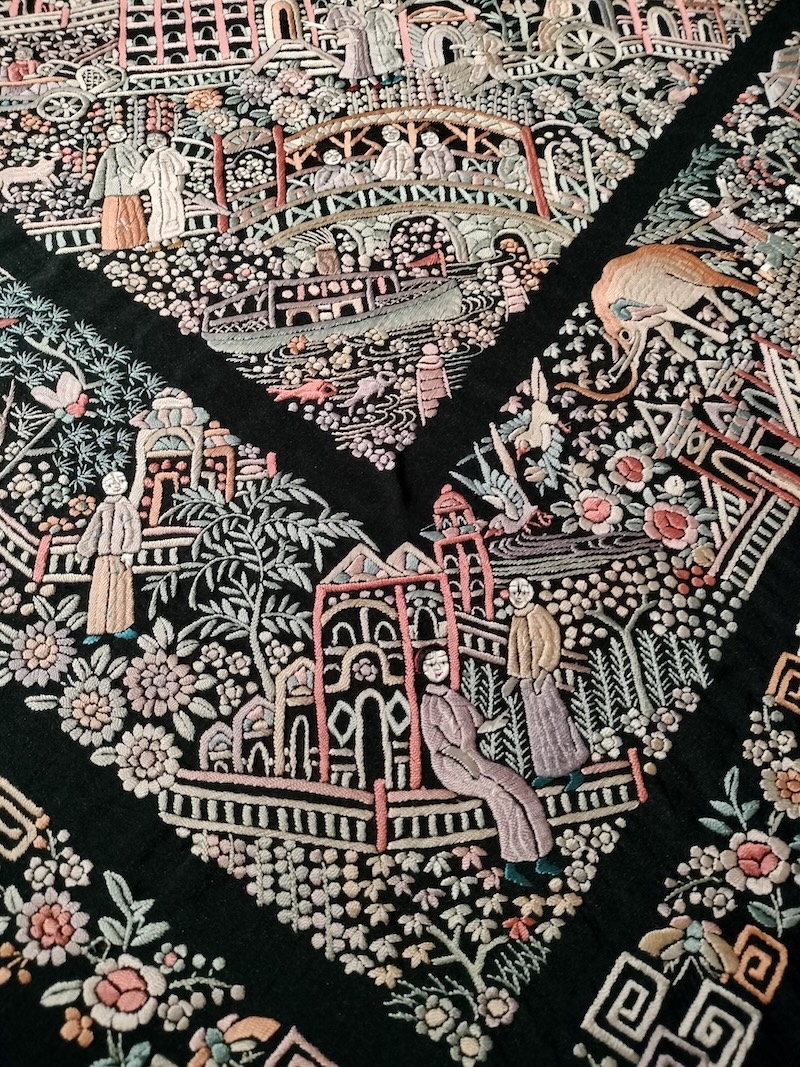
Mantón featuring bustling cityscape (early 20th c.) (Photo by Liana Garcellano)
The Constantinos explained that the galleon trade was the principal preoccupation of the Western or Spanish economy—one of the economic systems existing during the early part of Spanish rule. The other two were the native (aka indio) economy and Chinese economy.
They said Manila benefited from the galleon trade, developing and prospering as a single metropolis with solid walls and imposing buildings. Likewise, money from the trade financed the religious orders’ obras pias (pious works), leading to the construction of schools, hospitals, and charitable institutions. The friars also became interested in the lucrative trade and borrowed heavily from the obras pias funds to subsidize their own participation.
But despite the trade’s profitability and Manila’s advancement, the native economy remained underdeveloped and locally oriented, the Constantinos wrote. The reason being, they pointed out, was that the Philippine Spaniards did not find it profitable to develop local products for export because Philippine products were not in great demand in China or Mexico.
“(With) the quick returns from the trade, the Spaniards were further dissuaded from productive work and (hence) neglected to develop the agricultural potential of the colony,” the Constantinos added.
Mezcla: Interwoven Cultures and the Mantón de Manila runs until Feb. 22, 2026. Ayala Museum (Makati Avenue, Makati City) is open Tuesdays to Sundays, 11 a.m. – 7 p.m. Fee is ₱500/₱850 for full museum access for Filipinos and foreigners, respectively. For more information, visit ayalamuseum.org.


