
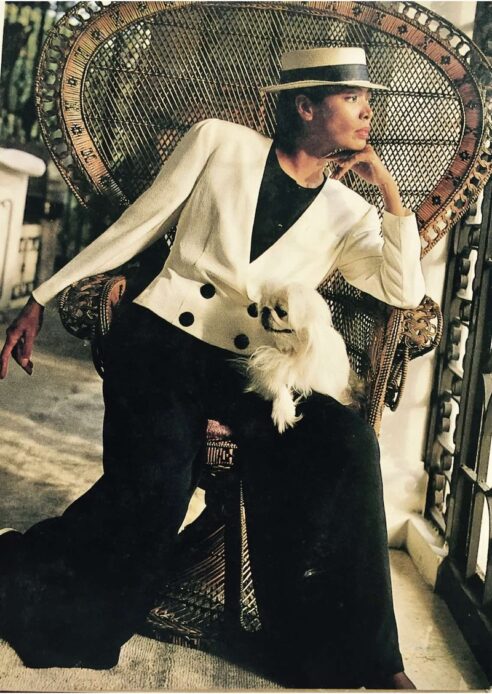
(In 2025, the world lost Giorgio Armani, the Italian designer who, the New York Times obituary said, “rewrote the rules of fashion not once but twice in his lifetime.” Armani was 91.
The New York Times wrote: “A reluctant designer but an instinctive empire builder, Mr. Armani initially became a household name by adapting a custom from traditional Neapolitan tailors: softening the internal structure of a man’s suit to reveal the body inside. Simply by removing shoulder pads and canvas linings, Mr. Armani devised what in the early 1980s became a new male uniform, the easy and almost louche sensuality of which soon enough found favor among a female clientele.”)
At his peak in the 1980s and 1990s, Giorgio Armani’s soft jackets and power suits defined the look of Hollywood and the corporate world. In the Philippines, brand-conscious travelers made pilgrimages to Armani boutiques abroad, and when Emporio Armani opened at Glorietta in the late ’90s, shoppers lined up. Everybody wanted to be in Armani. Filipino designers took note, adapting his soft, deconstructed tailoring and pared-down elegance to the tastes of their own clients.
In an interview with TheDiarist.ph, Inno Sotto noted how, until his passing, Armani never lost relevance. He resisted trends, yet his clothes carried a quiet class that always felt current.
For Sotto and his peers in Philippine fashion, the point was clear: Style didn’t need to be reinvented each season—just sharpened so it still felt modern.
Sotto observed that Filipino men continued to favor structured suits for dressy occasions, yet they did not take to Tom Ford’s tailoring. Ford’s sharply contoured suits, with strong shoulders, a narrow waist, and peak lapels, projected too much flash, unlike Armani’s softer jackets that combined ease with the look of authority. Filipino designers, taking their cue from Armani, kept the fluidity but added structure to suit local preferences.
Sotto adapted to the market. While Armani’s suits had the signature soft shoulders and the unstructured silhouette, Sotto’s versions were less relaxed, keeping a measure of structure. Women were more partial to Armani’s soft tailoring. In time, that balance of softness and structure, modern yet still formal, came to define Filipino tailoring. He recalled how the Filipinos in the ’90s, even for daytime, did not take to the neutral or light colors that defined Armani’s palette.
Joey Samson carried it forward in his way, with sharp cuts, precise proportions, curvilinear shoulders, and stripped-down detail. In barong, he eschewed heavy embroidery for clean lines and a closer fit. In women’s suiting, Samson kept the same discipline. He often used muted shades, a nod to Armani’s restraint, but leaned towards darker tones that matched the Filipino taste for dressier occasions.
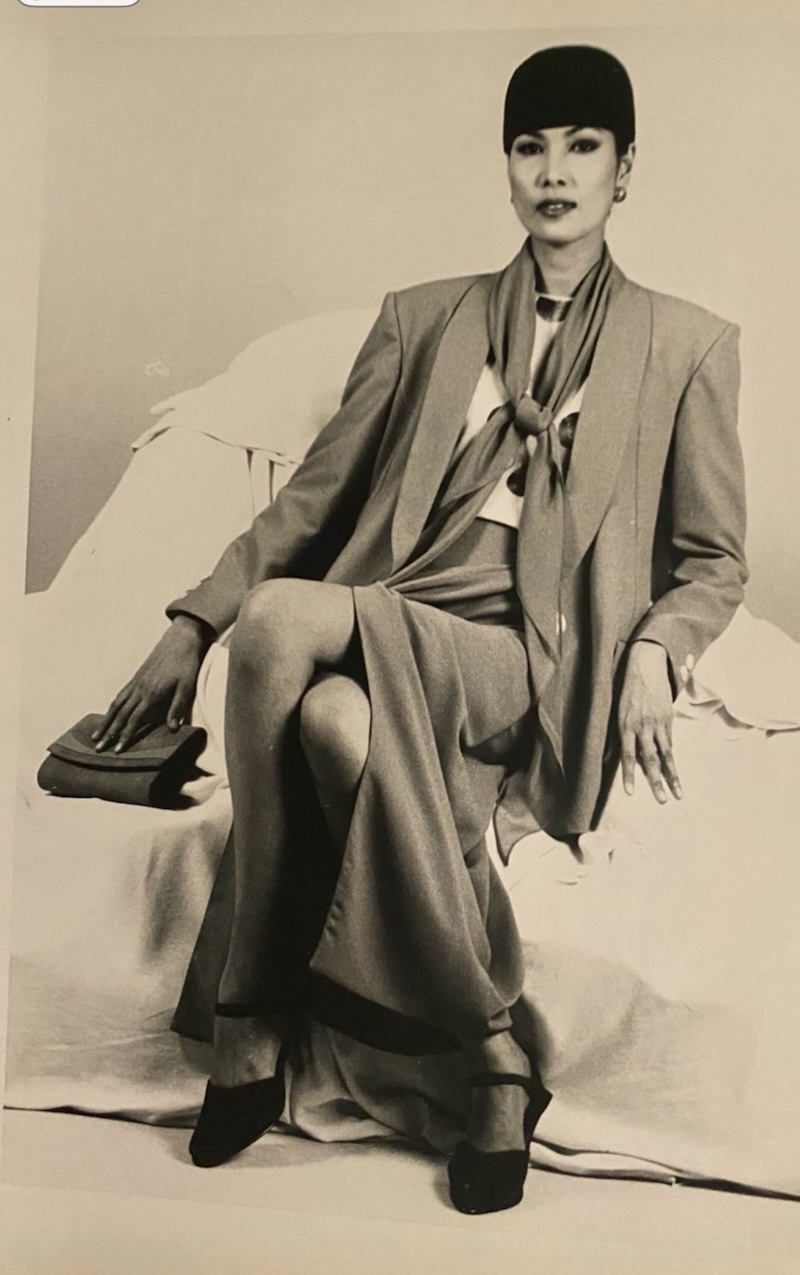
In this timeless look Mike dela Rosa draws inspiration from Armani’s oversize, menswear suit for women, modeled by Maritess Damian
Mike dela Rosa was dubbed the Armani of Manila for his soft suiting, especially at the height of the Armani trend in the 1980s and early ’90s, when power dressing ruled and tailored clothes dominated corporate and social wear. Dela Rosa’s designs were clean, elegant, and uncluttered, a sharp break from the ornate styles of earlier decades. They captured the soft tailoring, minimal detailing, and quiet authority that Armani championed.
An avid reader of fashion magazines, dela Rosa studied Armani obsessively. “Every time I traveled, I visited the boutiques,” he said. “I would look at the construction, the finishing, the fall of the sleeves, and the way the shoulders worked. Then I would explain to my tailor. I was very strict. I made sure the fabrics were soft and fell the same way, that the blazers had the same lightness and flow. Every season, there were always unstructured blazers with the same look and fall. Designers told me I was the only one who could pull it off.”
To achieve that effect, he instructed his tailor to replace stiffeners with a lighter fabric that gave shape while remaining flexible, so the blazer held its form without rigidity. Today, dela Rosa makes custom gowns, but the lessons of Armani—soft tailoring, detailed construction, and the balance of structure and ease—continue to guide his work.
The late Anthony “Tonichi” Nocom was a pioneer in Philippine menswear, known for his clean lines and wearable sophistication. An avid collector of fashion magazines and a devout archivist of Philippine fashion material, he clearly took cues from Giorgio Armani. While he did not publicly cite the designer as a direct influence, Anthony Nocom made suits that echoed a similar philosophy of soft tailoring—lightly lined or unlined jackets—and attention to comfort. Nocom often favored muted and restrained colors—blacks, gray, navy, and earth tones—that kept the focus on fit and proportion. His suits carried a quiet flair, balancing elegance with practicality. In this way, he translated international ideas of modern elegance into a distinctly Filipino context, creating clothes that were versatile and affordable.
The defunct Bergamo, once a byword in fine tailoring, ran for 34 years under its late founder, Mel Meer. Roland Magalang, the company’s longtime operations chief, recalled that in meetings, Meer often brought out his Armani suits for the staff to study, treating them as benchmarks of fabric, fit, and finish. Armani’s sleeve buttonholes, usually four to a cuff, were neatly sewn, kept discreet, and never used as decoration.
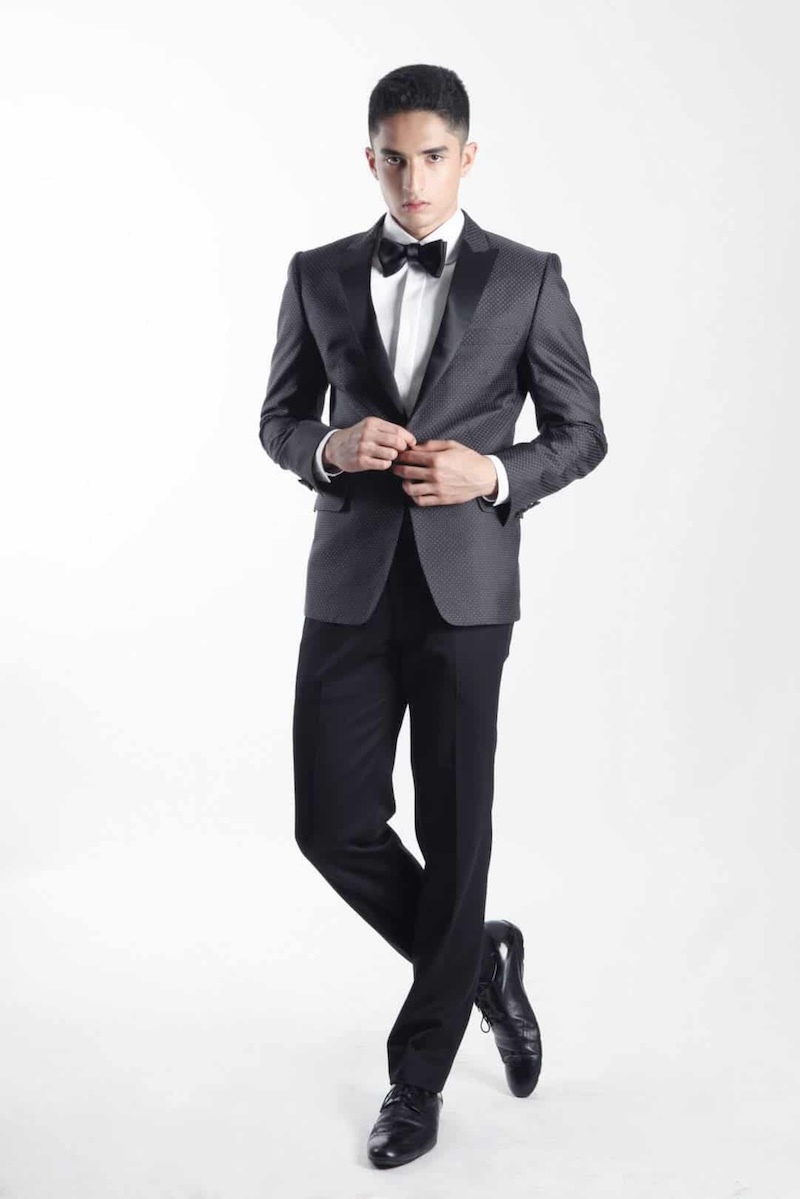
Bergamo’s use of grosgrain silk lapels typically used in Armani tuxedos
Bergamo’s jackets retained more structure than Armani’s deconstructed suits, but the brand embraced his lighter silhouette, supple fabrics, and natural drape. Meer insisted on giving suits a drape that followed the body without constraining it, even as Filipino clients still preferred broad shoulders.
Like Armani, Bergamo used plush silk linings. “Silk doesn’t make a noise when you brush against it,” Magalang said. The company also adopted an Armani palette of gray, taupe, navy, black, and white, allowing cut and fabric to stand out. Styling cues followed Armani as well, with a silk pocket square or scarf that added a touch of Italian sprezzatura—effortless elegance that projected confidence even when worn over a plain T-shirt, said Magalang.
Together, these designers took Armani’s ideas and made them their own, shaping a style that felt modern, yet distinctly Filipino.


