
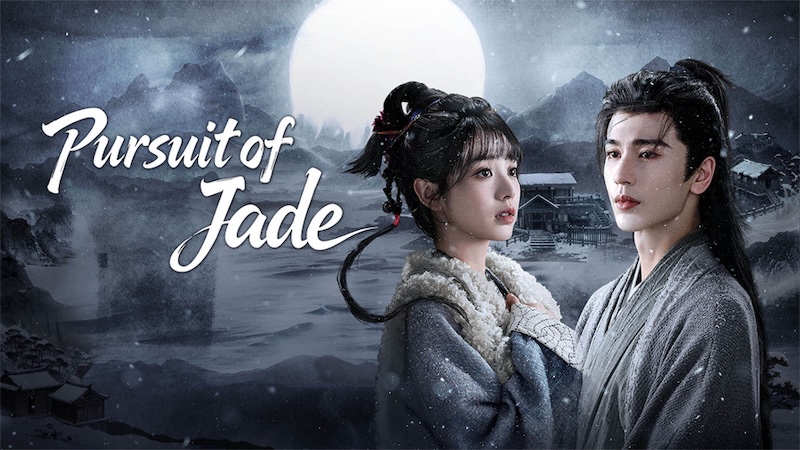
Online, people were talking nonstop about Pursuit of Jade (POJ) even before the 40-episode idol drama concluded end of March.
POJ is the most popular Chinese drama series since The Prisoner of Beauty. It ranked sixth on Netflix’s Global Top 10 for non-English TV on March 9-17, with 1.9 million views and 34.2 million hours viewed. It landed on the Top 10 shows in Southeast Asia, Hong Kong, South Korea, and Taiwan.
It’s the tale of faithful love between Fan Changyu and Xie Zheng set against the megalomania of the Great Yin dynasty ruled by a puppet emperor and the warring Wei and Li families. Its episodes on the lovers’ romantic moments and setbacks (i.e., diverse social backgrounds, the kingdom’s norms and laws, political machinations) capture the viewers’ interests, keeping everyone guessing if they will find their happily-ever-after. The will-they-or-won’t-they plot dovetails a political conspiracy connecting every major character, leading to a satisfactory reveal.
POJ owes half of its success to director Zeng Qing Jie, who maintains an engaging balance among the romance, action, and mystery genres. Under his creative leadership, the usually superfluous subplots become integral to the drama’s movement, and bits of levity counteract tense confrontations.
His play on light and shadow, as well as the camera work, results in scenes appearing like music videos. Take the bathtub scene of the butcher and the marquis: The room, engulfed in steam, was shot from overhead, showing the couple’s black and white robes swirling and forming the yin and yang symbol, and imbuing the unleashed love and passion a touch of romantic elegance.
The other half of the drama’s success rests on Zhang Linghe and Tian Xi Wei, who are not only gorgeous but also skilled actors. They bring their characters to life convincingly. Linghe embodies the formidable Marquis Xie Zheng, whose presence makes women swoon and whose gaze makes men quake in terror. Xi Wei personifies the no-nonsense yet vivacious butcher girl Fan Changyu.
Changyu is a fresh take on the stereotype of an ugly, ill-tempered butcher. She’s beautiful and a ray of sunshine despite her unglamorous job, and the villagers constantly cavil about her “shameful” situation. Her path crosses that of the marquis in the opening scene, while she is walking home during a heavy snowfall. She trips on a mound of snow under which lies the half-dead marquis; she saves him after a moment’s hesitation.
As solicitous as she is, she’s still a woman—she knows an attractive man when she sees one.
Xi Wei eloquently portrays Changyu as a naive butcher girl and, later, a redoubtable general. Changyu’s martial arts skills put opportunists in their place, including her corrupt uncle who wants to take the house she inherited from her late father to pay for his gambling debts, the food merchants engaged in profiteering, her sanctimonious ex-fiancé, the hired hooligans Jin Yuan Bao, et al. She lets them know she’s not one to be trifled with. But she is also compassionate; she straightens out Yuan Bao and friends, hiring them to work in her market stall.
Changyu’s emotions are clearly projected—the relief and overwhelming love when she finally finds Yan Zheng (she still didn’t know his real identity) and the searing pain of learning he’d lied to her. Likewise, deep sorrow crosses her face when she accepts the reality that marrying outside one’s social class is taboo.
The character of Changyu has a historical basis. Per Google, Tuanzi Lai Xi, the author of the novel from which the series is adapted, drew inspiration from Gen. Qin Liang Yu, the only female general in Chinese history recorded in the biographical section of the official dynastic histories. Qin, who led troops in battle, was said to be beautiful, courageous, and proficient in martial arts. Changyu is all that, and the de facto leader of the Northwest Pig Butcher Squad that fought Prince Changxin. She killed him, earning her the title of “Flower-adorned General.”
Linghe was impressed that she could carry him piggyback-style
In the drama, Changyu’s strength isn’t obvious, given her thin frame. Yet she carries the unconscious marquis on her back, hiding him in a tent so he wouldn’t have to join the battle. (Per Google, Xi Wei underwent high-intensity strength training in preparation for the physicality of the role, and Linghe was impressed that she could carry him piggyback-style. He said it was the first time a girl had done it, and so effortlessly.)
Lai Xi said she made Changyu a plebeian to make her relatable. While General Qin was learned and had an elegant bearing, Changyu is semi-literate. She isn’t obtuse but she grasps information differently—a fact that Grand Tutor Tao (her mentor and adoptive father) and Xia Zheng took note of, leading them to teach her with patience.
Xie Zheng the tragic hero is the victim of betrayal. He has been triumphant in battle, like Odysseus, but a conspiracy leaves him severely injured and near death, when Changyu finds him. Linghe portrays Zheng’s dual identities with plausible ease, contrasting Yan Zheng’s rustic life with Xie Zheng’s aristocratic, militaristic world.
Linghe has Xie Zheng exude power through his towering carriage (he stands 1.9 m tall) and firm strides, inciting simultaneous awe, obedience and fear in his men. His gaze is stony, as if telepathically saying, don’t test me. He has an air of supremacy, so that approaching him even needs approval. He doesn’t hesitate to use his sword to settle issues, and his word is law.
Authority and duty come naturally to Xie Zheng, who was raised by his maternal uncle, Wei Yan, the Prime Minister of War. He learns early on that emotions have no place in the battlefield, and his interactions are devoid of pleasant companionship. Off the field he’s reclusive, often reading or writing. Unapologetically, he brandishes his achievements he made on his own, as seen in his grand return to the kingdom, dressed in military finery, on his head a small crown adorned with two long pheasant feathers undulating in the air as his horse ambles through the street.
Per internet chatter, the idea came from Linghe, who saw it in the video games he plays. Qing Jie said the feathers were an extension of Xie Zheng’s soul—the feathers’ spine represented uncompromising strength, courage and assertiveness during wartime. Theatrically, the headpiece is part of the traditional Chinese opera costumes of heroic characters like general-warlord Lü Bu, heroine Mu Guiying, and monkey king Sun Wukong.
But the detail of the pheasant feathers isn’t a whimsical artist design. Per Google, quoting Huang Qiang, costume historian and professor at the School of Arts of Jiangsu Open University, pheasant feathers were bestowed by King Wuking of Zhao on his valiant warriors. These were inserted in military headpieces to emphasize the wearers’ valor and honor. The feathers measured between 9 and 10.5 inches and plucked from wild mountain pheasants.
As the nondescript Yan Zheng, Linghe shows Xie Zheng reining in his innate aggression while immersing himself in a different world. He blends in, enduring the villagers who label him as Changyu’s pretty and useless kept husband. As he recuperates, his face loses its steeliness, his gaze softens, and he becomes approachable. He writes Spring Festival couplets, besting Lin’an’s scholar (Changyu’s ex-fiancé); babysits Ningniang, Changyu’s younger sister; and supports his wife in her new braised-pork business.
He is awakened to the truth of how the other half of the kingdom’s population lives. He can’t eat the pork noodles Changyu offers him, unused to eating offal. He’s shocked that having pork noodles is a luxury. Earning a living is alien to him, as well as frugality.
He agrees to a transactional marriage with Changyu, a plan that serves their purposes: she needs a husband to keep her property, and he needs a temporary identity. Nonetheless, living with Changyu gives him a glimpse of life unburdened by truculence and political conspiracies. The tangerine-peel candy scene is the turning point, with the uncaring marquis feeling how it is to be liked for who he is and not what he stands for.
The shift in demeanor is discernible when Xie Zheng answers the pressing call of duty. Yan Zheng’s amiability disappears, and Xie Zheng’s authority, sharpness, and glacial detachment return.
The scenes are like meticulously composed photographs for a coffee table book
The popularity of POJ is also due to Qin Jie capturing the tension in relationships, especially between men and women (abuse, passion, rejection, unrequited love). His scenes are like meticulously composed photographs for a coffee table book, framing the characters’ beauty and nuanced expressions and gestures against a poignant landscape of rain, snow, or fire, with an evocative soundtrack playing.
View on Threads
The relationship of Xie Zheng’s strategist Gong Sun and Qi Shu, with their hilarious teenage awkwardness, shows the lighter side of romance.
View on Threads
Deng Kai and Lin Muran as the psychopathic villains become viral hits.
Conversely, possessive, desperate love is seen between Qi Min (played by Deng Kai) and Qian Qian (Kong Xueer). Qing Jie plays up domestic violence through Qi Min’s relentless pursuit of Qian Qian, who flees and hides from him. His maniacal obsession is seen in his hard gaze, contemptuous smile, and cruelty as he tries to control her.
Unrequited love is depicted in various ways. It’s farcical with Emperor Qi Sheng, who quickly rescinds his decree of taking Changyu as his concubine after he learns who her husband is. It’s touching with Northwest Pig Butcher Squad member Jin Yuan Bao, who quietly accepts that he’s no match to Xie Zheng. And it’s pitiful with military commandant Li Huai An, who’s constantly pushed to the friend zone.
The romance turns sensual
Similarly, Qing Jie shows love as thrilling and sensual with Changyu and Xie Zheng. There’s Xie Zheng tying Changyu’s hair with a ribbon from his hair bun, and Changyu hand-feeding Xie Zheng tangerine peel candy when he’s convalescing.
The most romantic is Xie Zheng, in his armor and pheasant-feather crown, stopping his entourage and waiting for Changyu’s love token. Catching the ribbon she throws at him is a hardcore proclamation of his love for her. In another scene, Xie Zheng, after enduring 108 lashes as punishment for marrying beneath him, declares before his ancestral altar: “This woman is the companion of my life. I will never betray this vow. My heart will stay true till death.”
The romance turns sensual: Xie Zheng performs the coining therapy on Changyu, as instructed by a blind healer, to “awaken” her meridians, and their steamy bathtub scene marks the consummation of their marriage.
Qing Jie puts a new spin on love in POJ, reworking it without neglecting the core romance and making the secondary characters just as important as the primary. The supporting characters steer the viewers toward the core narrative of Changyu and Xie Zheng’s relationship and individual development. Because of love, Changyu becomes a valiant combatant, who says, “I am a butcher’s daughter; with my knife I can slaughter pigs, and I can also protect mountains and rivers.” And Xie Zheng’s introspective transformation lets him find peace and love.
The title of the drama is given layers of meaning by Qing Jie. Pursuit isn’t just romantic—Xie Zheng chasing his wife (the character Yu in Changyu’s name means “jade”) after she rejects his marriage proposal. It is also Changyu and Xie Zheng’s pursuit of justice for the victims of the Lin’an and Jinzhou massacres. It is Sui Yuangqing’s pursuit of vengeance on Changyu. It is the warring Wei and Li clans’ pursuit of power.
Nonetheless, it’s important to remember that POJ shouldn’t be taken as more than a fictional historical romance and idol drama (hence Linghe’s consistent perfect makeup and hairstyle even in battle). Undeniably, it’s a well-executed series, from script to acting and directing, offering a momentary escape from the world.
It’s one example of why viewers fall in love with Chinese drama.


