
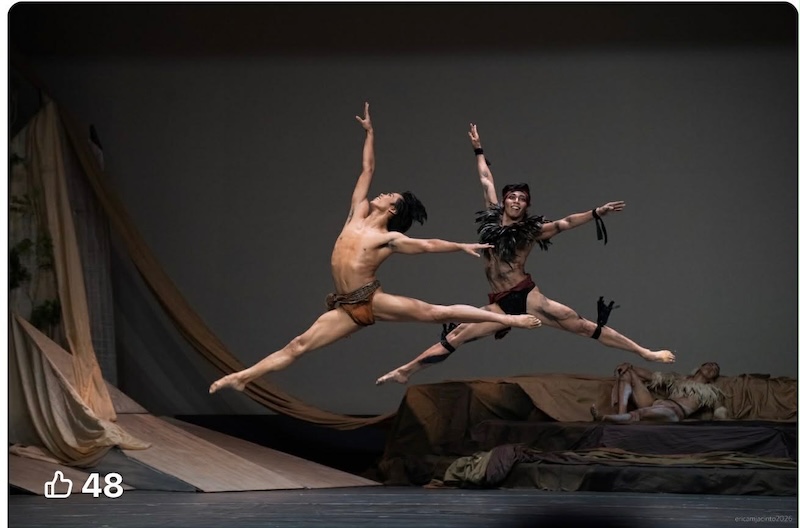
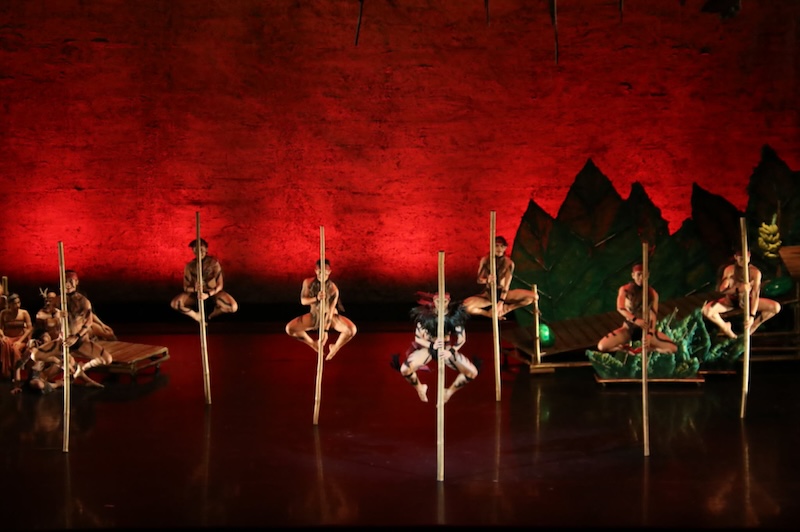
Renzen Arboleda (center) with the male corps de ballet
It was in 1977 when Alice Reyes, then artistic director and choreographer of the CCP (Cultural Center of the Philippines) Dance Company (currently known as Ballet Philippines), daringly dove into creating the first fusion of indigenous and modern dance, using the music genre of that time—rock, integrated with tribal musical instruments. Through the decades it became the classic, Tales of the Manuvu. Its most recent staging by the company she founded, Alice Reyes Dance Philippines (ARDP), was March 27-29, 2026 at the Proscenium Theater in Rockwell. (Then followed performances, mainly for student audiences, at the University of the Philippines and the University of the East.)
Its storyline was based on the extensive research of anthropologist Esperidion Arsenio Manuel, known as the “Father of Philippine Folklore,” who wrote diligently researched folk epics, one of which was of the Manuvu tribe.
Armed with scholarly information, the two future National Artists, Bievenido Lumbera (lyrics) and Alice Reyes (choreography), collaborated with popular pop music composer Nonong Pedero for the 1977 premiere.
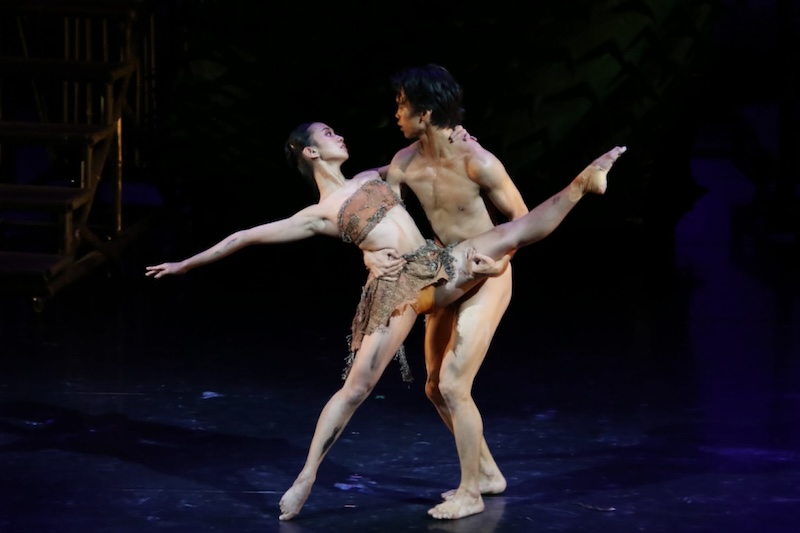
Renzen Arboleda as First Man and Krislynne Buri as First Woman (Photo by Kurt Copon)
The rock dance musical follows the Genesis plot: the creation of the world (Mindanao in this case), and the first man and woman. The narrative tells of the god, Manama, the creator, and the deception of his serpentine counterpart, Ogassi, that led to the initial fall of mankind and the eventual victory of good over evil, personified by the gigantic Makarallig.
Artistic director of this latest staging is former lead dancer Ronelson Yadao, with Lester Reguindin as re-stager and director, with the guidance of Alice Reyes as artistic consultant. This latest version of the 49-year-old masterpiece becomes “of the times,” as Reyes hands over the baton to her successors.
The original music of Nonong “Dero” Pedero is given current music elements by Michael Guevarra—for example, the use of the saxophone and an electronic “wailing” wah-wah punctuation often heard as music accents in current rock music. He keeps the indigenous wooden percussion instruments and the kulintang, a familiar sound in ethnic pieces. The bass and drums have become more pronounced, further defining the beats.
The UP Concert Chorus, led by Jai Sabas-Aracama, performs the operatic/rock songs, their voices reverberating with theatrical drama. The alternating singing cast was composed of Joshua Cadelina, Almond Bolate, Ado Villanueva, and Greg de Leon as Manama, Ogassi, and First Man, and Christy Lagapa and Toni Carm Santos as First Woman.
Sets and costumes were by award-winning director and designer Loy Arcenas. The original sets, done for the CCP Main Theater, had to be reconfigured to fit the smaller Rockwell Proscenium Theater. The original costumes by famed designer of the ‘70s and ‘80s, Ernest Santiago were a mix of colorful ethnic textures, which were re-designed for the current breed of dancers, showing more skin while allowing movement in the modern ballet/jazz/ethnic genre.
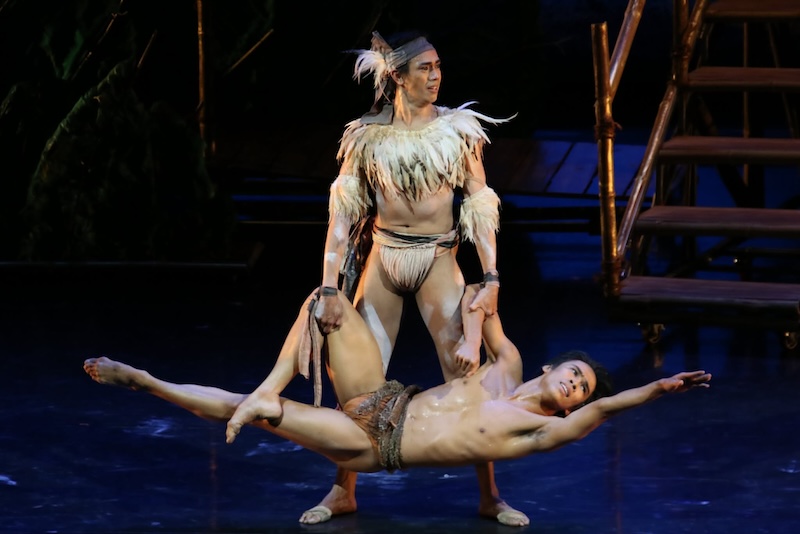
John Ababon as Ogassi and Renzen Arboleda as First Man
In this year’s performances at the University of the Philippines, University of the East, and the Proscenium Theater at Rockwell, Tales of the Manuvu was staged for a fairly new audience: students and faculty members. At Proscenium Theater, the paying audience was a mix of students, professionals, foreign guests, generally first-timers unfamiliar with the premiere of 49 years ago, nor with the two re-stagings in recent years before this current one.
ARDP, in its advocacy to expose students and the academic community to dance as art form, invited several public schools to the March 29 performances.
In the premiere 49 years ago, Tales drew an audience that packed the CCP Main Theater, some seated right on the steps. The latest performance last March drew a similarly large crowd, its shouts of bravos filling the theater, and the audiences later lauding it as “groundbreaking,” “mind-blowing.”
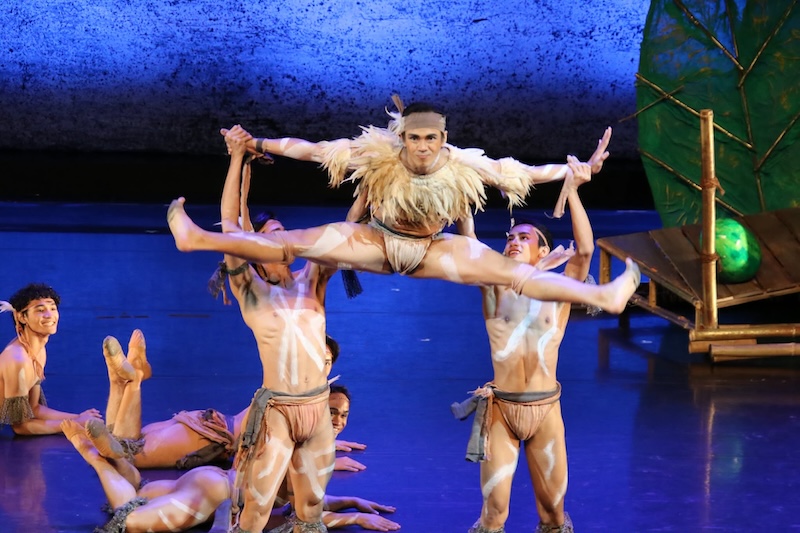
Ababon as Ogassi
The “Filipino-ness” of the masterpiece was not lost in the hybrid concept. The premiere production in 1977 had OPM stars Celeste Legaspi, Hajji Alejandro, Anthony Castelo, and Boy Camara, and introduced the very young Leah Navarro in her debut. In this production, the signature song, Noong Unang Panahon, was sung by a trio of voices: Manama, First Man, and First Woman, instead of just the First Woman, heightening its lyrical impact that built up to a full-bodied crescendo at the end.
Apart from the kudos the musical got for music and lyrics, the dancers also received superior ratings for precision of technique, their musicality and energy. Performing Manama were Renzen Arboleda and John Ababon. Ogassi was Erl Sorilla; First Man, James Galarpe and Renzen Arboleda. First Woman was solely Krislynne Buri. These dancers, all young and daring but masterfully seasoned, executed the biting exactness and bravura the choreography required.
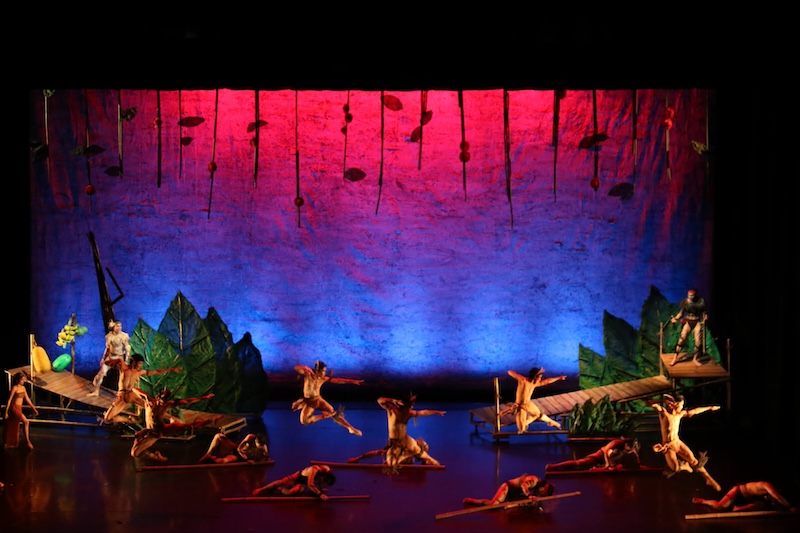
The male corps de ballet
Certain factors lead up to the performance level of today’s generation of dancers. Foremost of these is the rigorous training under the meticulous watch of the company founder, National Artist Alice Reyes. Then there is the in-bred athletic energy of the youthful dancers, so evident in their execution of time-extended balances, multiple turns, hyper-extensions of limbs, grande jetes en l’aire a la seconde (sky-high jumps with horizonal leg extensions), with sharp and almost percussive musical accents. Clinically speaking, this generation seems to possess aerobic high-octane energy, sustainable through two performances in one day.
In the case of ARDP, the March 29 twin back-to-back performances were followed by an uproarious cast party lasting almost till midnight with a sumptuous post-performance dinner for the tired, literally starving artists, served by the company’s board, friends, and loyal supporters.
Indeed, unbridled energy to the max—and more.


