
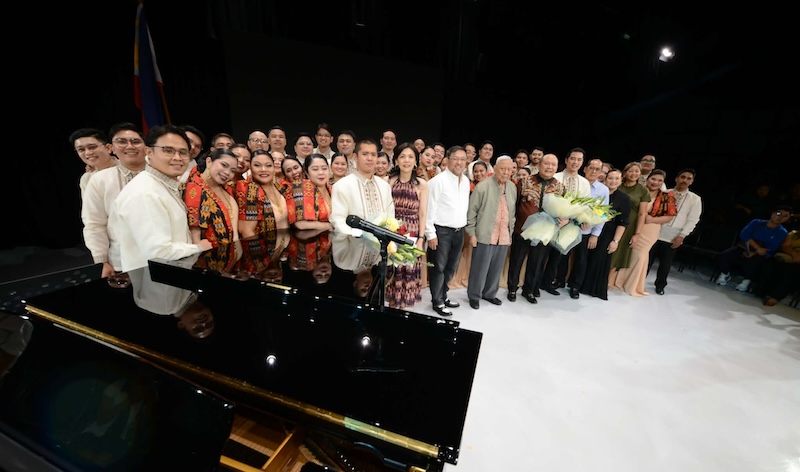
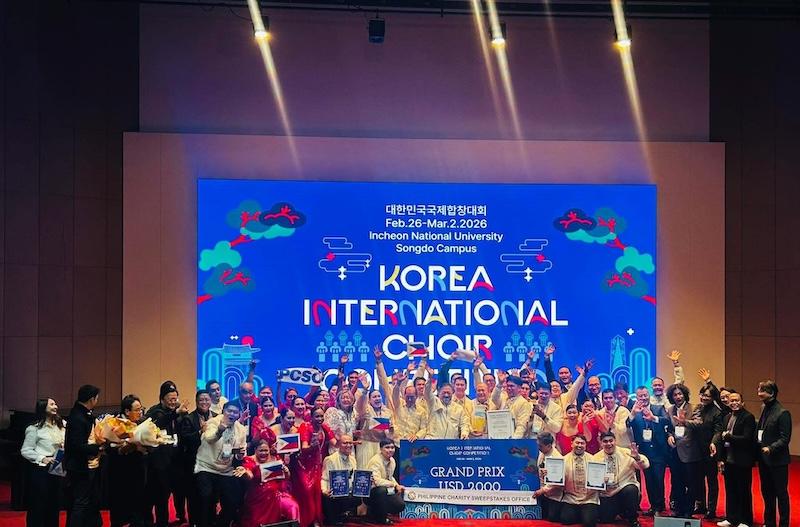
PCSO Chorale after winning the top prize in the recently concluded Korea International Choir tilt
The Philippine Charity Sweepstakes Office (PCSO) Chorale held its victory concert April 26, 2026 at the Blackbox of the Proscenium Theater at Rockwell, Makati City. The title, Vincero, which means I shall win!, was taken from the aria Nessun dorma (Let no one sleep) from Giacomo Puccini’s opera Turandot. It celebrated the chorale’s winning the Grand Prix in the recent 2026 Korea International Choir Competition, where it beat 47 choirs from Asia, Europe, and the US.
This victory qualifies the chorale to join the 2027 Asian Grand Prix for the grand prize, with five leading Asian choirs competing for grand championship.

PCSO general manager Mel Robles gives opening remarks before the concert.
The choir was revived by PCSO general manager Melquiades A. Robles, whom President Ferdinand Marcos, Jr. appointed to the position.
The audience came in droves, led by the First Lady Liza C. Araneta-Marcos, National Artist for Music Dr. Ramon Santos, CCP president Kaye Tinga, artistic director of then Puerta Real Evenings Zenas Lozada, piano pedagogues Cecile B. Roxas and Antony Say. There were prominent musicians, choral music lovers, PCSO employees who filled the theater.
In his message, President Marcos said that his administration “recognizes the arts as an engine of national development, advancing cultural diplomacy, strengthening human capital, and expanding the creative economy.”
Chairperson Judge Felix P. Reyes (Ret) said that the PCSO takes pride not only in fulfilling its mission, but also in “supporting endeavors that enrich the lives of our employees.”
In his opening remarks, Robles said that in the fulfillment of the office’s mandate of “uplifting the lives of our countrymen,” the office also must “lift spirits” by reminding our countrymen of “the beauty of our culture and the richness of our identity—so that we may all grow into responsible, compassionate, and patriotic citizens.” This was the reason, he said, he reestablished the PCSO Chorale. Himself a musician who studied voice and piano performance, Robles is no stranger to this humanistic dimension of the bureaucracy.
Choral singing was at its most glorious. Here is an amateur choir whose members are public servants, who sing as a professional choir. Truly it has distinguished itself as a premiere choral group among today’s existing choral groups in and outside the government.
A mixed choir, the chorale is made up of 36 choristers, all PCSO employees. In a video presentation, these members expressed their joy in attending rehearsals, on top of their official work, memorizing not only the lyrics in several languages, but likewise the music of their respective vocal classifications. On stage, they did many formations, all done in consideration of tonal output and balancing.
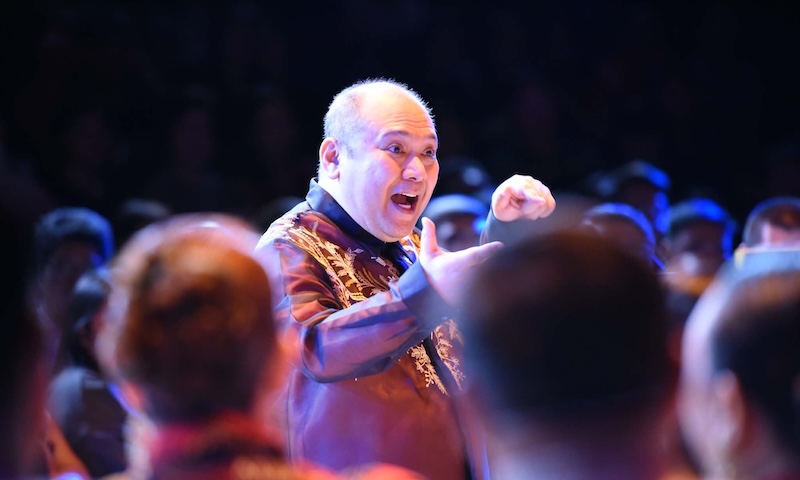
Dynamic conductor Robert Delgado
Their conductor, Robert Delgado, is no stranger to choral music singing, directing, and arranging, having sung with the Philippine Madrigal Singers and made choral arrangements of several pieces for the “Madz.” He has conducted several choirs.
He shared the podium with an equally talented choral conductor, Triston Caliston Ignacio,of the Imusicapella, which, under his direction, has won four Grand Prix titles in the European Grand Prix (EGP) that marked their entry into the qualifying competitions in Tours, France; Varna, Bulgaria; Debrecen, Hungary; and Jurmala, Latvia.
Listening was such a delight! The program consisted of religious songs, Philippine songs, pop songs, and the like. Included in their program were the two songs they sang in the said competition in Korea: Levente Gyonggyosi’s Puer natus in Bethlehem and his other composition, Te Lucis Ante Terminun. The former is a song about Jesus’ nativity and the latter is a hymn, a night prayer that implores protection. These two songs were the highlights of the first part of the program.
Conducted by Tristan Ignacio, the first piece showcased the choir’s utmost brilliance and virtuosic ability as it intoned vibrant rhythmic passages, all expressed in rich harmonic devices.
Robert Delgado led the choir in singing the next piece, an ancient Latin hymn sang as a night prayer, an utterly contemplative and prayerful song that provided a stark contrast to the song it followed.
Hearing these two songs alone convinced the listeners of the sterling ability of the chorale. And to think that its members are regular office workers, with perhaps only a few having acquired singing exposure as members of choirs before they enlisted in the chorale.
The second part of the program had pop songs that included some Tagalog love songs, all arranged by Robert Delgado. Ernani Cuenco’s Bato sa Buhangin and George Canseco’s Gaano ko Ikaw Kamahal were a hit among the oldies in the audience. On the other hand, the inclusion of the BINI song Karera was a hit among the “Zoomers.”
Nostalgia came in when conductor Robert Delgado dedicated Gaano ko Ikaw Kamahal to former First Lady Imelda R. Marcos, who he said was largely responsible for adding a cultural-musical dimension to the bureaucracy during President Ferdinand E. Marcos Sr.’s incumbency as president of the country. True to what conductor Delgado said, during those years, practically all government offices had a choral group, which was adopted too by the private sector. The song unfurled with warm romantic sweep, all expressed in brilliant singing tones
The final song, Lipad, as popularized by Kuh Ledesma, provided more meaning to the chorale’s quest for greater heights that indeed, truly make choral singing a meaningful but challenging endeavor.
Bravi and congratulations!


