
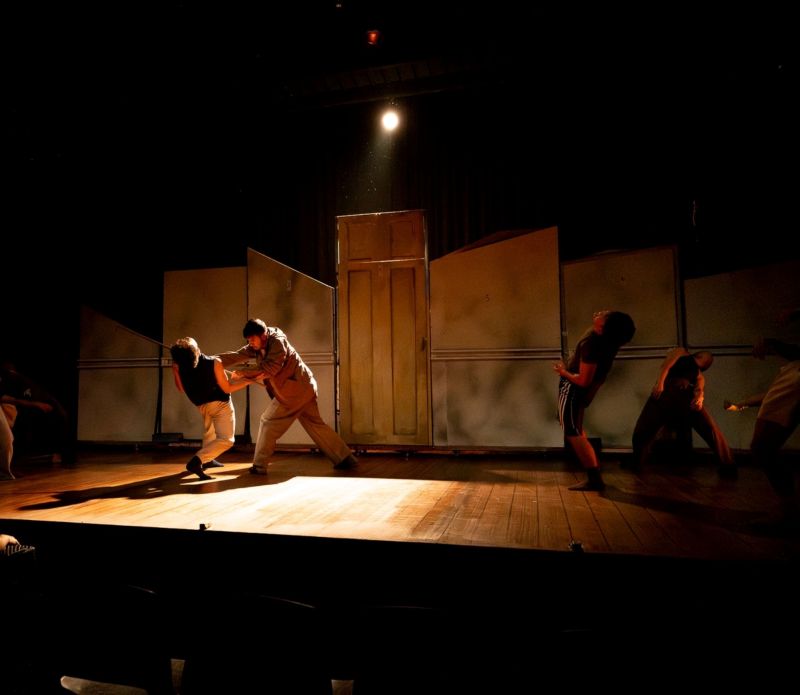
The applause arrived early for A Dance in a Day in a Dance. When contemporary company Mari Dance first staged the work last October, clips spread online and drew admiration for the blend of theater and movement, and for the innovative choreography of Japhet Mari Cabling. However, that attention remained largely online rather than translating into ticket sales. Hence, the company returns with a rerun from May 16 to 31, in partnership with Areté at Ateneo.
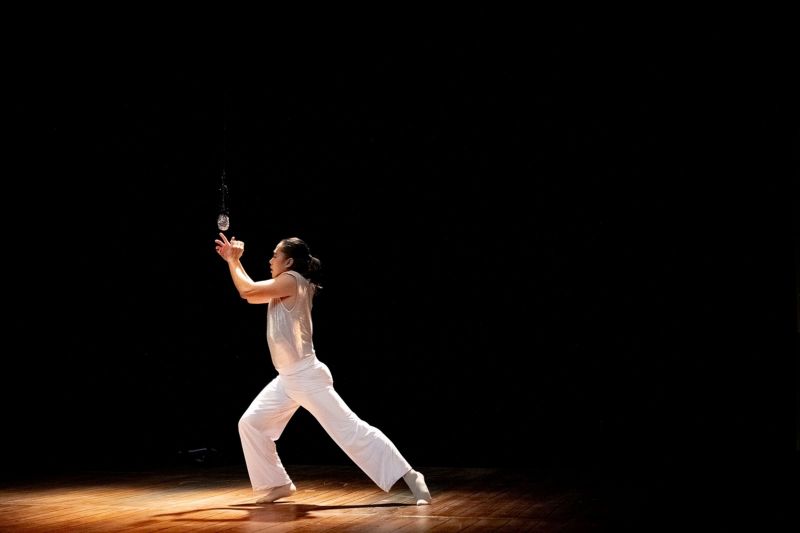
Michael Barry Que as the dancer’s conscience in ‘I Wanna Say Something’
A Dance in a Day in a Dance draws from Cabling’s earlier works, woven into the arc of a long rehearsal led by a domineering choreographer and a compliant cast. Each piece mirrors the dancers’ inner lives, revealing tensions between director and ensemble. I Wanna Say Something, created during the pandemic for Alice Reyes Dance Philippines, unfolds as a study of unspoken emotion and group solidarity.
Midway through the dance, the dancers rehearse for the main production with a modular set in Lihim Ni Lea. The piece takes its cue from a children’s story about a girl who imagines passing through condominium walls. Beneath the premise lies a darker reality, a child’s attempt to cope with sexual abuse by her father. The mother’s solo, performed as an overseas worker, draws from Lullaby, Cabling’s contemporary piece presented at the Cultural Center of the Philippines (CCP) Ballet Competition 2018.
Bent centers around two dancers drawn to each other, with the male dancer wrestling with guilt as he comes to terms with his sexuality. The work, which takes up questions of gender fluidity, won first prize at the WiFi Body New Choreographers Competition 2014. Cabling traces its origins to a moment he witnessed during Virgin Labfest, where two performers moved with a candor that blurred the line between acting and play. “You could not tell if they were performing or simply playing onstage,” he said in Tagalog. “That stayed with me. I used to think contemporary dance had to be serious. I wanted to bring humor into the choreography.”
As the rehearsal unfolds, the choreographer recedes and begins to reflect. Nothing Special, first created for a competition, becomes a duet between the choreographer and his younger self, a conversation shaped by hindsight and awareness. The piece was a finalist at the Yokohama Dance Collection 2019. By the end of the rehearsal, the choreographer drops his harsh tone and meets the dancers with a degree of patience that had been absent earlier.
Cabling describes the choreographer as a composite, drawn in part from his younger self and from teachers whose severity left a mark on their students.
Each performance drew bursts of cheers from the audience, but the box office told another story. The company broke even. Cabling said the rerun of A Dance in a Day in a Dance is meant to identify its audience and to clarify transitions between scenes. “This time, we hope to find better ways to bring people in,” he said in Tagalog. “Finding an audience is still a challenge. Even when we share the reviews and praise from last October, we do not fully understand audience behavior.” Filipino audiences can be difficult to read, even for strong work in theater and film.
Filipino audiences can be difficult to read, even for strong work in theater and film
At 33, Cabling has built a résumé that moves between large-scale events and musical theater. He choreographed segments for the 2019 Southeast Asian Games and for Expo 2020 Dubai, and worked on a string of major productions, including Mula sa Buwan, Himala: Isang Musikal, and Bagets: The Musical. His work Lam-ang: An Ethno-epic Musical earned him the Philstage Gawad Buhay Awards for outstanding choreography in 2019.
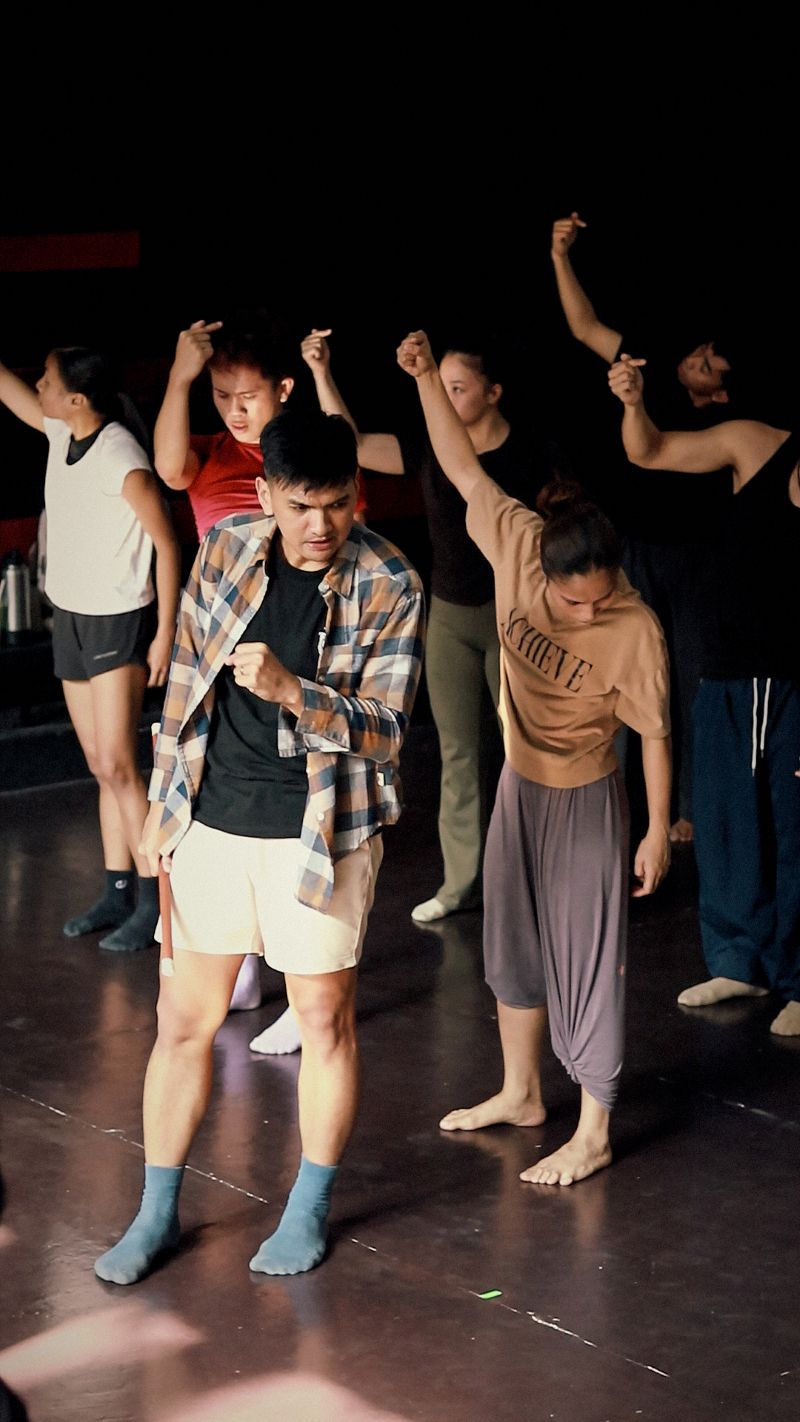
One of his most formative experiences came as assistant to director and choreographer Karla Puno Garcia in Theatre Group Asia’s staging of A Chorus Line. The company sent him to New York to observe a workshop that brought together alumni of the show. In the Philippines, Cabling followed the process from national auditions through boot camp and closing night. “I saw how Karla led the group in a collaborative way,” he said. “Her musicality is remarkable. She hears things I miss.”
From that experience, he took a practical lesson. Problems, he said, are there to be solved. They do not need to be taken personally or carried beyond the work itself.
He also points to his grant with the Asian Cultural Council as a turning point, particularly in how he teaches. Classes now include games and simple props such as sticks and balls. He wants dancers to move beyond choreographed movements by building instinct and body awareness, and to spontaneously respond to what they hear and see rather than rely solely on set choreography.
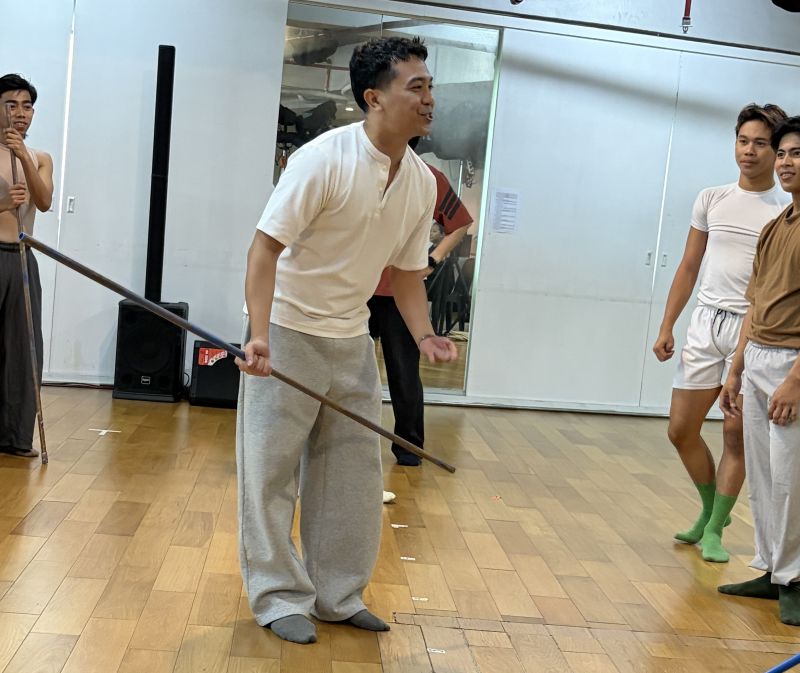
JM Cabling guiding dancers in a game as a warm-up
That shift toward experimentation carries into his professional work. Cabling’s calendar remains full, with projects that move between the commercial (rakets) and the contemporary. He recently completed his second collaboration with SB19. “I’m happy the group took a risk,” he said. “Instead of going for something purely commercial, they wanted a contemporary approach.”
Several musicals are now in development, and Mari Dance is preparing a new production later this year, extending the company’s effort to build an audience for work that sits between forms.
Co-presented by Areté, ‘A Dance in a Day in a Dance’ will run from May 16 to 31, 2026 at the Doreen Black Box Theater, Areté. Other collaborators include director Mikko Angeles, Wika Nadera for set design, Arvy Dimaculangan for sound design, Joyce Garcia for video projection design, and D Cortezano for lights design
Get tickets via: maridance.com. Interested sponsors, and block buyers may email we@maridance.com. Instagram @Maridanceph and Facebook www.facebook.com/MariDanceph.


